
Pharmacology of Antidiabetic Drugs: The 2026 High-Yield Study Guide
With the 2026 FDA approvals of oral orforglipron and once-weekly basal insulin icodec-abae, the clinical landscape is shifting faster than most textbooks can keep up. You’ve likely felt the pressure of trying to memorize dozens of drug names while untangling complex incretin pathways and distinguishing between various insulin kinetics. It’s frustrating to feel like you’re drowning in a sea of mechanisms and life-threatening side effects, especially when board exams are looming. We understand that mastering the pharmacology of antidiabetic drugs requires more than just rote memorization; it requires a logical framework that sticks.
This high-yield review is designed to provide that framework, helping you bridge the gap between complex physiology and clinical application. You’ll master every major drug class, learn to recognize key adverse effects instantly, and build the confidence needed for board-level success. We’ll examine the physiological failures of Type 2 Diabetes, explore the latest SGLT2 inhibitor data, and provide a clear classification of therapies to ensure you’re ready for any question the exam throws your way.
Key Takeaways
- Connect the metabolic pathophysiology of diabetes to the specific drug classes used to manage absolute versus relative insulin deficiency.
- Differentiate between insulin formulations based on their kinetic profiles, ensuring you can accurately predict onset, peak, and duration for board exam scenarios.
- Simplify the pharmacology of antidiabetic drugs by organizing oral agents into clear categories like sensitizers and secretagogues to streamline your memorization process.
- Analyze the physiological mechanisms behind the latest incretin-based therapies and SGLT2 inhibitors to understand their role in weight management and cardiovascular protection.
- Recognize life-threatening adverse effects and essential contraindications, such as the disulfiram-like reaction with sulfonylureas, to prioritize patient safety in clinical practice.
Pathophysiology and Classification of Diabetes Mellitus
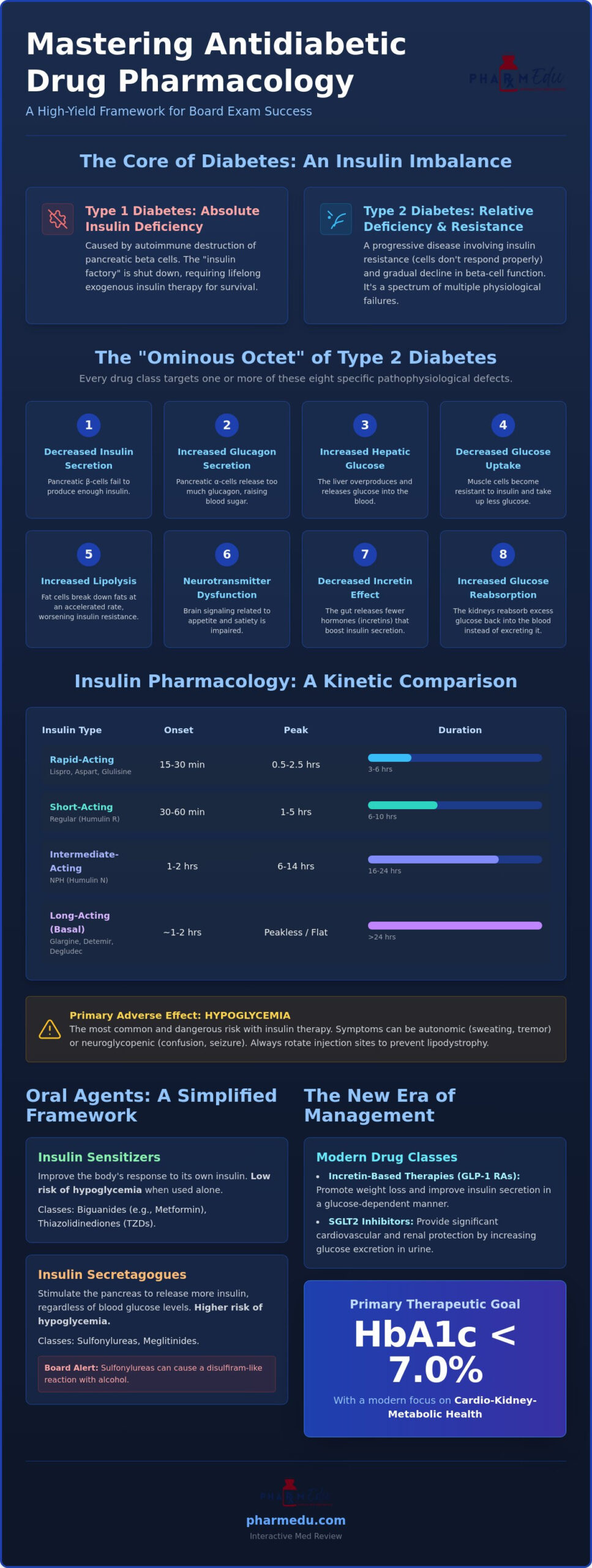
Diabetes Mellitus isn’t just a single disease; it’s a systemic metabolic disorder that disrupts how the body processes carbohydrates, fats, and proteins. At its core, the condition stems from an imbalance between insulin supply and demand. When we study the pharmacology of antidiabetic drugs, we’re looking for ways to correct specific physiological breakdowns. In Type 1 diabetes, the issue is an absolute lack of insulin due to autoimmune destruction of pancreatic beta cells. Type 2 diabetes is more nuanced, involving a relative deficiency or a resistance to insulin’s effects. Understanding these defects is the prerequisite for choosing the right pharmacological agent from a modern Overview of Diabetes Medications.
To master this topic for your boards, you have to move past the idea that Type 2 is just “resistance.” Modern therapy is based on the “Ominous Octet,” a framework describing eight distinct pathophysiological defects. This includes decreased insulin secretion from the pancreas, increased glucagon secretion, increased hepatic glucose production, and decreased glucose uptake in the muscles. It also involves increased lipolysis in fat cells, neurotransmitter dysfunction in the brain, decreased incretin effect in the gut, and increased glucose reabsorption in the kidneys. Every drug class we’ll discuss targets one or more of these specific failures.
Type 1 vs. Type 2: Pharmacological Implications
Type 1 patients require exogenous insulin to survive. There’s no way around it because the pancreatic “factory” is permanently closed. In contrast, Type 2 is a progressive disease. It often starts with lifestyle changes and metformin, but as beta-cell function declines over time, most patients eventually require combination therapy. Gestational diabetes presents a unique clinical challenge. Insulin remains the gold standard here because many oral agents cross the placenta or lack sufficient safety data for the developing fetus, though some clinicians use metformin in specific settings.
The Role of HbA1c in Monitoring Therapy
HbA1c measures the percentage of hemoglobin coated with sugar, reflecting average blood glucose over the past three months. It’s the primary metric for long-term success. For the 2026 board exams, remember that the ADA generally targets an HbA1c of less than 7.0% for most non-pregnant adults. The focus has shifted significantly toward “cardio-kidney-metabolic” health. The pharmacology of antidiabetic drugs now prioritizes agents that lower HbA1c while simultaneously offering cardiovascular protection and minimizing the risk of hypoglycemia. We don’t just want the numbers to look good; we want to protect the patient’s heart and kidneys for the long term.
Insulin Pharmacology: Types, Kinetics, and Delivery
Insulin is the essential therapy for Type 1 patients and a critical tool for Type 2 management as the disease progresses. It acts by binding to the alpha subunits of the tyrosine kinase insulin receptor. This binding activates the beta subunits, triggering an intracellular signaling cascade that translocates GLUT4 transporters to the cell membrane. When you’re reviewing the pharmacology of antidiabetic drugs, understanding this molecular mechanism helps you predict clinical outcomes and metabolic shifts.
Our clinical goal is to replicate the body’s natural rhythm through a basal-bolus regimen. This involves a steady, long-acting insulin to cover metabolic needs between meals and rapid-acting doses to handle postprandial glucose spikes. If you find these kinetic curves difficult to memorize, PharmEDU’s Interactive Pharmacology Flashcards are an excellent resource for drilling these specific onset and peak times.
Adverse effects are a major focus for board exams. Hypoglycemia remains the most common and dangerous risk, often presenting with autonomic or neuroglycopenic symptoms. We also teach patients to rotate their injection sites. This prevents lipodystrophy, a localized accumulation of fat that can significantly delay insulin absorption and lead to unpredictable glycemic swings.
Rapid-Acting and Short-Acting Insulins
Lispro, Aspart, and Glulisine are considered rapid-acting analogs. They’ve been modified to prevent hexamer formation, allowing for almost immediate absorption into the bloodstream. This “no lag time” profile means patients can inject them right before a meal. In contrast, Regular insulin is short-acting. While it takes about 30 to 60 minutes to work, it’s the only formulation approved for intravenous use in emergency settings like Diabetic Ketoacidosis (DKA). You’ll often see exam questions asking you to differentiate these based on their specific peak action times.
Basal Insulins: NPH to Ultra-Long Acting
NPH is an intermediate-acting insulin that’s easily identified by its cloudy appearance due to the addition of protamine. It’s often used in twice-daily regimens, but its distinct peak at 4 to 12 hours requires careful timing to avoid hypoglycemia. For a more stable, peakless profile, we turn to glargine, detemir, or degludec. These long-acting agents provide a steady baseline for 24 hours or longer.
The landscape changed significantly on March 26, 2026, when the FDA approved Awiqli (insulin icodec-abae). It’s the first once-weekly basal insulin for adults with Type 2 diabetes, offering a massive leap forward in patient convenience. As you study the pharmacology of antidiabetic drugs, you must also be aware of concentrated formulations like U-300 glargine. These require precise dosing to avoid the severe errors often discussed in clinical literature and the Pharmacological Agents for Type 2 Diabetes guidelines. Mastering these distinctions is vital for both patient safety and your board performance.
Oral Hypoglycemic Agents: Secretagogues and Sensitizers
Transitioning from injectable insulin to oral therapy marks a significant phase in managing Type 2 Diabetes. While insulin replaces a missing hormone, oral agents aim to fix the underlying machinery that’s either sluggish or resistant. The pharmacology of antidiabetic drugs in the oral category is broadly divided into sensitizers, which make existing insulin work better, and secretagogues, which demand more output from the pancreas. Understanding these distinctions is critical for clinical decision making and board exams alike.
For students, the challenge lies in connecting the drug’s molecular target to its clinical profile. Whether you’re studying for the NAPLEX or NCLEX, you’ll need to know why certain drugs cause weight gain while others are weight neutral. If you’re struggling to visualize these cellular interactions, PharmEDU’s High-Yield Video Vignettes provide a clear, animated breakdown of how these molecules interact with their receptors.
Metformin: The Gold Standard
Metformin remains the undisputed first-line agent for almost every patient newly diagnosed with Type 2 Diabetes. It primarily works by inhibiting hepatic gluconeogenesis through the activation of adenosine monophosphate-activated protein kinase (AMPK). This process essentially tells the liver to stop pumping out unnecessary glucose. It also increases peripheral insulin sensitivity, making it a powerful tool for lowering HbA1c without the risk of hypoglycemia.
However, its use requires caution. The most feared complication is lactic acidosis, a rare but serious condition. This risk increases significantly in patients with renal impairment or those undergoing imaging with iodinated contrast media. You’ll often be tested on the “hold” rules: stop metformin before the procedure and wait 48 hours after to ensure renal function is stable. Don’t forget that long-term use can lead to Vitamin B12 deficiency, a side effect that’s frequently overlooked in clinical practice but highly relevant for comprehensive care.
Secretagogues: Sulfonylureas and Meglitinides
While metformin works on the liver and muscles, secretagogues target the pancreatic beta cells directly. Sulfonylureas, such as glipizide and glimepiride, bind to the SUR1 subunit of the ATP-sensitive potassium (K-ATP) channels. This closure leads to cell depolarization and a subsequent burst of insulin release. Because this effect is independent of current blood glucose levels, the pharmacology of antidiabetic drugs in this class carries a high risk of hypoglycemia. Patients with a known “sulfa” allergy should also be monitored closely due to potential cross-reactivity.
Meglitinides, including repaglinide and nateglinide, offer a similar mechanism but with a much shorter half-life. These are “post-prandial” secretagogues. They’re taken right before meals to handle glucose spikes and are skipped if a meal is missed. This flexibility makes them useful for patients with irregular eating schedules. For a deeper dive into how these agents compare to newer injectables, refer to the Oral and Injectable Antidiabetic Drugs review on NCBI.
Finally, Thiazolidinediones (TZDs) like pioglitazone act as PPAR-gamma agonists. They’re potent sensitizers but come with “weighty” side effects, including significant weight gain and fluid retention. Because they can exacerbate heart failure, they’re often contraindicated in patients with NYHA Class III or IV cardiac issues. Mastering these contraindication maps is a hallmark of a well-prepared board candidate.
Modern Antidiabetic Classes: Incretins and SGLT2 Inhibitors
The most significant shift in the pharmacology of antidiabetic drugs over the last decade involves moving beyond simple glucose lowering toward organ protection. This evolution is rooted in the “incretin effect,” the observation that oral glucose triggers a significantly higher insulin response than an equivalent dose given intravenously. This difference is due to gut-derived hormones like Glucagon-Like Peptide-1 (GLP-1) and Glucose-dependent Insulinotropic Polypeptide (GIP). Modern therapy leverages these pathways to provide glucose-dependent control, which inherently reduces the risk of hypoglycemia compared to older secretagogues.
Data from 2022 showed that GLP-1 receptor agonist usage among new-onset Type 2 patients rose to 21%, while SGLT2 inhibitor use reached 14%. These classes are no longer just “add-on” therapies; they are central to the management of cardio-kidney-metabolic comorbidities. If you need to visualize how these gut hormones and renal transporters function at a cellular level, our High-Yield Video Vignettes offer a streamlined way to master these complex pathways before your next exam.
GLP-1 Agonists and Dual GIP/GLP-1 Agonists
GLP-1 receptor agonists, often recognized by the suffix “-tide,” work through three primary mechanisms: stimulating glucose-dependent insulin secretion, suppressing inappropriate glucagon release, and slowing gastric emptying. This last effect is a major driver for the weight loss benefits seen with agents like liraglutide and semaglutide. A landmark moment in this class occurred on April 1, 2026, when the FDA approved orforglipron (Foundayo), the first once-daily oral GLP-1 that can be taken without the strict food and water restrictions required by previous oral formulations.
The development of such convenient oral delivery formats is supported by ongoing laboratory research, where specialized providers like Biomod Peptides supply the high-purity materials necessary for testing new softgel and peptide stability protocols.
SGLT2 Inhibitors: Beyond Glycemic Control
SGLT2 inhibitors, or the “flozins,” represent a paradigm shift in the pharmacology of antidiabetic drugs by targeting the kidneys rather than the pancreas or liver. By inhibiting the sodium-glucose co-transporter 2 in the proximal convoluted tubule, these drugs prevent the reabsorption of glucose, leading to glucosuria. This mechanism is entirely independent of insulin, making them effective even as beta-cell function declines.
Beyond lowering HbA1c, SGLT2 inhibitors like empagliflozin and dapagliflozin provide profound cardiovascular and renal benefits. They are now standard of care for patients with heart failure or chronic kidney disease, regardless of their diabetes status. However, this unique mechanism leads to specific adverse effects. You should be prepared to identify risks such as mycotic genital infections and the rare but dangerous euglycemic diabetic ketoacidosis (DKA), where the patient presents with metabolic acidosis despite relatively normal blood sugar levels.
- DPP-4 Inhibitors (Gliptins): These oral agents prevent the breakdown of endogenous GLP-1. They are weight-neutral and generally well-tolerated, though they offer less potent A1c reduction than GLP-1 agonists.
- Weight Management: In clinical trials, orforglipron demonstrated an average body weight loss of 12.4% at the highest doses, making it a powerful tool in the 2026 clinical toolkit.
Clinical Integration and Board Review Strategies
Synthesizing the pharmacology of antidiabetic drugs into a clinical framework is the final step toward board readiness. You’ve learned the individual classes, but the exam will test your ability to choose the right drug for a specific patient while avoiding dangerous interactions. A classic example is the disulfiram-like reaction that occurs when patients combine alcohol with certain sulfonylureas. This reaction causes flushing, nausea, and palpitations, making it a favorite topic for high-yield questions. It’s these specific clinical pearls that often separate a passing score from a top-tier result.
Mapping contraindications is equally vital for patient safety. You must instinctively know to avoid Thiazolidinediones (TZDs) in patients with heart failure due to significant fluid retention risks. Similarly, while metformin is the gold standard, its use is limited by renal function. If a patient’s eGFR drops too low, the risk of lactic acidosis becomes a clinical dealbreaker. Grouping medications by their suffixes; “gliptins” for DPP-4 inhibitors, “tides” for GLP-1 agonists, and “flozins” for SGLT2 inhibitors; helps you categorize new agents like the 2026-approved oral orforglipron quickly during a timed exam.
High-Yield Side Effect Comparison
When ranking drugs by their hypoglycemia risk, insulin is always at the top, followed closely by sulfonylureas. Most newer oral agents, including metformin and SGLT2 inhibitors, carry a much lower risk when used as monotherapy. Weight impact is another major differentiator you’ll see on the boards. While TZDs and insulin often lead to weight gain, GLP-1 agonists and SGLT2 inhibitors are prized for their weight loss benefits. For patients struggling with GI distress on metformin or GLP-1 agonists, the clinical strategy is always slow titration to allow the gut to adapt to the medication.
Sample Board Exam Scenarios
Consider a patient with Type 2 Diabetes and new-onset Heart Failure with Reduced Ejection Fraction (HFrEF). Based on current 2026 guidelines, an SGLT2 inhibitor is the superior choice due to its proven mortality benefits in this population. Another common scenario involves a patient presenting with metabolic acidosis but a blood glucose level under 250 mg/dL. You’ll need to identify SGLT2 inhibitors as the likely cause of this euglycemic ketoacidosis, often triggered by surgery or extreme carbohydrate restriction. For more practice with these complex clinical decisions, see our comprehensive pharmacy review. Our Interactive Pharmacology Flashcards and Practice Quizzes are specifically designed to reinforce these high-yield connections, ensuring you don’t just memorize the pharmacology of antidiabetic drugs, but actually understand how to apply it in a high-pressure environment.
Elevate Your Clinical Mastery in Diabetes Care
Mastering the pharmacology of antidiabetic drugs requires more than just rote memorization of drug classes. It’s about understanding how 2026 breakthroughs, such as once-weekly basal insulin and simplified oral GLP-1 therapies, are reshaping patient outcomes. By anchoring every mechanism of action to the specific physiological defects of the “Ominous Octet,” you move beyond surface-level study and toward true clinical expertise. This approach ensures you’re prepared not just for a test, but for the complex decisions required in modern practice.
Whether you’re distinguishing between insulin kinetics or identifying the specific risks of euglycemic DKA, success on your boards depends on structured, high-yield practice. Start your high-yield pharmacology review with PharmEDU’s Monthly Subscription to access over 100 high-yield video vignettes that bring these concepts to life. Our interactive flashcards and mobile-compliant design allow you to study effectively on the go, turning every spare moment into a step toward your professional goals. You’ve already done the hard work of building a solid foundation; now it’s time to ensure you have the tools to excel on exam day.
Pharmacology of Antidiabetic Drugs: Frequently Asked Questions
What is the first-line pharmacological treatment for Type 2 Diabetes in 2026?
Metformin remains the foundational first-line therapy for most patients due to its proven efficacy, low cost, and long-term safety profile. However, current 2026 guidelines emphasize a personalized approach that prioritizes SGLT2 inhibitors or GLP-1 receptor agonists early in the treatment plan for patients with established cardiovascular or kidney disease. The clinical focus has shifted from simple glucose lowering to comprehensive organ protection based on the patient’s specific comorbidities.
Why is Metformin contraindicated in patients with severe renal impairment?
Metformin is contraindicated when the estimated glomerular filtration rate (eGFR) falls below 30 mL/min/1.73m² because the drug is primarily cleared by the kidneys. Impaired renal function leads to drug accumulation, which significantly increases the risk of lactic acidosis. This rare but life-threatening condition occurs because metformin inhibits mitochondrial respiration, causing a buildup of lactate that the compromised kidneys cannot effectively clear from the systemic circulation.
How do GLP-1 receptor agonists assist in weight loss?
GLP-1 receptor agonists promote weight loss by slowing gastric emptying and acting on the hypothalamus to increase satiety and reduce appetite. This dual mechanism helps patients feel full longer and reduces their overall caloric intake. Newer agents, such as orforglipron, which received FDA approval on April 1, 2026, have demonstrated an average body weight reduction of 12.4% in clinical trials, highlighting the potency of this class in managing obesity-related diabetes.
What is the difference between DPP-4 inhibitors and GLP-1 agonists?
The primary difference is that GLP-1 agonists directly mimic the natural hormone at much higher concentrations, while DPP-4 inhibitors simply prevent the breakdown of the body’s own endogenous GLP-1. Consequently, GLP-1 agonists provide much stronger HbA1c reduction and significant weight loss. In contrast, DPP-4 inhibitors are weight-neutral and generally better tolerated, but they lack the profound cardiovascular and renal protective benefits associated with the injectable agonists.
Which antidiabetic drugs carry the highest risk of hypoglycemia?
Insulin and sulfonylureas carry the highest risk of hypoglycemia because their pharmacological action is not dependent on the patient’s blood glucose levels. Insulin directly facilitates glucose uptake into cells, while sulfonylureas force the pancreas to secrete insulin even when blood sugar is already low. Understanding the pharmacology of antidiabetic drugs in these categories is critical for preventing severe adverse events, especially in patients with irregular eating patterns or renal dysfunction.
What are the cardiovascular benefits associated with SGLT2 inhibitors?
SGLT2 inhibitors offer significant cardiovascular protection by reducing the risk of heart failure hospitalizations and major adverse cardiac events. They achieve this through osmotic diuresis and natriuresis, which lowers blood pressure and reduces the workload on the heart. These benefits are so pronounced that “flozins” are now standard therapy for patients with heart failure with reduced ejection fraction (HFrEF), regardless of whether they have a diagnosis of diabetes.
How should insulin be adjusted for a patient who is NPO before surgery?
For patients who are nothing by mouth (NPO), clinicians typically withhold rapid-acting bolus insulin and reduce the basal insulin dose by 20% to 50% to prevent hypoglycemia. The goal is to provide enough baseline insulin to prevent ketoacidosis and metabolic derangement without causing a dangerous drop in blood sugar while the patient is not eating. Specific adjustments must be individualized based on the patient’s typical glycemic control and the planned duration of the procedure.
What is euglycemic diabetic ketoacidosis and which drug class causes it?
Euglycemic diabetic ketoacidosis (DKA) is a metabolic crisis where the patient presents with ketosis and acidosis despite having blood glucose levels that appear near-normal, typically under 250 mg/dL. This condition is a known risk associated with the SGLT2 inhibitor class. Because these drugs continue to promote glucose excretion in the urine, the systemic blood sugar level stays relatively low, which can dangerously delay the diagnosis unless blood or urine ketones are specifically checked.