
NCLEX Pharmacology Cheat Sheet 2026: The Ultimate High-Yield Study Guide
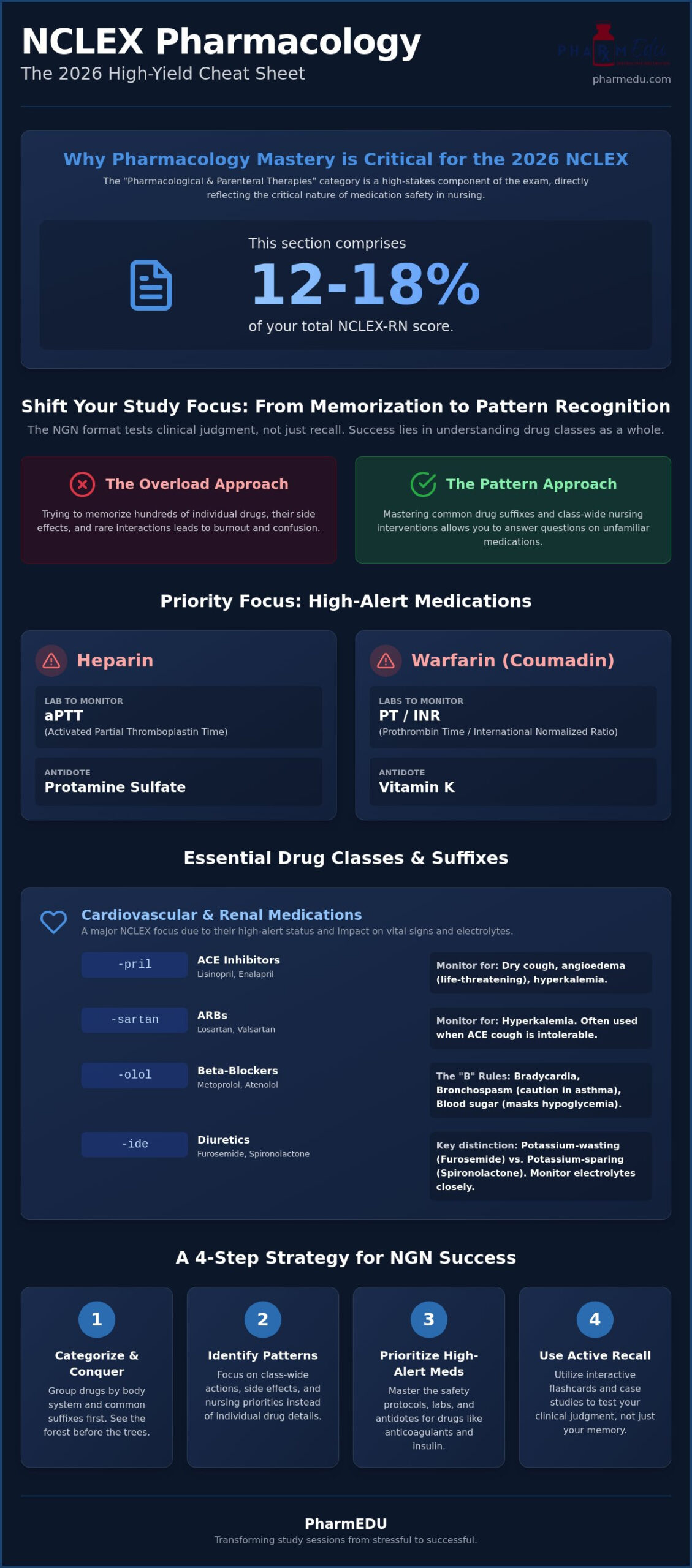
NCLEX pharmacology success isn’t about memorizing 500 individual medications; it’s about mastering 10 core patterns and the clinical judgment required to manage them safely. We understand that the sheer volume of information in traditional nursing textbooks often leads to total sensory overload, especially when you’re struggling to decode complex drug suffixes while facing the pressure of NGN-style case studies. It is a significant challenge, considering that pharmacological and parenteral therapies make up between 12% and 18% of the 2026 NCLEX-RN exam.
This NCLEX pharmacology cheat sheet 2026 is designed to cut through the academic noise and focus specifically on high-yield content that drives clinical safety. You will learn to identify the most frequently tested drug classes, prioritize nursing interventions for high-alert medications like anticoagulants and insulin, and develop the mindset needed to pass the exam on your first attempt. We’re going to break down the essential mechanisms and safety protocols you need to know to transform your study sessions from stressful to successful.
Key Takeaways
- Understand how the 2026 NCLEX test plan weights pharmacological therapies and why mastering this category is essential for a passing score.
- Leverage our comprehensive NCLEX pharmacology cheat sheet 2026 to categorize medications by body system and master high-yield suffixes efficiently.
- Identify critical nursing priorities for high-alert medications, including lab values and antidotes for common anticoagulants like Heparin and Warfarin.
- Adopt a four-step study strategy centered on active recall and pattern recognition to improve your clinical judgment for NGN-style questions.
- Learn how digital resources like high-yield video vignettes and interactive flashcards provide the practical knowledge required for safe medication administration.
Navigating NCLEX Pharmacology in 2026: Why a Cheat Sheet is Essential
The 2026 NCLEX test plan confirms that “Pharmacological and Parenteral Therapies” remains a high-stakes category, representing 12-18% of the exam content. This weighting reflects the high-risk nature of medication administration in clinical practice. When you sit for the exam, you’ll encounter questions that test your ability to administer medications safely, monitor for adverse effects, and educate patients effectively. Because this section is so dense, a structured approach isn’t just helpful; it’s a necessity for survival.
Success on the boards requires a functional understanding of Pharmacology, the science of how drugs interact with the body. However, trying to memorize every medication in the pharmacopeia is a recipe for failure. You need to adopt the “Rule of Patterns” over the “Rule of Memorization.” By focusing on how drug classes behave as a whole, you can answer questions about medications you’ve never even seen before. This NCLEX pharmacology cheat sheet 2026 provides the framework to help you spot those patterns quickly and accurately.
The Shift to Clinical Judgment in 2026
The NGN format evaluates your ability to recognize subtle drug-related cues within complex case studies. It moves beyond simple recall. For example, simple recall is knowing that a medication causes dizziness. Clinical application is recognizing that a patient’s recent fall was likely caused by that medication and deciding to hold the next dose. The exam wants to see if you can synthesize information in real-time. Clinical judgment in medication safety is the ability to determine the right action for the right patient at the right time based on evolving clinical data.
How to Use This Pharmacology Cheat Sheet
To get the most out of this guide, focus on drug suffixes and class-wide nursing interventions. Don’t waste time on rare side effects. Instead, focus on the high-alert warnings and safety protocols that appear on the ISMP lists. This NCLEX pharmacology cheat sheet 2026 is a streamlined tool designed for quick recall during your study sessions. For a more comprehensive breakdown of study techniques and exam-day strategies, you should also review the ultimate pharmacology study guide for nursing students in 2026. Using these resources together will help you build the clinical confidence needed to pass on your first attempt.
The 2026 NCLEX Pharmacology Cheat Sheet: Essential Drug Classes and Suffixes
Mastering pharmacology for the boards requires you to see the forest, not just the individual trees. By focusing on suffixes, you can immediately identify a drug’s class and its likely effects on the body. This NCLEX pharmacology cheat sheet 2026 prioritizes the most frequently tested classes to help you organize your mental map. For those seeking a deep dive into the foundational science, the OpenStax pharmacology textbook offers an excellent peer-reviewed resource for nursing students.
Cardiovascular and Renal Medications
Cardiovascular drugs are a staple of the NCLEX because of their high-alert status. ACE Inhibitors (ending in -pril) and ARBs (ending in -sartan) are primary targets for testing. You must monitor for hyperkalemia, as both classes can cause potassium retention. While ACE inhibitors are famous for causing a dry cough and potentially life-threatening angioedema, ARBs are often the alternative for patients who can’t tolerate the cough. For a more detailed breakdown of these medications, see our specific guide on ACE inhibitors pharmacology.
Beta-blockers (ending in -olol) require you to remember the “B” rules: Bradycardia, Breathing (bronchospasms in asthmatics), and Blood sugar (masking hypoglycemia). Diuretics also require careful attention to electrolyte shifts. You’ll need to distinguish between potassium-wasting diuretics like Furosemide and potassium-sparing types like Spironolactone. If you find these patterns difficult to visualize, our interactive pharmacology flashcards can help reinforce these suffixes through active recall.
Psychiatric and Neurological Agents
Safety is the primary focus for psychotropic drugs. SSRIs and SNRIs are tested on their 4-6 week lag time and the risk of Serotonin Syndrome, which presents with tremors, hyperreflexia, and agitation. Benzodiazepines (ending in -pam or -lam) are high-risk because of respiratory depression; always know that Flumazenil is the antidote. For anticonvulsants like Phenytoin, the NCLEX often tests narrow therapeutic windows. You’ll need to recognize that levels above 20 mcg/mL indicate toxicity, often manifesting as nystagmus or ataxia.
Endocrine and Anti-Infective Drugs
Insulin is perhaps the most critical high-alert medication. The boards don’t just want you to know the names; they want you to know the peak times. Hypoglycemia risk is highest when the insulin is at its peak, not when it’s administered. In the world of antibiotics, suffixes like -cillin, -cef, and -floxin are your best friends. Always check for cross-sensitivity between penicillins and cephalosporins, as a patient allergic to one may react to the other. These “NCLEX Alerts” are the difference between a correct answer and a critical safety error.
Prioritizing High-Alert Medications: What the NCLEX Really Tests
The Institute for Safe Medication Practices (ISMP) maintains a rigorous list of high-alert medications that require special safeguards to reduce the risk of errors. For the 2026 NCLEX, you aren’t just expected to recognize these drugs; you must demonstrate the clinical judgment to manage them under pressure. This NCLEX pharmacology cheat sheet 2026 focuses on the medications where a single nursing error can lead to catastrophic patient outcomes. Examiners prioritize these drugs because they test your ability to protect patient safety in high-stakes scenarios.
Anticoagulants are a primary focus in almost every testing cycle. You must clearly distinguish between Warfarin and Heparin. Warfarin is an oral medication monitored via PT/INR, and its effects are reversed with Vitamin K. In contrast, Heparin is usually administered parenterally, requires monitoring of aPTT, and uses Protamine Sulfate as its antidote. The nursing priority is always assessing for occult signs of bleeding, such as coffee-ground emesis or bruising, before administering the next dose.
Digoxin and Lithium represent medications with narrow therapeutic windows where toxicity is a frequent exam topic. If a patient reports seeing yellow-green halos or experiences sudden bradycardia, you should immediately suspect Digoxin toxicity. Similarly, Lithium management depends heavily on sodium balance. Dehydration or low sodium levels can cause the kidneys to reabsorb Lithium instead of excreting it, leading to toxic accumulation. You’ll need to educate patients to maintain a consistent salt intake and stay hydrated to keep levels within the therapeutic range of 0.6 to 1.2 mEq/L.
Electrolyte and Fluid Management
Potassium Chloride is perhaps the most dangerous electrolyte if administered incorrectly. The “K-kills” rule is absolute in nursing practice. The nurse must verify adequate renal output and never administer potassium chloride via IV push to prevent immediate cardiac arrest. When managing Magnesium Sulfate, often used in preeclampsia, you must monitor deep tendon reflexes (DTRs) and respiratory rates closely. A disappearance of DTRs is usually the first sign that magnesium levels are reaching toxic peaks, requiring the immediate administration of Calcium Gluconate.
The “Antidote” Quick-Reference
Safe medication administration also means knowing how to reverse an effect when things go wrong. Keep these high-yield pairs in mind:
- Opioids: Naloxone (Narcan) is the immediate priority for respiratory rates that drop below 10 or 12 breaths per minute.
- Acetaminophen: Acetylcysteine (Mucomyst) must be administered according to the Rumack-Matthew nomogram to provide maximum liver protection.
- Iron: Deferoxamine is the primary chelating agent used for pediatric toxicity cases involving accidental ingestion.
How to Study Pharmacology for the NCLEX: A 4-Step Strategy
While an NCLEX pharmacology cheat sheet 2026 provides the raw data, your study strategy determines whether that data becomes usable knowledge under the pressure of the testing center. Moving beyond rote memorization requires a methodical approach that prioritizes clinical application. You don’t need to know every drug in existence; you need a system that allows you to categorize information and retrieve it accurately when faced with complex Next Generation NCLEX (NGN) scenarios.
Step 1 is to master the suffixes. Grouping medications by their family names, such as -statin for lipid-lowering agents or -prazole for proton pump inhibitors, drastically reduces your total memorization load. Once you understand the family name, you automatically know the general mechanism of action and common side effects. Step 2 involves utilizing active recall. Instead of passively reading your notes, you should test yourself before you feel ready. Using tools like Interactive Pharmacology Flashcards forces your brain to retrieve information, which builds much stronger neural pathways than re-reading a textbook ever could.
Step 3 requires the application of spaced repetition. You should revisit difficult drug classes every three days to ensure they move from your short-term memory into long-term storage. If you struggle with autonomic nervous system drugs on Monday, don’t wait two weeks to look at them again. Finally, Step 4 is practicing NCLEX-style questions. Focus specifically on “select all that apply” (SATA) questions involving side effects and nursing priorities. These questions are designed to test the limits of your clinical judgment, and practicing them daily will help you recognize the subtle cues examiners use to distinguish a safe nurse from an unsafe one.
The Power of High-Yield Video Vignettes
Micro-learning is a powerful tool against cognitive overload. Instead of sitting through a two-hour lecture, high-yield video vignettes break down complex mechanisms of action into digestible segments. Seeing a clinical application in a video format helps you visualize the patient’s response to a medication, which aligns perfectly with the 2026 exam’s focus on recognizing and analyzing cues. These vignettes provide the context that a static list simply cannot offer, making it easier to remember nursing priorities during high-stress moments.
Creating Your Personalized Pharmacology Study Plan
A successful study plan is structured and predictable. Divide your sessions by body system over a 10-day period, spending one full day on cardiovascular drugs and another on respiratory agents. To build the necessary mental stamina, you should incorporate at least 25 practice questions into your daily routine. If you’re deciding between different preparation styles, refer to our comprehensive pharmacy review to see how digital platforms compare to traditional study methods. Start mastering your drug classes today with our Interactive Pharmacology Flashcards.
Mastering Pharmacology with PharmEDU: Beyond the Cheat Sheet
While the NCLEX pharmacology cheat sheet 2026 provides a strong foundation, the digital evolution of nursing education demands more than a static document. PharmEDU serves as the ultimate digital mentor, transforming passive reading into an active learning experience. With a comprehensive library of over 100 pharmacology topics delivered through interactive media, the platform ensures you aren’t just memorizing names but understanding the clinical “why” behind every intervention. It’s about building a bridge between theory and the bedside.
Nursing students often find themselves moving between lectures and clinical rotations, where carrying a heavy reference book is simply impractical. PharmEDU’s mobile-compliant design allows you to review High-Yield Video Vignettes on the go, turning a brief break in the hospital breakroom into a productive study session. For nursing programs and educators, we offer an Institutional Platform License. This option is specifically designed to streamline curriculum delivery and boost first-time pass rates through standardized, high-quality content that aligns with current regulatory standards.
The demand for high-quality, standardized digital prep is a global trend in education. For example, students in Poland looking for comprehensive exam support can check out NextSchool to prepare for the Matura 2027 exams with similar platform-based precision.
Why PharmEDU Beats Traditional Textbooks
Traditional textbooks often bury critical safety information in thousands of pages of academic text. PharmEDU strips away the fluff to focus exclusively on high-yield facts that reflect the 2026 board standards. Our content is updated in real-time to match the evolving Next Generation NCLEX requirements. Additionally, our Pharmacology Practice Quizzes are engineered to mimic the actual NGN testing environment. This ensures that when you see a complex case study on exam day, the format feels familiar and manageable. You’ll spend less time searching for information and more time mastering it.
Get Started with PharmEDU Today
You can begin your journey toward clinical mastery by choosing between a PharmEDU Monthly Subscription or a PharmEDU Annual Subscription. Both options grant full access to our High-Yield Video Vignettes, Interactive Pharmacology Flashcards, and Clinical Case Studies. These resources work in tandem to build the clinical judgment skills necessary for modern nursing practice. The road to becoming a licensed nurse is challenging, but with the right tools, you don’t have to face it alone. Master the content, trust your preparation, and take the final step toward your professional career with confidence. Your 2026 NCLEX success starts with a commitment to excellence today.
Secure Your Future in Nursing Practice
Passing the boards in 2026 requires a structured approach to the most complex subject on the exam. You’ve seen how focusing on suffixes and high-alert safety protocols can turn a mountain of data into manageable patterns. This NCLEX pharmacology cheat sheet 2026 serves as your roadmap to identifying those patterns quickly during the actual test. By prioritizing clinical judgment over rote memorization, you’re already ahead of the curve.
While static guides are a great start, true mastery comes from active engagement with the material. You need tools that simulate the clinical environment and adapt to your busy schedule. PharmEDU provides over 100 High-Yield Video Vignettes, interactive flashcards, and practice quizzes designed for mobile-compliant micro-learning. These resources ensure you can study effectively whether you’re at home or on a clinical rotation.
Master NCLEX Pharmacology with a PharmEDU Monthly Subscription today to gain full access to our professional study suite. You’ve put in the hard work throughout nursing school; now it’s time to ensure you cross the finish line with confidence. We’re here to support your professional journey every step of the way.
Frequently Asked Questions
How many pharmacology questions are on the NCLEX in 2026?
Approximately 12% to 18% of the NCLEX-RN exam consists of “Pharmacological and Parenteral Therapies” questions. This percentage remains consistent in the 2026 test plan as a continuation of the 2023 standards. Since the exam is a computerized adaptive test, the exact number of questions varies by candidate, but you can expect a significant portion of your clinical judgment items to involve medication safety and administration.
What are the most common drugs tested on the NCLEX?
High-alert medications such as insulin, anticoagulants like Heparin and Warfarin, and opioids are among the most frequently tested drugs. The exam also emphasizes medications with narrow therapeutic windows, including Digoxin, Lithium, and Phenytoin. You should prioritize these classes when using your NCLEX pharmacology cheat sheet 2026 to ensure you understand the critical nursing interventions and monitoring requirements for each.
How do I memorize drug suffixes for the NCLEX?
The most effective way to memorize suffixes is through pattern recognition and active recall rather than rote repetition. Grouping medications by their family names, like -olol for beta-blockers or -statin for cholesterol meds, allows you to learn the characteristics of an entire class at once. Utilizing digital tools like interactive flashcards can further reinforce these patterns by forcing your brain to retrieve the information in different clinical contexts.
Does the NCLEX use brand names or generic names for drugs?
The NCLEX uses generic names exclusively for all pharmacological items. You won’t see brand names like Lasix or Coumadin; instead, the exam will list Furosemide or Warfarin. Mastering the generic names and their associated suffixes is a vital component of your preparation, as it ensures you can identify the drug class and its primary indications regardless of how the medication is marketed in a clinical setting.
What is the best way to study for NGN pharmacology case studies?
Studying for NGN case studies requires a shift from simple recall to analyzing clinical cues and predicting patient outcomes. You should practice identifying the relationship between a patient’s lab values, their medical history, and their prescribed medications. Focus on determining the “first action” a nurse should take when an adverse effect occurs, as this reflects the clinical judgment the 2026 exam is designed to evaluate.
Are there new medications added to the 2026 NCLEX test plan?
Yes, newer drug classes such as GLP-1 receptor agonists and SGLT-2 inhibitors are being integrated into NCLEX preparation materials to reflect their increased use in clinical practice. While the core test plan remains stable, the exam evolves to include medications that have become standard in modern healthcare. Staying updated with a current NCLEX pharmacology cheat sheet 2026 helps you account for these additions to the pharmacological landscape.
What happens if I forget the antidote for a high-alert medication during the exam?
If you forget a specific antidote, you should fall back on your foundational nursing priorities: safety and assessment. Focus on the patient’s immediate physiological needs, such as maintaining a patent airway or monitoring vital signs. The NCLEX often provides enough clinical data in the question or case study to help you determine the safest next step, even if a specific fact briefly escapes your memory.