
PANCE Pharmacology Practice Exam: The Ultimate 2026 Prep Guide
Passing the PANCE isn’t about how many drug names you can recite; it’s about how well you can apply that knowledge to a complex clinical scenario. With pharmacology influencing roughly 18% of your total score, many students feel buried under massive textbooks and the constant fear of mixing up similar drug classes. It’s frustrating to spend hours studying only to freeze when faced with a pance pharmacology practice exam or a multi-step vignette. We understand that information overload is a real barrier to your certification, and you deserve a study plan that prioritizes precision over rote memorization.
This guide provides a clear roadmap to mastering the 2026 blueprint by focusing on resources that mirror the actual NCCPA difficulty. You’ll learn how to navigate the 91.5% first-time pass rate standards with confidence. We’re going to explore the specific task categories required for success, from mechanism of action to contraindications. By the end of this article, you’ll have a structured strategy to tackle practice quizzes and clinical case studies, ensuring you’re fully prepared for exam day.
Key Takeaways
- Learn how the NCCPA distributes pharmacology across 14 organ systems so you can focus on the most high-yield blueprint requirements.
- Discover which “Top 200” drug classes, such as cardiovascular agents, are essential for mastering multi-step logic questions.
- Identify the specific features of a high-quality PANCE pharmacology practice exam that ensure your preparation matches the actual test difficulty.
- Master a structured two-phase study approach that replaces traditional textbook reading with active recall and high-yield video vignettes.
- Gain a competitive edge by using interactive tools designed to simulate the clinical reasoning required for the 2026 certification standards.
Understanding the PANCE Pharmacology Blueprint
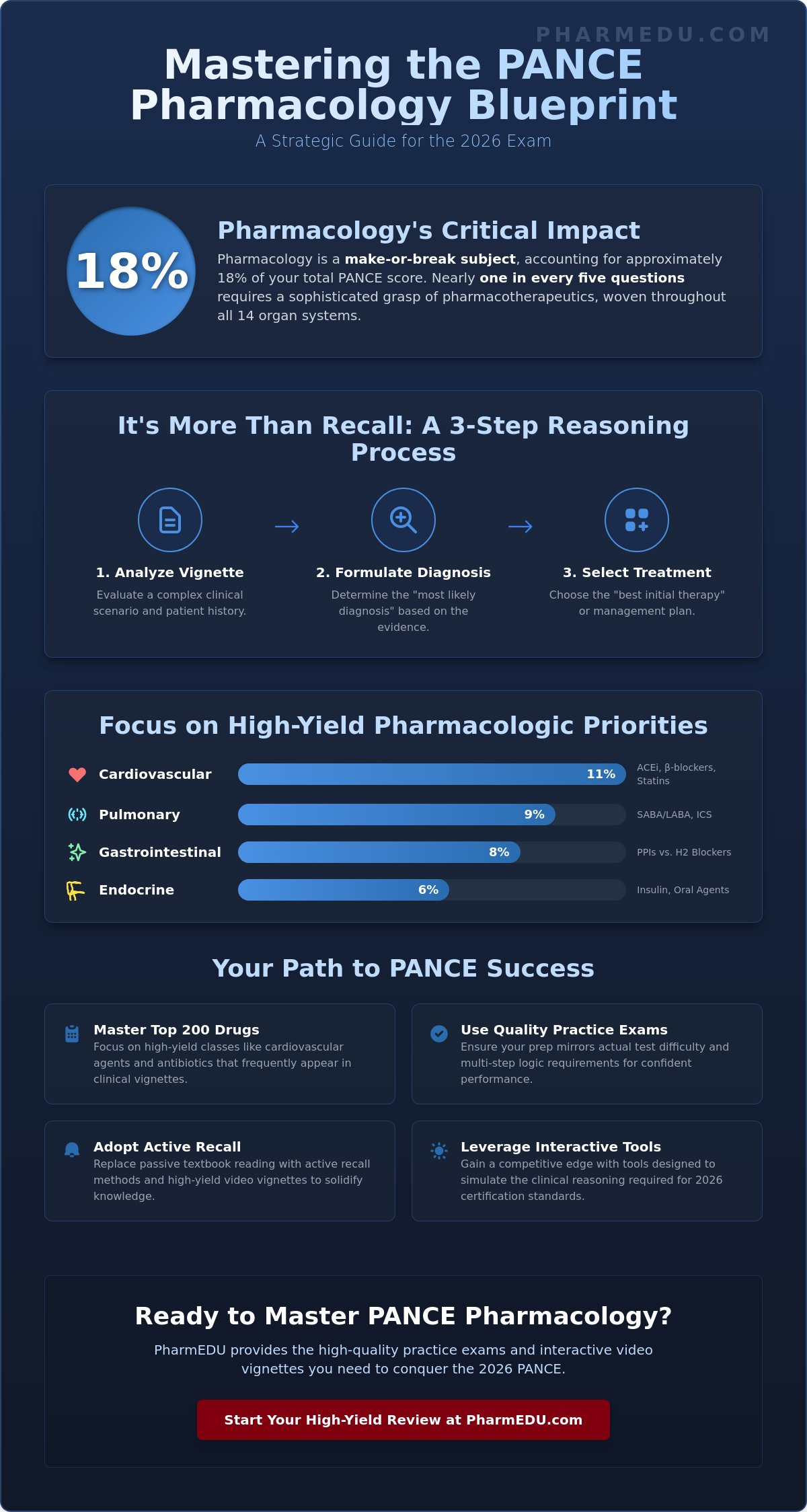
The NCCPA Content Blueprint is the indispensable foundation of your preparation. For the 2026 exam, the blueprint that became effective in January 2025 remains the definitive guide. While many students search for a dedicated “pharmacology section,” the reality is more integrated. Pharmacology is woven into the very fabric of the Physician Assistant National Certifying Exam (PANCE). It accounts for approximately 18% of the total exam, which means nearly one out of every five questions requires a sophisticated grasp of pharmacotherapeutics.
The 18% Rule: Why Pharmacology is a Make-or-Break Subject
Missing what should be straightforward pharmacology questions can quickly jeopardize your overall score. The 2026 exam format emphasizes clinical reasoning over simple recall. You won’t just encounter questions asking for a drug’s mechanism of action in isolation. Instead, you’ll face vignettes where you must first reach the correct diagnosis and then select the most appropriate management. If you haven’t engaged with a high-quality PANCE pharmacology practice exam, these multi-step logic requirements can lead to avoidable errors. Every medical content question is now coded to a specific task, such as clinical intervention or health maintenance, making pharmacology a universal thread throughout the test.
Organ Systems and Their Pharmacologic Priorities
Pharmacology isn’t distributed equally across the blueprint. Certain organ systems are significantly more drug-heavy than others. For instance, the Cardiovascular System represents 11% of the medical content, while the Pulmonary System covers 9%. These areas are packed with pharmacologic interventions that you must master to succeed. You should prioritize your study time based on these high-yield categories:
- Cardiovascular (11%): You must be an expert in ACE inhibitors, Beta-blockers, and Statins.
- Pulmonary (9%): Focus heavily on the nuances of SABA/LABA applications and inhaled corticosteroids.
- Gastrointestinal (8%): Understand the distinct indications for PPIs versus H2 blockers.
- Endocrine (6%): Master insulin types and oral hypoglycemic agents.
The NCCPA frequently tests your ability to determine the “best initial treatment” immediately after identifying the “most likely diagnosis.” This dual-step process is a hallmark of the modern exam. Using a PANCE pharmacology practice exam that stresses these connections across all 14 organ systems is the only way to ensure your knowledge is ready for the 300-question marathon. Success in 2026 requires moving beyond the drug list and understanding how these therapies function within the context of patient care. It’s about recognizing the right drug for the right patient at the right time.
High-Yield Drug Classes for the 2026 PANCE
Mastering the “Top 200” drugs is a strategic necessity for any candidate. While the total number of FDA-approved medications is staggering, the official PANCE Content Blueprint prioritizes specific classes that appear most frequently in clinical practice. You don’t need to know every rare orphan drug. Instead, you must focus on the medications that manage the 14 organ systems discussed in the previous section. Developing a deep familiarity with these high-yield classes through a PANCE pharmacology practice exam will help you recognize patterns in complex vignettes.
Cardiovascular Pharmacology: The PANCE Powerhouse
Cardiology is often the most challenging area for students due to the sheer volume of medications. You must distinguish between dihydropyridine (DHP) calcium channel blockers, like amlodipine, which primarily cause vasodilation, and non-DHP types, like verapamil and diltiazem, which affect heart rate and contractility. ACE inhibitors are essential in treating heart failure with reduced ejection fraction as they provide a clear mortality benefit by inhibiting the renin-angiotensin-aldosterone system. Watch for side effects such as the classic dry cough or life-threatening angioedema. If a patient develops these, you’ll likely need to identify an ARB as the next logical step in management.
Infectious Disease: Spectrum and Selection
Antibiotic selection is a frequent source of anxiety. The exam tests your ability to choose the right agent for community-acquired pneumonia, where Streptococcus pneumoniae is the target, versus healthcare-associated pneumonia, which requires coverage for MRSA or Pseudomonas. You should also understand the nuances of cross-reactivity. While the risk of a cephalosporin reaction in a penicillin-allergic patient is historically cited between 1% and 10%, it’s much lower with third-generation agents. Don’t forget the “big guns” like Vancomycin and Aminoglycosides. These require careful monitoring for nephrotoxicity and ototoxicity, which are classic “vignette-style” clues. Reviewing high-yield video vignettes can help you visualize these complex drug-receptor interactions and their clinical consequences.
Psychiatry and Neurology: Managing the Central Nervous System
Neurologic and psychiatric medications often feature narrow therapeutic indices or severe adverse reactions. You’ll need to differentiate between SSRIs and SNRIs, specifically regarding their indications for chronic pain or anxiety. Be alert for Serotonin Syndrome when these are combined with other serotonergic agents. For antiepileptic drugs like lamotrigine or carbamazepine, recognizing the early signs of Stevens-Johnson Syndrome is a critical safety task. Lithium remains a favorite for testing due to its narrow therapeutic window and the need for regular blood level monitoring. Practicing these scenarios in a PANCE pharmacology practice exam ensures you can spot these high-stakes details under time pressure.
Evaluating PANCE Pharmacology Practice Exams
Selecting the right study materials is often the difference between a passing score and a frustrating retake. Many students fall into the trap of completing thousands of questions without actually improving their clinical reasoning. A high-quality PANCE pharmacology practice exam shouldn’t just tell you the right answer; it should provide exhaustive rationales for every distractor. Understanding why a specific beta-blocker is contraindicated in a patient with reactive airway disease is more valuable than simply memorizing a drug name. These rationales turn every mistake into a specific learning opportunity, allowing you to bridge the gap between theory and practice.
Effective practice exams must mirror the five 60-minute blocks of 60 questions that you’ll face at the Pearson VUE testing center. If your study tools are too easy, you’ll develop a false sense of security that evaporates on exam day. Look for platforms that prioritize the task categories outlined by the NCCPA, such as health maintenance and clinical intervention. This ensures you’re practicing the exact logical steps required to manage a patient’s care from initial presentation to final treatment plan.
Vignette-Style Questions vs. Simple Recall
The NCCPA has shifted away from simple recall. You’ll rarely see a question asking for the side effect of a drug in isolation. Instead, you’ll face third-order questions. These require you to identify the diagnosis from a lab value, determine the first-line treatment, and then recognize a specific contraindication for that treatment. Identifying buzzwords like “moon facies” or “currant jelly sputum” is helpful, but you can’t rely on them alone. Clinical case studies are the gold standard for this type of preparation because they force you to synthesize information, mirroring the actual difficulty of the 300-question exam.
Analyzing Your Practice Test Results
Data-driven preparation is the most efficient path to success. Don’t just look at your overall percentage; you must track your performance across the 14 organ systems to identify exactly where your pharmacology knowledge falters. If your scores in Cardiology are high but your Psychiatry results are lagging, your study plan must adapt immediately. We recommend the “Rule of Three”: review a difficult concept, test yourself on it, and then revisit the rationale 48 hours later to ensure the information has moved into long-term memory. When you find that your foundational knowledge is consistently missing, it’s time to transition from a PANCE pharmacology practice exam back to a comprehensive pharmacy review to fill those gaps before your next attempt. This systematic approach ensures that you’re not just guessing, but building the professional competence required for certification.
Strategic Study Plan for PANCE Pharmacology
Mastering 18% of your exam requires more than sporadic late-night study sessions. You need a methodical, three-phase approach that transitions from passive learning to high-stakes simulation. By the time you reach your testing date in 2026, your responses to pharmacologic vignettes should be instinctive. This level of proficiency is only possible through a structured plan that respects the complexity of the NCCPA blueprint while optimizing your cognitive load.
Our recommended strategy begins with foundation building. Phase 1 focuses on high-yield video vignettes that provide clinical context for the “Top 200” drugs. Phase 2 moves into active recall, where interactive flashcards and quizzes force your brain to retrieve information without the help of multiple-choice cues. Finally, Phase 3 involves full-length simulation. Taking a PANCE pharmacology practice exam under timed conditions is the only way to replicate the pressure of the five 60-minute blocks you’ll face at the Pearson VUE center. Throughout these phases, you must employ “Spaced Repetition.” This technique involves revisiting difficult drug classes at increasing intervals, ensuring that the mechanism of action for an SGLT2 inhibitor stays in your long-term memory rather than evaporating after 24 hours.
Developing a Daily Pharmacology Routine
Success is built in the 60 to 90 minutes you dedicate to pharmacology every day. Consistency is your most powerful tool, but you must avoid “pattern recognition” bias. If you only study cardiovascular agents on Mondays, your brain begins to expect those answers, which doesn’t happen on the real exam. Mix your drug classes daily to keep your diagnostic skills sharp. While mnemonics are helpful for memorizing specific side effects, don’t over-rely on them. A mnemonic might help you remember a list, but it won’t help you navigate a third-order question about a drug-drug interaction in a complex patient with multiple comorbidities.
Integrating Pharmacology into Your General PANCE Prep
You shouldn’t study drugs in a vacuum. The most effective students link pharmacology directly to pathophysiology. When you understand the underlying mechanism of a disease, the treatment becomes a logical extension of that knowledge rather than a random fact to memorize. If you find yourself struggling with the nuances of a particularly dense class, utilizing a pharmacology study guide for nursing students can serve as an excellent, simplified starting point before you layer on the PA-level clinical management details. This tiered approach ensures you never feel overwhelmed by information overload. To begin refining your clinical reasoning today, explore our collection of Interactive Pharmacology Flashcards and see how structured recall can transform your scores.
By integrating your PANCE pharmacology practice exam results back into your daily routine, you create a feedback loop that continuously strengthens your weakest areas. This disciplined approach turns a daunting subject into a series of manageable, high-yield tasks.
PharmEDU: Your Partner in Mastering PANCE Pharmacology
Navigating the transition from clinical rotations to board certification requires a resource that’s as mobile and dynamic as your schedule. PharmEDU serves as a digital mentor, providing the precision and support necessary to conquer the most difficult aspects of the NCCPA requirements. While traditional textbooks often present information in a dry, academic format, our platform utilizes high-yield video vignettes to demonstrate how drugs interact within real-world clinical scenarios. This method ensures that you’re not just memorizing data points but developing a deep, intuitive understanding of pharmacotherapy.
Our curriculum covers over 100 pharmacology topics, each meticulously mapped to the 2026 blueprint. We provide a PANCE pharmacology practice exam experience that mirrors the actual vignette style you’ll encounter on test day. This high-fidelity simulation is crucial for building the stamina and logic needed for the 300-question exam. Consistently utilizing a PANCE pharmacology practice exam helps you identify subtle diagnostic clues that simple flashcards might miss. Because our platform is fully mobile-compliant, you can access these resources during a quick break on your internal medicine rotation or while waiting for a procedure to begin.
High-Yield Content for Busy PA Students
Efficiency is the cornerstone of our educational philosophy. We’ve broken down complex topics into micro-learning segments that fit perfectly into a 15-minute window. This approach eliminates the information overload that often leads to burnout. By focusing strictly on the “must-know” facts and clinical applications, we help you streamline your preparation. You’ll move beyond rote memorization and start thinking like a board-certified clinician, identifying the best initial treatments with speed and accuracy.
Join the PharmEDU Community
Becoming a member of PharmEDU means gaining access to a wealth of expert-led reviews and clinical case studies. These tools are designed to reinforce your knowledge through active recall and critical thinking. Whether you’re an individual learner looking for a monthly or annual subscription, or an educator seeking an institutional platform license, we have a solution tailored to your needs. Our goal is to take the administrative and cognitive burden off your shoulders, allowing you to focus on what matters most: your professional growth. Start your PANCE pharmacology mastery with PharmEDU today! and secure your future as a certified Physician Assistant.
Secure Your Professional Future with Strategic Preparation
Mastering the pharmacology component of your certification is a significant milestone in your professional journey. You’ve learned that success in 2026 requires more than memorizing drug lists; it demands a deep understanding of clinical application within the integrated organ systems. By prioritizing high-yield classes and utilizing a realistic PANCE pharmacology practice exam, you can transform a daunting 18% of your total score into a source of confidence. Efficiency is essential, especially when balancing your study time with the demands of clinical rotations.
PharmEDU is here to support you with 100+ high-yield video vignettes and content that is strictly aligned with the NCCPA blueprint. These mobile-compliant micro-learning tools ensure you can make progress during any break in your day. You have the skills and the dedication to succeed. Now, you just need the right professional tools to bridge the gap between PA student and board-certified practitioner.
Access the Full PharmEDU Pharmacology Library
Your commitment to excellence today will define the quality of care you provide tomorrow. We’re honored to be your partner in this critical stage of your career. Keep pushing forward; your certification is within reach.
Frequently Asked Questions
How much of the PANCE is pharmacology?
Pharmacology content is integrated across various medical categories and accounts for approximately 18% of the total exam weight. This means you’ll encounter pharmacologic management questions throughout the 300-question test rather than in a single standalone block. Understanding this distribution is vital for prioritizing your study time effectively, as it influences nearly one out of every five questions you’ll face on test day.
What are the most common drug classes tested on the PANCE?
The most frequently tested drug classes align with the high-weight organ systems in the blueprint. These include cardiovascular agents like ACE inhibitors and beta-blockers, pulmonary medications like inhaled corticosteroids, and endocrine treatments such as insulin and metformin. You should also focus on common antimicrobials and psychiatric medications, as these classes appear frequently in multi-step clinical vignettes that require both diagnosis and management.
Are there free PANCE pharmacology practice exams available?
You can find limited free resources and trial periods on professional platforms to assess your current knowledge level. For a realistic PANCE pharmacology practice exam experience, PharmEDU offers a 7-day free trial that includes access to high-yield questions and detailed rationales. This allows you to test the quality of the vignettes and the interface before committing to a full subscription for your 2026 prep.
How should I study for the PANCE pharmacology section if I am short on time?
Focus your limited time on high-yield organ systems like Cardiology and Pulmonology, which represent the largest portions of the exam. Using a PANCE pharmacology practice exam as a diagnostic tool allows you to identify specific weaknesses quickly. Use micro-learning tools like video vignettes and interactive quizzes to maximize efficiency during short clinical breaks rather than attempting to read exhaustive textbooks that may contain low-yield information.
Does the PANCE test specific drug dosages?
No, the NCCPA typically doesn’t require you to memorize specific milligram dosages for the boards. The exam focuses on choosing the correct first-line agent, recognizing contraindications, and understanding therapeutic monitoring for drugs with narrow indices like lithium or warfarin. You should prioritize learning the “best initial treatment” for a given diagnosis rather than focusing on the administrative details of dosing schedules or pill sizes.
What is the best way to memorize mechanism of action for the boards?
The most effective method is linking the mechanism of action directly to the pathophysiology of the disease state. When you understand how a disease disrupts normal function, the way a drug restores that balance becomes a logical step instead of an isolated fact to memorize. This conceptual approach helps you answer third-order questions that require you to predict side effects based on how the drug interacts with specific receptors.
Can I use nursing pharmacology resources for PANCE prep?
While nursing resources can provide a simplified foundation for complex drugs, they often lack the diagnostic depth required for PA boards. You’ll need resources that emphasize the “most likely diagnosis” and “best initial management” tasks specific to the PA scope of practice. PA-specific materials ensure you’re practicing the exact logical steps required to manage a patient’s care from initial presentation to final treatment plan within the 2026 standards.
How often does the NCCPA update the pharmacology blueprint?
The NCCPA updates the Content Blueprint periodically based on professional practice analysis; the current version was made effective in January 2025. It’s important to ensure your study materials reflect these latest standards to stay aligned with current clinical practice and exam requirements. While the core pharmacology remains stable, the emphasis on clinical reasoning and task-based questions has increased in the most recent updates.