Pharmacokinetics vs Pharmacodynamics for Students: The High-Yield Guide
The difference between a passing grade and clinical mastery isn’t how many drug names you can list, but how clearly you see the “how” and “why” of dosing. If you’re struggling with pharmacokinetics vs pharmacodynamics for students, it’s likely because traditional textbooks bury the fundamental logic under layers of dry academic jargon. It’s easy to confuse ADME pathways with receptor binding when you’re facing information overload before a major board exam.
We understand that you need clarity, not just more data. This guide provides the high-yield definitions and clinical examples required to finally achieve that “click” moment where the science becomes intuition. You’ll gain the confidence to ace your pharmacology quizzes by mastering the core distinction: what the body does to the drug versus what the drug does to the body. We’ll explore practical mnemonics and real-world applications, such as the March 2026 FDA guidance on biosimilars, while showing you how to sharpen your skills using PharmEDU Practice Quizzes and Clinical Case Studies.
Key Takeaways
- Learn the “Golden Mnemonic” to instantly distinguish between what the body does to a drug and how that drug interacts with biological receptors.
- Master the ADME framework to understand how absorption, distribution, metabolism, and excretion determine drug concentration in the bloodstream.
- Explore receptor theory and the lock-and-key model to predict how agonists and antagonists influence clinical outcomes and patient safety.
- Clarify the relationship between pharmacokinetics vs pharmacodynamics for students by applying concepts like the therapeutic window and steady state to real-world clinical cases.
- Discover how to reinforce these complex principles using high-yield video vignettes and interactive pharmacology flashcards to ensure board-exam readiness.
Pharmacokinetics vs Pharmacodynamics: The Essential Distinction
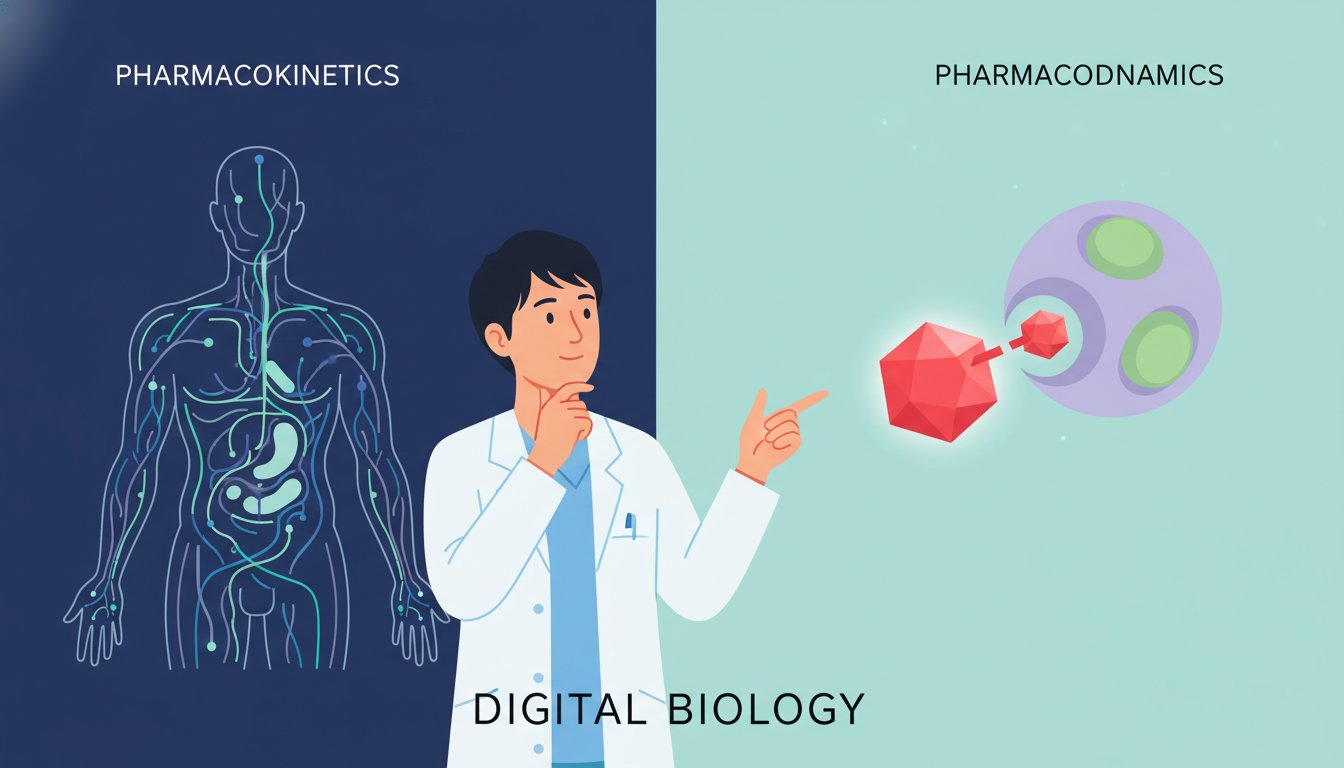
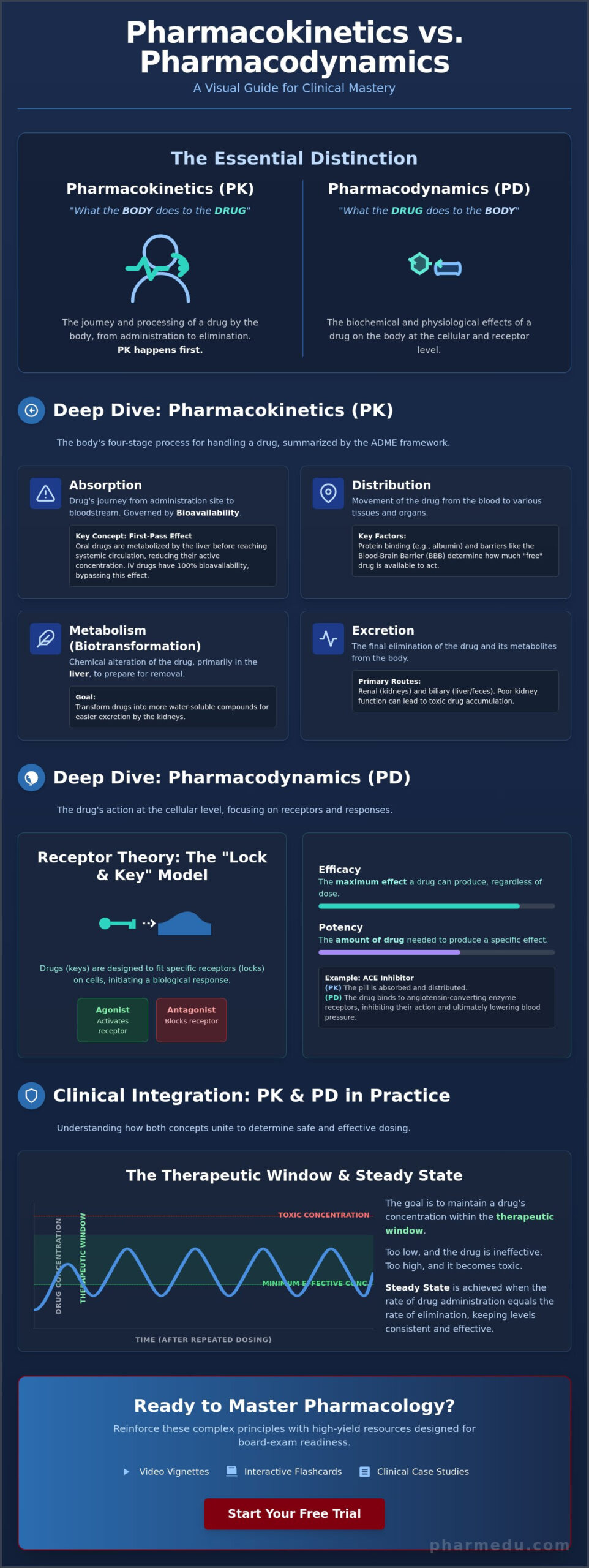
Success in medical and pharmacy education relies on moving past rote memorization toward a conceptual understanding of drug behavior. For many, the simplest way to grasp pharmacokinetics vs pharmacodynamics for students is the “Golden Mnemonic”: PK describes what the body does to the drug, while PD describes what the drug does to the body. This distinction serves as the bedrock of clinical pharmacology; without it, dosing regimens and side effect profiles remain a confusing collection of disconnected facts.
Visualize the pharmacological timeline as a sequential process. Before a drug can exert any therapeutic effect, it must first be processed by biological systems. PK happens first. If a drug isn’t absorbed or distributed effectively, it will never reach its target receptor to initiate a pharmacodynamic response. This sequence is vital for predicting how long a drug stays in the system and when the patient will feel the benefits. Mastering this logic prevents dangerous medication errors, such as failing to adjust dosages for patients with renal or hepatic impairment.
Pharmacokinetics (PK): The Body’s Processing Plant
The study of Pharmacokinetics (PK) involves tracking the movement of a drug through various biological compartments. Think of the body as a complex processing plant that receives, transports, alters, and eventually discards the chemical substance. Key metrics in this phase include half-life, clearance, and the volume of distribution. For example, a patient’s liver function is a critical PK factor. If the liver can’t metabolize a drug at a standard rate, the drug concentration may rise to toxic levels, even if the initial dose was correct. Understanding these variables is essential for maintaining safety.
Pharmacodynamics (PD): The Drug’s Mechanism of Action
Pharmacodynamics focuses on the biochemical and physiological consequences of drug administration. This is where the actual “work” happens at the cellular level. PD revolves around receptor theory, potency, and efficacy. Consider the example of an ACE inhibitor. While PK explains how the pill reaches the bloodstream, PD explains how the drug binds to specific receptors to inhibit the angiotensin-converting enzyme, ultimately lowering blood pressure. It’s the study of receptor affinity and how a molecule triggers a specific biological change.
Refining your understanding of pharmacokinetics vs pharmacodynamics for students requires more than reading a single definition. It takes practice with clinical scenarios. PharmEDU’s High-Yield Video Vignettes and Interactive Pharmacology Flashcards are designed to help you visualize these differences in real time, ensuring you’re ready for both your next quiz and your future board certification exams.
Deep Dive into Pharmacokinetics: The ADME Framework
Mastering pharmacokinetics vs pharmacodynamics for students starts with a deep dive into the ADME framework. If pharmacodynamics is the “why” of drug therapy, pharmacokinetics is the “how much” and “how long.” ADME represents the four stages a drug must navigate: Absorption, Distribution, Metabolism, and Excretion. Each stage determines the concentration of the drug at its target site, which is why biologic medicines, which account for 51% of all drug spending in the U.S. as of 2025, require such rigorous PK testing to ensure safety and efficacy.
- Absorption: This is the drug’s journey from the site of administration to the bloodstream. Bioavailability measures the percentage of the dose that reaches systemic circulation.
- Distribution: Once in the blood, the drug moves to various tissues. Factors like protein binding (often to albumin) and the Blood-Brain Barrier (BBB) determine how much “free” drug is available to do its job.
- Metabolism: Most drugs undergo chemical transformation, primarily in the liver, to become more water-soluble for easier removal.
- Excretion: This is the final exit through renal or biliary routes. If a patient’s kidneys aren’t functioning at 100%, the drug can’t leave, leading to potentially toxic accumulation.
Bioavailability and the First-Pass Effect
The route of administration changes everything. Intravenous (IV) drugs have 100% bioavailability because they bypass the initial “tax” levied by the digestive system. Oral drugs aren’t so lucky. They must pass through the gut wall and then the liver via the portal vein before reaching the rest of the body. This is the first-pass effect. If a drug has high first-pass metabolism, the liver might destroy 90% of it before it ever reaches the heart. This is why nitroglycerin is given sublingually; it avoids the liver to provide immediate relief for chest pain.
Metabolism and Drug-Drug Interactions
Metabolism typically occurs in two phases. Phase I involves the Cytochrome P450 (CYP450) system, which uses oxidation, reduction, or hydrolysis to modify the drug. Phase II involves conjugation, where the body attaches a large polar molecule to the drug to make it ready for excretion. The CYP450 system is a major source of drug-drug interactions. For example, grapefruit juice is a potent inhibitor of certain CYP enzymes. If a patient drinks it while taking a statin, the drug isn’t broken down properly, leading to dangerously high levels in the blood. To reinforce these concepts, using interactive pharmacology flashcards can help you memorize these metabolic pathways without the usual textbook fatigue.
Understanding Pharmacodynamics: Receptors and Responses
While pharmacokinetics determines how a drug reaches its destination, pharmacodynamics explores the biological impact once it arrives. For those studying pharmacokinetics vs pharmacodynamics for students, it’s helpful to view this stage as the “business end” of pharmacology. This is where the chemical signal meets the biological target. If the previous sections focused on the body’s management of the drug, we now pivot to the drug’s influence on the body’s physiological functions.
Most drugs work by binding to receptors, which are typically proteins located on the cell surface or within the cytoplasm. The “Lock and Key” model remains the gold standard for visualizing this interaction; the drug molecule must possess the correct shape and chemical charge to fit into the receptor site. Once this binding occurs, the drug can either initiate a biological response or prevent other endogenous molecules from doing so. This interaction is the fundamental unit of drug action.
Pharmacodynamics isn’t just about whether a drug works, but how much effect it produces at a specific concentration. We visualize this relationship using the dose-response curve. A crucial safety metric derived from these observations is the Therapeutic Index (TI). This index represents the ratio between the dose that causes toxicity and the dose that produces a therapeutic effect. A narrow TI means the window between a cure and a toxin is dangerously small, which requires rigorous patient monitoring and precise dosing adjustments.
Agonists, Antagonists, and Partial Agonists
Full agonists bind to a receptor and produce a maximum biological response. Antagonists, however, act as blockers. They have affinity for the receptor but zero intrinsic activity. A classic clinical example is the use of Naloxone to reverse an opioid overdose. Naloxone acts as a competitive antagonist, meaning it can “out-compete” the opioid for the receptor site if given in sufficient concentration. Partial agonists are unique because they bind to the receptor but only produce a sub-maximal response, even when all receptors are occupied.
Potency vs. Efficacy: Clearing the Confusion
Students often use these terms interchangeably, but they describe different pharmacological properties. Potency refers to the amount of drug needed to produce a specific level of effect, often measured as the EC50. Efficacy describes the drug’s “ceiling,” or the maximum response it can possibly achieve. A drug that’s highly potent isn’t necessarily superior for the patient. In clinical practice, efficacy is usually the more important metric because it determines the total therapeutic potential of the treatment. You can refine your grasp of these curves and metrics by using PharmEDU’s Pharmacology Practice Quizzes, which are designed to simulate board-style questions on these exact distinctions.
Clinical Integration: Why PK and PD Matter for Exams
Board exams like the NAPLEX and NCLEX prioritize patient safety over simple recall. This is why examiners focus so heavily on the therapeutic window. It’s the narrow space where a drug concentration is high enough to be effective (PD) but low enough to avoid being toxic (PK). If you’re preparing for these hurdles, mastering pharmacokinetics vs pharmacodynamics for students isn’t just about passing; it’s about your ability to predict clinical outcomes. You’ll often encounter distractors that swap these definitions, such as claiming a change in “potency” (a PD term) is caused by “renal failure” (a PK issue).
A common exam trap involves the distinction between loading doses and maintenance doses. A loading dose is a pharmacokinetic intervention used to reach the therapeutic window quickly, especially for drugs with long half-lives. In contrast, the maintenance dose is designed to replace the drug that the body eliminates, keeping the concentration at a steady state. You’ll reach this equilibrium after approximately five half-lives. Understanding this math is the difference between a patient receiving a subtherapeutic dose and a life-saving intervention.
Recent regulatory shifts, like the March 2026 FDA draft guidance on biosimilars, underscore the real-world weight of these concepts. The FDA now permits advanced analytical data to replace some clinical PK studies to lower drug development costs. This shows that your understanding of these principles is directly linked to the evolving landscape of drug development and healthcare economics. To see these concepts applied to real-world scenarios, explore our Clinical Case Studies which bridge the gap between classroom theory and clinical practice.
The Half-Life (t1/2) and Dosing Intervals
Half-life is the time required for the plasma concentration to decrease by 50%. In first-order kinetics, this value remains constant regardless of the dose administered. However, clinical reality often complicates the math. When a patient has renal impairment, their clearance decreases significantly. This extends the half-life and forces you to adjust the dosing interval or the dose itself to prevent dangerous drug accumulation. Exams love to test your ability to calculate these adjustments based on a patient’s creatinine clearance.
Pharmacogenomics: The Future of PK and PD
The future of medicine is personalized, and pharmacogenomics is the tool that makes it possible. Genetic variations can drastically alter drug response. For example, a polymorphism in a CYP450 enzyme affects PK by changing how fast a drug is metabolized. Conversely, a mutation in a receptor site affects PD by altering drug affinity or intrinsic activity. One-size-fits-all dosing is becoming obsolete as we better understand these individual differences, making it vital for students to distinguish between metabolic and receptor-based variations.
Mastering Pharmacology with PharmEDU’s High-Yield Resources
Mastering the complex relationship between pharmacokinetics vs pharmacodynamics for students requires more than just reading a chapter in a textbook. It demands a structured approach that moves from abstract theory to clinical intuition. PharmEDU provides a suite of digital tools designed to facilitate this transition, ensuring that the time you spend studying translates directly into higher scores on pharmacology quizzes and greater confidence during clinical rotations. By focusing on high-yield content, we help you filter out the academic noise and focus on the principles that matter most for patient safety and board certification.
Our High-Yield Video Vignettes simplify the most challenging aspects of pharmacology, such as the Cytochrome P450 system and receptor kinetics, by using clear visual metaphors and clinical context. To reinforce this knowledge, students can utilize Interactive Pharmacology Flashcards that specifically target ADME frameworks and receptor theories. These tools are complemented by Clinical Case Studies that bridge the gap between classroom learning and the bedside, allowing you to see how PK and PD variables dictate real-world treatment decisions. Whether you’re preparing for the NAPLEX or the NCLEX, our targeted Pharmacology Practice Quizzes simulate the rigor of board exams to ensure you’re fully prepared for any distractor an examiner might throw your way.
Micro-Learning for the Busy Healthcare Student
Traditional two-hour lectures often lead to cognitive overload, making it difficult to retain specific details about drug metabolism or efficacy. PharmEDU solves this by offering five-minute video segments that focus on one high-yield topic at a time. This micro-learning approach is proven to be more effective for long-term retention. Our platform is fully mobile-compliant, meaning you can access over 100 high-yield pharmacology topics during a quick break or while commuting to your clinical site. Study anywhere. Consistency builds mastery.
Join the PharmEDU Community for Board Success
We offer flexible PharmEDU Monthly and Annual Subscriptions to fit your specific study timeline, as well as Institutional Platform Licenses for universities looking to support their entire student body. Every learner has access to an intuitive dashboard that tracks progress across different modules, highlighting areas where you might need more focus. This data-driven approach removes the guesswork from your study sessions, allowing you to focus your energy where it’s needed most. Start your pharmacology mastery today with a PharmEDU subscription and turn your study time into a professional advantage.
Elevate Your Clinical Intuition
Distinguishing between pharmacokinetics vs pharmacodynamics for students is the first step toward professional excellence. You now have the framework to separate the body’s processing of a drug from the drug’s cellular impact. By mastering ADME pathways and receptor theory, you’re better equipped to navigate complex dosing schedules and avoid critical medication errors. This knowledge isn’t just for passing exams; it’s the foundation of every safe clinical decision you’ll make throughout your career.
PharmEDU is here to support your journey with over 100 High-Yield Video Vignettes and interactive NAPLEX & NCLEX Practice Quizzes. Our platform is trusted by universities and nursing schools nationally to provide the precision and clarity required for board success. Whether you’re refining your understanding of half-lives or receptor affinity, we provide the tools to make the science stick and ensure you’re ready for the bedside.
Master PK/PD and Ace Your Exams; Subscribe to PharmEDU
Your dedication to understanding these fundamentals today will define the quality of care you provide tomorrow. Keep pushing forward.
Frequently Asked Questions
Is absorption part of pharmacokinetics or pharmacodynamics?
Absorption is a fundamental component of pharmacokinetics. It represents the initial stage of the ADME framework, describing the process by which a drug moves from the site of administration into the systemic circulation. This phase determines the drug’s bioavailability and is a critical concept for understanding pharmacokinetics vs pharmacodynamics for students during their early clinical training. Factors like gastric pH and surface area directly influence how efficiently this process occurs.
How do I remember the difference between PK and PD?
The most effective way to distinguish the two is the “Body vs. Drug” rule. Pharmacokinetics (PK) is what the body does to the drug, focusing on its movement and concentration over time. Pharmacodynamics (PD) is what the drug does to the body, focusing on the resulting biological effects at the receptor site. You can also remember that “K” comes before “D” in the alphabet, just as PK processes like absorption usually happen before the PD effect begins.
What is the “first-pass effect” in pharmacokinetics?
The first-pass effect is the extensive metabolism of a drug by the liver or GI tract before it reaches systemic circulation. When a medication is taken orally, it’s absorbed into the portal venous system and delivered directly to the liver. Hepatic enzymes may deactivate a large portion of the drug during this initial pass. This phenomenon explains why oral doses of certain medications must be significantly higher than their intravenous counterparts to achieve the same therapeutic effect.
What is the difference between a competitive and non-competitive antagonist?
A competitive antagonist binds reversibly to the same receptor site as the natural agonist, while a non-competitive antagonist binds to an allosteric site or binds irreversibly. In competitive antagonism, you can overcome the blockade by increasing the concentration of the agonist. However, a non-competitive antagonist reduces the maximum possible response of the receptor regardless of how much agonist is present. This effectively lowers the efficacy ceiling on a dose-response curve.
Why is the therapeutic index important in pharmacodynamics?
The therapeutic index is a safety ratio that compares the dose required for a therapeutic effect to the dose that causes toxicity. In the study of pharmacodynamics, this index helps clinicians identify drugs that require narrow monitoring. Medications with a low therapeutic index, such as lithium or warfarin, have a very small margin between a helpful dose and a dangerous one. Precise dosing and regular blood tests are mandatory to keep patients within this safe window.
How does liver disease affect the pharmacokinetics of a drug?
Liver disease alters pharmacokinetics by impairing the body’s ability to metabolize and clear medications. When hepatic function declines, the enzymes responsible for breaking down drugs become less efficient, which often extends the drug’s half-life. This can lead to toxic accumulation if dosages aren’t adjusted. Mastering the nuances of pharmacokinetics vs pharmacodynamics for students is vital for safely managing patients with cirrhosis or hepatitis, as their bodies process chemicals differently than healthy individuals.
What does “steady state” mean in drug dosing?
Steady state is the point where the amount of drug being administered equals the amount being eliminated by the body. Once this equilibrium is reached, the plasma concentration of the drug remains stable within the therapeutic range. It generally takes four to five half-lives of consistent dosing to achieve this state. Understanding this timeline is essential for determining when to measure blood levels or when a patient should expect to see the full clinical benefits of a treatment.
Can a drug have high potency but low efficacy?
Yes, potency and efficacy are independent properties of a drug’s pharmacodynamic profile. Potency refers to the amount of drug needed to produce a specific effect, while efficacy is the maximum response the drug can possibly achieve. A drug might be highly potent because it works at a very low dose, yet have low efficacy because its maximum effect is relatively small. In clinical settings, high efficacy is often more desirable than high potency when treating severe symptoms.