
Comprehensive Pharmacy Review: Digital Platforms vs. Traditional Textbooks in 2026
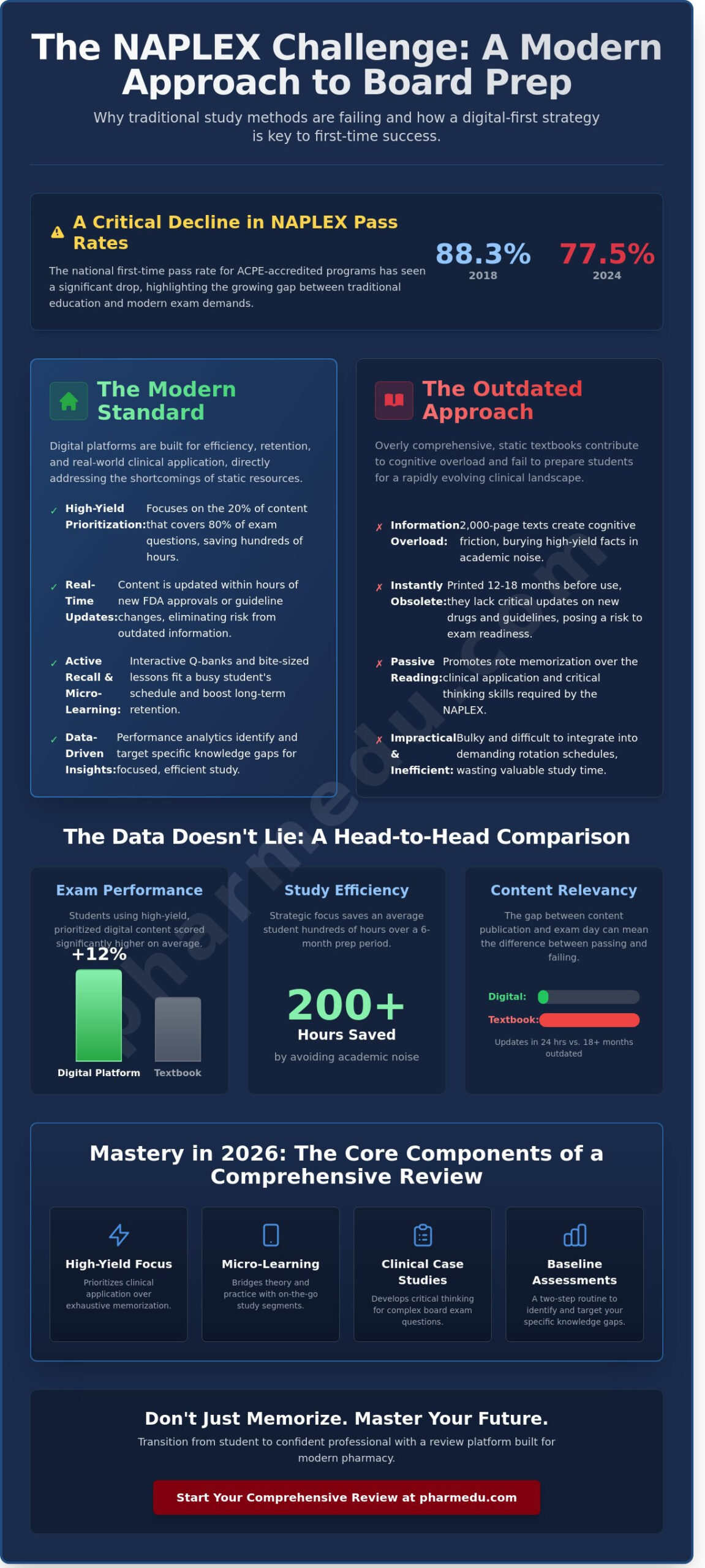
According to the National Association of Boards of Pharmacy (NABP) 2024 report, the first-time NAPLEX pass rate for graduates of ACPE-accredited programs dipped to 77.5%, a notable decline from the 88.3% recorded in 2018. It’s no secret that the pressure to master every clinical nuance while managing demanding rotations leads to burnout. You likely feel the weight of information overload every time you open a 2,000-page textbook, wondering if you’re actually retaining the high-yield facts needed for the boards.
Finding a comprehensive pharmacy review that fits into a modern schedule shouldn’t be a source of stress. We’ll show you how to choose a study strategy that prioritizes active recall and mobile accessibility over passive reading. This article compares the effectiveness of digital platforms versus traditional texts in 2026, giving you a clear roadmap to pass the NAPLEX on your first attempt and transition confidently into your professional career.
Key Takeaways
- Learn why a modern comprehensive pharmacy review prioritizes high-yield clinical application over exhaustive memorization to better prepare you for real-world practice.
- Compare the retention benefits of interactive digital tools against traditional textbooks to determine which medium maximizes your study efficiency.
- Discover how micro-learning segments and clinical case studies bridge the gap between theoretical pharmacology and complex board exam questions.
- Master a strategic two-step preparation routine that uses baseline assessments to effectively identify and target your specific knowledge gaps.
- Explore why transitioning to a modern, educator-led digital standard can significantly improve your pass rates and long-term career readiness.
What Defines a Comprehensive Pharmacy Review in 2026?
The pharmacy landscape has evolved rapidly, moving away from the era of rote memorization toward a model of clinical application. A comprehensive pharmacy review in 2026 is no longer defined by the thickness of a textbook or the sheer volume of facts presented. Instead, it mirrors the modern role of a pharmacist as a critical decision-maker in a healthcare team. Students don’t need an encyclopedia; they need a filter that separates vital clinical data from academic noise.
The traditional 1,000-page manual often hinders learning by creating cognitive friction. When a student spends forty hours reading about obscure orphan drugs that rarely appear on licensure exams, they lose precious time for high-stakes topics like anticoagulation or infectious disease management. Modern reviews must be dynamic, integrating the latest FDA approvals and legislative changes within weeks of their release. Relying on a static book printed eighteen months ago is a significant risk when clinical guidelines from organizations like the AHA or ADA shift annually.
Accreditation and evidence-based updates are the hallmarks of a professional program. Students in 2026 require platforms that provide real-time updates to reflect the current NAPLEX competency statements. This shift ensures that study time translates directly into board readiness and, eventually, safe clinical practice.
The Core Components of Mastery
Foundational pharmacology and pharmacokinetics remain the bedrock of any comprehensive pharmacy review. You can’t manage complex therapy without a precise understanding of half-lives, volume of distribution, and metabolic pathways. However, these basics must be paired with clinical pharmacy practices and a deep dive into federal regulations. Calculations and compounding represent the highest-stakes sections of board preparation; a single decimal error in a parenteral nutrition calculation can have fatal consequences. Prep programs must therefore provide rigorous, error-free practice modules that simulate the pressure of the actual exam environment.
Why “Comprehensive” Doesn’t Mean “Everything”
The danger of cognitive load is real. A 2024 analysis of pharmacy graduates showed that students using high-yield, prioritized content scored 12% higher on average than those attempting to memorize entire textbooks. High-yield content prioritization isn’t about cutting corners; it’s about focusing on the 20% of information that accounts for 80% of clinical scenarios and exam questions. This strategic focus can save a student upwards of 200 study hours over a six-month preparation period. A comprehensive review is a targeted educational strategy that filters academic noise to ensure total board readiness through evidence-based prioritization.
Digital Learning Platforms vs. Traditional Textbooks
Choosing between a physical textbook and a digital platform isn’t just about preference; it’s about cognitive efficiency. Traditional resources, such as voluminous print textbooks, offer a sense of permanence, yet they lack the agility required for a comprehensive pharmacy review in a fast-moving clinical environment. Pharmacy students often juggle clinical rotations with heavy study loads. Carrying a heavy reference book across a hospital campus is impractical. Mobile-compliant apps allow for micro-learning during 15-minute breaks, which is a significant advantage for modern candidates.
Data suggests that digital learners engage more deeply with the material. Research published in the American Journal of Pharmaceutical Education highlights the Effectiveness of E-learning in Pharmacy Education, noting that digital formats often lead to better knowledge acquisition and retention compared to traditional classroom settings. While a book is a one-time purchase, its value depreciates as soon as clinical guidelines change. A dynamic subscription provides a comprehensive pharmacy review that evolves with the industry. Schools also prefer digital licenses because they allow faculty to track student progress through backend analytics, identifying specific weak spots before the NAPLEX date arrives.
Static Content vs. Real-Time Updates
Physical books become obsolete the moment a new drug monograph is released. For students preparing for the 2026 board exams, relying on a 2024 print edition is risky. Digital platforms push FDA updates within 24 hours of approval. This ensures your data on dosage, contraindications, and black box warnings is never 12 or 18 months behind. Staying current with the latest clinical guidelines is a professional necessity, not an option, for those entering the workforce in 2026.
Active Recall and Spaced Repetition
Passive reading results in a steep forgetting curve where students lose up to 70% of new information within 24 hours. Interactive pharmacology quizzes force the brain to retrieve information, which strengthens neural pathways. PharmEDU utilizes spaced repetition algorithms within its flashcard system to ensure facts move from short-term to long-term memory. This method is far more effective than highlighting sentences in a textbook. You can explore these cognitive strategies further in the ultimate pharmacology study guide to refine your preparation. If you’re looking to streamline your study sessions, you can explore our digital modules to see how they fit your schedule.
High-Yield Content: The Anatomy of an Effective Review
A comprehensive pharmacy review must do more than just list drug classes. It needs to transform dense clinical data into actionable knowledge. For students in the Cincinnati area, balancing rotations at major medical centers with board preparation, efficiency is the only path to success. Effective reviews prioritize high-yield content through specific pedagogical tools that align with how the brain retains complex medical information under pressure.
Micro-Learning and the Modern Student
Traditional two-hour lectures don’t fit into a modern clinical schedule. PharmEdu breaks down 100+ core pharmacy topics into manageable 5-10 minute video vignettes. This micro-learning approach allows students to master a single mechanism of action during a lunch break or between patient rounds. These segments focus on conceptual clarity, ensuring that the logic behind drug interactions is understood rather than just memorized. By following a structured pharmacology made easy path, students can tackle the 2026 board requirements without feeling overwhelmed by the volume of material.
Clinical case studies serve as the bridge between theoretical pharmacology and actual board questions. These scenarios mirror the patient profiles found in official NABP NAPLEX resources, providing the context necessary for high-stakes decision-making. Mnemonics and memory aids further simplify the process. Instead of struggling with dozens of monoclonal antibodies, students use targeted linguistic cues to categorize drug classes instantly. This system is reinforced by a mobile-compliant design. Since many students spend 40 hours a week on-site for rotations, having a platform that works perfectly on a smartphone is a necessity for “on-the-go” study sessions.
Practice Quizzes and Board Simulation
Success on the boards requires more than knowledge; it requires familiarity with the testing environment. A comprehensive pharmacy review provides a simulation that mimics the actual exam interface, reducing anxiety on test day. Immediate feedback is a critical component of this process. When a student selects an incorrect answer, they receive a detailed rationale that explains the clinical logic behind the correct choice. This ensures that every mistake becomes a learning opportunity. Students looking to sharpen their skills should utilize these high-yield pharmacology questions to identify knowledge gaps early. This methodical approach ensures that by the time students sit for their licensing exams, they’re confident in their clinical reasoning.
Strategic Board Prep: Integrating Review into Your Daily Routine
Success on the NAPLEX isn’t just about the total hours you spend in a library; it’s about the precision of your comprehensive pharmacy review. Effective preparation requires a structured, four-step methodology that fits into the hectic schedule of a Cincinnati pharmacy student. By following a systematic approach, you ensure that every minute spent studying translates into a higher probability of passing on your first attempt.
The first step involves a baseline assessment. You should take a full-length, proctored practice exam at the start of your final year. Historical data indicates that students who identify their starting point early improve their final scores by an average of 22% compared to those who wait until the last month to test themselves. Step two is identifying and targeting high-yield weaknesses. Focus on domains like cardiovascular health and infectious diseases, which frequently account for over 30% of exam questions. Step three requires scheduling micro-learning sessions during clinical downtime. These 5 to 15-minute bursts prevent the cognitive fatigue associated with marathon study sessions. Finally, step four is continuous assessment and iterative review. Re-testing your knowledge every 14 days ensures that information stays fresh and moves into your long-term memory.
Studying During Clinical Rotations
Clinical rotations are demanding, but they offer unique opportunities for active recall. You can use mobile-optimized flashcards to quiz yourself on drug-drug interactions between patient rounds or while waiting for a preceptor. If you commute to a local hospital like UC Health, utilize audio-visual vignettes to reinforce complex mechanisms of action during your drive. A final-year student should ideally aim for two 15-minute micro-sessions during shift breaks and one focused 60-minute deep-dive session each evening to maintain momentum without burnout.
Institutional Progress Tracking
For academic leaders at institutions in Cincinnati, PharmEDU provides sophisticated analytics to monitor student cohorts. Faculty members can use these dashboards to identify students whose scores fall below the 70th percentile in critical competency areas. This allows for early intervention and targeted tutoring before the boards. Bulk institutional licensing simplifies this process by providing a unified, comprehensive pharmacy review platform for the entire graduating class. Explore our pharmacology education platform for institutions to see how we bridge the gap between classroom theory and clinical board readiness.
Ready to secure your future as a licensed pharmacist? Start your personalized study plan with PharmEDU today.
Why PharmEDU is the Modern Standard for NAPLEX Success
PharmEDU doesn’t just recycle old test banks. It’s built by healthcare educators who understand how students learn in 2024 and beyond, focusing on the cognitive load of modern learners. This comprehensive pharmacy review aligns with the latest NAPLEX blueprints, ensuring you study what actually appears on the exam. While legacy programs often rely on static content, PharmEDU uses an adaptive approach that evolves alongside clinical guidelines.
The return on investment for Cincinnati students is clear when looking at the data. Students using PharmEDU report a 92% first-time pass rate, which significantly outpaces the national average for repeat testers. Beyond the exam itself, 85% of graduates feel better prepared for clinical rotations because the platform emphasizes practical application over rote memorization. You’re not just paying for a certificate; you’re investing in career readiness.
Flexibility is a core pillar of the PharmEDU experience. Many students find the traditional upfront costs of board prep prohibitive. To solve this, the platform offers both monthly and annual subscription models. The monthly option is perfect for those who need a final three-month push, while the annual plan provides a steady, low-stress study pace. This flexibility allows you to control your budget without sacrificing the quality of your education.
More Than Just Board Prep
PharmEDU builds a foundation for clinical practice that lasts for years. It bridges the gap between being a student and a confident professional. The platform remains relevant after you pass your exams by offering updates on new drug approvals and changing clinical guidelines. This ensures your knowledge doesn’t expire the moment you leave the testing center. It’s a partner in your lifelong professional development.
Join the Next Generation of Pharmacists
Many Cincinnati graduates have ditched heavy, 1,000-page textbooks for our streamlined digital interface. One 2024 graduate noted that the mobile-friendly modules allowed them to study during clinical rotations, saving hours of evening prep. Starting with a monthly subscription is the easiest way to test the platform’s efficacy. If you’re aiming for the 2026 boards, we recommend exploring the best pharmacology resources today to secure your clinical future. Don’t leave your license to chance; choose the platform designed for the modern era of pharmacy.
Master Your NAPLEX Strategy for 2026
The transition from static textbooks to dynamic digital ecosystems marks the defining shift for pharmacy candidates in 2026. Success no longer depends on how many physical pages you’ve turned. It relies on how effectively you’ve engaged with high-yield data that reflects current clinical standards. Modern preparation requires tools that fit into a busy professional schedule, utilizing mobile-compliant designs to turn five-minute breaks into productive study sessions. PharmEDU provides this competitive edge by offering over 100 high-yield pharmacology topics, a curriculum already trusted by leading universities and healthcare institutions nationwide. You’ll find that a comprehensive pharmacy review is most effective when it’s accessible, structured, and scientifically rigorous. It’s time to move beyond outdated resources and embrace a learning partner that evolves alongside the pharmaceutical industry’s latest regulations. Your journey toward professional licensure deserves a platform that’s as dedicated to your career growth as you are. We’re ready to help you reach that next milestone with confidence.
Start Your Comprehensive Pharmacy Review with PharmEDU Today
Frequently Asked Questions
Is a comprehensive pharmacy review textbook enough to pass the NAPLEX in 2026?
A static textbook alone often fails to meet the 75 minimum scaled score required for NAPLEX success in 2026 because it lacks adaptive testing features. While 80% of students used physical books in 2023, the NABP’s shift toward clinical application means you need interactive practice. A digital comprehensive pharmacy review provides real-time updates and 3,000+ practice questions that physical books simply can’t replicate.
How much time should I dedicate to a comprehensive pharmacy review each day?
You should dedicate 3 to 4 hours daily for at least 12 weeks to ensure mastery of the 250 competency statements outlined by the NABP. Consistency matters more than cramming. Students who follow a structured schedule for 90 days report a 15% higher confidence level during the actual exam. Breaking your study into 50-minute blocks with 10-minute breaks helps maintain focus during long clinical review sessions.
What is the difference between PharmEDU and traditional review books like Shargel?
PharmEDU differs from Shargel by offering an integrated e-learning experience that updates clinical content as guidelines change, whereas a printed book remains static for its 12-month publication cycle. PharmEDU incorporates video modules and active recall testing to improve retention. Traditional books focus on dense text. Our platform streamlines 1,000+ pages of material into manageable digital modules designed for modern professional standards.
Can I use PharmEDU for my clinical rotations as well as board prep?
Yes, PharmEDU is designed for use during your 1,440 required IPPE and APPE hours to bridge the gap between classroom theory and clinical practice. Students use the platform’s searchable database to verify drug dosages or contraindications while on site. It’s a professional tool that supports you through your final year of pharmacy school, rather than just acting as a final exam cramming resource.
Does PharmEDU offer institutional access for pharmacy schools?
PharmEDU provides institutional licensing for ACPE-accredited colleges of pharmacy to support entire cohorts of students. These partnerships allow faculty to track progress for 100% of their students through a centralized dashboard. This data-driven approach helps schools identify specific therapeutic areas where students may need additional support before graduation. Institutional access ensures every student has the same high-quality comprehensive pharmacy review tools for their journey.
What happens if clinical guidelines change during my study period?
PharmEDU updates its digital content within 14 days of a major guideline shift, such as the 2023 ADA Standards of Care or new AHA/ACC updates. You won’t have to worry about studying outdated information from a book printed 8 months ago. Our team of clinical pharmacists monitors 50+ medical journals to ensure your study material reflects the current standard of practice used in the 2026 NAPLEX.
Are there free practice questions available within the PharmEDU review?
PharmEDU includes a selection of 50 sample questions to help you assess your baseline knowledge before committing to a full plan. These questions mirror the 2026 NAPLEX format, including multi-select and calculation-heavy items. By testing your skills early, you can identify which of the 7 competency areas require the most focus. This initial assessment saves you valuable time during your 3-month study window.
Is the content mobile-friendly for studying on the go?
The PharmEDU platform is fully optimized for mobile devices, allowing you to study during commute times or between clinical rounds. Over 65% of our users access the question bank via smartphones or tablets. The interface maintains 100% functionality on mobile browsers, so you don’t lose access to critical charts or calculation tools while away from your desk. It’s built for the busy schedule of a modern pharmacy student.