

How to Critically Appraise a Drug Study for Patient Care
A promising result isn’t enough to justify a treatment decision. Knowing how to critically appraise a drug study means judging whether its design and methods support trustworthy findings, what the results mean, and whether they apply to the patient in front of you. Look beyond the authors’ conclusions to the research question, participants, potential sources of bias, outcome measures, and clinical relevance.
It’s understandable to focus first on whether a drug appeared to work, but the strength and usefulness of that finding depend on how the study was conducted and who took part. This article explains how to assess validity, interpret results, and judge relevance to patient care, including when evaluating systematic reviews. It also introduces Critically Appraised Topics (CATs), concise, standardized summaries of research articles, and explains how they connect evidence to a specific clinical question.
Key Takeaways
- Judge a drug study by its methods, potential biases, measured outcomes, and fit with the patient population, not by its conclusion alone.
- Use critical appraisal to distinguish trustworthy findings from evidence that may not support a clinical decision.
- When reviewing a systematic review, examine whether its question, search strategy, and study-selection process are clear and reproducible.
- Use a Critically Appraised Topic to connect a concise evidence summary with a focused clinical question.
Assessing study validity, results, and patient-care applicability
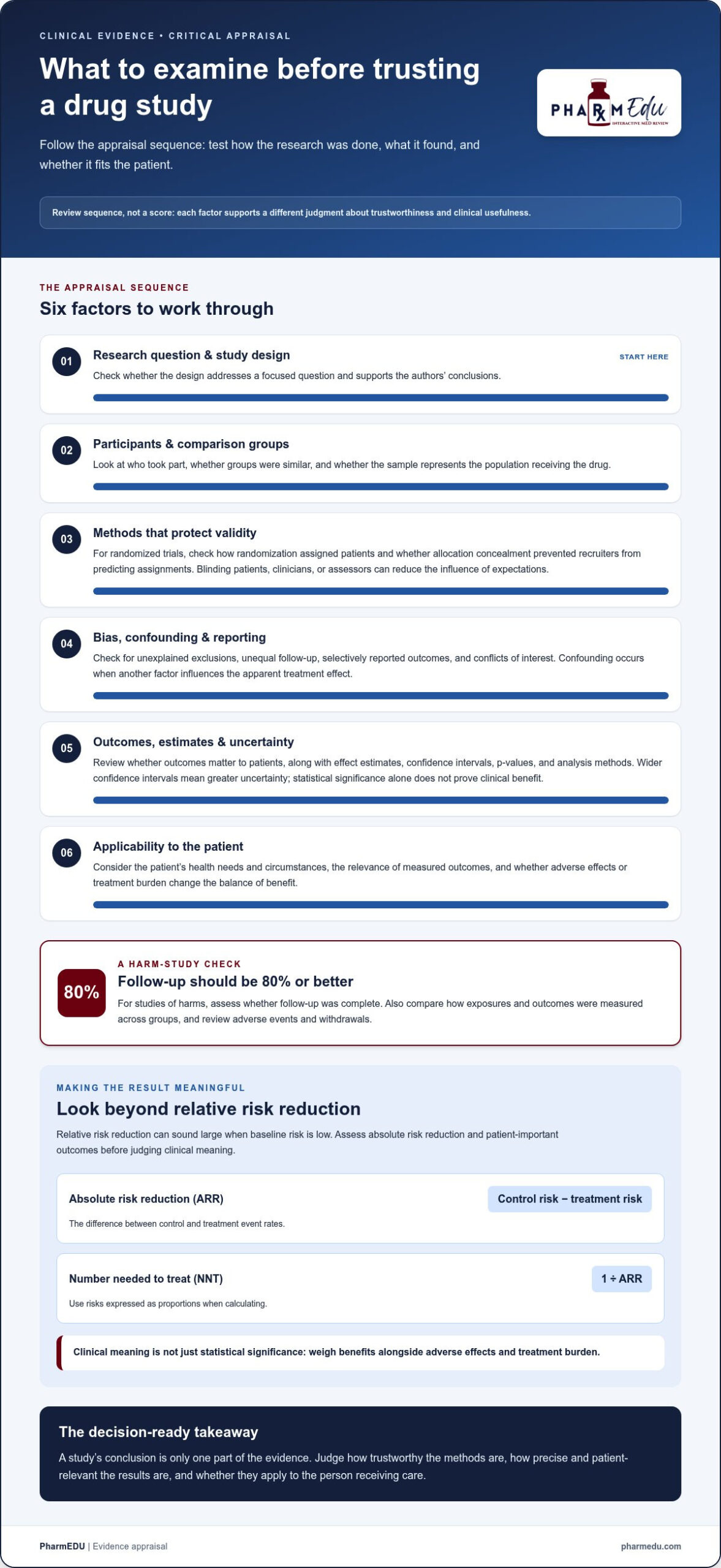
Start with the research question and study design. Then examine the participants, methods, outcomes, analysis, and limitations. These steps help you judge whether the findings are trustworthy and relevant to the patient’s situation.
Study Design and Trustworthiness
Validity asks whether a study’s design and conduct support its conclusions. In a randomized controlled trial, check how randomization assigned patients and whether allocation concealment prevented recruiters from predicting group assignments. Blinding patients, clinicians, or outcome assessors can reduce the influence of expectations on care and measurement. Also check whether comparison groups were similar and outcomes were reported for participants. These details shape confidence in the results.
Bias, Confounding, and Reporting
Bias is a systematic error that can distort a study’s findings; confounding occurs when another factor influences the apparent treatment effect. Look for unexplained exclusions, unequal follow-up, selective reporting of outcomes, and conflicts of interest among researchers or funders. For harms, compare how exposures and outcomes were measured across groups, review adverse events and withdrawals, and assess whether follow-up was complete. Harm studies should have 80% or better follow-up.
Accuracy and Precision of Results
Accuracy concerns how closely an estimate reflects the true effect; precision concerns the uncertainty around it. Review effect estimates alongside confidence intervals, p-values, and analysis methods. Statistical significance alone does not prove clinical benefit. Wider confidence intervals indicate greater uncertainty. Ask whether the measured outcomes matter to patients and whether the sample represents the population receiving the drug. Finally, consider whether the results apply to an individual’s health needs and circumstances.
Relative and Absolute Risk Reduction
Relative risk reduction compares the reduction in risk with the control group’s risk; absolute risk reduction is the difference between control and treatment event rates. Calculate ARR as control risk minus treatment risk, then NNT as 1 divided by ARR, using risks expressed as proportions. RRR can sound large when baseline risk is low, so assess ARR and patient-important outcomes before judging clinical meaning. Consider adverse effects and treatment burden alongside benefit when deciding whether findings apply in practice.
What is Critical Appraisal?
Critical appraisal evaluates whether published research can support a clinical decision. In evidence-based medicine, it helps connect study findings with professional judgment and the needs of people affected by disease. Learning how to critically appraise a drug study means asking not only what researchers found, but whether their methods and evidence support that interpretation.
Critical Appraisal in Evidence-Based Medicine
Critical appraisal is a reasoned assessment of evidence validity and clinical usefulness. It matters because a study’s conclusion may not fit the patient, disease, or therapy under consideration. Assess the research question, methods, findings, and limitations before deciding what the evidence supports.
Evidence-based medicine doesn’t mean automatically following a study’s conclusion. Clinicians weigh research alongside professional expertise and patient circumstances. For example, a reported benefit may have limited relevance if the study measured an outcome that doesn’t reflect a patient’s priorities. Appraisal skills help distinguish a well-supported conclusion from an appealing but incomplete claim. Knowing how to critically appraise a drug study also means recognizing where evidence leaves uncertainty.
Recording Appraisal Evidence
A written appraisal records the reasoning behind each judgment and notes article page numbers for key details. This makes the process traceable: another reader can find the methods and compare them with the reported outcomes. Record strengths, limitations, and clinical implications rather than relying on unchecked boxes.
A SOAP-style note can organize the record: Subjective captures the clinical question and patient priorities; Objective summarizes methods and findings; Assessment describes evidence strengths and limitations; Plan explains how findings inform the decision. Add page references beside key claims, such as eligibility criteria or outcome definitions. A checklist can prompt a consistent review, while written explanations preserve your reasoning. To practice how to critically appraise a drug study, use a new research article and document how each finding informs the clinical question.
Appraising systematic reviews of therapy
A systematic review gathers and evaluates studies addressing a focused treatment question. Appraising its methods helps determine whether its summary is useful in clinical practice and relevant to the population being treated.
Structured Critical Review Forms
A structured critical review form organizes questions for assessing a review’s methods and findings. A consistent framework can help readers identify gaps that a persuasive summary might otherwise conceal.
Check first whether the review defines an answerable therapy question and describes a thorough, reproducible literature search. Then examine the study-selection criteria, whether they were applied consistently, and whether the included studies meet appropriate quality standards. A form can prompt these checks, but completing a checklist alone is not a critical evaluation. Explain how each strength or limitation affects the review’s conclusions and applicability.
Keep the form specific to the review question. A diagnostic review asks whether a test identifies disease accurately; a therapy review asks whether an intervention changes relevant outcomes. Recording this distinction helps prevent different evidence questions from being treated as interchangeable.
Systematic Reviews and Meta-Analysis
A systematic review uses a structured process to identify and analyze relevant studies; a meta-analysis statistically combines results from multiple studies. These methods can summarize evidence and assess whether findings are consistent, but a pooled estimate still depends on the quality and compatibility of the underlying studies.
Check whether the search could be reproduced and whether the review explains how records became included studies. Look for a protocol or clear selection process, and assess whether study populations, interventions, comparisons, and outcomes align. If studies differ substantially, a combined result may hide meaningful differences instead of providing a useful average. The Preferred Reporting Items for Systematic Reviews and Meta-Analyses (PRISMA) provides a reporting framework, but complete reporting does not prove methodological quality.
Finally, compare the review’s conclusions with its evidence. Ask whether the interpretation reflects limitations, inconsistent results, and the target population. This connects critical appraisal skills to a practical question: can the combined findings reasonably inform the treatment decision at hand?
Critically Appraised Topics (CATs)
A Critically Appraised Topic (CAT) is a concise, standardized summary that evaluates a research article. It connects a focused clinical question with evidence appraisal, helping readers see what a study contributes to a specific decision.
CATs offer a practical bridge between lengthy literature searches and bedside questions. They don’t replace systematic reviews or full-text evaluation; instead, a CAT distills one article’s relevance, methods, findings, and limitations. For example, a question about whether a treatment helps a defined patient group can guide appraisal of a controlled trial, while a question about real-world harms may call for observational evidence. The study design should fit the clinical question.
A useful CAT makes its reasoning visible. It should identify:
- The clinical question and patient group being considered.
- The study design and why it suits that question.
- The main outcomes, results, and important methodological limitations.
- How well the evidence applies to the clinical situation.
These elements keep statistical results in context. A CAT should distinguish what the article measured from what clinicians need to decide, and avoid treating a single study as a universal answer. If the evidence comes from a narrow population, state that limitation clearly. If the article reports an outcome that doesn’t match the patient’s priorities, explain the mismatch rather than overstating its value.
Build confidence by applying this approach to realistic cases. Practice evidence appraisal with clinical case studies and connect research findings to patient-care questions.
PharmEDU: PharmEDU Monthly Subscription
PharmEDU Monthly Subscription offers a structured way to continue pharmacology learning after appraising a study. PharmEDU’s curriculum covers over 100 topics through learning resources, including High-Yield Video Vignettes. Use this kind of review when you want to strengthen the pharmacology knowledge that helps you interpret a drug’s therapeutic role and connect research findings with clinical context.
For continued study, PharmEDU offers an Annual Subscription and an Institutional Platform License. These options support individual and institutional learning through an online educational platform for pharmacology review.
Explore PharmEDU at pharmedu.com to learn more.
Make Evidence Appraisal Part of Your Practice
Turn your next research question into a small, repeatable learning exercise. As you consider how to critically appraise a drug study, note what evidence could change your understanding, then record how the study supports or limits that conclusion. Revisiting this reasoning across different therapies can strengthen your judgment and help you focus future appraisals.
Ongoing pharmacology study can support this development by helping you connect drug mechanisms with evidence and patient-care decisions. Choose a learning rhythm that fits your professional goals, and make time to reflect on how new knowledge informs your work.
Contact PharmEDU to discuss your learning needs and identify a useful next step. Each careful appraisal is an opportunity to deepen your expertise and bring greater clarity to clinical decisions.
Frequently Asked Questions
What is validity?
Validity is the extent to which a study’s design and results support its interpretation. In a drug trial, ask whether the observed difference plausibly reflects the treatment rather than flaws in measurement or study conduct. Internal validity concerns conclusions about the trial’s participants; external validity concerns whether findings apply beyond them, including to patients in your practice.
How do I assess the validity of a randomized controlled drug trial?
Assess whether the trial’s methods were followed as planned and whether the analysis accounts for participants who stopped treatment or missed visits. Compare the stated outcomes with those reported, and look for unexplained changes or missing results. For example, if the protocol identifies symptom improvement as the primary outcome but the report emphasizes a different measure, consider whether that change affects the interpretation of the treatment effect.
How do I assess whether a drug study’s participants and setting match my patient population?
Compare the trial’s eligibility criteria, participant characteristics, and care setting with the patient group you serve. Consider whether exclusions remove people with common comorbidities, other medications, or different disease severity. A tightly controlled trial may estimate effects under conditions unlike routine care. Ask whether differences in baseline risk, access to monitoring, or treatment adherence could change the expected benefits or harms for your patients.
How do I interpret primary outcomes, effect sizes, confidence intervals, and p-values in drug trials?
Begin with the prespecified primary outcome, then judge the effect’s size and clinical importance. A confidence interval shows the range of effects compatible with the study data, so a wide interval signals uncertainty about the estimate. A p-value reflects how compatible the data are with a specified statistical model; it doesn’t show the size of the benefit or prove the treatment matters to patients.