

Adrenal Pharmacology Review: Hormones, Drug Classes, and High-Yield Concepts
What if adrenal pharmacology feels less like a collection of unrelated facts when you trace each drug back to the hormone pathway it changes? The adrenal cortex and medulla can seem like separate topics, and it’s easy to mix up mechanisms, uses, adverse effects, and monitoring. A pathway-first approach makes an adrenal pharmacology review easier to organize.
This review connects major adrenal hormones and drug classes to their targets and effects. You’ll relate mechanisms to therapeutic uses, identify important risks, and recognize monitoring considerations, building a clearer framework for study and clinical reasoning.
Start with adrenal hormone pathways, then connect the drugs that alter them through practical comparisons and case-based thinking. Use this structure to work through study questions and revisit the distinctions that matter most.
Key Takeaways
- Use the cortex-versus-medulla framework to organize adrenal hormones by their source and role.
- Trace each drug class to its pathway target to distinguish hormone replacement from synthesis inhibition and receptor blockade.
- Compare adrenal drugs by mechanism, clinical use, effects, and key safety considerations rather than memorizing isolated facts.
- Build an adrenal pharmacology review step by step: start with hormone regulation, then connect each drug to its clinical role, risks, and monitoring.
- Strengthen recall with flashcards and quizzes, then apply the concepts to video vignettes and clinical cases.
Adrenal Pharmacology Review: How the Cortex and Medulla Set the Stage
Adrenal pharmacology examines how drugs influence hormones produced by the adrenal glands or act on the receptors those hormones target. Start with anatomy: the outer cortex makes steroid hormones, while the inner medulla releases catecholamines. This distinction helps you connect each drug to its source, regulatory pathway, and physiological effect.
Adrenal cortex hormones are steroids regulated mainly by endocrine signals; adrenal medulla catecholamines are released in response to sympathetic nerve stimulation. Keep this difference in view to give your adrenal pharmacology review a useful framework for understanding drug mechanisms.
Which hormones come from each adrenal region?
The cortex has three zones, each associated with a principal hormone output:
- Zona glomerulosa: produces mineralocorticoids, chiefly aldosterone, which supports sodium and potassium balance.
- Zona fasciculata: produces glucocorticoids, chiefly cortisol, which affects metabolism and the response to stress.
- Zona reticularis: produces adrenal androgens, including dehydroepiandrosterone (DHEA) and androstenedione.
The medulla contains chromaffin cells that synthesize and release epinephrine and norepinephrine. These catecholamines contribute to sympathetic “fight-or-flight” responses, including changes in heart rate and vascular tone. For a broader anatomical foundation, see the Adrenal Gland Overview.
Which regulatory pathways control adrenal hormone release?
Cortisol secretion is regulated by the hypothalamic-pituitary-adrenal (HPA) axis. The hypothalamus releases corticotropin-releasing hormone (CRH), prompting the pituitary to release adrenocorticotropic hormone (ACTH). ACTH stimulates cortisol production in the zona fasciculata; cortisol then provides negative feedback to the hypothalamus and pituitary. Secretion also follows a daily rhythm and can rise during physiological stress.
Aldosterone is controlled primarily by the renin-angiotensin-aldosterone system and blood potassium. When renal perfusion or sodium delivery falls, renin activity leads to the formation of angiotensin II, which stimulates aldosterone secretion. Increased potassium can also directly promote aldosterone release. ACTH has a comparatively minor, transient influence on aldosterone.
The medulla follows a different control route: preganglionic sympathetic nerves stimulate chromaffin cells to release catecholamines. In short, cortex regulation is largely hormonal, while medullary release is chiefly neural. This source-and-signal map helps distinguish drugs that replace adrenal hormones from those that suppress production or alter hormone effects.
How Major Adrenal Drug Classes Change Hormone Signaling
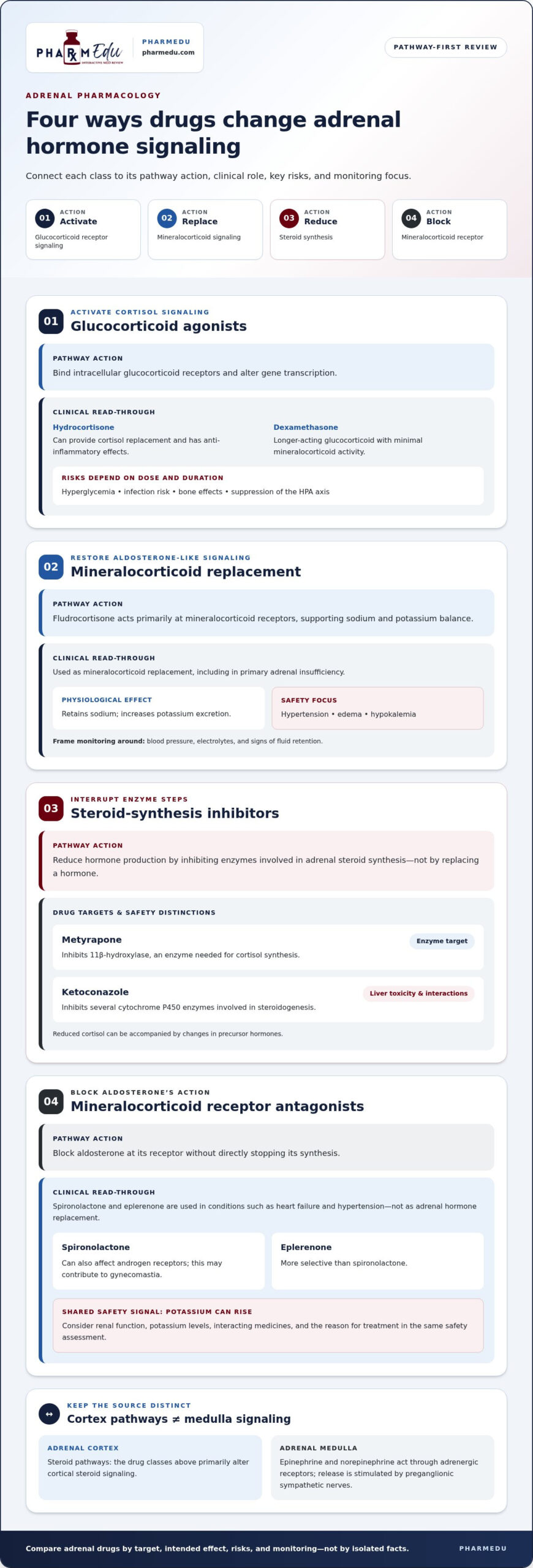
Once you’ve tied each hormone to its source and regulatory pathway, sort adrenal drugs by what they do: replace a hormone, stimulate its receptor, reduce its synthesis, or block its receptor. This distinction matters because drugs affecting the same pathway can have different clinical purposes and safety considerations.
How do glucocorticoids and mineralocorticoid drugs differ?
Glucocorticoid agonists bind intracellular glucocorticoid receptors and alter gene transcription. Hydrocortisone can provide cortisol replacement and has anti-inflammatory effects; dexamethasone is a longer-acting glucocorticoid with minimal mineralocorticoid activity. Glucocorticoid agonists activate cortisol signaling to replace deficient activity or suppress inflammation. Risks depend on dose and duration and can include hyperglycemia, infection risk, bone effects, and suppression of the hypothalamic-pituitary-adrenal axis.
Fludrocortisone acts primarily at mineralocorticoid receptors and is used as mineralocorticoid replacement, including in primary adrenal insufficiency. Its sodium-retaining and potassium-excreting effects can contribute to hypertension, edema, or hypokalemia. Mineralocorticoid replacement restores aldosterone-like signaling to support sodium and potassium balance. Blood pressure, electrolytes, and signs of fluid retention help frame safety monitoring; clinical decisions depend on the patient’s context.
How do adrenal synthesis inhibitors and receptor antagonists work?
Synthesis inhibitors reduce hormone production rather than replacing a missing hormone. Metyrapone inhibits 11β-hydroxylase, an enzyme needed for cortisol synthesis. Ketoconazole inhibits several cytochrome P450 enzymes involved in steroidogenesis. Steroid-synthesis inhibitors lower adrenal steroid production by interrupting enzyme steps in the pathway. Reduced cortisol can be accompanied by changes in precursor hormones, while ketoconazole also raises concern for liver toxicity and drug interactions.
Mineralocorticoid receptor antagonists block aldosterone’s action at its receptor. Spironolactone and eplerenone are used in conditions such as heart failure and hypertension, rather than as adrenal hormone replacement. Spironolactone can also affect androgen receptors, contributing to effects such as gynecomastia; eplerenone is more selective. Mineralocorticoid receptor antagonists reduce aldosterone’s effects without directly stopping its synthesis. Both can raise potassium, so renal function, potassium levels, interacting medicines, and the reason for treatment belong in the same safety assessment.
Medullary pharmacology is distinct: epinephrine and norepinephrine act through adrenergic receptors, while the classes above primarily alter cortical steroid pathways. For an efficient adrenal pharmacology review, connect each drug’s target to its intended effect, indication, adverse effects, and monitoring needs. Interactive pharmacology flashcards and practice quizzes help reinforce those distinctions through retrieval practice.
Adrenal Drug Comparisons: Mechanisms, Uses, and Safety Distinctions
A pathway-first comparison separates three strategies: replacing a deficient hormone, reducing hormone synthesis, or blocking a hormone’s receptor. These approaches aren’t interchangeable. In an adrenal pharmacology review, first ask whether a treatment adds a signal, lowers its production, or prevents the signal from acting.
How can learners distinguish replacement, suppression, and blockade?
Use the clinical cue to identify the pharmacologic approach, then confirm the drug’s target and intended effect. For example, a vignette describing cortisol deficiency points toward replacement; excess cortisol production may prompt consideration of synthesis inhibition; and aldosterone-related effects despite hormone production may suggest receptor blockade. These are study cues, not treatment recommendations.
| Class | Target | Effect | Representative drug | Key caution |
|---|---|---|---|---|
| Glucocorticoid replacement | Glucocorticoid receptor | Restores cortisol activity when deficient | Hydrocortisone | Long-term exposure can suppress the HPA axis; risks vary with dose and duration. |
| Mineralocorticoid replacement | Mineralocorticoid receptor | Supports sodium retention and potassium excretion | Fludrocortisone | Monitor for hypertension, fluid retention, and hypokalemia. |
| Steroid-synthesis inhibitor | Steroidogenic enzymes | Reduces production of specific adrenal steroids | Metyrapone | Excess suppression can cause adrenal insufficiency; other steroid precursors may change. |
| Mineralocorticoid receptor antagonist | Aldosterone receptor | Blocks aldosterone effects without directly reducing its synthesis | Spironolactone | Hyperkalemia risk requires attention to potassium and renal function. |
| Catecholamine agonist | Adrenergic receptors | Activates sympathetic signaling | Epinephrine | Can affect heart rate and rhythm; context and clinical monitoring matter. |
Which adverse effects and monitoring themes matter most?
Distinguish suppression from blockade. Metyrapone inhibits an enzyme in cortisol synthesis, while spironolactone blocks aldosterone at its receptor; neither is hormone replacement. A vignette about a patient receiving a synthesis inhibitor calls for attention to adrenal function and signs of inadequate cortisol activity. A case involving a mineralocorticoid antagonist points instead to potassium and renal function.
Monitoring follows the drug’s pathway and the patient’s clinical context. Glucocorticoid therapy may involve attention to glucose and adrenal suppression; mineralocorticoid replacement can call for assessment of blood pressure and electrolytes. Catecholamine agents act on adrenergic receptors rather than cortical steroid pathways, so their cardiovascular effects are central to safety review. Contraindications, interactions, and monitoring plans are patient-specific and clinician-led; recommendations should be checked against current authoritative references.
How to Study Adrenal Pharmacology for Exams and Clinical Vignettes
Adrenal drug facts stick better when you retrieve them in a consistent order instead of rereading medication lists. Use this five-step adrenal pharmacology review for one drug class at a time, then compare related classes to expose differences in targets, effects, and safety considerations.
What is a repeatable five-step adrenal pharmacology review?
- 1. Identify the hormone and source. Name the hormone, the adrenal region that produces it, and the main pathway regulating its release. This anchors the drug to a physiological starting point.
- 2. Name the drug target and predict the effect. Ask whether the drug activates a receptor, inhibits steroid synthesis, or blocks receptor activity. State the expected pathway change in your own words before checking your notes.
- 3. Connect the mechanism to its clinical role. Distinguish replacement for deficient hormone activity from treatment intended to reduce hormone production or signaling. Link the indication to the specific drug, not just its class.
- 4. Add safety and monitoring themes. Recall the adverse effects and monitoring considerations that follow from the drug’s action. For example, mineralocorticoid effects point toward blood pressure and electrolyte considerations, while glucocorticoid exposure can make glucose and adrenal suppression relevant.
- 5. Test recall with a focused question. Close your notes and explain the drug’s pathway effect, one clinical role, and a key safety concern. Then revisit any part you couldn’t retrieve accurately.
Keep each review pass brief and active. Instead of copying a mechanism several times, ask, “Does this drug replace cortisol, reduce its synthesis, or block a receptor?” Answer from memory, then verify the explanation against a reliable reference. For broader context on drug mechanisms and classes, consult the comprehensive pharmacology guide.
How can case questions strengthen understanding?
Use vignettes as pathway exercises, not as a substitute for evaluating a real patient. Given symptoms and laboratory clues, identify the hormone pathway being tested, then predict how agonism, synthesis inhibition, or receptor blockade would change the signal. Avoid jumping straight from one clue to a diagnosis; explain the mechanism first.
After choosing an answer, review why the strongest distractors don’t fit. If a question describes hormone replacement, for example, a receptor antagonist is a poor match because it blocks rather than restores signaling. Interleave practice by alternating related classes, such as replacement and synthesis inhibition, so you have to identify each mechanism rather than rely on the previous question’s pattern.
Build this routine into short, repeatable study sessions with pharmacology practice quizzes and interactive flashcards, then use clinical cases to apply the same reasoning to new scenarios.
Build a Stronger Adrenal Pharmacology Review with PharmEDU
Understanding the pathways is the first step; retaining the distinctions takes repeated, active practice. PharmEDU brings several learning formats together so learners can revisit adrenal drug concepts, test recall, and apply mechanisms to clinical scenarios. Its curriculum spans more than 100 pharmacology topics, placing adrenal study within a broader learning plan.
How can multiple learning formats reinforce adrenal drug concepts?
Each format supports a different part of a structured adrenal pharmacology review:
- High-yield video vignettes revisit mechanisms in a concise, applied format. Use one to connect a drug target with its expected effect, then pause to explain the pathway in your own words.
- Interactive pharmacology flashcards support retrieval practice. Prompt yourself to recall a drug’s target, clinical role, or key safety consideration before revealing the answer.
- Pharmacology practice quizzes provide a knowledge check. Use questions to identify distinctions that need another review, such as hormone replacement versus synthesis inhibition.
- Clinical case studies connect drug mechanisms with patient scenarios. Trace the clues in a case to the relevant pathway and explain why a particular pharmacologic approach fits the question.
Moving between these formats helps shift study from recognition to recall and application. For example, review a mechanism in a vignette, test the key distinction with flashcards, then apply it in a case. Keep clinical decisions separate from study exercises: case-based learning supports pharmacology understanding, but it doesn’t replace patient-specific clinical judgment.
How can learners continue their pharmacology review?
PharmEDU’s mobile-compliant design and micro-learning segments support short study sessions across compatible devices. Focus one session on a drug class or pathway, then revisit concepts in later sessions. For a wider study framework, explore the pharmacology study guide for nursing students.
Choose a format that matches your next study task: revisit a mechanism, retrieve a key distinction, check your knowledge, or work through a case. Explore PharmEDU to continue structured pharmacology learning with videos, flashcards, quizzes, and clinical case studies.
Keep Building Your Adrenal Pharmacology Knowledge
A strong adrenal pharmacology review becomes more manageable when you connect each drug to its hormone pathway, then distinguish replacement from synthesis inhibition and receptor blockade. Carry that framework into study questions: identify the pathway, predict the drug’s effect, and consider the relevant safety and monitoring themes.
Consistent retrieval and case-based practice can help turn those connections into usable knowledge. PharmEDU offers more than 100 pharmacology topics, with video vignettes, interactive flashcards, quizzes, and clinical case studies. Its mobile-compliant design and micro-learning segments support flexible study in short sessions.
Explore PharmEDU’s pharmacology learning platform to reinforce key concepts and continue your learning across pharmacology topics. With a clear structure and steady practice, you can approach adrenal drug mechanisms and clinical scenarios with greater confidence.
Frequently Asked Questions
What are the main drugs used in adrenal pharmacology?
Major adrenal drug groups include glucocorticoids, mineralocorticoid replacement, steroid-synthesis inhibitors, and mineralocorticoid receptor antagonists. Hydrocortisone and dexamethasone are glucocorticoids; fludrocortisone provides mineralocorticoid activity. Metyrapone and ketoconazole can reduce steroid synthesis, while spironolactone and eplerenone block mineralocorticoid receptors. Epinephrine and norepinephrine act on adrenergic receptors and represent the medulla-related side of adrenal pharmacology. Their roles and safety considerations vary by indication.
How do glucocorticoids differ from mineralocorticoids?
Glucocorticoids primarily affect metabolism, inflammation, and stress responses through glucocorticoid receptors. Hydrocortisone is used for cortisol replacement, while dexamethasone has potent glucocorticoid activity with little mineralocorticoid effect. Mineralocorticoids, especially aldosterone, regulate sodium retention and potassium excretion. Fludrocortisone can provide mineralocorticoid replacement. In study questions, connect the hormone’s main physiological role to the expected drug effect, while remembering that individual agents can have activity across both receptor types.
What is the difference between steroid synthesis inhibitors and receptor antagonists?
Steroid-synthesis inhibitors reduce hormone production by interfering with steroidogenic enzymes. For example, metyrapone inhibits 11β-hydroxylase, while ketoconazole inhibits several enzymes involved in steroid synthesis. Receptor antagonists act downstream: spironolactone and eplerenone block aldosterone’s effects at mineralocorticoid receptors without directly stopping its production. This distinction helps predict different safety concerns. Synthesis inhibition can reduce cortisol activity, while receptor blockade can increase potassium, particularly when renal function or interacting medicines are relevant.
How does the hypothalamic-pituitary-adrenal axis affect adrenal pharmacology?
The hypothalamic-pituitary-adrenal (HPA) axis regulates cortisol production through a feedback loop. The hypothalamus releases corticotropin-releasing hormone, prompting pituitary release of adrenocorticotropic hormone (ACTH), which stimulates cortisol synthesis in the adrenal cortex. Cortisol then feeds back to reduce hypothalamic and pituitary signaling. Glucocorticoid drugs can influence this axis, and sustained exposure may suppress endogenous cortisol production. This connection makes the drug’s duration and effects on adrenal function important study and monitoring considerations.
What adverse effects are associated with adrenal medications?
Adverse effects depend on the drug, its dose and duration, and the patient’s health. Glucocorticoids can contribute to hyperglycemia, infection risk, bone effects, and HPA-axis suppression. Fludrocortisone may cause fluid retention, hypertension, or low potassium. Steroid-synthesis inhibitors can reduce cortisol excessively; ketoconazole also raises liver and interaction concerns. Spironolactone and eplerenone can increase potassium. Monitoring may include glucose, blood pressure, electrolytes, renal function, or adrenal function, as appropriate and clinician-directed.
How should I study adrenal pharmacology for an exam?
Use a repeatable adrenal pharmacology review sequence: identify the hormone and adrenal source, name its regulator, then connect each drug to its target and effect. Add the clinical role, major adverse effects, and relevant monitoring considerations. Next, close your notes and retrieve the mechanism from memory. Compare related classes, such as synthesis inhibitors and receptor antagonists, and explain why a plausible alternative doesn’t match the pathway or intended effect.
Can adrenal pharmacology be explained through clinical cases?
Yes. Clinical cases can turn mechanisms into applied reasoning by asking you to connect symptoms or laboratory clues to a hormone pathway, then predict the effect of replacement, synthesis inhibition, or receptor blockade. Treat each vignette as a learning exercise, not a way to diagnose a real patient. After choosing an answer, explain why the mechanism fits and why competing options do not. This strengthens recall and helps reveal distinctions that need further review.