Pharmacology of Urologic Medications Across Common Conditions
The medication that helps one urologic condition may have little role in another. The pharmacology of urologic medications includes alpha-blockers and 5-alpha reductase inhibitors for benign prostatic hyperplasia, hormone-targeting medicines for prostate cancer, and antibiotics for bacterial genitourinary infections.
It’s easy to focus on a drug’s name without understanding how its purpose, action, and timing differ across conditions. Recognizing these distinctions helps connect medication classes with the clinical problems they address.
This overview covers common medication groups for urinary symptoms, prostate cancer, and genitourinary infections, as well as therapies for erectile dysfunction and kidney stones. It explains how mechanisms of action shape treatment choices, offering a practical framework for reviewing this broad area of pharmacology.
Key Takeaways
- Compare how medication groups address urinary symptoms and erectile dysfunction, and learn which timing differences matter when reviewing their effects.
- Identify the role of leuprolide, goserelin, and degarelix in androgen deprivation therapy for prostate cancer.
- Understand why urine culture results guide antibiotic selection and how careful use helps limit antimicrobial resistance.
- Explore additional treatments, from stone-prevention medicines and bladder cancer immunotherapy to supportive therapies for prostate-related symptoms.
Pharmacological management of urological conditions
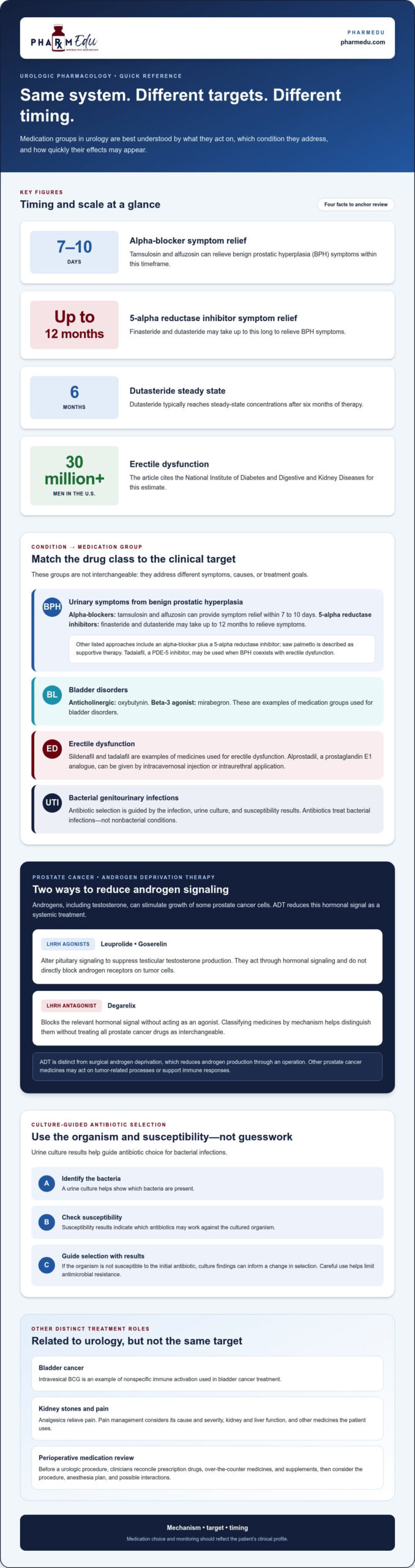
Pharmacological management uses medicines to reduce urinary symptoms or treat their underlying cause. Urological agents include treatments for urinary incontinence, prostatic hyperplasia, and erectile dysfunction. Alpha-blockers such as tamsulosin and alfuzosin can relieve benign prostatic hyperplasia symptoms within 7 to 10 days. Finasteride and dutasteride, which inhibit 5-alpha reductase, may take up to 12 months to relieve symptoms. For bladder disorders, examples include anticholinergics such as oxybutynin and beta-3 agonists such as mirabegron. Erectile dysfunction affects more than 30 million men in the United States, according to the National Institute of Diabetes and Digestive and Kidney Diseases. Sildenafil and tadalafil are examples of medicines used for this condition.
Perioperative medication management involves reviewing and coordinating medicines around a urologic procedure. Before surgery, clinicians reconcile prescription drugs, over-the-counter medicines, and supplements, then consider the procedure, anesthesia plan, and possible interactions. In surgical urology, antibiotics may be used to prevent postoperative infections and complications. A medication review can also identify drugs that may affect symptom control or need coordination with the perioperative plan.
Analgesics are medicines used to relieve pain. Pain management takes into account the cause and severity of pain, kidney and liver function, and other medicines the patient uses. For example, someone with renal colic may need pain relief while clinicians assess a suspected stone and urinary symptoms. Reviewing current medicines helps avoid overlapping ingredients and supports coordinated care.
Pain and symptom management addresses discomfort alongside the urinary problem causing it. Track symptoms, when they occur, and any medicines taken. This record can help distinguish persistent pain from changes in urinary symptoms. When considering urologic medicines for people with kidney or liver impairment, older adults, or pregnant patients, clinicians account for drug clearance, metabolism, interactions, frailty, and pregnancy-related risks. These factors can affect medicine choice, dose, and monitoring, so decisions should reflect the patient’s clinical profile.
Androgen deprivation therapy for prostate cancer
Androgen deprivation therapy (ADT) reduces androgen signaling in prostate cancer. Androgens, including testosterone, can stimulate the growth of some prostate cancer cells. ADT medicines reduce this hormonal signal, making ADT a systemic treatment rather than a therapy aimed only at one tumor site. This approach differs from surgical androgen deprivation, which reduces androgen production through an operation.
Luteinizing hormone-releasing hormone (LHRH) agonists alter pituitary signaling to suppress testicular testosterone production. Leuprolide and goserelin are examples used in prostate cancer care. They do not directly block androgen receptors on tumor cells. Instead, they act through hormonal signaling, so their role in treatment depends on the intended degree and timing of androgen suppression.
LHRH antagonists block the relevant hormonal signal without acting as agonists. Degarelix is an example used for prostate cancer. Distinguishing agonists from antagonists helps organize the drug class by mechanism, rather than relying on memorized names. When reviewing a medicine, identify the agent, classify its action, and connect that action to the goal of reducing androgen stimulation.
ADT is one treatment strategy, not a label for every medicine used against prostate cancer. Other drugs may act directly on tumor-related processes or support immune responses; consider their mechanisms separately from hormonal suppression. A useful comparison asks whether a medicine changes hormone signaling, blocks a receptor, or uses another antitumor mechanism. This clarifies why leuprolide, goserelin, and degarelix belong in an ADT review, while other therapies fit different pharmacologic categories. It also helps clinicians interpret treatment plans without treating all prostate cancer medicines as interchangeable.
Other prostate-related care may address lower urinary tract symptoms rather than androgen signaling. The page lists combination therapy using an alpha-blocker plus a 5-alpha reductase inhibitor, and describes herbal extracts such as saw palmetto as supportive therapies for these symptoms. Dutasteride typically reaches steady-state concentrations after 6months of therapy. Tadalafil is listed as a PDE-5 inhibitor that may be used when benign prostatic hyperplasia coexists with erectile dysfunction.
Treatment aimed at erectile dysfunction can also use alprostadil, a prostaglandin E1 analogue given by intracavernosal injection or intraurethral application. Intravesical BCG, by contrast, is an example of nonspecific immune activation used in bladder cancer treatment. These examples have distinct purposes and should not be grouped with ADT merely because they appear in discussions of genitourinary care.
Antibiotics for genitourinary infections
Antibiotics treat bacterial infections of the genitourinary tract. In urology, treatment may address urinary tract infections, with selection guided by the infection and culture results. A urine culture helps identify the bacteria present, while susceptibility results indicate which antibiotics may work against them. This information supports targeted selection rather than treating every urinary infection as if it had the same cause. Antibiotics do not treat nonbacterial conditions, so identifying the type of infection matters.
Culture-directed therapy means selecting an antibiotic based on laboratory identification of bacteria and their susceptibility. The practical sequence is to assess the infection, obtain culture information when appropriate, and use the results to guide treatment. For example, if results show that the cultured organism is not susceptible to the initial antibiotic, those findings can inform a change in selection. The key pharmacologic question is whether the medicine’s activity matches the identified bacteria, not simply whether it is commonly used for urinary symptoms.
Antibiotic prophylaxis means giving medicine to prevent infection rather than to treat an established infection. In surgical urology, antibiotics may be used prophylactically to help prevent postoperative infections and complications. This differs from treating a diagnosed genitourinary infection. The procedure and risk of postoperative infection inform the purpose of prophylaxis; prevention should not be confused with selecting treatment based on urine culture results.
Antimicrobial stewardship means using antibiotics carefully to preserve their effectiveness and limit resistance. For genitourinary infections, judicious use means matching antibiotic selection to culture findings and using these medicines when they address a bacterial infection. Resistance can make antibiotics less effective, so unnecessary or poorly targeted use can undermine successful treatment. When reviewing an antibiotic plan, ask: Is the problem bacterial? What do the culture results show? Is the selected medicine appropriate for those findings? This framework connects individual treatment choices with resistance prevention and patient outcomes.
Other urologic medications
Medication choice depends on the condition, its mechanism, and the treatment goal. The distinctions below help organize commonly used drug classes.
Benign Prostatic Hyperplasia Therapies
Benign prostatic hyperplasia therapies reduce prostate-related urinary symptoms or prostate enlargement. Alpha-blockers such as tamsulosin relax smooth muscle and may relieve symptoms within 7 to 10 days. Finasteride and dutasteride inhibit 5-alpha reductase and may take up to 12 months to relieve symptoms. The key distinction is faster symptom relief with alpha-blockers versus gradual effects from enzyme inhibition.
Overactive Bladder and Incontinence Medications
Overactive bladder medications reduce urgency, frequency, or related urinary symptoms. Antimuscarinics include oxybutynin, tolterodine, solifenacin, fesoterodine, and darifenacin; they act on muscarinic receptors. Beta-3 agonists, including mirabegron and vibegron, act through a different receptor pathway. Both classes address bladder symptoms, but their mechanisms differ. Botulinum toxin injected into the bladder is another treatment option for bladder and lower urinary tract disorders.
Erectile Dysfunction Medications
Kidney Stone Medications
Some kidney stone medications help prevent stones by addressing factors that contribute to their formation. Potassium citrate is used as a citrate preparation; allopurinol is used for uric acid stones, and thiazide diuretics for calcium stones associated with hypercalciuria. Medical expulsive therapy aims to support stone passage, while preventive treatment addresses recurrence risk. Stone type and the underlying metabolic cause guide the medication category.
For urinary retention, neurogenic bladder, or bladder spasms, medication selection depends on the symptom and its cause. Bladder anticholinergics, beta-3 agonists, and intravesical botulinum toxin are among therapies used for bladder and lower urinary tract disorders.
Side effects and interactions vary by medicine. Review each agent’s adverse-effect profile, other medicines being taken, and relevant kidney or liver impairment. This is especially important when combining therapies for urinary symptoms.
Use Interactive Pharmacology Flashcards to reinforce these drug-class distinctions.
PharmEDU: PharmEDU Monthly Subscription
PharmEDU Monthly Subscription supports structured pharmacology review when you want to reinforce concepts beyond this overview. The platform’s curriculum spans more than 100 topics, using High-Yield Video Vignettes, interactive flashcards, quizzes, and case studies to help connect drug mechanisms with clinical applications.
For urologic pharmacology, revisit distinctions such as alpha-blockers versus 5-alpha-reductase inhibitors, or compare antibiotic treatment with prophylaxis. Short video vignettes and practice activities can help you organize these categories and strengthen recall as you study. PharmEDU also offers an Annual Subscription and an Institutional Platform License for different learning needs.
Visit PharmEDU to explore its pharmacology learning options.
Build a Consistent Pharmacology Study Practice
Make your review of the pharmacology of urologic medications a repeatable learning practice: connect each drug class with its mechanism, indication, and key treatment considerations. Revisiting these connections can help organize complex material for coursework and exam preparation.
PharmEDU offers a PharmEDU Monthly Subscription, a PharmEDU Annual Subscription, and an Institutional Platform License. Choose the learning arrangement that fits your study or educational setting, then use its pharmacology resources to build a structured foundation.
For information about the available options, contact PharmEDU to learn more. Keep approaching each medication with curiosity and a clear framework, and you can continue strengthening your professional knowledge.
Frequently Asked Questions
What are the major classes of medications used in urology and their mechanisms of action?
The pharmacology of urologic medications is organized by drug target and mechanism. Alpha-blockers relax smooth muscle, while 5-alpha reductase inhibitors reduce conversion of testosterone to dihydrotestosterone. Antimuscarinics block muscarinic receptors, and beta-3 agonists act on beta-3 receptors. Other major groups include PDE-5 inhibitors, antibiotics, and hormone therapies. Comparing a drug’s target with its clinical purpose helps distinguish classes that may address related symptoms differently.
What antibiotics are commonly used for urinary tract infections and prostatitis, and what are their risks?
Antibiotic selection for urinary tract infections and prostatitis depends on the infection and, for urinary infections, culture results. When reviewing the pharmacology of urologic medications, connect the organism identified by culture with the antibiotic’s activity. Antibiotics can cause drug-specific adverse effects and interactions, while unnecessary or poorly targeted use can contribute to resistance. Judicious selection supports appropriate treatment and helps preserve antibiotic effectiveness.
What medications treat erectile dysfunction, and what are the contraindications and interactions of PDE5 inhibitors?
Erectile dysfunction medicines include the PDE-5 inhibitors sildenafil, vardenafil, tadalafil, and avanafil, as well as alprostadil. PDE-5 inhibitors should not be used more than once per day; no specific contraindications or drug interactions are provided.