
Ophthalmology Drugs for Students: A High-Yield Study Guide
What if ophthalmology drugs became easier to remember when you stopped studying them as a list? For many learners, ophthalmology drugs for students can seem like a tangle of indications, mechanisms, and cautions, especially when several classes affect the same eye structures in different ways.
That confusion is understandable: recalling a drug name alone doesn’t show why it works, what effect to expect, or which safety concern matters in a clinical case. A more useful approach is to connect each class to its purpose, mechanism, intended effect, and key caution, then compare it with drugs that may look similar on an exam.
This guide builds that framework across major ophthalmic medication classes, including drugs used for glaucoma, inflammation, infection, allergy, and retinal disease. You’ll review distinctions that support recall, connect foundational pharmacology to case-based questions, and separate high-yield principles from clinical nuance. Short, structured review sessions can also help you revisit difficult mechanisms and class-specific cautions over time.
Key Takeaways
- Organize ophthalmology drugs for students by purpose, mechanism, intended eye effect, and key caution to make class comparisons clearer.
- Compare anesthetic and dilation agents, glaucoma therapies, corticosteroids, and antibiotics by what they do and where extra caution is needed.
- Connect receptor or pathway actions to ocular outcomes instead of memorizing drug names in isolation.
- Use a repeatable study routine: sort drug classes, explain mechanisms from memory, retrieve key facts, and revisit errors with comparison cards.
- For additional pharmacology review, PharmEDU covers over 100 topics, including Ears/Eyes/Nose/Skin, with formats such as flashcards, quizzes, and case studies.
What students should know about ophthalmology drugs and eye drops
Ophthalmic pharmacology is the study of medicines used to examine, prevent, or treat eye conditions, including how they reach ocular tissues, produce effects, and present safety considerations. Start by learning more than a drug’s name: note its route, intended effect, mechanism, and cautions. This section is a study overview, not patient-specific prescribing or treatment guidance.
Why ophthalmic medication study can feel different
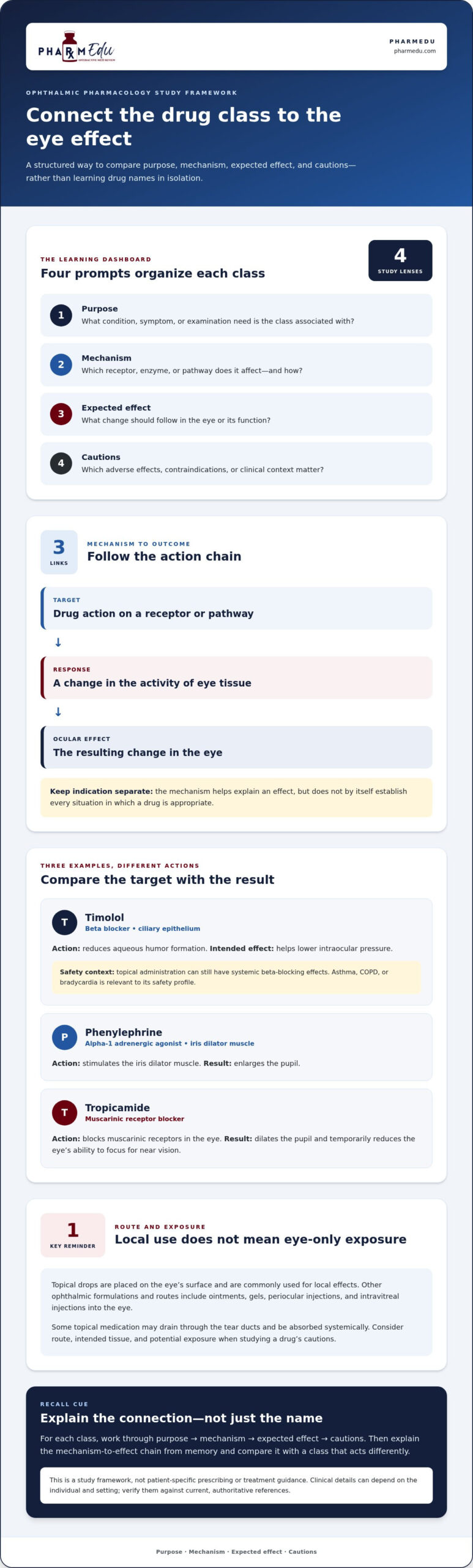
Eye medicines act in a small, specialized organ with distinct structures, including the cornea, pupil, lens, and retina. Route matters because it affects which tissues a medicine can reach. Topical drops are placed on the eye’s surface and are commonly used for local effects, but not every ophthalmic medicine is a drop. Formulations and routes can include ointments, gels, periocular injections, and intravitreal injections into the eye. Some topical medication may also be absorbed systemically, so “applied locally” doesn’t mean “limited to the eye.”
For an overview of administration routes and the challenges of topical delivery, consult Ophthalmic Drug Administration. As you study a drug, ask: Where does it act? How is it given? What effect follows?
Tropicamide offers a simple mechanism-to-effect example: by blocking muscarinic receptors in the eye, it dilates the pupil and temporarily reduces the eye’s ability to focus for near vision. This links a receptor action, an effect on a specific cellular target, to an observable ocular effect. It’s a learning model, not guidance for selecting or using a medicine.
A four-part framework for learning each drug class
Use the same sequence for each class. A mechanism is how a drug produces its effect; the expected effect is the resulting change in the eye or its function. Keeping those concepts separate helps prevent a common mix-up: knowing a drug’s target but forgetting what that action is intended to achieve.
- Purpose: What condition, symptom, or examination need is the class associated with?
- Mechanism: What receptor, enzyme, or pathway does it affect, in plain terms?
- Expected effect: What change should follow from that action?
- Cautions: What adverse effects, contraindications, or clinical context could alter its safe use?
For ophthalmology drugs for students, this framework turns a long list into concepts you can compare. Use it in the class comparisons and revision steps below to distinguish medicines with similar purposes but different actions or safety considerations. Study summaries simplify details that may depend on the individual patient and setting, so verify clinical information against current, authoritative references.
How ophthalmic drugs work: connect mechanisms to effects
A drug’s mechanism explains how it acts; its clinical indication names the condition or purpose for which it’s used. These are related, but not interchangeable. For ophthalmology drugs for students, separating them prevents a common reasoning error: assuming that knowing a drug’s target automatically tells you every situation in which it is appropriate.
A mechanism can help predict an ocular effect: blocking beta-adrenergic receptors in the ciliary epithelium reduces aqueous humor production, which can lower intraocular pressure. In this chain, the receptor is the target, reduced fluid production is the physiologic response, and lower pressure is the intended outcome. Learn the indication separately, since it depends on clinical context.
From target to ocular effect
Receptors are cellular targets that respond to chemical signals. Adrenergic receptors respond to signals such as norepinephrine, while muscarinic receptors respond to acetylcholine. A drug may activate or block a receptor, changing the activity of the tissue where it is found.
For example, the beta blocker timolol reduces aqueous humor formation in the eye, helping lower intraocular pressure. By contrast, the alpha-1 adrenergic agonist phenylephrine stimulates the iris dilator muscle, enlarging the pupil. Both affect the eye, but their targets and resulting effects differ. This target-to-response sequence is more useful for comparison than memorizing a broad label such as “eye drop.”
Keep the chain explicit in your notes: drug action → tissue response → ocular effect. Then record the indication separately. Regulatory categories offer another perspective: the federal Ophthalmic Drug Product Regulations describe certain over-the-counter ophthalmic drug categories and labeling. They complement, but don’t replace, mechanism-based pharmacology learning.
Route, local action, and whole-body considerations
Route helps explain where a drug is intended to act and which safety points matter. A topical drop is applied to the eye’s surface, while other ophthalmic medicines may be given as ointments or injections. Formulation and route influence delivery to ocular tissues, so don’t treat them as interchangeable just because the medicines relate to eye care.
Local use doesn’t rule out systemic exposure. Some medicine from an eye drop can drain through the tear ducts and be absorbed beyond the eye. Timolol is a useful teaching example: topical administration can still have systemic beta-blocking effects, so a history of asthma, COPD, or bradycardia is relevant to its safety profile. Connect route with potential exposure, then verify cautions in current references rather than assuming a topical drug acts only locally.
To reinforce these mechanism-to-effect links in focused review sessions, explore structured pharmacology review resources alongside your course materials and clinical references.
Ophthalmology drug classes compared: purpose, action, and cautions
These classes serve distinct study purposes: anesthetics temporarily reduce sensation, dilation agents change pupil size or focusing, glaucoma therapies lower intraocular pressure, corticosteroids suppress inflammation, and antibiotics target susceptible bacteria. The comparison below follows the same sequence for each group, making differences easier to retrieve without treating the classes as interchangeable. These are educational summaries, not recommendations for an individual patient.
Examination and pressure-related drug groups
Start by asking whether the intended effect is temporary numbness, a change in pupil function, or pressure reduction. Intraocular pressure (IOP) is the fluid pressure inside the eye. Glaucoma drug classes can lower it through different effects on aqueous humor, the clear fluid produced inside the eye.
| Class and example | Common purpose | Basic mechanism | Key caution | Memory cue |
|---|---|---|---|---|
| Topical anesthetic, such as proparacaine | Temporarily numbs the ocular surface for examination or procedures | Blocks voltage-gated sodium channels, interrupting nerve signal conduction | Repeated or prolonged use can damage the corneal surface and delay healing | “Numbs the surface” |
| Mydriatic, such as tropicamide | Dilates the pupil for eye examination | Blocks muscarinic receptors in the iris sphincter, reducing its constriction | Dilation can precipitate angle closure in susceptible eyes | “Opens the pupil” |
| Prostaglandin analog, such as latanoprost | Lowers IOP in glaucoma | Increases aqueous humor outflow, mainly through the uveoscleral pathway | May cause iris pigmentation and changes around the eyelids or lashes | “More fluid out” |
| Topical beta blocker, such as timolol | Lowers IOP in glaucoma | Reduces aqueous humor production | Systemic absorption can matter in asthma, COPD, or bradycardia | “Less fluid made” |
Anti-inflammatory and anti-infective drug groups
Distinguish control of inflammation from treatment of a bacterial infection. The drug’s target and the suspected cause matter; a class name alone doesn’t establish that it is suitable for a particular red or painful eye.
| Class and example | Common purpose | Basic mechanism | Key caution | Memory cue |
|---|---|---|---|---|
| Corticosteroid, such as prednisolone acetate | Reduces ocular inflammation | Suppresses inflammatory signaling and immune activity | Can raise IOP and worsen some infections, including herpes simplex keratitis | “Calms inflammation, but check infection risk” |
| Ophthalmic antibiotic, such as moxifloxacin | Treats susceptible bacterial eye infections | Fluoroquinolones inhibit bacterial enzymes needed for DNA replication | Doesn’t treat viral or fungal causes of eye disease | “Targets bacteria, not every infection” |
For ophthalmology drugs for students, use each memory cue to prompt recall, then explain the mechanism and caution in your own words. Confirm class details against current clinical references, especially where infection or elevated IOP could change the significance of a medication.
How to study ophthalmology drugs for exams without rote memorization
Studying ophthalmology drugs for students is more effective when revision asks you to retrieve and apply information, not just recognize a list you’ve reread. Build a repeatable routine: organize classes, explain them from memory, and use missed questions to guide your next review.
Build a compact comparison sheet
Use one row per class and the same columns throughout: purpose, mechanism, expected effect, key caution, and a short memory cue. Consistent columns make differences easier to spot, such as whether a class changes pupil function, reduces pressure, or addresses inflammation. Keep cues brief and use them as prompts for explanation, not substitutes for understanding.
Mark each entry as either a fact you can explain confidently or one that needs source review or instructor clarification. This prevents an uncertain detail from quietly becoming a memorized “fact.” Confirm clinical details against current references and course materials.
Use retrieval practice and cases
Close your notes before testing yourself. Recall a class’s purpose and mechanism, then check and correct your answer. Follow with a fictional educational case that asks you to distinguish broad drug purposes, such as reducing inflammation versus targeting a bacterial cause. The goal is to explain the pharmacology, not to choose treatment for a real patient.
- Sort classes: Group medicines by broad purpose, then identify which classes may seem similar.
- Explain mechanisms: Describe how each group’s action leads to the expected ocular effect in your own words.
- Retrieve facts: Use flashcards or brief self-tests to recall purposes, effects, and cautions before looking at your notes.
- Revisit errors: Record what you missed, verify it, and return to those concepts in a later short review session.
Apply the same four steps to any pharmacology topic: sort the classes, explain the action, test your recall, and revisit errors. This keeps revision focused and shows whether you understand a concept or only recognize its wording.
After a self-test, make a comparison card for each class. Put the class name on one side; on the other, add its purpose, mechanism, expected effect, and caution. If two cards feel interchangeable, write one sentence that clarifies their key difference. For example, ask whether each class changes a physiologic process or targets an infectious cause, then check that distinction against a reliable reference.
Track recurring errors in a short review log. Note the concept, the mistaken answer, and the corrected explanation. Revisit the log in focused sessions, spending extra time on repeated mix-ups rather than reviewing every card equally. Use PharmEDU’s pharmacology practice quizzes to add structured self-testing to your study routine.
Continue reviewing ophthalmic pharmacology with PharmEDU
Once you’ve organized drug classes and identified concepts that need more practice, structured review can help you return to them in manageable steps. PharmEDU provides a comprehensive pharmacology review with over 100 topics, including Ears/Eyes/Nose/Skin. Its interactive formats support different kinds of study alongside clinical references and course instruction.
Fit short review sessions into a busy study schedule
Micro-learning units let you revisit material in short sessions instead of setting aside time for one long study block. PharmEDU is mobile-compatible, with 24/7 access on computers, tablets, laptops, and phones. You can revisit each unit without completing a course in one sitting. Use a brief session to focus on one difficult mechanism or caution, then return to it later to strengthen recall.
The platform includes short video vignettes and content reviews alongside interactive flashcards, pharmacology practice quizzes, and clinical case studies. These formats support ophthalmic pharmacology revision within the broader Ears/Eyes/Nose/Skin topic area. They’re study aids, not a promise of exam results or a replacement for checking current clinical information.
Choose an interactive way to reinforce concepts
Match the format to the task. Flashcards prompt active recall of a drug class’s purpose or mechanism. Quizzes help you check which facts you can retrieve accurately, while case studies let you practice applying foundational concepts to a scenario. Video vignettes and content reviews offer other ways to revisit material when a concept is easier to understand through explanation than through a prompt alone.
For a focused review cycle, choose one concept, try to recall it before opening the relevant material, and use a quiz or case to check how well you can apply it. Return to missed or uncertain points, then review them again later. This directs study toward specific knowledge gaps instead of repeating lists without a clear purpose.
Track progress with the Mark Complete and Continue functions. Use them to record completed learning units and move forward through your review, while returning to units that need another pass. Consistent, manageable practice can help you build a more organized foundation in ophthalmic pharmacology alongside your course materials and authoritative references.
Explore PharmEDU’s pharmacology review to choose learning formats that fit your study routine and revisit foundational concepts at your own pace.
Build confidence through your next review session
Make your next study block purposeful: choose one concept you hesitated over, explain it aloud without notes, then check your explanation against a current, trusted reference. Write down any remaining question and bring it to your instructor or course review. This turns uncertainty into a clear next step, rather than another pass through material you may already know.
With ophthalmology drugs for students, steady progress comes from returning to challenging ideas and strengthening your reasoning over time. Keep the focus on understanding, and treat study resources as support for learning, not as a replacement for clinical guidance.
When you’re ready to continue, explore PharmEDU’s comprehensive pharmacology review and choose a format that fits your next study session. Each focused review is another opportunity to build confidence and prepare for the learning ahead.
Frequently Asked Questions
What ophthalmic drug classes should students learn first?
Begin with anesthetic agents, dilation agents, glaucoma medications, corticosteroids, and antibiotics. For each class, note its broad purpose, mechanism, expected effect, and important cautions, then compare it with a class that serves a different purpose. This gives ophthalmology drugs for students a manageable starting structure, not a complete formulary or treatment recommendation. Check specific drug examples and clinical details against current authoritative references and your course materials.
How can I remember the difference between ophthalmic drug classes?
Use the same four prompts for every class: purpose, mechanism, expected effect, and caution. After filling in a comparison sheet, cover it and try to recall each field before checking your notes. For example, ask which classes affect pupil function and which are studied for pressure control. Add a short memory cue only after you can explain the pharmacology, and return to missed points during later review sessions.
Are ophthalmic drugs always given as eye drops?
No. Eye drops are common, but ophthalmic medicines and examination agents can come in other formulations or be given through other routes. As you study a medicine, record its specific formulation and route rather than inferring them from its class name. This detail can help distinguish how a medicine is used and what considerations to review. Confirm route information in current references and course materials before relying on a study note.
What is the difference between dilation drops and glaucoma medications?
Dilation agents are studied for their effects on pupil size or their role in eye examination; glaucoma medications are studied in relation to intraocular pressure and glaucoma management. Their purposes differ, even though both groups may include topical medicines. To keep them distinct, compare the intended physiologic change for each drug rather than sorting everything under “eye drops.” Individual effects and cautions depend on the medicine, so verify them with up-to-date references.
Why do students study cautions as well as indications for eye medications?
Indications describe an intended use, while cautions flag factors that may affect safe use or require closer consideration. Learning both helps you interpret an educational case more precisely: a drug’s general purpose alone may not address all the details in a scenario. Keep safety notes tied to the specific medicine and context, and don’t turn a general class summary into personal treatment advice. Use current authoritative sources for class-specific cautions.
How should nursing, medical, and pharmacy students approach ophthalmology pharmacology differently?
All three groups can use the same foundation: identify a class’s purpose, explain its action, describe the expected effect, and review relevant cautions. Then tailor the depth of revision to your program’s syllabus, instructor guidance, and assessment objectives. A shared comparison sheet can support core learning, while your course materials clarify which details your discipline expects you to apply. Avoid assuming that every program emphasizes the same clinical responsibilities.
Can PharmEDU help students review ophthalmology drugs?
PharmEDU supports broader pharmacology review through its Ears/Eyes/Nose/Skin topic area within a library of over 100 topics. Learners can use short video vignettes, interactive flashcards, content reviews, quizzes, and case studies to revisit concepts in different formats. Use these resources alongside course instruction and authoritative references for clinical information.