

Thyroid Medication Pharmacology: Mechanisms, Uses, and Monitoring
What if the key to remembering thyroid medications isn’t memorizing drug names, but tracking where each one changes hormone balance? That distinction is central to thyroid medication pharmacology: some medicines replace thyroid hormone, while others reduce its production or control selected symptoms. If their mechanisms, adverse effects, and monitoring points seem easy to mix up, connect each drug to its role in the treatment goal.
This article compares hormone replacement with thyroid-suppressing therapy, links major medication classes to their mechanisms, and reviews key safety and monitoring concepts. It also explains how laboratory follow-up fits into pharmacology learning, without turning general education into patient-specific treatment advice.
Use hormone balance, drug action, and monitoring as a framework, then apply it to clinical learning cases. Short retrieval practice and case-based review can help reinforce distinctions over time. PharmEDU’s video vignettes, interactive flashcards, quizzes, and clinical case studies provide structured ways to revisit pharmacology concepts and strengthen recall.
Key Takeaways
- Use the opposing hormone-balance states of hypothyroidism and hyperthyroidism to orient your understanding of thyroid medication pharmacology.
- Relate T4’s role as a circulating precursor to T3’s active hormonal effects when reviewing replacement therapy.
- Compare medication classes by therapeutic goal, mechanism, safety considerations, and monitoring focus rather than treating them as interchangeable.
- Interpret TSH and thyroid hormone results in clinical context, following a structured sequence from baseline assessment to safety reassessment.
- Practice moving from drug class to mechanism, treatment goal, safety, and monitoring cue to strengthen recall in clinical cases.
Thyroid Medication Pharmacology: What the Main Drug Groups Treat
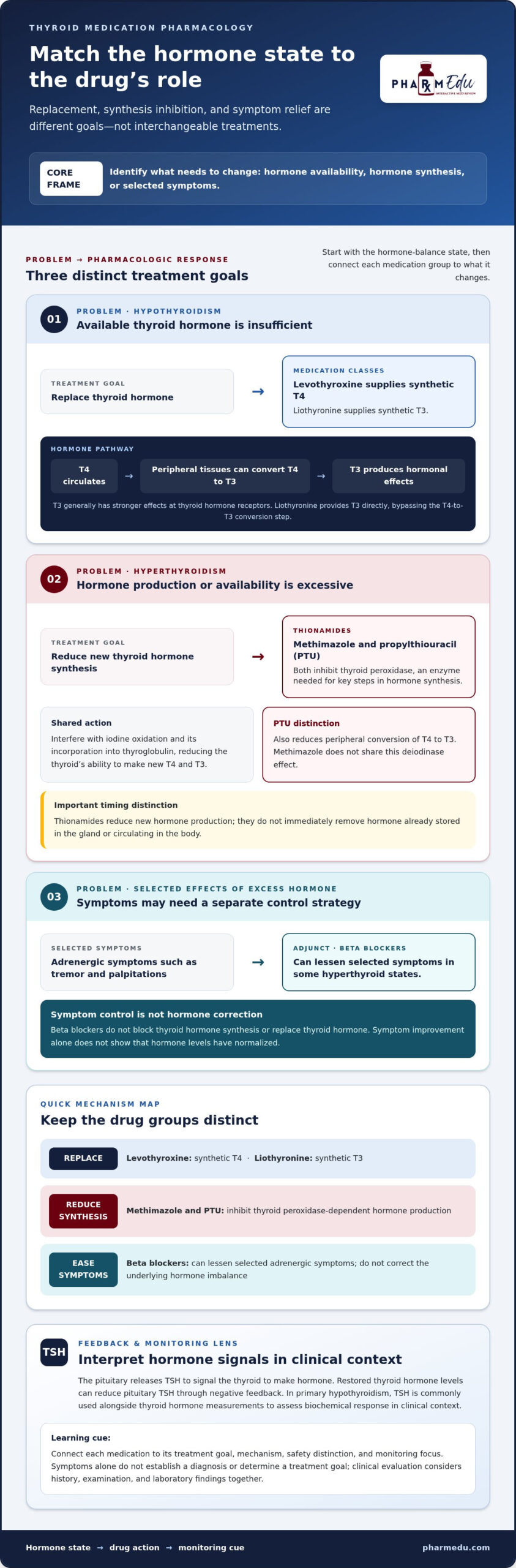
Hypothyroidism and hyperthyroidism represent opposing hormone-balance states. In hypothyroidism, available thyroid hormone is insufficient for the body’s needs; in hyperthyroidism, hormone production or availability is excessive. Each state calls for a different pharmacologic goal, so thyroid medications aren’t interchangeable. Thyroid medication pharmacology examines how drugs replace thyroid hormone, reduce its synthesis, or help control effects associated with excess hormone.
How thyroid hormone balance frames medication choice
Three reference points help organize the topic: thyroxine (T4), triiodothyronine (T3), and thyroid-stimulating hormone (TSH). The thyroid produces T4 and T3, while TSH, released by the pituitary gland, signals the thyroid to make hormone. T4 circulates in greater amounts and can be converted into T3 in tissues; T3 generally has stronger effects at thyroid hormone receptors.
Low thyroid hormone states generally direct treatment toward replacement. Excess hormone states may call for reducing thyroid hormone synthesis. Symptom-control medicines can help address selected effects, but don’t correct the underlying hormone imbalance. Symptoms alone don’t establish a diagnosis or determine a treatment goal. Clinical evaluation considers history, examination, and laboratory findings together.
Which medication classes appear in thyroid pharmacology?
Start by sorting medicines according to what they’re intended to change: hormone availability, hormone synthesis, or symptoms. This makes each drug’s role clear before you compare individual agents.
- Replacement agents: Levothyroxine supplies synthetic T4; liothyronine supplies synthetic T3. Both are used as thyroid hormone replacement, though their pharmacologic profiles differ.
- Antithyroid agents: Thionamides such as methimazole and propylthiouracil reduce new thyroid hormone synthesis. Propylthiouracil also reduces peripheral conversion of T4 to T3.
- Symptom-control adjuncts: Beta blockers can lessen adrenergic symptoms such as tremor and palpitations in some hyperthyroid states. They don’t block thyroid hormone synthesis or replace thyroid hormone.
The difference between changing hormone supply and easing symptoms is clinically meaningful: symptom improvement alone doesn’t show that hormone levels have normalized. For a broader overview of antithyroid drug categories and actions, see Antithyroid Agents: Mechanisms and Uses.
In short, medication choice follows the hormone state and treatment objective: replace what’s deficient, inhibit excess synthesis, or control selected symptoms as an adjunct. Use this framework to sort the major drug groups, then connect each group’s mechanism to its intended effect.
How Thyroid Medications Work: From Hormone Replacement to Synthesis Inhibition
Once the treatment goal is clear, trace how each drug changes hormone availability. Replacement agents add hormone to the body; thionamides limit new hormone production. Changes in laboratory values and symptoms don’t necessarily appear at the same pace, so consider mechanism and clinical response separately.
Levothyroxine and liothyronine: replacing thyroid hormone
Levothyroxine is synthetic thyroxine (T4), while liothyronine is synthetic triiodothyronine (T3). T4 circulates and can be converted to T3 in peripheral tissues; T3 binds thyroid hormone receptors and produces hormonal effects. This conversion helps explain how T4 replacement can support T3 availability, although conversion and individual response aren’t identical in everyone.
Levothyroxine replaces circulating T4, which peripheral tissues can convert to biologically active T3, while restored thyroid hormone levels can reduce pituitary TSH through negative feedback.
This feedback relationship is useful for learning: administered hormone contributes to tissue exposure, and the hypothalamus and pituitary respond to circulating hormone signals. In primary hypothyroidism, TSH is commonly used alongside thyroid hormone measurements to assess biochemical response in clinical context. Liothyronine provides T3 directly, bypassing the T4-to-T3 conversion step. Which medicine is used, and how response is assessed, are clinician-directed decisions, not choices to make from a mechanism summary alone.
Methimazole and propylthiouracil: reducing hormone production
Methimazole and propylthiouracil (PTU) are thionamides. Both inhibit thyroid peroxidase, an enzyme needed for key steps in thyroid hormone synthesis. By interfering with iodine oxidation and its incorporation into thyroglobulin, they reduce the thyroid’s ability to make new T4 and T3. They don’t immediately remove hormone already stored in the gland or circulating in the body.
PTU has an additional action: it inhibits peripheral conversion of T4 to T3. Methimazole doesn’t share this clinically relevant deiodinase effect. This distinction matters when comparing mechanisms, but it doesn’t by itself determine which agent is appropriate. That decision depends on the clinical situation and professional guidance.
- Replacement: Levothyroxine supplies T4; liothyronine supplies T3.
- Synthesis inhibition: Methimazole and PTU interfere with thyroid peroxidase-dependent hormone production.
- Additional PTU action: PTU also reduces peripheral T4-to-T3 conversion.
Mechanism isn’t the same as speed of clinical effect. Thionamides limit new synthesis, while previously formed hormone remains available for a time. Improvement therefore depends on more than the moment enzyme activity is inhibited. Treatment response and safety require follow-up, rather than inference from symptoms alone. To reinforce these distinctions, use structured pharmacology learning resources to review mechanisms and test recall with clinical cases.
Thyroid Medication Comparison: Uses, Distinctions, and Safety Trade-Offs
Compare medications first by therapeutic direction: replacement therapy supplies hormone, thionamides reduce new hormone synthesis, and beta blockers can control selected symptoms without correcting the underlying excess. These are distinct pharmacologic roles, not interchangeable options. The table links each class to its purpose and a key monitoring focus. Actual monitoring depends on clinical context and current drug labeling.
| Class | Example | Pharmacologic goal | Mechanism | Key monitoring focus |
|---|---|---|---|---|
| Thyroid hormone replacement | Levothyroxine | Replace deficient hormone | Supplies synthetic T4, which can be converted to T3 in tissues | TSH and thyroid hormone response, interpreted in context |
| Thyroid hormone replacement | Liothyronine | Replace deficient hormone with T3 | Supplies synthetic T3 | Clinical and biochemical response, including appropriate thyroid hormone measurements |
| Thionamide antithyroid therapy | Methimazole | Reduce new thyroid hormone synthesis | Inhibits thyroid peroxidase-dependent synthesis | Thyroid function and symptoms suggesting serious adverse effects |
| Thionamide antithyroid therapy | Propylthiouracil (PTU) | Reduce hormone synthesis; also reduce T4-to-T3 conversion | Inhibits thyroid peroxidase and peripheral conversion | Thyroid function and signs of hepatic or blood-related adverse effects |
| Symptom-control adjunct | Beta blocker | Reduce selected adrenergic symptoms | Blocks beta-adrenergic effects; doesn’t stop hormone synthesis | Heart rate, blood pressure, and tolerability |
Replacement therapy versus antithyroid therapy
In a teaching case involving hypothyroidism, replacement addresses insufficient hormone availability. In a case involving hyperthyroidism, antithyroid therapy may reduce new hormone production. These examples help organize the pharmacology, but they aren’t self-diagnosis categories: symptoms can overlap with other conditions, and treatment selection depends on the cause, patient factors, laboratory results, and clinician assessment. Neither class is universally preferable; each serves a different therapeutic objective.
Adverse effects, cautions, and clinically important differences
Safety considerations differ by class. Excess thyroid hormone replacement can produce signs of over-replacement, so biochemical response and clinical context matter. Methimazole and PTU can rarely cause serious blood-related reactions; PTU also carries a risk of severe liver injury. Fever or sore throat during thionamide treatment warrants prompt clinical assessment, as these symptoms may signal a serious blood complication. Beta blockers can lower heart rate and blood pressure, and suitability depends on individual health factors.
Pregnancy is a setting where drug selection and monitoring require particular care. The American Thyroid Association’s 2026 pregnancy guidelines advise against liothyronine and desiccated thyroid extract during pregnancy. Antithyroid drug decisions also require current, pregnancy-specific professional guidance. For learners, the central distinction is straightforward: match the thyroid medication class to its goal, then connect that goal to the mechanism, safety profile, and monitoring plan.
Monitoring Thyroid Medication: Labs, Response, and Patient-Safety Concepts
Monitoring makes more sense as a sequence than as a list of tests. In thyroid medication pharmacology, the same laboratory result can mean different things depending on the treatment goal, drug, and clinical picture. Use this four-step framework to organize the reasoning:
- Establish a baseline: Review relevant thyroid tests, symptoms, medical context, and current medicines or supplements before assessing change.
- Identify the therapy goal: Clarify whether treatment aims to replace deficient hormone, reduce excess synthesis, or control selected symptoms.
- Follow the response: Relate laboratory findings to symptom trends and the expected action of the medication.
- Reassess safety: Consider adverse effects, new medicines or supplements, and whether the clinical picture still fits the treatment objective.
Interpret laboratory trends and clinical response together: test results show biochemical patterns, while symptoms and safety findings add context about how those patterns relate to the person’s clinical course.
What learners should know about TSH, T4, and T3
TSH reflects signaling from the pituitary to the thyroid and is commonly used to assess thyroid status and replacement response. T4 measurements provide information about circulating thyroxine, while T3 measurements reflect the active hormone and may be useful in selected clinical contexts. These markers aren’t interchangeable, and a single value doesn’t establish the full picture.
Interpretation depends on the treatment goal, specific medication, timing of testing, and other clinical factors. Test selection, schedules, and result interpretation belong with qualified clinicians using current guidance. Avoid applying a cutoff or routine testing interval without that context.
Interactions and patient-education themes
Some medicines and supplements can affect levothyroxine absorption. Calcium- or iron-containing products, for example, may reduce absorption when taken at the same time; other medicines can also influence absorption or thyroid test interpretation. When an unexpected laboratory trend appears, review the full medication and supplement list rather than assuming the dose is the only possible factor.
Biotin is another important consideration because it can interfere with certain laboratory assays, potentially producing results that don’t reflect the person’s true thyroid status. The direction and degree of interference depend on the assay. Patients should tell their clinician and laboratory about biotin use, and follow assay-specific instructions from qualified professionals. Don’t independently change medication timing or stop supplements based on a test result.
Administration details matter, but instructions should be individualized by the prescriber or pharmacist and aligned with the specific product information. For focused review, use PharmEDU’s pharmacology learning resources to practise connecting test patterns with drug class, intended effect, and safety considerations.
How to Study Thyroid Medication Pharmacology with Clinical Cases
Drug names are easier to retain when you can explain the problem a class addresses and how its action fits the treatment goal. For thyroid medication pharmacology, use the same recall sequence for each agent, then test it against short clinical learning cases. This shifts review from recognizing familiar terms to retrieving and applying distinctions.
A repeatable recall sequence for each thyroid drug
Start with the physiologic problem, not the drug name. Does the learning scenario involve deficient hormone, excess hormone production, or symptoms that may need adjunctive control? Then retrieve the mechanism, intended therapeutic role, major safety consideration, and a relevant monitoring cue. If one link is unclear, mark it for targeted review rather than rereading everything.
- Class: Is the medicine a replacement agent, thionamide, or symptom-control adjunct?
- Mechanism: What does it change, and where does it act?
- Goal: What physiologic objective does that action support?
- Safety and monitoring: What key risk or response would a learner need to recognize?
Space reviews over time and revisit missed distinctions. For example, contrast a medicine that supplies thyroid hormone with one that inhibits its synthesis, then check whether you can explain why their monitoring cues differ. This is more useful than repeatedly reviewing details you already recall accurately.
Apply the framework with PharmEDU learning tools
Use a high-yield video vignette to establish the concept, then write a concise comparison note from memory. Interactive pharmacology flashcards can prompt retrieval of one link at a time, while practice quizzes help reveal whether you can distinguish similar mechanisms without relying on recognition alone.
Try two brief cases. In the first, a learning scenario describes low thyroid hormone and asks which pharmacologic goal would address the imbalance. In the second, the scenario focuses on excessive hormone synthesis and asks how an inhibitor differs from replacement therapy. For each, state the class, mechanism, goal, safety consideration, and monitoring cue before checking the explanation. These are study exercises, not patient-specific treatment recommendations.
Clinical case studies add context: a drug fact may be easier to remember when connected to the hormone state and reason for monitoring. PharmEDU offers video vignettes, interactive flashcards, quizzes, and case studies across more than 100 pharmacology topics, supporting structured review in short learning segments.
Build your next review session around one class distinction, then test your recall with a case instead of simply rereading notes. Explore PharmEDU’s pharmacology learning tools to reinforce thyroid medication mechanisms and practise applying them in educational cases.
Turn Each Review into a Stronger Clinical Learning Habit
Build your next study session around one question: can you explain why a medication’s mechanism fits its therapeutic goal? Answer from memory, then check what you missed. This can reveal gaps that passive rereading may leave hidden. Over time, deliberate practice can make thyroid medication pharmacology more organized and easier to apply in educational cases.
Keep the process manageable. Choose one drug class, retrieve its mechanism and safety considerations, then use a case or quiz to test whether you can connect those details to the monitoring context. Return to difficult distinctions in later study sessions instead of trying to master every detail at once. Each focused review gives you another opportunity to strengthen recall and build a reliable framework for learning.
To continue with a structured review, explore PharmEDU’s pharmacology learning platform. Use its educational tools to reinforce your study, practise retrieval, and build your knowledge step by step.
Frequently Asked Questions
How long does thyroid medication take to work?
It depends on the medication, treatment goal, and clinical context. A drug’s pharmacologic action may begin before a meaningful change in symptoms or laboratory results can be assessed. In thyroid medication pharmacology, keep those timelines distinct: the mechanism describes what the drug does, while follow-up evaluates the response. A prescriber determines when to reassess and whether therapy needs adjustment. Don’t change treatment based on an expected timeline alone.
Is levothyroxine used for weight loss?
No. Levothyroxine replaces thyroid hormone when medically indicated; it isn’t a weight-loss medication. Taking thyroid hormone without a clinical need, or changing a prescribed amount for weight loss, can cause harmful effects, including cardiovascular and bone effects. Weight changes can have many causes and aren’t enough to identify a thyroid disorder. A clinician can assess the concern and review treatment safely; don’t use or adjust levothyroxine for weight management without medical direction.
Can thyroid medication be stopped suddenly?
Don’t stop or pause thyroid medication without guidance from the prescriber. The risks and consequences depend on the specific drug and why it was prescribed, and a change can disrupt disease management or complicate interpretation of later symptoms and tests. If side effects, access, or another concern makes continuing difficult, raise it with the prescriber or pharmacist before changing the regimen. This general information can’t determine whether stopping is appropriate for an individual.
Do people usually take thyroid medication for life?
Not everyone takes thyroid medication for life. Duration depends on the diagnosis, its cause, prior treatment, and how the condition changes over time. Some people require ongoing hormone replacement, while other treatment plans may be reassessed as clinical circumstances evolve. The medicine’s name alone can’t predict duration. Clinicians consider medical history, symptoms, and appropriate test results when reviewing whether treatment should continue, change, or be monitored further.
What should someone do after missing a thyroid medication dose?
Follow the instructions for the specific medication rather than assuming the same missed-dose advice applies to every thyroid drug. Check its patient information and ask a pharmacist or prescriber if the directions aren’t clear. Don’t double a dose or create a catch-up schedule based on general online advice. For learners, this shows why counseling details should be checked against authoritative, drug-specific guidance rather than inferred from a class mechanism.
Can thyroid medications be used during pregnancy?
Some thyroid medications may be used during pregnancy, but the appropriate choice and monitoring plan depend on the condition, pregnancy stage, and current clinical guidance. Anyone who is pregnant or planning pregnancy should promptly discuss thyroid treatment with a clinician. Don’t stop, start, or switch medication independently, since an unplanned change may affect disease management. Pregnancy-related recommendations can change, so educational material should be checked against current authoritative guidance.
Can thyroid medication affect heart rate?
Yes, thyroid hormone levels and medicines that affect thyroid activity can be relevant to heart rate, but the effect varies with the drug, treatment context, and individual response. A fast or irregular heartbeat doesn’t by itself establish a thyroid cause. New, severe, or concerning symptoms should be assessed by a healthcare professional rather than managed by changing medication independently. In a learning case, consider medication effects alongside the broader clinical picture.