
Auditory Pharmacology Learning: 2026 Practical Guide
What if listening to pharmacology explanations could do more than fill a quiet commute or study break? The difference comes from what you do after pressing play. Effective auditory learning strategies for pharmacology pair listening with recall and application, helping you keep drug names, mechanisms, indications, adverse effects, and interactions distinct.
If drug classes and safety details seem to blur together, passive listening can feel reassuring without showing what you actually remember. When time is tight, replaying a long lecture may not be the most useful way to review. A short, structured routine makes audio a starting point for active study, not a substitute for it.
This guide shows you how to turn concise audio-supported explanations into a repeatable study cycle: listen with a focused question, pause to explain the key points from memory, then check and revisit what you missed. You’ll also learn how to use spaced review and retrieval practice to identify gaps, connect core drug concepts, and make study sessions more purposeful. Video vignettes, flashcards, quizzes, and clinical cases can support each step.
Key Takeaways
- Use auditory learning strategies for pharmacology as a study format, not as evidence that one fixed learning style suits you best.
- Focus each listening session on one drug class or learning objective, then test what you can recall before checking your notes.
- Match the audio method to the task: drug-class patterns, individual facts, and case application call for different recall checks.
- Build a repeatable routine and return to difficult concepts across multiple sessions to strengthen understanding over time.
- Use PharmEDU video vignettes, flashcards, quizzes, and clinical cases to reinforce audio-supported review alongside your course materials.
What auditory learning can, and cannot, do for pharmacology
Auditory study uses listening and spoken explanation to encounter information, followed by verbal recall to retrieve and organize it. For pharmacology, you might hear a concise explanation of a drug class, pause, and describe its mechanism and key safety considerations without looking at your notes. These auditory learning strategies for pharmacology support repeated exposure and make focused review easier to fit into flexible moments.
Audio is a format, not proof that you have a fixed learning type. The overview of Auditory learning discusses the distinction between a preference for spoken material and claims about learning styles. Use audio when it helps you engage with a topic, then judge its value by what you can explain or apply, rather than by how comfortable listening feels.
Listening alone has limits. A familiar drug name may sound recognizable after several repetitions, but familiarity doesn’t show that you can explain its action, identify its indication, or distinguish adverse effects from precautions. Pharmacology depends on connecting these details, not treating them as isolated facts. Audio can introduce or refresh those relationships, while independent recall and case-based questions help reveal whether you can use them.
Does being an auditory learner determine how you should study?
No fixed label needs to dictate your study plan. Try spoken explanations, then assess whether you can recall key points without prompts and use them to reason through a question. Combine formats where they add value: listen to an explanation, sketch a mechanism or comparison, then answer a question from memory. Comfort is useful feedback, but it isn’t a measure of mastery.
Why pharmacology needs more than repeated listening
Repeated listening can help you revisit concise explanations, but it can also make information feel familiar without testing retrieval. Active audio study means listening to a focused explanation, pausing to state the core facts and connections from memory, then checking and correcting your account against reliable course materials. This turns sound into a prompt for effortful recall, not simply another pass over the same content.
Build connections as you review. Ask what a drug does, why it’s indicated, which adverse effects matter, and what precautions or interactions are relevant to the topic. Then test those links with a question or case. If you can recall the name but can’t explain the relationships, you’ve found a specific gap to review. That distinction keeps your study focused on understanding, not just recognition.
How to turn pharmacology audio into active recall
Give each audio session a retrieval task. Rather than playing a broad lecture and hoping the details stick, choose one drug class or connected learning objective, decide what you want to recall, then use the recording to check and strengthen your understanding. This makes auditory learning strategies for pharmacology more focused and helps expose gaps while there’s still time to correct them.
Use a listen-pause-recall-check cycle
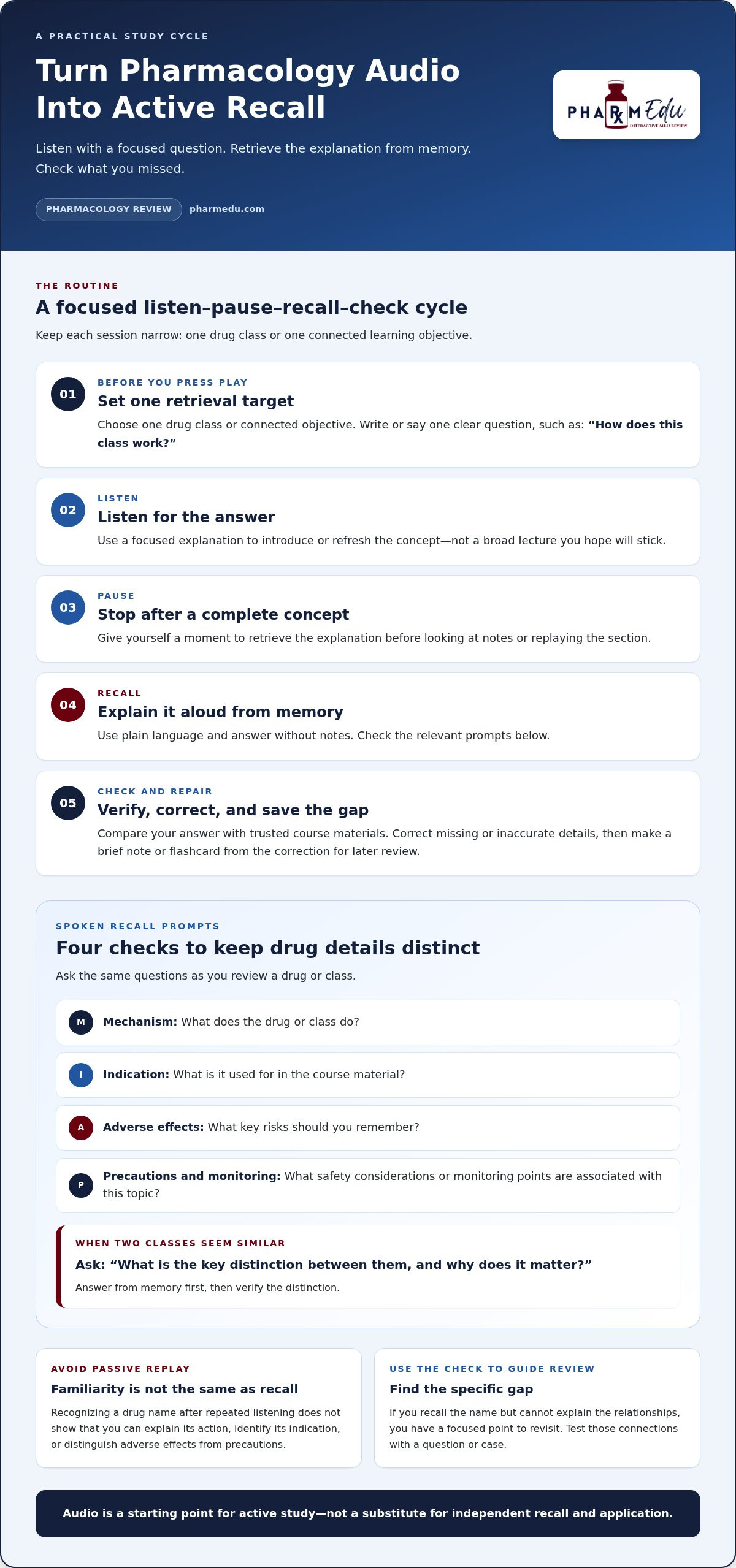
Before pressing play, write or say one clear question, such as, “How does this class work?” Listen for the explanation, then pause after a complete concept. Without looking at notes, explain the answer aloud in plain language. Finally, check it against trusted course materials and correct any missing or inaccurate details. Don’t simply replay the section. Make a brief note or flashcard from the correction so the gap becomes a prompt for later review.
Keep the cycle narrow. A single session might focus on one class and its mechanism, or on one connected objective such as linking an indication to relevant risks. Trying to cover several unrelated classes at once can make it harder to tell which concept you’ve recalled accurately.
Create spoken prompts for drug classes
Use the same prompts each time to build a consistent check. After listening, answer them aloud without notes:
- Mechanism: What does the drug or class do?
- Indication: What is it used for in the course material?
- Adverse effects: What key risks should I remember?
- Precautions and monitoring: What safety considerations or monitoring points are associated with this topic?
When two classes seem similar, add a comparison question: “What is the key distinction between them, and why does it matter?” Answer from memory first, then verify the distinction. This helps prevent a list of names and facts from blurring into one undifferentiated set.
Retrieval practice is the act of bringing learned information to mind without relying on the original material, a process studied by Roediger and Karpicke in their research on test-enhanced learning. In practice, your spoken answer is the test. Checking it against a reliable source lets you identify and repair errors. To pair concise explanations with follow-up recall checks, explore PharmEDU pharmacology learning resources, including video vignettes, flashcards, quizzes, and cases.
Which auditory pharmacology strategies work best for different tasks?
The most useful audio method depends on what you need to learn. A spoken explanation can help organize an unfamiliar mechanism, while a verbal prompt can test whether you can retrieve a specific adverse effect. Applying knowledge to a case requires another step: deciding which facts matter in context. The options below are a practical menu, not a universal ranking. Choose based on the learning objective and check whether you can recall or apply the information afterward.
| Learning task | Audio-supported method | Recall check | Limitation |
|---|---|---|---|
| Understand a drug-class pattern | Listen to a concise explanation of the mechanism and how it relates to the class. | Explain the pattern aloud, then describe how one example fits it. | A verbal summary may leave out a step or relationship. Check it against course materials. |
| Remember individual facts | Use spoken prompts alongside flashcards for names, indications, and adverse effects. | Answer each prompt before revealing or checking the response. | Recall of separate facts doesn’t automatically show that you can connect or apply them. |
| Apply knowledge to a case | Listen to or read a case question, then talk through the relevant pharmacology. | State which concepts inform your reasoning and explain why. | Practice questions support learning, but don’t replace assigned course materials or clinical guidance. |
Choose audio methods by pharmacology learning objective
For an unfamiliar concept, start with a short explanation and listen for the logic connecting a mechanism to an indication. For names, indications, and adverse effects, use a spoken question-and-answer prompt or a flashcard, answering before you look. To test transfer, work through a case question and explain your reasoning. These auditory learning strategies for pharmacology match the format to the task rather than asking audio to do every job.
Combine listening with visual and written cues
Some relationships are easier to inspect when they’re visible. Pair an explanation with a simple drug-class map or comparison chart, then add a concise written correction for any detail you missed during recall. A chart makes similarities and distinctions easier to compare; a spoken summary gives you a chance to explain them in your own words. For foundational concepts, consult the comprehensive pharmacology guide alongside your course materials. Use each format to clarify a different part of the topic, then test what you can retrieve without looking.
How to build an audio-supported pharmacology study routine
A reliable routine doesn’t depend on finding a long, uninterrupted block of time. It depends on repeating a focused sequence and using the results to decide what to review next. These auditory learning strategies for pharmacology can turn brief study opportunities into purposeful sessions without treating time spent listening as proof of progress.
Fit short listening sessions into a busy study week
Choose one defined objective for each micro-session, such as organizing the key features of a drug class or reviewing a difficult mechanism. Use spare listening time to revisit a concise explanation, then do the recall portion when you can give it your attention. If you need a broader framework for planning, see this pharmacology study guide for nursing students.
- Set a target: Name the topic and what you want to be able to explain.
- Listen with purpose: Focus on a short audio segment related to that objective.
- Recall independently: Put the material aside and state the main ideas aloud or write them from memory.
- Check and correct: Compare your answer with trusted course materials, then record missing or inaccurate details.
- Return strategically: Revisit difficult concepts in later sessions, using the correction as a prompt rather than replaying the entire lesson by default.
Keep a simple error log organized by topic. If you repeatedly miss a precaution or confuse two related mechanisms, turn that specific gap into a spoken question or flashcard. This gives the next session a clear purpose and helps prevent review from becoming an unstructured loop.
Measure retention instead of counting minutes listened
Track what you can explain accurately without notes, and use practice quiz results to identify which concept needs attention next. Successful recall matters more than replay count because retrieving information tests whether you can bring it to mind, while another listen alone may only make it feel familiar. A missed answer isn’t a failure; it’s useful direction for your next review.
Use PharmEDU’s concise video vignettes, interactive flashcards, and quizzes to support focused review and check what you can retrieve. Explore PharmEDU study resources and build them into a routine that pairs listening with independent recall.
Use PharmEDU resources to reinforce auditory pharmacology study
PharmEDU can help organize review across concise explanations and follow-up practice, while your course materials remain the reference point for required content. The platform’s library covers more than 100 pharmacology topics and includes High-Yield Video Vignettes, Interactive Pharmacology Flashcards, Pharmacology Practice Quizzes, and Clinical Case Studies. Used together, these resources support auditory learning strategies for pharmacology without making listening the whole study process.
Move from a concise explanation to a knowledge check
Choose one topic that matches your current learning objective. Watch a video vignette as a focused explanation, then pause and summarize the main idea without looking at the screen. Use flashcards or a practice quiz to check recall of relevant details, and try a clinical case to consider how the concept applies in a scenario. Each format has a distinct role: explanations introduce or revisit, questions test retrieval, and cases prompt application.
For example, a focused review of ACE inhibitors might begin with the topic explanation, continue with questions that check what you remember, and then move to a case that asks you to apply the course concept. The ACE inhibitors pharmacology guide offers an example of a focused topic resource. Compare what you recalled with your course materials, and note any details that need further review.
Keep study materials accessible across short sessions
Mobile-compliant access and micro-learning segments can make it easier to return to a topic during available study moments. Keep each short session purposeful: set one learning objective, review the relevant segment, then complete a recall check using a prompt, flashcard, or quiz. If you’re listening when you can’t give full attention, treat that as exposure or review. Return later to test what you can explain independently.
Consistency matters more than trying to cover a large number of topics at once. A short explanation followed by an accurate recall check gives you a clear sense of what’s solid and what needs another pass. Explore the PharmEDU learning platform and choose the format that fits your next study objective, whether that’s a video vignette, flashcards, a quiz, or a case.
Make your next pharmacology review active
Audio can make pharmacology review easier to revisit, but listening alone won’t show what you can recall or apply. The most useful auditory learning strategies for pharmacology pair a focused explanation with a pause to retrieve key ideas, check your answer, and correct gaps. Match the study method to the task, whether you’re organizing a drug-class mechanism, recalling specific facts, or working through a case.
Build a routine around one learning objective at a time, and use independent answers and quiz performance to guide what you revisit. PharmEDU supports this approach with more than 100 pharmacology topics, video vignettes, interactive flashcards, quizzes, and clinical case studies. Its mobile-compliant design and micro-learning segments can also help you fit focused review into available study moments.
Explore PharmEDU’s pharmacology learning platform and choose a resource that supports your next recall check. Keep each session focused, review what you missed, and build confidence through steady, active practice.
Frequently Asked Questions
How can I use auditory learning strategies to study pharmacology?
Start with one drug class and a clear question, then listen to a concise explanation. Pause before hearing the answer again and explain the mechanism, use, and key risks from memory. Check your explanation against reliable course materials, correct any gaps, and finish with a quiz or case question. This listen, retrieve, check, and apply cycle turns auditory learning strategies for pharmacology into active review rather than background listening.
Is listening to pharmacology lectures enough to prepare for an exam?
No. Listening can introduce or reinforce concepts, but it doesn’t show whether you can recall details independently or apply them to a question. After a lecture, close your notes and explain the topic aloud, then answer practice questions. Use incorrect or incomplete answers to guide a focused review. Keep your preparation aligned with your course or exam objectives, and combine audio review with active recall and application practice.
Can podcasts help me remember drug names and mechanisms?
Podcasts can help you revisit explanations and hear how concepts relate, but repeated playback alone doesn’t establish recall. Pause and state a mechanism without help, then try to distinguish the class from a similar one. Check your answer against course materials, and turn easily confused details into a flashcard or short written prompt. Use the podcast as a cue for retrieval, not as evidence that you’ve mastered the information.
What is the best way to memorize pharmacology drug classes with audio?
Use the same spoken prompts for each class: how it works, what it treats, important adverse effects, and relevant precautions. Listen to an explanation, then answer each prompt without notes. For similar classes, explain their key distinctions aloud and verify them with trusted course materials. Revisit missed facts in a later session, then use practice questions to check whether you can retrieve those details without hearing the explanation first.
How long should I listen to pharmacology study materials each day?
There’s no single daily listening duration that fits every learner or course. Instead, choose a manageable session focused on one topic, and leave time to pause, recall, and check your understanding. Several focused reviews may fit a busy schedule better than one long passive session. Adjust your routine based on coursework, quiz results, and the concepts you still find difficult, rather than aiming for a set number of listening minutes.
How do I know whether auditory study is working for pharmacology?
Check what you can do after the audio ends. Explain a concept without notes, distinguish related drug classes, or answer a relevant question or case. Track recurring errors and see whether your later practice addresses them. Feeling that an explanation is familiar can be encouraging, but independent recall and application give you a more useful measure of whether you can retrieve and use the information.
Should I combine audio with flashcards and practice questions for pharmacology?
Yes. Use audio to introduce or reinforce an explanation, flashcards to prompt recall of concise facts, and practice questions to test understanding in context. Give each format a clear purpose instead of repeating the same material passively. For example, listen to a mechanism explanation, recall key points with a flashcard, then apply the concept in a case question. Check any errors against your course materials and use them to plan review.