

Kinesthetic Learning Activities for Pharmacology: 10 Practical Ways to Learn by Doing
What if the fastest way to make a confusing drug class clearer is to put it on the table? When mechanisms, adverse effects, and similar-sounding medications blur together, rereading the same notes may not be enough. Kinesthetic learning activities for pharmacology turn facts into something you can arrange, recall, and apply, without assuming that one learning style works best for everyone.
This guide shares 10 practical ways to study by doing, from sorting drug cards and mapping mechanisms to role-playing course concepts and building quick case scenarios. Each activity gives you a chance to retrieve information and connect drug facts with patient-care concepts, while still fitting into a focused study session.
You’ll also learn how to match activities to specific pharmacology topics and use movement or physical materials as part of a broader study approach, not as a guarantee of better results. The goal is straightforward: organize abstract concepts, test what you remember, and practise applying your knowledge responsibly.
Key Takeaways
- Make pharmacology concepts tangible by sorting, building, or moving materials, and explain the relationships as you work.
- Use kinesthetic learning activities for pharmacology to practise retrieving drug facts before checking your notes.
- Match card sorting, movable concept maps, role-play, gesture cues, or case stations to the specific study goal you want to practise.
- Build a repeatable session around one objective: create a physical task, recall the information, check your accuracy, and revisit it later.
- Use digital flashcards, quizzes, video vignettes, and clinical case studies to reinforce physical practice and review concepts.
What Kinesthetic Learning Means for Pharmacology Study
Kinesthetic pharmacology study is learning through purposeful movement or physical interaction, such as sorting drug cards, building a mechanism map, or matching adverse effects to a drug class, while actively recalling and explaining the pharmacology represented.
The key is purpose. Moving a card should help you retrieve or organize a specific relationship, not simply keep your hands busy. Drug mechanisms, class similarities, and adverse effects can feel abstract when presented as separate facts. Laying them out physically makes connections easier to inspect, compare, and question. For example, place cards for a drug class beside its mechanism and relevant adverse effects. Then explain why each belongs there and check your reasoning against a trusted course source.
What makes a pharmacology activity genuinely hands-on?
A useful hands-on task asks you to build, sort, match, gesture, or manipulate concept cards in service of a learning objective. Give every movement meaning: placing a drug card beneath a receptor target should represent a mechanism relationship; grouping two cards should prompt you to name a shared class feature or explain a meaningful difference.
Copying notes onto colorful cards or decorating a study sheet involves your hands, but doesn’t necessarily require pharmacology recall. Before checking your notes, ask: Can you explain why you put those cards together? If not, add a retrieval or explanation step. That distinction makes kinesthetic learning activities for pharmacology more than craft projects.
Does being a kinesthetic learner mean one method is enough?
No. Learning-style categories can describe preferences, but they shouldn’t dictate the only method you use. The overview of kinesthetic learners sits within broader learning-style models; a label isn’t evidence that someone can learn effectively only through movement or touch. Use hands-on tasks alongside reading, listening, and other approaches that fit the material.
For a stronger study routine, pair physical organization with active retrieval: recall a mechanism before turning over its card, then explain the connection aloud. Check what you got right, correct errors, and return to the material during later review. Keep the facts grounded in reliable learning resources, especially when connecting drug mechanisms with adverse effects or clinical use. For a foundation in core concepts, see this comprehensive pharmacology guide.
How Hands-On Pharmacology Activities Strengthen Recall and Understanding
Building or sorting a model asks you to organize pharmacology into relationships: which drug acts on which target, what changes downstream, and how that action relates to a clinical effect. That’s different from rereading a list, where the information is already arranged for you. A physical task can make the structure visible, but learning depends on thinking through the connections, not simply handling the materials.
Add active retrieval by pausing before you place a label or check a note. Ask yourself what the drug does, what effect follows, or how one class feature differs from another. Then explain your choice aloud and verify it against current, trusted course materials. These kinesthetic learning activities for pharmacology work best when each action tests a clear piece of knowledge.
Connect drug mechanisms to visible or movable models
Use movable labels for a receptor, drug action, downstream effect, and possible clinical consequence. Arrange them in sequence, narrate how one step relates to the next, then mix up the labels and reconstruct the model from memory. Keep the example within your current coursework, and check every mechanism and clinical detail against authoritative learning materials. A physical sequence is a study aid, not a substitute for verifying the pharmacology.
A 2011 study examined two pharmacotherapeutics card games in a specific educational setting. It offers an example of game-based teaching, but findings from one course and a particular set of games shouldn’t be treated as proof that every hands-on activity improves learning for every student. Before quoting outcome figures, check the original paper’s sample, study period, assessment methods, and reported results.
Use retrieval and spacing to make activities more useful
Don’t stop once the model looks right. Put it away and explain the same relationships later without looking at the original layout. Repeat the activity during later study sessions, leaving time between reviews, and note which links you still confuse. This turns the task into a way to check recall over time rather than a one-off construction exercise.
- Retrieve: Name the drug feature or relationship before checking notes.
- Verify: Compare your answer with trusted course material and correct errors.
- Revisit: Rebuild or explain the model later, focusing on the connections that were hardest to recall.
After physical practice, use a quiz or flashcards for an independent recall check. PharmEDU’s pharmacology study resources include interactive flashcards and quizzes that can complement hands-on review.
Which Kinesthetic Pharmacology Activity Fits Your Study Goal?
Choose the format based on the relationship you need to learn, not on an assumption that one activity works best for everyone. Cards help compare categories, movable pieces show connections, and role-play or case stations give you a structured way to retrieve and explain information. Keep examples aligned with your coursework, and use them for study rather than as instructions for patient care.
| Activity | Best-fit study goal | Materials | Recall check |
|---|---|---|---|
| Card sorting | Compare drug classes, mechanisms, adverse effects, or monitoring concepts | Drug and concept cards | Explain why each card belongs in its group, then reshuffle and sort again from memory. |
| Concept mapping with movable pieces | Show sequences or connections that are hard to visualize | Label cards, paper, or a reusable board | Rebuild the map without looking at the original. |
| Role-play | Practise recalling and communicating a pharmacology concept | Prompt cards and a fictional learning scenario | Summarize the relevant concept clearly, then check it against course materials. |
| Gesture cues | Pair a brief movement with a term or process for retrieval practice | A short list of concepts and consistent gestures | Perform the gesture and name the related concept without prompts. |
| Physical case stations | Organize clues and connect them with course concepts | Written fictional case prompts and labeled stations | Explain which pharmacology concepts each clue is intended to test. |
When should you use cards, models, movement, or role-play?
Use cards when the task involves sorting and comparison. For a model, arrange pieces to show a sequence or relationship. For example, place pharmacokinetic cards in the order of absorption, distribution, metabolism, and excretion, then explain the sequence. A gesture can act as a retrieval cue, while role-play gives learners practice explaining a concept to a peer. Keep scenarios fictional and focused on coursework, not on making unsupervised clinical decisions.
How can activities cover different pharmacology topics?
For medication classes, build a matrix that links representative drugs with mechanisms and relevant safety considerations from your course materials. Cover the labels and recall the connections before checking your work. To see how a focused class example can be organized, review this ACE inhibitor pharmacology guide.
These kinesthetic learning activities for pharmacology are most useful when the recall check matches your objective: compare, sequence, explain, or connect. Choose one target at a time, and verify drug information against trusted, up-to-date learning resources.
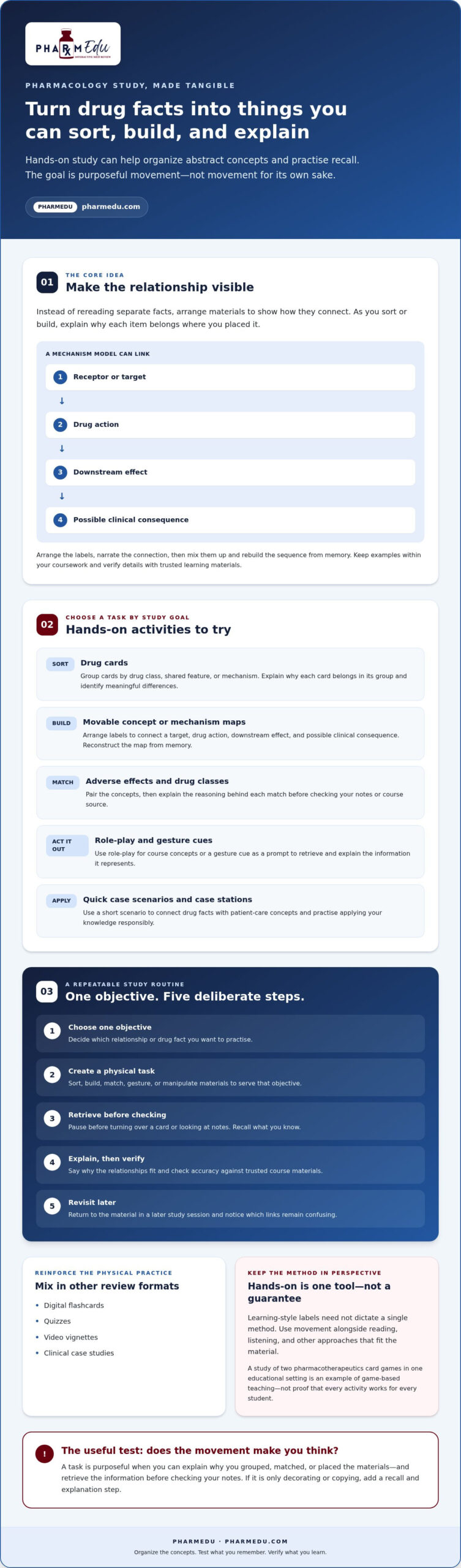
How to Build a Repeatable Kinesthetic Pharmacology Study Session
A reliable study routine doesn’t need specialized equipment. Keep each session focused on one course objective, such as distinguishing a drug class, explaining a mechanism, or connecting a medication concept with monitoring. Use current, authoritative course materials to confirm the facts before turning them into a physical task. A narrow target makes it easier to identify what you can recall and what needs more review.
What steps turn a topic into a useful hands-on exercise?
Represent the target relationship with cards, movable labels, a quick sketch, or a gesture. Once you’ve arranged the material, cover your references and rebuild or explain the idea from memory. Check your version against trusted course sources, correct inaccuracies, and note questions to follow up with an instructor or course material. This loop keeps kinesthetic learning activities for pharmacology practical, focused, and grounded in verified information.
- Select one objective. State what you need to recall or explain, and check the relevant course materials.
- Create a physical task. Use cards, labels, a sketch, or a gesture to represent one class, mechanism, or clinical relationship.
- Retrieve without prompts. Rebuild the layout or explain the relationship before looking at your notes.
- Check and correct. Compare your response with a trusted reference, fix errors, and record unresolved questions.
- Revisit and self-check. Return to the task later. Rate your accuracy and confidence, and identify one point that still needs review.
Adapt the objective to your course and assessment format rather than assuming nursing and pharmacy students need identical practice. A nursing student might organize course-approved medication concepts alongside monitoring considerations or patient-education topics. A pharmacy student might map therapeutic reasoning to the course objective and use supervised coursework to explore its application. These are study exercises, not directions for making independent patient-care decisions. For additional foundational support, see this pharmacology study guide for nursing students.
After each session, ask: Did I represent the concept accurately? How confident am I in recalling it without the layout? What remains unclear? Keep the answers brief so you can use them to choose the next review task. For digital follow-up, explore pharmacology flashcards and quizzes to check recall alongside your hands-on practice.
How PharmEDU Can Reinforce Hands-On Pharmacology Study
Physical activities help you arrange and manipulate pharmacology concepts; digital resources can provide another way to retrieve and review them afterward. Use the two approaches together. After sorting drug-class cards or building a mechanism map, close your notes and recall the key relationships. Then use a flashcard or quiz to check what you remembered and identify details that need correction.
How can digital tools extend a hands-on study activity?
Match the follow-up format to the task you just completed. Interactive flashcards can prompt recall after you’ve sorted or matched concepts. Quizzes can reveal gaps, which you can then check against your course materials. Clinical case studies offer educational scenarios for considering how pharmacology concepts relate to a case within your course objectives. Short video vignettes provide another way to revisit content. These tools complement physical practice; they don’t replace building, sorting, or explaining a model yourself.
What should learners look for in a pharmacology platform?
Start with fit, not the number of features. Check whether the material aligns with your course level and current study objectives. A useful resource should offer formats that support both recall and application, while leaving room for you to verify details against trusted course materials. Consider whether mobile access and short study segments suit the time you have available for review.
PharmEDU is an online pharmacology learning platform with more than 100 topics, including video vignettes, interactive flashcards, quizzes, and clinical case studies. Its mobile-compliant design and micro-learning segments can support short follow-up sessions. If you use kinesthetic learning activities for pharmacology, build a physical concept map first, then use a digital quiz or flashcards to check which connections you can still recall. The digital review adds a retrieval check; the physical task remains part of your study process.
Choose the combination that addresses a specific learning need, and keep checking pharmacology details against current, reliable materials. PharmEDU’s formats are study resources, not a promise of exam results or clinical competence. Explore PharmEDU’s pharmacology learning resources to see whether they fit your study routine.
Make Your Next Pharmacology Review Active
Drug facts become easier to organize when your study task asks you to do more than reread. Choose one objective, turn it into a physical activity such as sorting or mapping, then retrieve the key relationships from memory and check them against reliable course materials. The most useful kinesthetic learning activities for pharmacology have a clear purpose behind every movement.
Match the activity to your goal: use cards to compare concepts, movable pieces to show relationships, and a focused case exercise to practise applying course knowledge. Then revisit the material later and note what still needs attention. Hands-on practice can be part of a balanced study routine, alongside explanation and digital recall checks.
PharmEDU offers more than 100 pharmacology topics, with video vignettes, interactive flashcards, quizzes, and clinical case studies to support review. Explore the formats and see whether they fit your learning objectives: Explore PharmEDU’s pharmacology learning resources.
Start with one concept and one practical task. Each focused review is an opportunity to build a clearer understanding.
Frequently Asked Questions
What are kinesthetic learning activities for pharmacology?
Kinesthetic learning activities for pharmacology use purposeful movement or physical materials to organize and recall drug concepts. Examples include sorting cards by drug class, arranging movable labels to show a mechanism, or using gestures to retrieve key terms. The activity should make you explain what each action represents. Simply handling or decorating study materials, without recalling or discussing pharmacology, may not provide the same kind of active practice.
How can I study pharmacology if I learn best by doing?
Choose one small learning objective, then turn it into a task you can build, sort, match, or explain. For example, arrange cards that connect a drug class with its mechanism and relevant adverse effects. Try to recall the connections before checking your notes, then correct errors using current course materials. Add a later review to see what you can still explain without the original layout.
Do kinesthetic learning activities help with pharmacology exams?
Hands-on activities can give you a practical way to retrieve and organize material relevant to exams, but they can’t guarantee a particular score or outcome. Make the task resemble the thinking your assessment requires: compare drug classes, explain a mechanism, or connect a concept to a course-based scenario. Pair it with practice questions and review mistakes against trusted materials. Follow your course guidance about exam content and expectations.
Can physical activities help me memorize drug classes and mechanisms?
Physical activities can support recall by asking you to sort, sequence, or reconstruct relationships instead of only reviewing completed notes. To study drug classes, group cards by a shared feature and explain what distinguishes each class. To review mechanisms, arrange labels into a sequence and then recreate it from memory. Check each connection against reliable course resources, since a memorable arrangement is useful only if the pharmacology is accurate.
What are some hands-on pharmacology activities I can do at home?
Use paper cards to sort drug names, mechanisms, adverse effects, or monitoring concepts. Draw a simple pathway and cover it, then rebuild it from memory with movable labels. You can also set up written case prompts around a table and explain which course concepts each prompt tests. Keep activities focused on learning, use fictional educational scenarios, and verify facts with current course materials rather than treating exercises as patient-care instructions.
How do you make pharmacology flashcards into an active learning activity?
Write one clear prompt per card, such as asking for a drug class’s mechanism or a key distinction between two concepts. Before checking the answer, say it aloud or write it from memory. Then sort cards into groups such as “recalled,” “uncertain,” and “review,” and explain the basis for each grouping. Revisit difficult cards later and confirm answers with course materials. Avoid relying on recognition alone by hiding the response.
Are learning styles scientifically proven to improve pharmacology learning?
Learning-style labels can describe preferences, but evidence does not establish that matching instruction to a fixed label reliably improves learning. You don’t need to identify as a kinesthetic learner to benefit from purposeful movement, and hands-on study shouldn’t be your only method. Choose techniques based on the topic and your learning objective, then combine physical activities with retrieval, explanation, and review. Check your progress by testing what you can recall and apply.