Pharmacology for Nurse Practitioners: The Path to Prescribing Authority in 2026
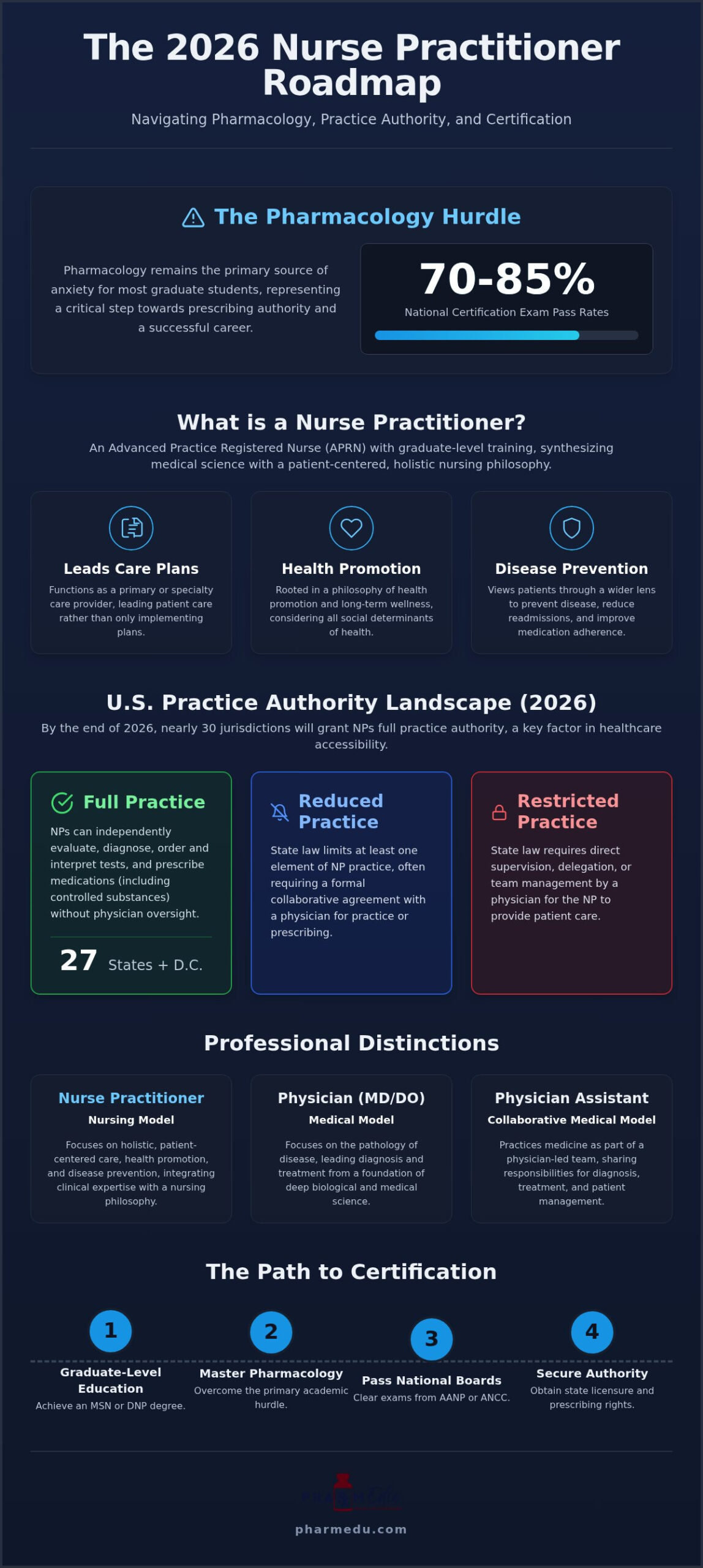
By the end of 2026, nearly thirty jurisdictions nationwide will grant full practice authority, yet the pharmacology hurdle remains the primary source of anxiety for most graduate students. Transitioning from the bedside to the prescription pad requires more than just memorizing drug classes; it demands a total shift in clinical reasoning. You’ve likely spent nights staring at complex mechanisms of action, feeling the burnout of high-stakes science courses while worrying about the 70% to 85% pass rates of national certification exams. It’s a heavy burden to carry when your future career depends on mastering pharmacology for nurse practitioners.
We understand that navigating the evolving standards of the AANP and ANCC can feel overwhelming, especially with the diverse new tiered systems and shifting regulations encountered across various regions. This article provides a definitive roadmap for your education and certification journey in 2026. You’ll learn how to synthesize patient-centered care with expert-level pharmacological mastery through high-yield study strategies. We’ll explore the essential steps to secure your prescribing authority, giving you the tools to move past the administrative stress and into a role where you can confidently manage patient outcomes.
Key Takeaways
- Understand the Advanced Practice Registered Nurse (APRN) role and how it synthesizes clinical expertise with nursing-based disease prevention.
- Navigate the complex 2026 legal landscape of prescribing authority and the national standards for managing controlled substances.
- Distinguish the unique educational pathways and residency requirements that separate the NP role from physicians and physician assistants.
- Identify the specific milestones required to master pharmacology for nurse practitioners and successfully clear national board certification exams.
- Discover high-yield micro-learning strategies and digital tools that help you overcome academic burnout while preparing for real-world clinical practice.
What is a Nurse Practitioner? Defining the Advanced Practice Role
A Nurse practitioner is an Advanced Practice Registered Nurse (APRN) who has achieved graduate-level clinical training beyond the scope of a registered nurse. This role represents a unique synthesis in healthcare; it combines the rigorous scientific foundation of medicine with the patient-centered, holistic philosophy of nursing. While registered nurses focus on the implementation of care plans, NPs are trained to lead them. They function as primary and specialty care providers, serving as a critical solution to the rising demand for accessible healthcare services across the nation.
Autonomy for these professionals is governed by state laws, which fall into three distinct categories:
- Full Practice: NPs can evaluate, diagnose, and prescribe medications independently without physician oversight.
- Reduced Practice: At least one element of NP practice is limited, often requiring a formal collaborative agreement with a physician.
- Restricted Practice: State law requires supervision or delegation by a physician for the NP to provide patient care.
Core Responsibilities of the Modern NP
Modern NPs carry a heavy clinical load that involves diagnosing and treating both acute and chronic conditions. They’re responsible for the entire patient journey, from the initial assessment to the final prescription. This includes ordering and interpreting complex diagnostic tests, such as metabolic panels or advanced imaging like MRIs. Beyond the clinical data, they provide essential holistic counseling. They teach patients how to manage their health through education, which significantly reduces hospital readmission rates and improves long-term adherence to medication regimens.
Practice Settings for Advanced Practice Nurses
Scope of Practice: Prescribing Authority and Medication Management
The legal authority to prescribe medications represents the cornerstone of advanced practice nursing. As of August 2026, 27 states and the District of Columbia grant NPs full practice authority, allowing them to manage therapeutic regimens independently. This responsibility requires a profound mastery of pharmacology to prevent adverse outcomes. Beyond basic administration, NPs are now the primary decision-makers for controlled substances, which necessitates a strict adherence to both state regulations and federal DEA guidelines.
Managing patients with multi-system diseases often leads to polypharmacy, where the risk of therapeutic duplication or harmful interactions increases exponentially. The NP’s role involves meticulous medication reconciliation during every transition of care. By identifying barriers to adherence and simplifying complex regimens, NPs ensure that pharmacological interventions remain effective rather than burdensome. Mastering pharmacology for nurse practitioners allows you to move beyond simply following protocols to designing individualized care plans that prioritize patient safety.
Mastering Drug Classes for Clinical Excellence
Clinical excellence requires a granular understanding of high-alert medications, such as ACE Inhibitors, which are frequently used in managing hypertension and heart failure. You must apply the principles of pharmacokinetics and pharmacodynamics to predict how a drug will move through and affect a specific patient’s body. Pharmacotherapeutics is the clinical application of drugs to treat specific diseases. By integrating these sciences, you can adjust dosages based on renal function or age-related changes, ensuring each prescription is optimized for the patient’s unique physiological profile.
The Challenges of Prescribing in Advanced Practice
The prescribing journey isn’t without significant hurdles. Navigating complex drug-drug interactions and identifying subtle adverse drug reactions (ADRs) requires constant vigilance and updated knowledge. NPs carry the ethical and legal weight of their DEA registration, which demands precise documentation and monitoring of high-risk substances. Staying current is a legal necessity; you should regularly review the ANCC certification renewal requirements to ensure your pharmacology continuing education hours are met. Utilizing evidence-based guidelines helps you select the most effective interventions while minimizing risks. Success in advanced practice relies on a continuous commitment to pharmacology for nurse practitioners as the science evolves. To build confidence in these high-stakes decisions, practicing with clinical case studies can bridge the gap between theory and the exam room.
Nurse Practitioner vs. Doctor vs. Physician Assistant
Distinguishing between the three primary prescribing roles in modern healthcare requires an analysis of both educational pathways and clinical philosophy. Physicians undergo four years of medical school followed by mandatory residency programs that last between three and seven years. Physician Assistants (PAs) typically complete two-year master’s programs modeled after the medical school curriculum. Nurse Practitioners build their expertise upon a foundation of registered nursing, completing either a Master of Science in Nursing (MSN) or a Doctor of Nursing Practice (DNP). This progression from the bedside to the prescription pad allows NPs to integrate years of direct patient interaction into their advanced training.
Clinical hour requirements also vary significantly across these roles. While physicians log thousands of hours during residency, national certification for NPs requires between 500 and 1,000 supervised clinical hours. PAs generally complete around 2,000 hours. Despite these differences in volume, the focus of the training is what truly differentiates the roles. For those pursuing the APRN path, mastering pharmacology for nurse practitioners is not just about learning dosages; it’s about applying those dosages within a specific nursing framework that prioritizes the patient’s overall life context.
The Nursing Model vs. The Medical Model
The medical model focuses heavily on biological systems and curative interventions, often prioritizing the pathology itself. In contrast, the nursing model is inherently patient-centered, treating the individual rather than just the disease. When an NP approaches a clinical case, they look beyond the symptoms to evaluate lifestyle, environmental factors, and social determinants of health. This model prioritizes health promotion and disease prevention as much as the treatment. An NP might prescribe a medication for chronic care while simultaneously developing a plan to address the patient’s environmental barriers to health, ensuring the pharmacological intervention is both safe and sustainable.
National Clinical Outcomes and Patient Satisfaction
Extensive research confirms that the quality of care provided by NPs is comparable to that of physicians. With a projected 35% growth rate for the NP role through 2034, these professionals are essential for maintaining national healthcare access. Safety standards remain high, and patients frequently report higher levels of satisfaction with NP-led care. This preference often stems from the NP’s focus on communication and holistic education. When patients understand their treatment plan, adherence improves. This trust is the foundation of successful outcomes in pharmacology for nurse practitioners, as it bridges the gap between a written prescription and a patient’s daily health management.
The Path to Certification: Education and Board Exams
Your educational path is defined by your clinical goals and the populations you wish to serve. The Family Nurse Practitioner (FNP) track remains the most popular choice, offering the broadest scope for primary care across the entire lifespan. If you’re drawn to hospital-based settings or the intensive care unit, the Adult-Gerontology Acute Care (AGACNP) certification is the standard requirement. For those interested in behavioral health, the Psychiatric-Mental Health (PMHNP) sub-specialty addresses a critical national demand. Each of these paths requires a specialized approach to pharmacology for nurse practitioners, as the drug profiles for a pediatric patient in primary care differ significantly from those in an acute geriatric or psychiatric setting.
The Reality of Graduate-Level Pharmacology
Advanced pharmacology is widely considered the most difficult course in any NP program. This challenge stems from a fundamental shift in clinical reasoning. As an RN, your primary responsibility was the safe administration of medications; as an NP, you’re now responsible for the initial selection, dosing, and long-term management of those drugs. You’re no longer just identifying a pill; you’re analyzing pharmacodynamics to predict how a specific patient will respond. For those preparing for this transition, The Ultimate Pharmacology Study Guide for Nursing Students in 2026 offers the foundational prep needed to survive the first semester. Success in pharmacology for nurse practitioners requires moving beyond rote memorization and toward a deeper understanding of therapeutic applications. To help you master these high-stakes concepts, you can utilize interactive pharmacology flashcards that simplify complex drug classes into high-yield study segments.
Mastering the Pharmacology Hurdle with PharmEDU
The transition from a registered nurse to a prescribing provider requires a specialized set of tools that textbooks alone cannot provide. PharmEDU serves as the premier digital pharmacology resource, specifically engineered to help students navigate the academic rigors of graduate school in 2026. Our “High-Yield” philosophy eliminates the noise of irrelevant data; we focus exclusively on the 100+ drug topics most likely to appear on national board exams. This targeted approach ensures that your study time is spent on the clinical applications that matter most for patient safety and certification success. By centralizing essential pharmacology for nurse practitioners into one intuitive platform, we remove the administrative burden of sourcing study materials from multiple, often conflicting, locations.
Modern students often balance full-time clinical rotations with heavy course loads. To accommodate this, our mobile-compliant platform allows for seamless micro-learning during short breaks or transit. Whether you’re a visual learner who benefits from structured graphics or an auditory learner who prefers narrated content, the platform adapts to your needs. This flexibility is essential for maintaining consistent progress without succumbing to the academic burnout common in advanced practice programs.
High-Yield Video Vignettes and Clinical Case Studies
Cognitive overload is a significant barrier when preparing for high-stakes exams. Our High-Yield Video Vignettes break down complex physiological responses into manageable, bite-sized segments. These micro-learning modules allow you to master one mechanism at a time, ensuring long-term retention rather than temporary memorization. To bridge the gap between theoretical knowledge and real-world prescribing, we integrate Clinical Case Studies that mirror the patterns you’ll encounter on the boards. PharmEDU simplifies complex drug mechanisms by using clinical context and visual cues to trigger rapid recall during exams. This practical application transforms abstract concepts into the concrete clinical reasoning required for safe medication management.
Preparing for AANP and ANCC Success
The final step in your journey to prescribing authority is clearing the AANP or ANCC certification hurdle. Success on these exams requires more than just reading; it requires active engagement with the material. Our Interactive Pharmacology Flashcards utilize active recall to reinforce your knowledge of drug classes, contraindications, and adverse effects. When you’re ready to test your stamina, our Pharmacology Practice Quizzes provide a simulated environment that mirrors the question style and difficulty level of national boards. Mastering pharmacology for nurse practitioners is a marathon, not a sprint, and having the right digital mentor makes all the difference. Ready to conquer your boards? Start your PharmEDU subscription today.
Securing Your Clinical Future in 2026
The journey to becoming a certified provider is defined by your ability to bridge the gap between nursing theory and clinical prescribing. In 2026, the demand for independent practitioners continues to rise, but the legal and ethical weight of a DEA registration requires more than just passing a test. It demands a deep, functional mastery of pharmacology for nurse practitioners. By understanding the nuances between the nursing and medical models, you’ve already taken the first step toward a patient-centered practice that prioritizes both safety and outcomes.
Success on the AANP or ANCC boards doesn’t have to be a source of burnout. You can transform your study routine with a comprehensive pharmacology library that features over 100 high-yield topics. Designed by healthcare educators to ensure clinical excellence, our platform provides the high-yield video content and interactive flashcards you need to succeed during busy clinical rotations. Don’t let the pharmacology hurdle delay your career goals. Master Pharmacology for Your NP Boards with PharmEDU and step into your new role with the confidence your patients deserve. Your path to prescribing authority is clear, and we’re here to support every milestone of your professional evolution.
Frequently Asked Questions
Can a nurse practitioner see patients without a doctor present?
Yes, nurse practitioners can see patients independently in states that grant Full Practice Authority. As of August 2026, 27 states and Washington, D.C. allow this level of autonomy, enabling NPs to evaluate, diagnose, and treat patients without physician oversight. In states with Reduced or Restricted authority, a formal collaborative agreement or supervision is required. This independent role is a primary driver for the 35% growth rate projected for the profession through 2034.
How long does it take to become a nurse practitioner in 2026?
Becoming a nurse practitioner typically takes six to eight years of post-secondary education and clinical training. This path includes four years for a Bachelor of Science in Nursing (BSN) and an additional two to four years for a Master’s (MSN) or Doctorate (DNP) degree. Most competitive programs also require at least one to two years of bedside RN experience before admission. This ensures that the transition to advanced practice is built on a solid foundation of clinical judgment.
Is a nurse practitioner considered a doctor?
While many nurse practitioners hold a Doctor of Nursing Practice (DNP) degree, they aren’t medical doctors, such as MDs or DOs. The title “Doctor” in a clinical setting refers to their academic achievement, but their professional license is as an Advanced Practice Registered Nurse. NPs follow the nursing model of care, which emphasizes health promotion and disease prevention. This differs from the physician’s medical model, which focuses primarily on biological systems and curative interventions for pathology.
What is the main difference between an NP and a PA?
The main difference lies in their educational philosophy and clinical background. NPs are trained in the nursing model, which focuses on holistic, patient-centered care, while PAs are trained in the medical model, similar to physicians. Additionally, NPs must be registered nurses before entering graduate school, whereas PAs often come from various healthcare or science backgrounds. Both roles are essential for increasing healthcare access, but their approach to clinical reasoning and patient education remains distinct.
Can nurse practitioners prescribe controlled substances nationwide?
Yes, nurse practitioners have the authority to prescribe controlled substances in all 50 states, though specific regulations vary by jurisdiction. Every NP must obtain a federal DEA registration to prescribe these high-risk medications. In Full Practice states, they do so independently, while states like Florida may limit Schedule II prescriptions to a seven-day supply. You must verify your specific state’s board of nursing rules to ensure full legal compliance and safety in your clinical practice.
Which NP specialty is currently in the highest demand?
Psychiatric-Mental Health Nurse Practitioners (PMHNPs) and Family Nurse Practitioners (FNPs) are currently in the highest demand across the country. The national shortage of mental health providers has made the PMHNP role essential for community health systems. FNPs remain vital due to their broad scope of practice across the lifespan. Other high-growth areas include Adult-Gerontology Acute Care, particularly in hospital systems facing staffing shortages. These specialties offer robust career stability and competitive opportunities for new graduates.
How hard is the pharmacology section of the NP board exam?
The pharmacology section is often cited as the most difficult part of the national board exams. Success requires a deep understanding of pharmacology for nurse practitioners, moving beyond simple drug names to complex mechanisms of action. First-time pass rates for the AANPCB exam typically hover around 80%, while ANCC rates range from 70% to 85%. Mastery of high-alert drug classes and pharmacokinetics is essential for clearing this hurdle and ensuring patient safety in advanced clinical practice.
What is the average salary for a nurse practitioner in the U.S.?
The average salary for a nurse practitioner in the U.S. typically ranges from $120,000 to $130,000, though this varies by specialty and location. Specialized roles like PMHNPs often command higher compensation due to the critical provider shortage. With the U.S. Bureau of Labor Statistics projecting a 35% growth rate through 2034, the financial outlook for the profession remains exceptionally strong. Mastering pharmacology for nurse practitioners is a key factor in securing these high-demand, high-paying clinical positions.