
Hardest Pharmacy School Classes: 2026 Survival Guide
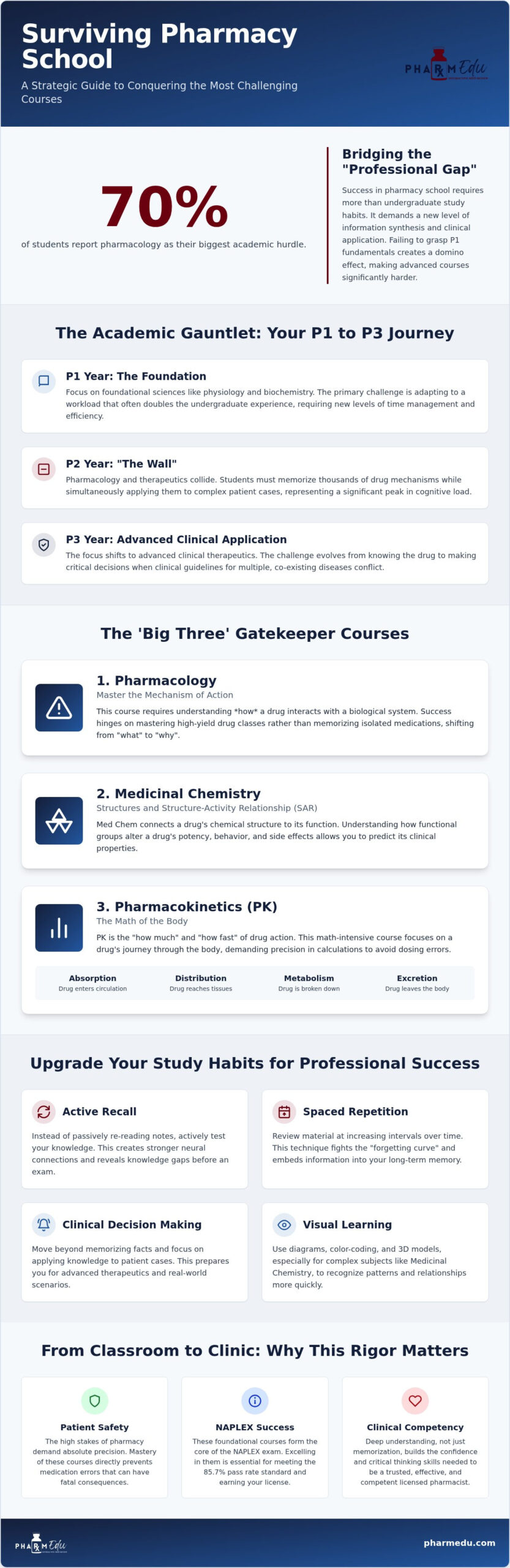
Nearly 70% of students in 2026 report that pharmacology remains the most significant academic hurdle in their professional journey. It’s a sobering statistic that highlights a common reality: the study habits that served you well in undergraduate courses often collapse under the weight of a 19 credit hour professional semester. If you feel buried by information overload or fear that one high-stakes exam could derail your career, you’re experiencing the standard pressure of the hardest classes in pharmacy school.
We’re committed to helping you transform that pressure into professional mastery. This guide provides a ranked analysis of the most difficult subjects you’ll encounter, along with high-yield frameworks designed to simplify complex concepts like medicinal chemistry and pharmacokinetics. You’ll learn how to replace inefficient habits with proven study modalities that actually work in a professional setting. By following this 2026 survival guide, you’ll gain the tactical advantage needed to navigate your curriculum with precision and confidence.
Key Takeaways
- Understand why undergraduate study habits often fail in professional school and how to bridge the “Professional Gap” to maintain academic excellence.
- Identify the specific cognitive demands of the hardest classes in pharmacy school, including the molecular complexity of Medicinal Chemistry and the mathematical rigor of Pharmacokinetics.
- Learn how to transition from rote memorization to clinical decision-making when managing complex, multi-disease states in Advanced Therapeutics.
- Implement evidence-based learning frameworks like active recall and spaced repetition to manage high-volume information without burnout.
- Discover how mastering these foundational courses directly impacts your NAPLEX performance and your future clinical competency as a licensed pharmacist.
Navigating the Academic Rigor of Pharmacy School
The transition into a professional program often reveals a “Professional Gap” that surprises even the most diligent students. While undergraduate success focuses on mastering isolated subjects, earning a Doctor of Pharmacy (PharmD) degree requires a synthesis of information that most bachelor’s programs don’t demand. You aren’t just learning facts; you’re building a foundation where every missed concept in your P1 year creates a domino effect. If you fail to grasp the fundamentals of physiology early on, the hardest classes in pharmacy school like pharmacology will become nearly impossible to navigate later.
Academic rigor in pharmacy education represents the intersection of exhaustive pharmacological knowledge and the ethical imperative to ensure absolute patient safety in clinical practice. This rigor isn’t just about technical complexity; it’s also about the immense mental load. Some courses are difficult because the concepts are abstract, while others are challenging simply because of the sheer volume of data you must process within a 19 credit hour semester.
The P1 to P3 Journey: When Difficulty Peaks
The P1 year focuses on foundational sciences, forcing students to adjust to a workload that often doubles their undergraduate experience. By the P2 year, most students hit “The Wall.” This is where pharmacology and therapeutics collide, requiring you to memorize thousands of drug mechanisms while simultaneously applying them to complex patient cases. P3 year shifts the focus toward advanced clinical therapeutics. Here, the challenge isn’t just knowing the drug, but making difficult decisions when clinical guidelines for multiple diseases conflict.
Why Pharmacy Courses are Historically Challenging
Pharmacy education is uniquely demanding because the stakes are incredibly high. A single decimal point error in a pharmacokinetics calculation or a misunderstood drug interaction can lead to fatal medication errors. This pressure necessitates a dual approach to learning. You must master rote memorization for drug names and classes, but you also need high-level critical thinking to manage the integration of biology, chemistry, and mathematics. The hardest classes in pharmacy school test your ability to remain precise under pressure, ensuring you are prepared for the 85.7% NAPLEX pass rate standard and the responsibilities of a licensed pharmacist.
The ‘Big Three’ Gatekeepers: Pharmacology, Med Chem, and PK
While every semester brings its own set of challenges, three specific subjects consistently earn their reputation as the hardest classes in pharmacy school. These courses aren’t just difficult because of the volume of material; they require a fundamental shift in how you process scientific data. You’ll move beyond simple biology into a world where chemistry and mathematics dictate life-saving clinical decisions.
Pharmacology: Master the Mechanism of Action
Pharmacology is often the first time students realize that undergraduate memorization techniques won’t suffice. Success depends on mastering high-yield drug classes rather than trying to learn every obscure medication in isolation. You need to understand how a drug interacts with a biological system to produce a specific effect. For a deeper look into this discipline, explore Pharmacology: The Comprehensive Guide to the Science of Drugs. PharmEDU’s high-yield video vignettes are specifically designed to simplify these complex mechanisms, turning abstract concepts into durable clinical knowledge.
Medicinal Chemistry: Structures and SAR
Many students fear medicinal chemistry because it feels like a return to organic chemistry. However, the focus here isn’t just drawing hexagons; it’s about Structure-Activity Relationship (SAR). This discipline teaches you how specific functional groups change a drug’s interaction with its target receptor. Understanding the chemical backbone allows you to predict behavior, potency, and side effects before you even read the clinical data. Visual learning strategies, like color-coding structures or using 3D models, are essential for recognizing these patterns quickly during a high-stakes exam.
Pharmacokinetics: The Math of the Body
If pharmacology is the “what,” then pharmacokinetics is the “how much” and “how fast.” This course represents a significant mathematical hurdle, focusing on absorption, distribution, metabolism, and excretion (ADME). Common pitfalls often involve rushing into formulas like half-life and clearance without a conceptual grasp of the body’s underlying physiology. If you don’t understand how volume of distribution changes in a patient with edema, the formula won’t save you. Mastering PK is vital for preventing toxicity and ensuring precise clinical dosing. To reinforce these concepts, using interactive pharmacology flashcards can help bridge the gap between mathematical theory and active recall.
Pharmacotherapy and Advanced Clinical Therapeutics
The progression from foundational sciences to pharmacotherapy marks a pivotal shift in your education. You move beyond identifying a drug’s mechanism to determining how to treat a specific patient. This transition is often why students categorize therapeutics among the hardest classes in pharmacy school. The difficulty doesn’t stem from memorization alone, but from the synthesis of patient data, laboratory values, and conflicting clinical guidelines. You aren’t just a scientist anymore; you’re becoming a clinical decision maker.
Managing multi-disease states presents a significant challenge in advanced therapeutics. Clinical guidelines are typically written for isolated conditions, but real-world patients often present with comorbid heart failure, chronic kidney disease, and diabetes. When the gold-standard treatment for one condition is contraindicated for another, you must navigate these “gray areas” with precision. This complexity is a primary reason why researchers often include these modules when discussing the hardest courses in a pharmacy degree. Staying current with ever-evolving evidence is a full-time commitment that continues long after graduation.
Mastering Disease State Management
Success in therapeutics requires a “top-down” approach to learning guidelines. Instead of memorizing every detail, focus on the primary algorithms for major modules like Cardiology and Infectious Disease (ID). Infectious Disease is frequently cited as the most difficult module because it requires you to balance pathogen characteristics, drug penetration, and resistance patterns simultaneously. Using Clinical Case Studies helps bridge the gap between theory and practice. To keep these complex guidelines fresh during your clinical rotations, Interactive Pharmacology Flashcards provide a high-yield method for active recall in a fast-paced environment.
The Role of Evidence-Based Medicine
Evidence-Based Medicine (EBM) is the backbone of modern clinical practice, yet it’s a significant academic hurdle. You must learn to interpret clinical trials, understand statistical significance, and evaluate whether a study’s population actually matches the patient standing in front of you. It’s not enough to know that a drug “works”; you have to understand the strength of the evidence supporting its use. This analytical rigor ensures patient safety and helps you justify your clinical recommendations to a multidisciplinary healthcare team. Mastering EBM transforms you from a student who follows rules into a practitioner who understands the “why” behind the therapy.
Strategic Study Methods for High-Volume Learning
Surviving the hardest classes in pharmacy school requires more than just longer hours in the library. Many students enter professional programs relying on passive review techniques, such as re-reading notes or highlighting textbooks. These methods often fail because they create a false sense of fluency. In reality, passive review doesn’t challenge the brain to retrieve information. To master a 19 credit hour semester, you must pivot to active recall. This method forces your brain to reconstruct knowledge, which strengthens neural pathways and ensures you can apply concepts under the pressure of a high-stakes exam.
Active recall works best when paired with spaced repetition. This strategy involves reviewing information at increasing intervals to combat the “forgetting curve.” If you don’t revisit a complex topic like drug-drug interactions within 24 hours, you’ll likely lose up to 70% of what you learned. While originally designed for a different cohort, The Ultimate Pharmacology Study Guide for Nursing Students in 2026 offers universally applicable study frameworks that excel in professional pharmacy environments. These frameworks help you organize vast amounts of data into manageable, retrievable units.
Micro-learning has also emerged as a vital tool for the modern PharmD student. Research suggests that the brain’s ability to maintain intense focus wanes after 20 to 30 minutes. Instead of attempting a grueling two-hour cram session, break your study blocks into 10-minute segments focused on specific drug classes or pharmacokinetic formulas. This approach keeps your cognitive load manageable and allows you to make consistent progress even on your busiest days. These methods are essential for maintaining your GPA while tackling the hardest classes in pharmacy school.
Leveraging High-Yield Video Vignettes
Visual storytelling is a powerful mnemonic tool for retaining drug side effects and complex interactions. By associating a medication with a specific clinical scenario or visual cue, you create a mental “hook” that makes retrieval easier during rotations or exams. You can easily integrate these vignettes into “dead time,” such as your morning commute, gym sessions, or short breaks between lectures. High-yield summaries prevent cognitive overload by distilling vast amounts of pharmaceutical data into essential clinical pearls that are easier for the brain to process and store.
Interactive Flashcards and Quizzing
Self-testing is the most reliable way to identify knowledge gaps before they impact your grades. Building a daily habit with PharmEDU’s interactive pharmacology flashcards ensures that you’re constantly practicing active recall on the most relevant topics. Unlike static notes, these digital tools adapt to your performance, showing you difficult cards more frequently. Supplementing this with pharmacology practice quizzes allows you to simulate the exam environment, building the stamina and clinical reasoning skills necessary for success in both the classroom and the NAPLEX. To start optimizing your study schedule, consider a PharmEDU Monthly Subscription to access these specialized resources.
Preparing for Professional Success Beyond the Classroom
Mastering the hardest classes in pharmacy school isn’t just about passing the next exam; it’s about building the clinical foundation required for licensure. The subjects that cause the most stress in the classroom, such as pharmacology, therapeutics, and kinetics, are precisely the ones that dominate the North American Pharmacist Licensure Examination (NAPLEX). In 2025, the mean pass rate for first-time takers was 85.7%, a figure that underscores the need for deep, conceptual understanding rather than surface-level memorization. Your ability to recall drug mechanisms under pressure today directly predicts your performance on the boards tomorrow.
The board exam doesn’t focus on obscure trivia. It prioritizes high-yield topics like cardiovascular management, infectious disease, and complex calculations. These are the same modules often cited as the hardest classes in pharmacy school because they require a synthesis of multiple scientific disciplines. By treating your P1 through P3 years as a continuous board review, you significantly reduce the pressure during your final year. You’re shifting from a “classroom exam” mindset to a holistic board mindset where knowledge is cumulative. For a structured approach to this final hurdle, consult The Best NAPLEX Prep Course Guide: How to Pass in 2026. Mastery of these difficult subjects now ensures you don’t have to relearn them under the intense pressure of graduation.
From Hard Classes to NAPLEX Mastery
Identifying high-yield topics early in your curriculum allows you to allocate your study time more effectively. Pharmacology review remains the cornerstone of NAPLEX preparation because it touches every other clinical subject. When you understand the “why” behind drug action in your P2 year, you’re already halfway to passing the boards. Transitioning to this holistic mindset means you stop viewing courses as isolated hurdles and start seeing them as the building blocks of your professional identity. This long-term perspective is what separates average students from top-tier clinical pharmacists.
Conclusion: The PharmEDU Advantage
Navigating the academic rigor of a PharmD program requires more than grit; it requires the right tools to manage the intense information load. PharmEDU serves as a bridge between dense academic theory and real-world clinical application. By utilizing resources like High-Yield Video Vignettes and clinical case studies, you’re doing more than surviving; you’re excelling. A PharmEDU Monthly Subscription provides the continuous support needed to maintain academic excellence and prepare for your future as a licensed practitioner.
Don’t be discouraged by the difficulty of your current curriculum. The most challenging courses are designed to produce the most competent pharmacists. Every complex pharmacokinetic calculation and every intricate drug mechanism you master today brings you one step closer to ensuring patient safety and professional success. You’ve got the capacity to handle this rigor, and with the right strategic approach, you’ll emerge as a leader in the healthcare team.
Advancing Toward Clinical Mastery
Mastering the most rigorous aspects of your curriculum requires a strategic shift from undergraduate habits to professional level critical thinking. By prioritizing active recall and focusing on high yield clinical concepts, you can navigate the hardest classes in pharmacy school with precision. Your performance in pharmacology and pharmacokinetics today builds the essential foundation for your NAPLEX success and future patient care. Success isn’t just about the hours spent studying, but the efficiency of the tools you use to retain that knowledge.
To streamline your preparation, you can master your hardest classes with a PharmEDU Monthly Subscription. This platform provides direct access to over 100 high yield pharmacology topics, board style practice quizzes, and interactive flashcards designed for mobile use. These resources help you maintain academic excellence whether you’re in the library or on a clinical rotation. The path to becoming a licensed pharmacist is demanding, but the rigor of your education is what ensures your professional competency. Stay focused on the long term value of your studies; you have the capacity to excel and become a leader in the healthcare team.
Frequently Asked Questions
Which year of pharmacy school is the hardest?
The P2 year is widely considered the most challenging period for most students. This is the stage where you encounter the “Big Three” gatekeepers: pharmacology, medicinal chemistry, and pharmacokinetics. The academic load often peaks during this time, requiring you to synthesize foundational knowledge with complex clinical application. Success during this year depends on moving beyond rote memorization and adopting more efficient study modalities to handle the increased technical complexity and mental load.
Is pharmacology harder than medicinal chemistry?
Difficulty depends on your personal strengths, but pharmacology is often cited as one of the hardest classes in pharmacy school due to its sheer volume. While medicinal chemistry focuses on the molecular “why” and chemical structures, pharmacology requires you to memorize thousands of mechanisms, side effects, and drug-drug interactions. Most students find the breadth of pharmacology more taxing, whereas medicinal chemistry presents a higher hurdle for those who struggle with organic chemistry concepts.
How many hours a day should I study in pharmacy school?
Most successful PharmD students report studying between three and five hours daily outside of scheduled lectures. However, the total number of hours is less important than the quality of your study methods. Spending ten hours on passive review like re-reading notes is less effective than two hours of high-intensity active recall. Utilizing digital tools for spaced repetition can help you maximize your limited time, ensuring you retain high-yield information without suffering from burnout or cognitive overload.
What happens if I fail one of the hardest classes?
Failing a core course usually triggers an academic review process within your institution. Common outcomes include remediation over the summer, academic probation, or the requirement to repeat the entire academic year. Because the curriculum is cumulative, failing a P1 or P2 course often creates a domino effect that delays your graduation date. It’s essential to consult your student handbook and maintain regular communication with your academic advisor to understand your specific school’s policies.
Are online pharmacology reviews better than textbooks?
Are online pharmacology reviews better than textbooks?
Online reviews and video vignettes are often superior for active learning and clinical application, while textbooks remain valuable for deep reference. Textbooks are frequently too dense for daily study during a 19 credit hour semester. Digital platforms like PharmEDU distill that information into high-yield segments, making it easier to grasp complex mechanisms of action quickly. If you are looking for supplementary digital guides and professional courses to complement your studies, find out more at the Peradus Store. For most students, a hybrid approach works best, using textbooks for initial understanding and online resources for long-term retention.
Pharmacokinetics and Pharmacology historically have some of the highest failure rates in the curriculum. Pharmacokinetics is challenging because of the heavy mathematical requirements and the need to apply formulas to physiological changes. Pharmacology’s difficulty lies in the massive amount of data students must master in a short timeframe. These courses test your ability to maintain precision under pressure, which is a key requirement for achieving the 85.7% NAPLEX pass rate standard.
How does PharmEDU help with the hardest pharmacy classes?
PharmEDU provides a structured, high-yield review system designed to simplify the most difficult subjects. By using High-Yield Video Vignettes, the platform breaks down complex Medicinal Chemistry and Pharmacology concepts into micro-learning segments. Interactive Pharmacology Flashcards and practice quizzes leverage active recall, which is scientifically proven to improve long-term retention. This approach helps students bridge the gap between dense academic theory and the practical clinical knowledge required for both classroom exams and future professional practice.
Can I use PharmEDU for NAPLEX prep while still in classes?
Yes, using PharmEDU during your P1 through P3 years is an excellent strategy for long-term board preparation. Because the board exam is cumulative, mastering the hardest classes in pharmacy school as you encounter them reduces the need for intense cramming during your final year. The platform’s clinical case studies and board-style quizzes help you adopt a holistic mindset early on, ensuring that you are building a durable foundation for licensure and your future clinical career.