
Active Recall for Pharmacology: The Science-Backed Way to Master Drug Classes in 2026
What if the hours you spend rereading your pharmacology notes are actually the reason you’re forgetting them? Most students fall victim to the “Fluency Illusion,” a state where recognizing a drug class on a page feels like mastery, only for that knowledge to vanish during a high-stakes exam. This passive approach is why many feel overwhelmed by the sheer volume of drug mechanisms. To truly succeed in 2026, you must pivot to active recall for pharmacology studying. It’s not just a study tip; it’s a scientifically proven method to bridge the gap between temporary recognition and permanent clinical knowledge.
We know the pressure you’re under to perform, especially with the 2026 updates to the PTCB syllabus and the constant influx of new FDA-approved therapies. It’s exhausting to feel like you’re falling behind despite your hard work. This article will teach you how to replace ineffective habits with high-yield recall strategies that slash your study time while boosting your exam scores. We’ll preview the exact techniques needed to build long-term retention and the confidence required to pass your NAPLEX or NCLEX board exams on your first attempt.
Key Takeaways
- Understand why passive rereading creates a “Fluency Illusion” and how to transition to retrieval-based learning for genuine mastery.
- Discover the neurological benefits of active recall for pharmacology studying and how it strengthens memory pathways for complex drug mechanisms.
- Master specific implementation methods like the “Blurting Technique” to identify and fix knowledge gaps before they impact your exam performance.
- Learn to integrate the 1-3-7-30 spaced repetition rule to ensure long-term retention of drug classes for the NAPLEX or NCLEX.
- Explore how digital platforms can automate the active recall process through pre-vetted, high-yield flashcards and clinical vignettes.
What is Active Recall and Why is it Vital for Pharmacology?
Active recall is the process of actively retrieving information from memory rather than passively consuming it. When you’re tackling pharmacology, the temptation to reread your notes is high. This leads to the “Fluency Illusion.” You recognize the text on the page, so your brain tricks you into thinking you’ve mastered the content. In reality, you’ve only built familiarity, which leads to rapid forgetting once the book is closed.
The Science of Retrieval, often called the “testing effect,” proves that the act of forced retrieval actually changes how information is stored. Every time you struggle to remember a drug’s contraindications, you’re strengthening the synaptic pathways associated with that data. This is crucial for managing the high cognitive load of drug-drug interactions and complex mechanisms. Without this effort, the “data dump” found in a typical pharmacology study guide for nursing students becomes impossible to navigate effectively. Using active recall for pharmacology studying transforms your brain from a sieve into a vault.
Passive vs. Active Study: A Comparison
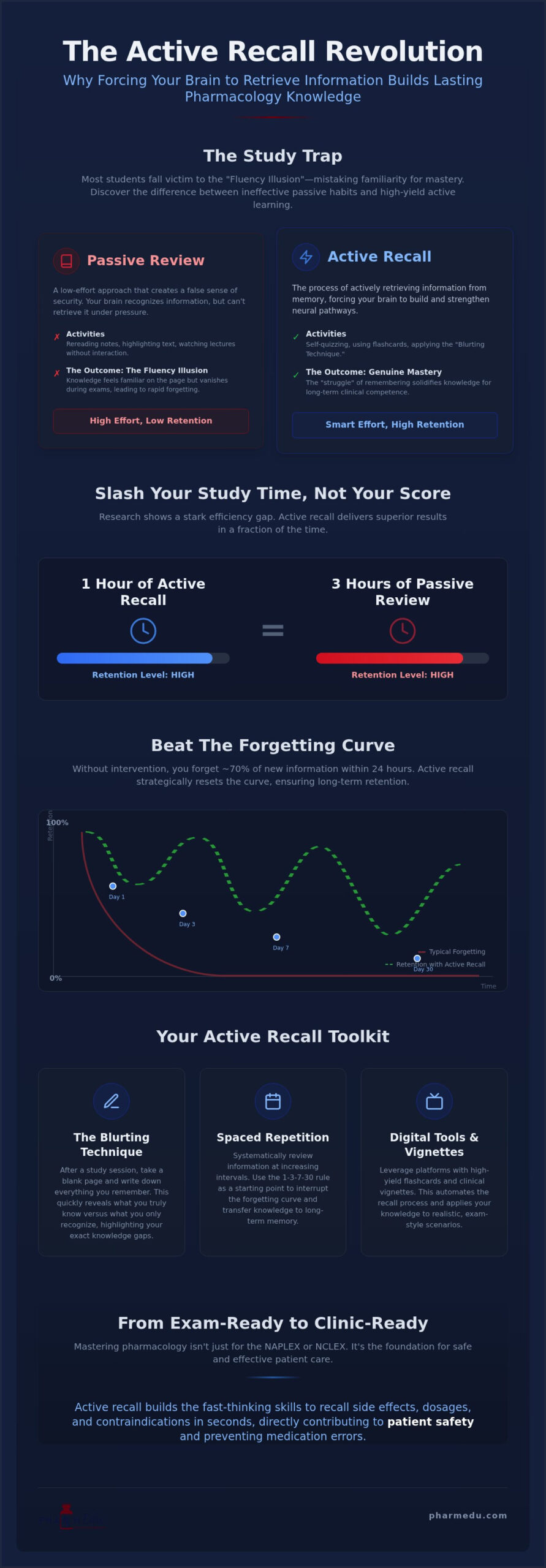
Passive study methods like highlighting, rereading, or watching videos without interaction are low-effort and provide a false sense of security. In contrast, active recall for pharmacology studying involves self-quizzing and the “blurting” method. The efficiency gap between these two approaches is stark. Consider these differences:
- Passive: Rereading a chapter three times with minimal retention.
- Active: One focused session of flashcards that identifies specific knowledge gaps.
- Efficiency: Research suggests that one hour of active recall can equal three hours of passive review.
The Role of Retrieval in Long-Term Clinical Competence
Mastering drug classes isn’t just about passing the NAPLEX or NCLEX. In a clinical environment, you won’t have time to consult a textbook before administering a medication. Active retrieval builds the “fast-thinking” skills necessary to recall side effects and dosages in seconds. By solidifying this knowledge now, you directly contribute to patient safety and the prevention of medication errors. Active recall is the gold standard for medical education in 2026.
The Science of Retrieval: Why High-Yield Learning Beats Rereading
Retrieval is a biological process of reconstruction, not just a search of a mental database. When you engage in active recall for pharmacology studying, you’re engaging neuroplasticity to strengthen the synaptic pathways associated with complex drug names and their therapeutic classes. Every time you struggle to remember the difference between an ACE inhibitor and an ARB, your brain builds a more durable connection. This “desirable difficulty” is exactly what makes the knowledge stick long after the lecture ends.
Cognitive Load Theory explains why students often feel overwhelmed. Pharmacology presents an immense volume of information, from pharmacokinetics to adverse reactions. Without a system to manage this “input,” your brain reaches a saturation point. Navigating a pharmacology study guide for nursing students can feel like drowning in a data dump if you focus solely on encoding (input). To succeed, you must shift your focus to retrieval (output). The brain prioritizes information that it’s required to produce, not just information it’s exposed to.
Overcoming the Forgetting Curve
The Ebbinghaus Forgetting Curve illustrates a harsh reality for medical students. Without active intervention, you’re likely to forget approximately 70% of a lecture within 24 hours. Strategic interruption is the only way to reset this curve. By performing a quick retrieval session shortly after learning a new drug class, you bring your retention back to 100%. This is why cramming fails; it provides the input but skips the retrieval practice necessary to survive the high-pressure environment of board exams.
High-Yield vs. Low-Yield Information
Success in 2026 requires efficiency. You can’t memorize every obscure drug ever manufactured. Instead, your recall efforts should focus on “High-Yield” data: Mechanism of Action (MOA), Black Box Warnings, and major contraindications. Experts at Windsor University School of Medicine highlight 5 Proven Active Recall Techniques that help students isolate these critical points. Many students find that using PharmEDU’s High-Yield Video Vignettes helps pre-filter this data, ensuring they only spend energy on the most relevant clinical information. This targeted approach prevents the cognitive fatigue that often accompanies traditional, unguided study methods.
5 Proven Active Recall Techniques for Drug Class Mastery
Transitioning from passive reading to active recall for pharmacology studying requires a shift in your daily routine. Instead of starting your session by opening a textbook, start by testing what you already know. This proactive approach identifies weak spots immediately, ensuring you don’t waste time on concepts you’ve already mastered. Implementation is most effective when it becomes a consistent, daily habit rather than a last-minute effort before an exam.
The Blurting Method is one of the most effective ways to begin. Take a blank sheet of paper and write down everything you can remember about a specific drug class, such as Beta-blockers or NSAIDs. Include indications, side effects, and contraindications. Once you’ve exhausted your memory, compare your “blurt” to your notes using a different colored pen. This visual representation of your knowledge gaps is a powerful tool for focused review.
Another essential technique is the Feynman Technique. This involves explaining the Mechanism of Action (MOA) of a drug as if you were speaking to someone with no medical background. For example, when studying ace inhibitors, you might describe how they “relax the pipes” by blocking a specific enzyme that usually tightens them. If you can’t simplify the concept, you don’t fully understand it yet. Finally, utilize Question-Based Note Taking. Instead of writing “Loop Diuretics Side Effects,” write “What is the primary side effect of Loop Diuretics?” This turns your study material into a series of mini-exams, forcing your brain to work for the answer every time you look at your page.
Mastering Flashcards: Beyond Simple Definitions
Effective flashcards follow the “One Idea Per Card” rule to prevent cognitive overload. If a card asks for five different side effects, you’re likely to fail the retrieval process. Instead, use Interactive Pharmacology Flashcards that focus on high-yield, singular facts. Cloze deletion, or fill-in-the-blank, is particularly effective for memorizing drug-drug interactions. For instance, a card might read: “Combining Sildenafil with [blank] can cause life-threatening hypotension.” This forces a precise retrieval that matches the demands of board exams.
Clinical Case-Based Recall
To prepare for clinical rotations, apply recall to real-world scenarios. Ask yourself: “A patient presents with a dry cough after starting a new blood pressure medication; what is the likely causative agent?” This is “Reverse Recall,” where you start with the side effect and work backward to the drug class. You can also integrate visuals by attempting to draw drug pathways on a blank diagram. These methods ensure that active recall for pharmacology studying builds the fast-thinking skills required for professional practice.
Building a Long-Term Retention System: Spaced Repetition Integration
Active recall for pharmacology studying is only half the battle. While recall is the “what” of your learning process, spaced repetition is the “when.” Without a structured schedule, even the most effective retrieval sessions won’t prevent the natural decay of memory over time. Integrating these two concepts creates a synergistic system that ensures drug mechanisms move from your short-term working memory into long-term clinical competence.
A proven framework for this is the 1-3-7-30 Rule. After you learn a new drug class, you should perform your first active recall session within 24 hours. You then revisit that material on day 3, day 7, and day 30. This schedule forces retrieval just as your brain begins to forget, which is the exact moment when learning becomes most durable. Digital platforms play a vital role here by automating this complex schedule, especially when you’re using a naplex prep course to manage your study workload.
Scheduling Your Recall Sessions
Consistency beats intensity every time. Many students find success with a morning brain dump, where they spend 15 minutes before clinical rotations performing a quick blurt of yesterday’s drug classes. If you’re on a busy rotation, use micro-learning segments. Five minutes of flashcards during a coffee break is more effective than a four-hour marathon on a Sunday. You can adjust the frequency based on the difficulty of the drug class. If you’ve mastered ACE inhibitors but struggle with anti-arrhythmics, increase the recall frequency for the latter until the neural pathways solidify.
Interleaving: The Secret to Board Exam Success
Don’t fall into the trap of studying only one drug class at a time. This is called blocking, and it creates a false sense of security. In clinical practice and on board exams, questions don’t arrive in neat, predictable categories. Interleaving involves mixing Cardiac, Respiratory, and Neuro drugs in a single recall session. This forces your brain to distinguish between similar-sounding drug names and differing mechanisms of action under pressure.
When you have a massive backlog of 500+ cards, don’t panic. Focus on high-yield topics first and subscribe to PharmEDU’s Interactive Pharmacology Flashcards to streamline your review sessions. Mixing categories simulates the random nature of the NAPLEX or NCLEX, preparing you for the reality of the exam room and the fast-paced nature of modern healthcare.
Optimizing Your Study Workflow with PharmEDU’s Active Learning Tools
The greatest barrier to active recall for pharmacology studying isn’t the difficulty of the concepts, but the “setup friction” of creating study materials. Manual flashcard creation and question writing often become forms of productive procrastination. PharmEDU removes this administrative burden by providing a platform where high-yield content is already structured for immediate retrieval. This allows you to spend your limited energy on the cognitive work that actually builds memory, rather than the clerical work of organizing notes.
Our Interactive Pharmacology Flashcards are pre-vetted to ensure they focus only on the most critical clinical data. By using these cards, you’re simulating exam conditions with every click. Similarly, our Pharmacology Practice Quizzes provide immediate feedback, which is a vital component of the retrieval process. When you get a question wrong, the platform doesn’t just show the correct answer; it provides the rationale needed to correct your mental model before the error becomes ingrained. This cycle of retrieval and correction is what separates top-tier students from those who simply “recognize” the material.
Leveraging High-Yield Video Vignettes
While video is traditionally a passive medium, PharmEDU’s High-Yield Video Vignettes are designed for active engagement. We recommend the “Pause, Recall, Play” strategy. When a mechanism of action is introduced, pause the video and try to sketch the pathway or explain it aloud before the narrator continues. This transforms the video from a lecture into a guided retrieval session. This method integrates perfectly with our comprehensive pharmacy review platform, ensuring that you aren’t just watching content, but actively processing it for long-term retention.
Tracking Your Mastery and Progress
You can’t fix what you don’t measure. The PharmEDU dashboard provides a clear visualization of your “Weak Spots,” allowing you to see exactly which drug classes require more frequent recall sessions. This data-driven approach ensures your study time is always allocated to the areas of highest need. For faculty members, our Institutional Platform License offers tools to monitor student engagement with active recall activities, ensuring the entire cohort is prepared for clinical rotations. It’s time to stop guessing and start mastering. Begin your journey today with a PharmEDU Monthly Subscription and experience the efficiency of a science-backed study workflow.
Secure Your Clinical Future with Retrieval-Based Learning
Mastering drug classes in 2026 requires more than just exposure to text; it demands a shift in how you process information. By replacing passive rereading with active recall for pharmacology studying, you’re building a neurological foundation that survives the pressure of board exams and real-world clinical rotations. You’ve learned that techniques like “blurting” and the Feynman method identify knowledge gaps early, while spaced repetition ensures that critical data doesn’t decay over time.
Efficiency is the hallmark of a successful healthcare professional. PharmEDU is built to remove the administrative burden of study prep. It’s a mobile-compliant platform that fits into your busiest clinical days. With access to over 100 high-yield pharmacology topics and interactive flashcards engineered for long-term retention, you can stop worrying about “what” to study and focus on mastery.
Master pharmacology today with a PharmEDU Monthly Subscription
Frequently Asked Questions
Is active recall better than highlighting for pharmacology?
Yes, retrieval practice is significantly more effective than highlighting for pharmacology. Highlighting is a passive habit that creates a “Fluency Illusion” where you recognize the text but can’t recall it later. Active recall forces your brain to reconstruct the information, which is essential for managing the high cognitive load of drug-drug interactions and contraindications found in professional clinical practice.
How long should I spend on active recall each day?
You should aim for 30 to 60 minutes of retrieval practice every day. While longer sessions are possible, the key is consistency and frequency. Using micro-learning segments of 10 to 15 minutes during clinical breaks can be highly effective. This approach prevents cognitive fatigue while ensuring you hit the necessary intervals for the 1-3-7-30 spaced repetition rule.
Can I use active recall for memorizing drug mechanisms of action?
Yes, active recall is the most effective way to master drug mechanisms. Instead of just reading how a drug works, you should explain the mechanism aloud or draw the pathway on a blank diagram. This forced retrieval strengthens the synaptic pathways associated with complex physiological processes, making it easier to remember how different drug classes interact with specific receptors in the body.
What is the best way to start using active recall if I am a beginner?
Beginners should start by turning their study guide headers into questions. For example, change “Beta-Blocker Side Effects” to “What are the primary side effects of Beta-Blockers?” Attempting to answer these questions before looking at the text is the easiest way to begin active recall for pharmacology studying. It immediately highlights your knowledge gaps without requiring complex setup or expensive materials.
Do I need to make my own flashcards for active recall to work?
You don’t have to make your own cards for the method to be effective. While making cards can be helpful, it often becomes a time-consuming administrative task. Using pre-vetted, Interactive Pharmacology Flashcards allows you to jump straight into the retrieval process. This ensures you’re spending your study time on high-yield content that is actually tested on board exams like the NAPLEX or NCLEX.
How does active recall help with NAPLEX or NCLEX board prep?
Active recall simulates the exact mental process required during high-stakes board exams. By practicing retrieval under timed conditions, you build the “fast-thinking” skills needed to navigate the random nature of the NCLEX or NAPLEX. This method helps you move beyond simple recognition to a deeper level of mastery, which is vital for passing these exams on your first attempt.
What is the “blurting method” in pharmacology studying?
The blurting method is a powerful retrieval technique where you write everything you know about a drug class on a blank page. After you’ve exhausted your memory, you use your notes to check for accuracy. This process provides immediate feedback on your “Weak Spots,” allowing you to focus your remaining study time on the specific mechanisms or side effects you forgot.
Can active recall be used for clinical case studies?
Applying active recall for pharmacology studying to clinical case studies is excellent for building professional competence. You can use “Reverse Recall” by identifying a patient’s symptoms and then retrieving the potential causative drug classes from memory. This practice bridges the gap between theoretical knowledge and the real-world decision-making required during clinical rotations or when working as a licensed pharmacist or nurse.