
Best Pharmacology Learning Apps: Top Picks for 2026
What if the thousand-page pharmacology textbook on your desk is actually hindering your ability to recall critical drug interactions when you’re standing at a patient’s bedside? Most healthcare students and professionals feel buried under an avalanche of mechanism-of-action diagrams and endless lists of adverse effects. It’s exhausting to spend hours highlighting chapters only to forget the specific contraindications of a drug class during a high-stakes exam or a busy clinical shift. Finding the best app for learning pharmacology isn’t just about digital convenience. It’s about shifting from passive reading to a structured, high-yield retention strategy that fits into the gaps of your daily routine.
You deserve a study method that respects your schedule and ensures you’re prepared for the NAPLEX, NCLEX, or USMLE. This guide explores the most effective mobile tools available in 2026 to help you master complex drug mechanisms and feel confident in clinical administration. We’ll preview the essential “study stack,” comparing clinical reference giants with innovative micro-learning platforms like PharmEDU. By the end of this review, you’ll know exactly which digital mentors will help you bridge the gap between theoretical knowledge and professional excellence.
Key Takeaways
- Transition from dense textbooks to digital micro-learning segments to prevent cognitive overload and master complex drug classes more efficiently.
- Identify the best app for learning pharmacology by prioritizing platforms that offer deep dives into mechanisms of action rather than simple drug lists.
- Utilize High-Yield Video Vignettes and clinical case studies to bridge the gap between theoretical knowledge and successful board exam performance.
- Incorporate Interactive Pharmacology Flashcards into clinical rotations to turn short breaks into high-retention active recall sessions.
- Apply the “15-minute rule” to maximize study efficiency during transit, ensuring consistent progress without requiring long, dedicated study blocks.
Why Mobile Apps Are Essential for Mastering Pharmacology in 2026
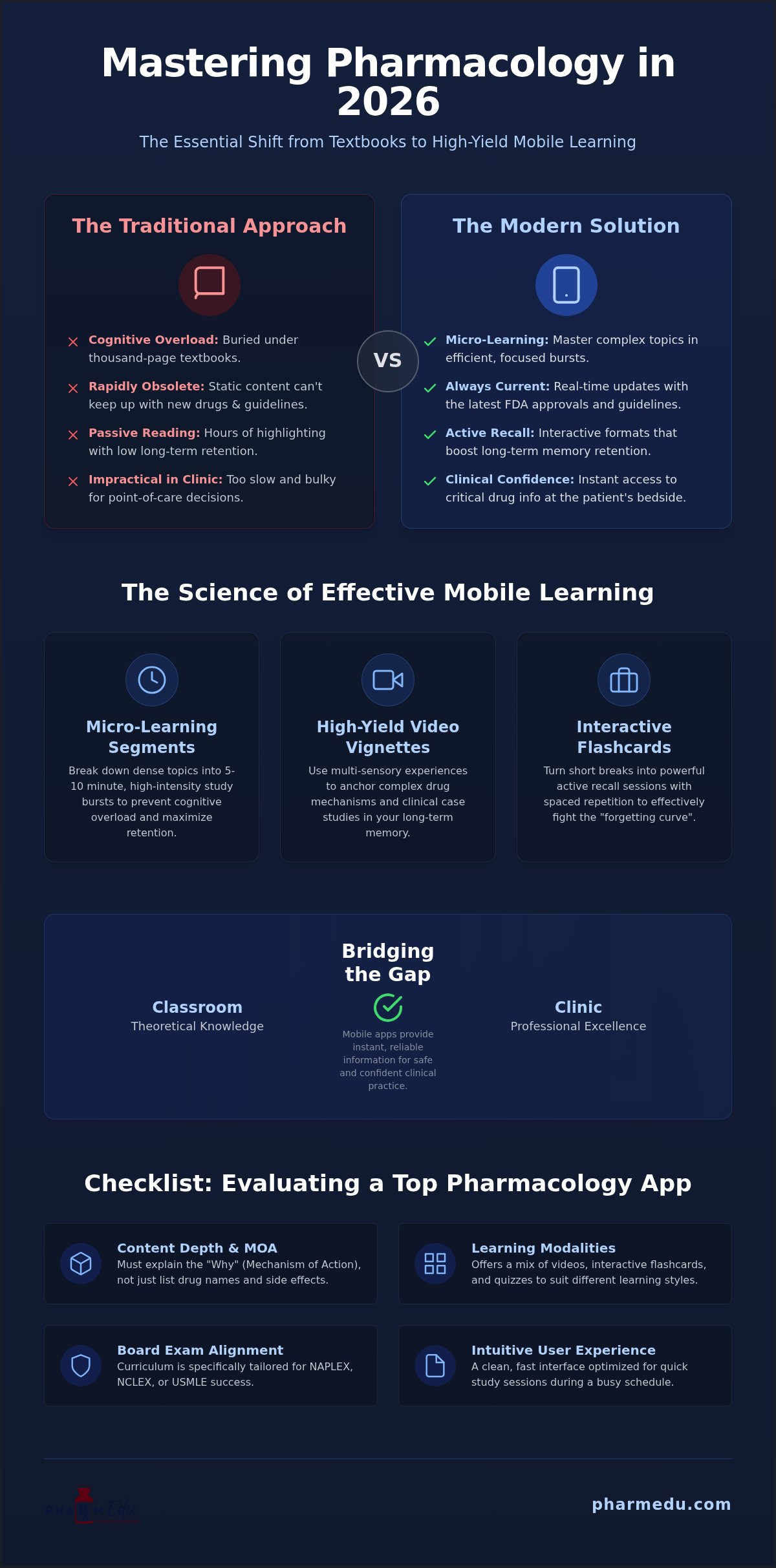
The days of lugging around heavy volumes for pharmacology are over. In 2026, the sheer volume of new therapeutic agents and updated clinical guidelines makes static textbooks obsolete almost as soon as they’re printed. Digital-first education isn’t just a convenience; it’s a necessity for staying current. Modern Educational technology allows for real-time updates that reflect the latest FDA approvals and safety warnings. This agility is vital because board exams like the NAPLEX, USMLE, and NCLEX have evolved. They no longer reward simple rote memorization. Instead, they test your ability to apply drug logic to complex patient scenarios, making the best app for learning pharmacology an essential partner in your professional development.
The Science of Micro-Learning in Medical Education
Micro-learning involves breaking down dense topics into 5 to 10 minute bursts of high-intensity study. This method is specifically designed to prevent cognitive overload, which often happens when you’re trying to memorize dozens of drug classes in a single sitting. High-yield video vignettes provide a multi-sensory experience that anchors drug mechanisms in your long-term memory more effectively than reading text alone. By focusing on one specific “mechanism of action” or “adverse effect profile” at a time, you build a stronger conceptual foundation. Mobile platforms utilize spaced repetition algorithms to ensure you revisit difficult concepts just as they’re beginning to fade from your memory, effectively fighting the forgetting curve. This approach respects your limited time while maximizing the impact of every study session.
Bridging the Gap Between Classroom and Clinic
The transition from a lecture hall to a fast-paced hospital environment is notoriously difficult. During clinical rotations, you don’t have time to consult a thousand-page manual before administering a medication. You need instant access to drug-drug interaction logic and dosing summaries to ensure patient safety. Using a digital pharmacology study guide for nursing students or pharmacy interns provides that essential bridge. These tools allow you to verify a medication’s safety profile in seconds, fostering a sense of security and professional competence. When you use the best app for learning pharmacology, you aren’t just studying for a passing grade; you’re preparing for the reality of patient care where speed and precision are non-negotiable. Digital tools ensure that the “Why” behind every prescription is always at your fingertips, turning “dead time” between patient rounds into productive, high-yield learning opportunities.
Criteria for Evaluating the Best Pharmacology Learning Apps
Selecting the best app for learning pharmacology requires looking beyond simple drug databases. While reference tools are vital for checking dosages at the point of care, a true learning platform must facilitate deep conceptual understanding. In 2026, the standard for excellence is no longer just about how much information an app contains, but how effectively it helps you retain that information. You should evaluate any potential tool based on its ability to bridge the gap between memorizing a name and understanding a biological system. High-quality platforms prioritize evidence-based updates to ensure their content reflects the latest 2026 clinical guidelines and FDA approvals.
To find a tool that actually supports your professional growth, consider these specific benchmarks:
- Content Depth: Does the app explain the “Why” behind the “What”? It should focus heavily on mechanisms of action (MOA) rather than just listing drug names and side effects.
- Learning Modalities: A mix of High-Yield Video Vignettes, flashcards, and quizzes is essential for catering to different learning styles.
- Board Exam Alignment: The curriculum must be specifically tailored to the rigorous requirements of the NAPLEX, NCLEX, or USMLE.
- User Experience: The interface must be intuitive. If you can’t navigate to a specific drug class during a five-minute coffee break, the app isn’t optimized for your busy schedule.
Instructional Quality vs. Pure Question Banks
Many students make the mistake of choosing an app based solely on the number of questions in its database. However, five thousand questions are useless if the rationales are thin or confusing. Instructional quality matters most. Look for content developed by verified healthcare educators who understand the nuances of pharmacokinetics. High-Yield Video Vignettes are particularly effective here; they transform abstract concepts into visual narratives that are much easier to recall during a high-stakes exam. If you want to see how structured rationales can improve your scores, exploring pharmacology practice quizzes is an excellent way to test an app’s instructional depth.
Mobile Accessibility and Offline Functionality
Your study environment isn’t always a quiet library with perfect Wi-Fi. Medical students and professionals often find themselves in hospital basements or on transit where connectivity is spotty. The best app for learning pharmacology must offer robust offline functionality. This ensures your progress stays synced across all your devices, from a tablet at home to your phone in the clinic. Additionally, evaluate the “clutter” factor. A clean, focused design without distracting ads or unnecessary features allows you to maintain the high levels of concentration required for mastering complex drug interactions.
Top Pharmacology Apps for Students and Professionals in 2026
The digital landscape for medical education has matured significantly, offering tools that cater to every stage of a healthcare career. PharmEDU leads the field as the best app for learning pharmacology because it provides a structured, high-yield curriculum that replaces the need for dense textbooks. While other platforms focus on raw data, PharmEDU uses High-Yield Video Vignettes to build a conceptual bridge between drug classes. For clinicians requiring precise dosing and real-time interaction checks, Lexicomp remains the gold standard in hospital settings. Students who prioritize active recall often integrate Anki into their routine, as its spaced repetition algorithm is highly effective for memorizing drug names and dosages. Medscape continues to be a vital free resource for medical news and basic drug lookups, while Pocket Pharmacist offers a streamlined, no-frills experience for those who need quick, reliable drug information on a simplified interface.
Learning Platforms vs. Clinical Reference Tools
It’s vital to understand that a drug database is not a substitute for a learning platform. Reference tools like Lexicomp are designed for the point of care, providing immediate answers to specific clinical questions. In contrast, a learning platform like PharmEDU is built to help you internalize the underlying logic of pharmacotherapy. A drug database tells you the dose; a learning app explains why that dose is necessary and how it affects the patient’s physiology. You’ll find that the best app for learning pharmacology is one that offers a subscription value beyond simple lookups, providing the interactive flashcards and practice quizzes needed for deep retention. Most successful professionals maintain a “study stack” that includes one tool from each category to ensure they’re prepared for both exams and patient care.
Best Apps for Specific Board Exams
Your choice of digital tool should be dictated by the specific milestones you’re facing. For those entering the pharmacy profession, PharmEDU serves as an essential naplex prep course supplement by organizing vast amounts of clinical data into manageable micro-learning segments. Nursing students often require apps that emphasize patient safety, monitoring parameters, and administration protocols for the NCLEX. Meanwhile, medical students focus on the pathophysiology and mechanism-heavy content required for USMLE Step 1 and Step 2. By selecting an app that aligns with your specific board requirements, you ensure that your study time is spent on high-yield material. This targeted approach reduces the anxiety of exam preparation and ensures that you aren’t just memorizing facts, but building a foundation for a successful clinical career.
Maximizing Your Study Efficiency with Pharmacology Apps
Efficiency in medical education is often misunderstood as the ability to endure grueling, hours-long library sessions. However, mastering complex drug classes requires frequent, high-intensity engagement rather than occasional marathons. The best app for learning pharmacology should empower you to reclaim “lost” time throughout your day. By applying the 15-minute rule, you can transform a daily commute or a gap between lectures into a focused review of beta-blockers or anticoagulants. This micro-learning approach ensures that your brain remains primed for retention without the mental fatigue associated with traditional study methods. It’s about making progress in the margins of your schedule so that your dedicated study blocks can be used for deeper integration.
Interactive Pharmacology Flashcards are the cornerstone of a high-efficiency strategy. These tools force your brain to retrieve information actively, which is far more effective than passively rereading a textbook chapter. When you’re on clinical rotations, these digital cards become a portable mentor. They allow you to reinforce your knowledge of a drug’s mechanism immediately after seeing it prescribed in a real-world setting. Combining these sessions with Clinical Case Studies allows you to see how theoretical facts translate into patient outcomes, fostering the clinical judgment required for 2026 practice standards. Setting daily goals within your platform helps maintain this momentum, ensuring you don’t fall behind during the most demanding weeks of the semester.
Active Recall and Spaced Repetition Techniques
Using app-based quizzes allows you to identify your knowledge gaps before they become critical failures on an exam. Instead of reviewing what you already know, use your data to focus on high-priority weaknesses. Most modern platforms allow you to ‘flag’ specific drugs or mechanisms that cause confusion, creating a customized queue for your next specialized review session. Consistency is the primary driver of success here. Setting a modest daily goal, such as completing twenty flashcards or watching one video vignette, builds a durable habit that outperforms any last-minute study session. This methodical approach ensures that by the time board exams arrive, the information is deeply ingrained in your long-term memory.
Supplementing Digital Learning with Traditional Study
While digital tools are revolutionary, they work best when integrated into a broader academic strategy. You can use mobile apps to supplement a comprehensive pharmacy review, allowing you to alternate between deep-dive reading and rapid-fire testing. A hybrid study plan balances the visual clarity of high-yield video vignettes with the rigorous demand of practice questions. Tracking your performance statistics within the app provides a clear, data-driven picture of your board readiness. This transparency allows you to adjust your focus areas in real-time, ensuring no drug class is left unmastered. To start building your personalized study habit and ensure you’re fully prepared, consider signing up for a PharmEDU Monthly Subscription today.
Why PharmEDU is the Definitive Pharmacology App for 2026
PharmEDU represents the evolution of medical education, moving beyond the limitations of digitized textbooks to offer a truly interactive experience. While legacy competitors often provide dry, text-heavy databases, this platform delivers a curriculum of over 100 topics through modern micro-learning segments. This structure is specifically designed for the 2026 student who must balance academic rigor with a demanding clinical schedule. You’ll achieve visual mastery through High-Yield Video Vignettes that prioritize the “Why” behind drug therapy, ensuring you understand the underlying physiology rather than just memorizing a list of side effects. These videos are seamlessly integrated with Interactive Pharmacology Flashcards, creating a high-speed retention loop that solidifies your knowledge in record time. Because the platform includes Clinical Case Studies that mirror the complexity of current board exams, it is widely considered the best app for learning pharmacology for those aiming for top-tier results.
A Mobile-First Design for the Modern Student
Many older applications suffer from technical pitfalls like slow load times, clunky navigation, or interfaces that don’t scale well across devices. PharmEDU avoids these frustrations with a streamlined, mobile-first design that allows for a seamless transition between video, quiz, and flashcard modalities. You can watch a vignette on your commute and immediately jump into a related quiz without any friction. The platform’s user-centric progress tracking provides a clear visual representation of your mastery, which helps maintain motivation during long, difficult semesters. This technical precision ensures that your focus remains entirely on the science, not on fighting a poorly designed interface.
Proven Results for Board Certification
The true measure of an educational tool is the success of its users. Students who have utilized PharmEDU report a significant increase in their confidence during high-stakes clinical rotations and board exams. This proven track record has led to an increase in institutional licensing, as more nursing and pharmacy programs recognize the value of providing their students with a unified, high-quality learning resource. By aligning content directly with the latest 2026 standards for the NAPLEX, NCLEX, and USMLE, the platform serves as a reliable bridge to professional licensure. If you’re looking for a partner in your professional journey, the best app for learning pharmacology is one that evolves alongside the industry. Ready to master pharmacology? Start your PharmEDU Monthly Subscription today and take the first step toward clinical excellence.
Elevate Your Clinical Competence in 2026
Mastering the complexities of modern drug therapy requires more than just a reference database; it demands a structured learning ecosystem that prioritizes conceptual understanding. By shifting from passive reading to micro-learning segments, you can overcome information overload and build the durable knowledge required for the NAPLEX, NCLEX, or USMLE. Integrating active recall through digital tools ensures that you aren’t just memorizing facts, but developing the clinical judgment necessary for safe patient care. Choosing the best app for learning pharmacology is a strategic decision that bridges the gap between your academic studies and the fast-paced reality of clinical practice.
PharmEDU is designed to be your digital mentor throughout this journey. With a mobile-compliant interface, you can access High-Yield Video Vignettes covering over 100 topics and use Interactive Pharmacology Flashcards during the quiet moments of your shift. Take control of your professional development and ensure you’re fully prepared for the challenges of 2026. Master pharmacology anywhere with a PharmEDU Monthly Subscription. You have the dedication to succeed, and with the right tools, your path to clinical excellence is within reach.
Frequently Asked Questions
What is the best app for learning pharmacology for nursing students?
PharmEDU stands out as the best app for learning pharmacology for nursing students because it integrates clinical case studies with medication safety protocols. Unlike tools that only list side effects, it helps students visualize the patient’s physiological response during drug administration. This focus on clinical judgment is essential for passing the NCLEX and ensuring high-quality patient care in a professional hospital environment.
Are there any free apps for learning pharmacology?
While apps like Medscape provide excellent free drug databases for quick clinical reference, they often lack the instructional depth needed for exam preparation. A dedicated learning platform offers structured video vignettes and interactive quizzes that free resources typically omit. Most students utilize free apps for dosing lookups while relying on premium subscriptions for their primary board exam study sessions.
How do pharmacology apps help with NAPLEX and NCLEX prep?
Pharmacology apps streamline board prep by utilizing spaced repetition algorithms that target your specific knowledge gaps. Instead of wasting time on drug classes you’ve already mastered, these tools focus your energy on difficult topics like pharmacokinetics or complex drug-drug interactions. This targeted approach is vital for the NAPLEX and NCLEX, where conceptual application is prioritized over simple rote memorization.
Can I use a pharmacology app as my only study resource?
You should use a pharmacology app as a powerful supplement to your institutional curriculum rather than your only study source. These apps are designed to clarify and reinforce the complex theories presented in your lectures and clinical rotations. They act as a high-yield bridge that transforms dense academic information into practical, retrievable knowledge for both exams and patient care.
What is the difference between a drug reference app and a learning app?
A drug reference app is essentially a digital manual used for verifying dosages and contraindications at the point of care. In contrast, the best app for learning pharmacology is an educational platform that builds your foundational understanding through instructional videos and active recall. While you need a reference tool for clinical precision, a learning app is what prepares you for professional licensure.
Do pharmacology apps work offline for hospital use?
Most high-quality pharmacology platforms offer offline functionality to support students working in hospital basements or areas with poor Wi-Fi connectivity. This allows you to review High-Yield Video Vignettes or flashcards during brief breaks in your clinical shift without worrying about data access. Syncing your progress once you’re back online ensures your study statistics remain accurate across all your devices.
How often is the content updated in pharmacology learning apps?
Professional learning apps are updated continuously to reflect the latest 2026 FDA approvals and changes in clinical practice guidelines. This real-time agility is a major advantage over traditional textbooks, which can become outdated within months of publication. Staying current with these updates is critical for maintaining patient safety and ensuring your knowledge aligns with the most recent board exam standards.
Is PharmEDU better than standard flashcard apps for board prep?
PharmEDU offers a more comprehensive experience than standard flashcard apps by integrating its study tools with high-yield video content. While basic flashcard tools are useful for raw memorization, they often lack the conceptual context required for the USMLE or NAPLEX. PharmEDU provides the “why” behind the drug therapy, ensuring that your knowledge is deep enough for complex clinical decision-making.