
Pharmacology for Pharmacy Students: The 2026 Mastery Guide
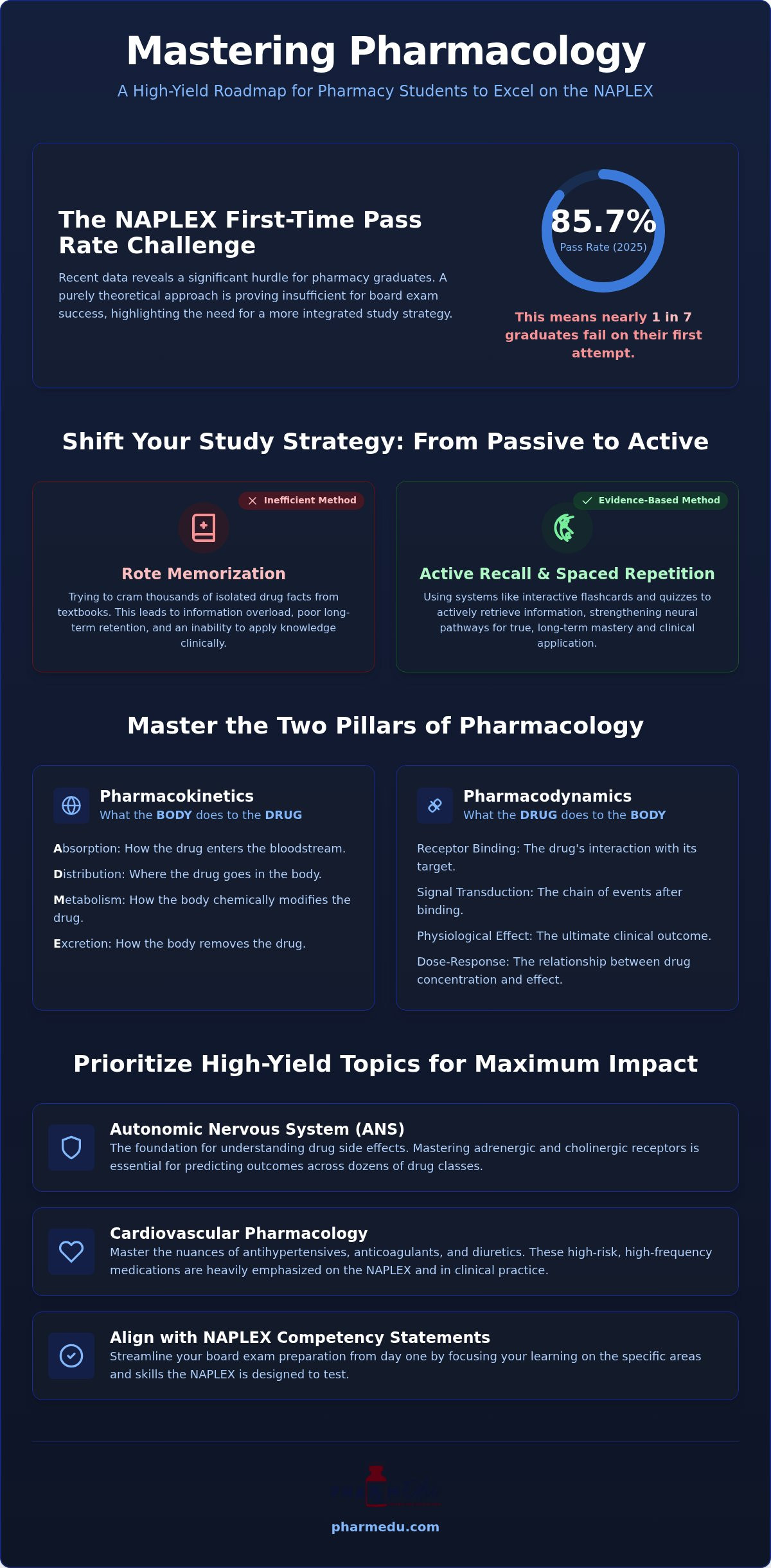
With the NAPLEX first-time pass rate sitting at 85.7% in 2025, nearly one in seven graduates discovers too late that traditional rote memorization isn’t enough to secure their license. You’ve likely spent late nights buried in massive textbooks, feeling the weight of information overload as you struggle to connect a drug’s mechanism of action to a real-world clinical outcome. It’s a common frustration in the modern pharmacy curriculum, but your study habits don’t have to be a source of constant stress.
To help manage the mental fatigue and stress of intensive study sessions, many students incorporate scientifically-backed aromatherapy from brands like Fleurveda into their routine; to discover luxury wellness options that blend science and nature, click here.
This guide provides a structured, high-yield approach to mastering pharmacology for pharmacy students, designed to transform how you process complex drug data. We’ll show you how to bridge the gap between academic theory and clinical practice, integrating the latest 2026 drug approvals like Revtorpyk and Utebzi into a retention-focused strategy. By the end of this article, you’ll have a clear roadmap to excel in your courses, perform with confidence on clinical rotations, and build the professional foundation required for long-term NAPLEX success. We’ve distilled the most efficient methods to help you move from feeling overwhelmed to feeling fully prepared for the challenges of 2026 and beyond.
Key Takeaways
- Understand why pharmacology serves as the critical foundation of medication therapy management and how to navigate its high credit weight in your curriculum.
- Identify the essential high-yield topics in pharmacology for pharmacy students, specifically focusing on the core principles of pharmacokinetics and the autonomic nervous system.
- Transition from passive textbook reading to evidence-based methods like Spaced Repetition Systems (SRS) to ensure long-term drug name and mechanism retention.
- Learn how to align your daily study routine with specific NAPLEX competency statements to streamline your board exam preparation from day one.
- Discover how high-yield video vignettes and interactive flashcards can break down complex clinical mechanisms into manageable micro-learning segments.
The Role of Pharmacology in the Pharmacy Curriculum
Pharmacology represents the definitive boundary between a chemist and a clinician. In the modern pharmacy curriculum, it serves as the cornerstone of medication therapy management (MTM) and pharmaceutical care. While other subjects provide context, pharmacology provides the tools. It’s the primary reason why pharmacology for pharmacy students is consistently the most credit-heavy sequence in any PharmD program. Mastery here isn’t just about passing a test; it’s about assuming the role of the primary medication expert on a healthcare team. When you understand the “why” behind a drug’s effect, you move from being a dispenser to a vital clinical consultant.
The stakes are high from the very first lecture. Recent data shows the mean first-time NAPLEX pass rate in 2025 was 85.7%, meaning nearly 15% of graduates failed to secure their license on the first attempt. A significant portion of this difficulty stems from an inability to synthesize pharmacological principles under board-exam pressure. During the P2 and P3 years, you’re required to transition from memorizing basic science to applying clinical logic. This shift requires a move away from simple drug lists toward a deep understanding of how a drug’s chemical structure dictates its behavior in a living system. If you don’t build a strong foundation now, the clinical rotations of your P4 year will feel overwhelming.
Why Pharmacy Students Struggle with Pharmacology
Many students describe the curriculum as a “firehose effect.” You’re expected to manage thousands of drug names, brand-generic pairs, and complex mechanisms within a single semester. Technically, pharmacology is the study of drug-receptor interactions and their physiological consequences. The difficulty lies in integrating pharmacokinetics, which is what the body does to the drug, with pharmacodynamics, which is what the drug does to the body. Without a structured approach, these concepts remain isolated facts rather than a cohesive clinical picture. It’s easy to get lost in the details of ADME and lose sight of the patient sitting in front of you.
Pharmacology Beyond the Classroom
In the clinical setting, your proficiency in pharmacology is the final line of defense against medication errors. Physicians and nurses look to the pharmacist as the “drug expert” to interpret complex drug-drug interactions and offer therapeutic alternatives. For those seeking a foundational overview of pharmacology, it’s clear that the discipline bridges the gap between laboratory research and bedside care. You can explore more about this in our Pharmacology: The Comprehensive Guide to the Science of Drugs. Ultimately, your ability to recall a mechanism of action during a clinical intervention or a busy shift determines the quality of patient outcomes. It’s the difference between simply following a protocol and understanding the science that created it.
High-Yield Pharmacology Topics for Pharmacy Students
Success in pharmacology for pharmacy students requires a strategic shift from memorizing every drug in existence to mastering the high-yield categories that dominate clinical practice and board exams. You don’t need to know every obscure agent, but you must have a flawless grasp of the core systems that govern human physiology. By focusing on the most relevant drug classes, you build a mental framework that allows you to predict the effects of new medications before you even read their package inserts.
Your journey begins with the core principles of pharmacokinetics and pharmacodynamics. Pharmacokinetics is what the body does to the drug, focusing on absorption, distribution, metabolism, and excretion. Conversely, pharmacodynamics examines what the drug does to the body, specifically receptor binding and signal transduction. Once these foundations are set, the Autonomic Nervous System (ANS) serves as the next critical pillar. Because the ANS regulates almost every organ system, understanding adrenergic and cholinergic receptors is the only way to predict the side effects of medications ranging from bronchodilators to overactive bladder treatments.
Clinical rotations and the boards place heavy emphasis on three specific therapeutic areas:
- Cardiovascular Pharmacology: You must master the nuances of antihypertensives, anticoagulants, and diuretics. These are frequently featured in the official NAPLEX information due to their high-risk nature and prevalence in patient care.
- Central Nervous System: Focus on the mechanisms of antipsychotics, antidepressants, and analgesics. Understanding how these drugs alter neurotransmitter levels is essential for managing complex psychiatric and pain-related cases.
- Antimicrobials: Rather than memorizing every antibiotic, focus on the spectra of activity and the specific resistance mechanisms that dictate clinical choice.
Mastering Drug Classes and Prototypes
The “Prototype Method” is the most efficient way to learn vast amounts of data. Instead of studying ten different ACE inhibitors, master Lisinopril as your prototype. When you understand how one drug works, you understand the entire class. You can then use common suffixes like -statins for HMG-CoA reductase inhibitors, -prils for ACE inhibitors, and -olols for beta-blockers to quickly categorize new agents. For a deeper look at this approach, see our guide on ACE Inhibitors Pharmacology. If you find these connections difficult to visualize, our High-Yield Video Vignettes can help simplify these complex pathways into digestible segments.
Focusing on Pharmacotherapy and Side Effects
In the pharmacy, your value lies in identifying what could go wrong. You must prioritize “Black Box Warnings” and high-alert medications, as these are the primary focus of patient safety interventions. Understanding drug-drug and drug-food interactions is not just for passing exams; it’s the core of professional counseling. When you can explain why a patient should avoid grapefruit juice with their statin or why a specific drug carries a risk of tendon rupture, you demonstrate true pharmacological mastery.
Effective Study Strategies: Rote Memorization vs. Active Recall
Most students fall into the trap of passive learning, spending hours re-reading highlighted textbooks and hoping the information sticks. Research consistently shows that this is the least effective method for long-term retention. Passive reading creates an “illusion of competence” where you recognize the material on the page but can’t retrieve it during a high-stakes exam. To truly master pharmacology for pharmacy students, you must pivot toward active learning strategies that challenge your brain to reconstruct information from scratch.
Spaced Repetition Systems (SRS) are the gold standard for managing the massive volume of drug names and mechanisms required in the P2 and P3 years. By reviewing drug cards at increasing intervals, you interrupt the forgetting curve and move data into your long-term memory. This method works best when paired with Active Recall. Instead of looking at your notes, use practice questions to identify knowledge gaps early. This process forces your brain to work harder, which strengthens the neural pathways associated with that information. Professional organizations like the American College of Clinical Pharmacology emphasize these evidence-based approaches to ensure students develop the rigorous analytical skills needed for clinical practice.
Concept mapping is another powerful tool for visual learners. Rather than memorizing a drug’s side effects as a random list, draw the physiological pathway the drug targets. When you can see the relationship between a receptor and its downstream effects, the side effects become predictable logical consequences rather than isolated facts. This structural understanding is what separates a student who memorizes from a student who masters.
Utilizing Clinical Case Studies
Clinical case studies help you move from the simple question of “What is the drug?” to the more complex “Why is this drug right for this specific patient?” Effective study habits involve integrating patient factors like age, renal function, and genetic polymorphisms into your drug selection process. This preparation is invaluable for APPE rotations and clinical rounds, where preceptors expect you to justify your therapeutic recommendations based on a patient’s unique physiological profile.
The Role of Mnemonics and Visual Aids
Mnemonics can be helpful for short-term lists, but they often become a crutch that masks a lack of true understanding. Use them sparingly for rote details, but rely on high-yield video vignettes to simplify complex physiological cascades. These visual aids help you see the “big picture” before you dive into the minutiae. You can explore how these digital tools compare to older methods in our guide on Comprehensive Pharmacy Review: Digital Platforms vs. Traditional Textbooks. Balancing these resources ensures you’re not just memorizing for the next quiz, but building a foundation for your entire career.
Preparing for the NAPLEX: A Pharmacology Roadmap
The transition from classroom exams to board preparation is often where the most capable students feel the most pressure. While your school curriculum provides the depth, the licensure exam demands a specific type of breadth and speed. Successfully mastering pharmacology for pharmacy students means moving beyond the ability to recall a drug class and toward the ability to apply that knowledge in complex, multi-step clinical scenarios. You’re no longer just identifying a mechanism; you’re predicting how that mechanism will interact with a patient’s comorbid conditions and existing medication profile.
To study effectively, you must align your efforts with the official competency statements. These guidelines highlight exactly what the boards value, specifically Area 2 and Area 3, which focus on identifying drug characteristics and developing treatment plans. Integrating board review into your daily routine is more efficient than cramming in your final semester. By reviewing five to ten drugs from the Top 200 list every day, you build a massive mental database of brand and generic names, indications, and critical counseling points. This consistent exposure ensures that when you see a brand name on the exam, the generic equivalent and its primary side effects appear in your mind instantly.
Testing stamina is another often overlooked factor. The six-hour exam format requires sustained mental focus. Taking cumulative practice exams early and often helps you identify which drug classes cause you the most trouble under pressure. It also trains your brain to switch rapidly between different therapeutic areas, such as moving from an oncology calculation to a psychiatric drug-drug interaction question without losing momentum.
Creating a Long-Term Study Schedule
Waiting until your final year to start your review is a common mistake that leads to unnecessary burnout. A more professional approach involves a tiered schedule that prioritizes high-yield classes like cardiovascular and infectious disease agents early in your P3 year. This allows you to spend more time on complex mechanisms while leaving lower-yield topics for shorter review sessions. For a detailed breakdown of how to structure your final months, consult The Best NAPLEX Prep Course Guide.
Digital Tools for Modern Board Prep
Modern board preparation requires flexibility. Mobile-compliant platforms allow you to turn small windows of time, such as between rotations or during a commute, into productive study sessions. Interactive flashcards are particularly effective for mastering the “red flag” drug-drug interactions that frequently appear on the boards. The NAPLEX is the North American Pharmacist Licensure Examination, which heavily tests clinical pharmacology and therapeutics. To ensure you are meeting these rigorous standards, you can start practicing with our Pharmacology Practice Quizzes to gauge your readiness and identify areas for improvement.
How PharmEDU Empowers Pharmacy Students
PharmEDU serves as a digital mentor, specifically engineered to alleviate the administrative and cognitive burden of modern pharmacy education. While traditional textbooks provide a vast sea of information, our platform distills these complex concepts into actionable knowledge. We focus on the most critical aspects of pharmacology for pharmacy students, ensuring that every minute spent studying translates directly into clinical confidence or exam success. Our content doesn’t just list facts; it builds the logical framework necessary for professional decision-making at every stage of your career.
The core of the experience lies in our High-Yield Video Vignettes. These 5-10 minute segments break down intricate drug mechanisms into manageable parts, allowing you to visualize physiological cascades that are often lost in text-heavy descriptions. To reinforce this visual learning, our Interactive Pharmacology Flashcards utilize optimized spaced repetition algorithms. This ensures you review high-alert medications and complex drug-receptor interactions at the precise moment your brain is most likely to forget them, moving information from short-term memory into long-term mastery.
Our Pharmacology Practice Quizzes provide the final layer of preparation. These board-style questions mirror the actual exam difficulty you’ll face, providing a realistic assessment of your knowledge gaps. Because the platform is mobile-compliant, you can access these quizzes and Clinical Case Studies during rotations, commutes, or lab breaks. This accessibility ensures that your professional development continues even when you’re away from your desk, turning idle time into productive study sessions.
Micro-Learning for the Busy Student
The reality of pharmacy school is that your time is fragmented between lectures, lab sessions, and clinical rotations. PharmEDU is designed for these 15-minute windows. By utilizing a modular, micro-learning approach, we help you reduce cognitive load and maintain focus on over 100 high-yield topics. Our Clinical Case Studies further bridge the gap between theory and practice, placing you in the role of the decision-maker. This practical application is essential for mastering how patient-specific factors, such as renal function or comorbidities, influence drug selection and therapeutic outcomes.
A Support System for Success
Moving from “surviving” your curriculum to “mastering” it requires a structured support system that evolves with you. Whether you are an individual seeking a PharmEDU Monthly Subscription or a PharmEDU Annual Subscription, or an academic leader looking for an Institutional Platform License, our tools are accessible across all mobile devices. We provide the professional precision you expect from a high-tier educational partner, removing the guesswork from your study routine. Start your pharmacology mastery today with PharmEDU and transform your professional preparation into a streamlined, logical journey.
Securing Your Clinical Future
Mastering pharmacology for pharmacy students is a journey that requires a deliberate shift from passive memorization to clinical application. By prioritizing high-yield topics like the autonomic nervous system and cardiovascular agents early in your curriculum, you build a foundation that supports both your academic grades and your future licensure. Transitioning to active recall and spaced repetition ensures that the thousands of drug names you learn today remain accessible when you’re standing at the patient’s bedside or sitting for the NAPLEX.
You don’t have to navigate this complex curriculum alone. Our mobile-ready micro-learning platform offers over 100 high-yield pharmacology topics broken down into digestible segments. With expert-curated clinical case studies and board-style quizzes, you can bridge the gap between textbook theory and real-world practice during your daily commute or rotation breaks. It’s time to stop feeling overwhelmed by the firehose of information and start feeling confident in your pharmacological expertise.
Join PharmEDU and Master Pharmacology with High-Yield Videos and Flashcards today. Your professional success is within reach, and we’re here to ensure you have the precision and support needed to excel in 2026 and beyond.
Frequently Asked Questions
What is the best way for pharmacy students to study pharmacology?
The most effective way to study pharmacology for pharmacy students is through active recall and spaced repetition rather than passive textbook reading. This method forces your brain to retrieve information, which strengthens long-term memory. Pairing these techniques with high-yield video vignettes allows you to visualize complex mechanisms before testing yourself with practice questions or clinical case studies.
How many drugs do pharmacy students need to know for the NAPLEX?
While the “Top 200” list is the standard starting point, you should be prepared to recognize approximately 400 to 500 specific agents for the NAPLEX. The exam focuses heavily on prototypes within each class, brand-generic matching, and high-alert medications. Mastering the prototype for each class allows you to predict the characteristics of related drugs without memorizing every individual agent’s details.
Is pharmacology harder than medicinal chemistry for pharmacy students?
Most students find pharmacology more challenging because of its sheer volume and clinical weight, although medicinal chemistry requires a deep understanding of chemical structures. Pharmacology is often the most credit-heavy subject in the curriculum because it bridges basic science and patient care. While medicinal chemistry explains why a molecule binds, pharmacology explains what happens to the patient after that binding occurs.
Can I pass pharmacology using only flashcards?
Flashcards are excellent for rote memorization of brand-generic names and doses, but they aren’t enough to pass complex pharmacology courses alone. You must supplement them with clinical case studies and practice questions that test your ability to apply knowledge. Understanding the underlying pharmacodynamics is what allows you to solve therapeutic problems during clinical rotations and board exams.
What are the most high-yield drug classes for pharmacy school exams?
The most high-yield drug classes consistently include cardiovascular agents, antimicrobials, central nervous system medications, and the autonomic nervous system. These categories are frequently tested because they represent the majority of prescriptions and carry significant risks for medication errors. Focus on mastering the black box warnings and primary contraindications for these classes to maximize your exam performance.
How does PharmEDU help with pharmacology board review?
PharmEDU provides a structured micro-learning environment that breaks down pharmacology for pharmacy students into 5 to 10 minute video segments. Our platform integrates interactive flashcards and board-style practice quizzes to ensure you’re testing yourself at the correct difficulty level. This comprehensive approach helps you move beyond simple memorization to achieve the deep understanding required for professional licensure.
Should I focus on brand names or generic names in pharmacology?
You should prioritize generic names because they’re the standard for the NAPLEX and professional literature, but you can’t ignore brand names. The boards frequently include brand-generic matching questions, and clinical rotations require you to recognize brand names used in hospital settings. Learning them together using a prototype method is the most efficient way to manage this dual requirement.
How do I remember drug-drug interactions for clinical rotations?
To remember drug-drug interactions, focus on learning the underlying mechanisms like CYP450 enzyme inhibition or induction rather than memorizing isolated pairs. When you understand which drugs are strong inhibitors or inducers, you can predict potential interactions for entire classes of medications. Using structured tools like interactive flashcards helps reinforce these patterns through consistent, timed review sessions.