
Legal and Ethical Issues in Pharmacology: The 2026 High-Yield Guide
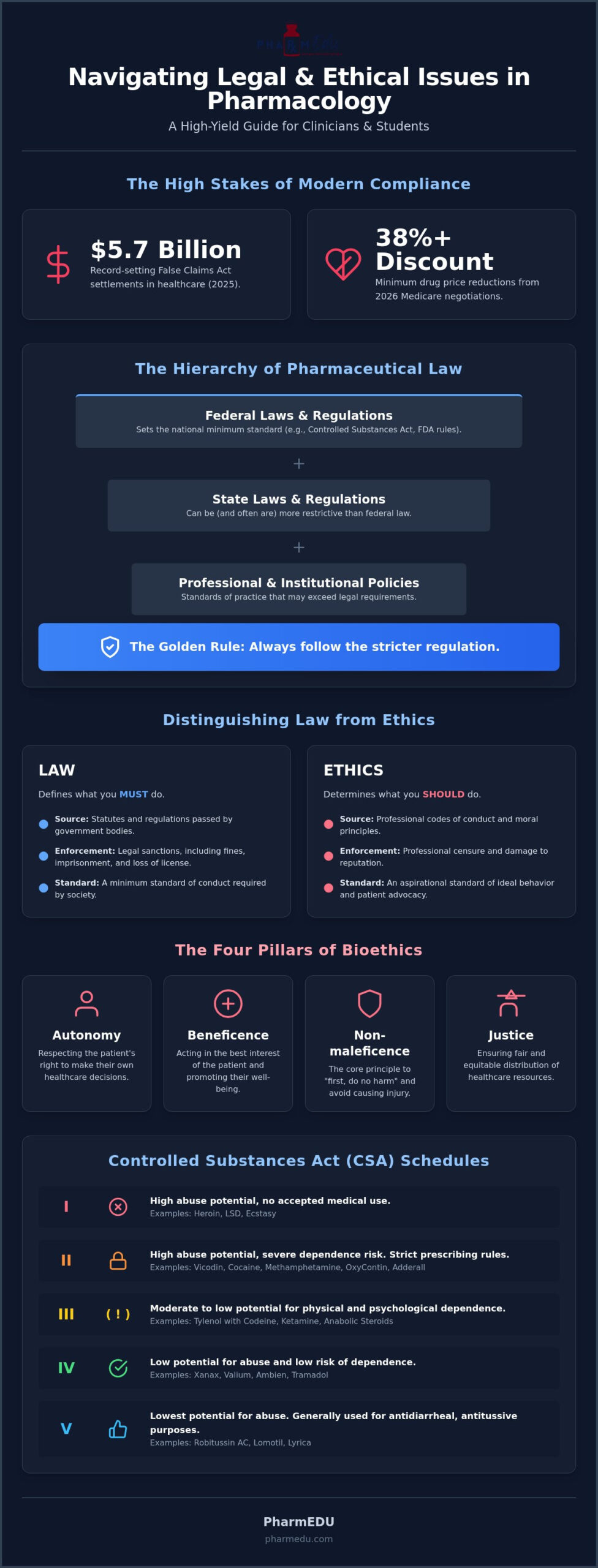
Did you know that healthcare-related settlements under the False Claims Act reached a record 5.7 billion dollars in 2025? For a busy clinician or a student preparing for boards, these figures represent the very real anxiety surrounding professional liability and the complex legal and ethical issues in pharmacology. It’s easy to feel buried under shifting federal mandates, especially with the 2026 implementation of Medicare drug price negotiations that introduced discounts of at least 38 percent on key medications. You shouldn’t have to navigate these complexities alone or worry that a gap in your knowledge might jeopardize your professional license.
This high-yield guide is designed to help you master the core principles required for both your board exams and your daily clinical practice. We’ll clarify the essential frameworks you need for compliance, from the latest DOJ enforcement priorities to the 2026 Code of Ethics for Pharmacists. By the end of this article, you’ll have a clear roadmap for distinguishing legal mandates from ethical duties, ensuring you pass your certification with confidence and provide the highest standard of patient care.
Key Takeaways
- Identify the hierarchy of authority between federal regulations and state laws to maintain professional compliance in a complex regulatory environment.
- Master the schedules of the Controlled Substances Act and modern FDA oversight to protect your professional license and ensure patient safety.
- Apply the four pillars of bioethics—autonomy, beneficence, non-maleficence, and justice—to navigate sensitive legal and ethical issues in pharmacology with clinical precision.
- Evaluate modern challenges such as drug pricing transparency and clinical trial ethics to better understand patient advocacy and the concept of justice in healthcare.
- Discover how to use High-Yield Video Vignettes to bridge the gap between academic theory and the practical application of pharmacy law on board certification exams.
Understanding the Legal and Ethical Framework in Modern Pharmacology
Pharmacology sits at a unique crossroads where hard science meets the gavel of the courtroom. Mastering legal and ethical issues in pharmacology isn’t just an academic hurdle; it’s a foundational prerequisite for safe clinical practice. Jurisprudence provides the “what” and “how” of drug distribution, while bioethics asks the critical “why.” When these fields intersect, they create a safety net for both the patient and the practitioner. Proficiency here reduces the risk of institutional misconduct and directly improves patient outcomes by ensuring treatments are both lawful and morally sound.
In the United States, the hierarchy of authority is clear but often confusing in daily practice. Federal laws, such as the Controlled Substances Act, set a national floor for regulation. However, state laws can be more restrictive. The golden rule for practitioners is simple: you must always follow the stricter of the two regulations. Professional standards and institutional policies add a third layer, often demanding a level of conduct that exceeds the baseline legal requirements. This structured approach ensures that healthcare providers remain compliant while prioritizing safety.
The Distinction Between Law and Ethics in Medicine
Legal obligations are rooted in statutes and regulations. If you violate them, you face tangible sanctions like fines, imprisonment, or the loss of your professional license. Ethical obligations, on the other hand, are guided by Core Ethical Principles in Medicine. These principles, including autonomy and beneficence, often require you to go beyond what’s simply “legal.” Gray areas emerge when a legal mandate feels ethically murky, such as strict pricing regulations that limit access to life-saving drugs. Navigating these moments requires a deep understanding of professional codes of conduct and a commitment to patient advocacy.
Why Legal Issues are High-Yield for Board Exams
Regulatory knowledge is a significant component of the NAPLEX and other certification exams. Examiners don’t just want you to memorize drug classes; they want to know you can apply HIPAA privacy rules or handle an informed consent scenario during a crisis. Clinical case studies frequently test your ability to define the scope of practice or identify a breach in protocol. These sections are often where students lose points due to anxiety about liability. Mastering these concepts is the fastest way to boost your overall score and enter the workforce with a sense of security.
Federal Regulations and Controlled Substances: The Legal Pillars
The transition from the Pure Food and Drug Act of 1906 to today’s rigorous oversight represents a century of learning from clinical tragedies. These regulations now form the essential backbone of the U.S. Legal and Ethical Framework in Pharmacology. In 2026, the FDA updated its Quality Management System Regulation (QMSR) to align with international standards, further complicating the legal and ethical issues in pharmacology for manufacturers and clinicians alike. Compliance today isn’t just about avoiding a fine; it’s about navigating an environment where the DOJ’s National Fraud Enforcement Division, established in January 2026, is more active than ever in pursuing healthcare misconduct.
The Controlled Substances Act (CSA) remains the primary tool for managing drugs with a potential for abuse. It organizes medications into five schedules based on their medical utility and risk. Schedule I substances have no accepted medical use, while Schedule II drugs, such as potent opioids, require the most stringent record-keeping. Clinicians must maintain meticulous logs, as even minor discrepancies can trigger federal audits or allegations of professional negligence. When a provider deviates from the established standard of care, they risk not only their license but also significant malpractice litigation.
The Role of the FDA in Drug Development and Safety
Drug development moves through four distinct phases, each requiring Institutional Review Board (IRB) approval to maintain ethical standards. Phase I tests safety in small cohorts, while Phase III determines efficacy in large populations. Even after a drug reaches the shelf, Phase IV post-marketing surveillance continues via the MedWatch program to catch rare adverse effects. The FDA’s primary mandate is to ensure that all marketed drugs are proven safe and effective for their intended use before they reach a single patient.
The DEA and Controlled Substance Management
Practitioners and pharmacies must maintain active DEA registration to handle controlled medications. By 2026, Electronic Prescribing of Controlled Substances (EPCS) mandates have become the standard to mitigate the risks of forgery and diversion. Schedule II prescriptions are the most restricted, requiring secure electronic signatures and allowing zero refills. In contrast, Schedules III through V permit up to five refills within a six-month window. If you’re finding it difficult to keep these rigid requirements straight, PharmEDU’s High-Yield Video Vignettes offer a practical way to visualize these legal scenarios for better exam retention.
Core Ethical Principles in Pharmacotherapy and Clinical Practice
Ethical principles provide the moral compass for every prescription written and every dose administered. While federal laws dictate the legal boundaries, bioethics governs the choices made within those lines. Mastering legal and ethical issues in pharmacology requires a firm grasp of the four pillars: autonomy, beneficence, non-maleficence, and justice. These aren’t just abstract concepts; they’re practical tools used to resolve conflicts between a patient’s wishes and a provider’s clinical judgment. By applying these frameworks, you ensure that your practice remains patient-centered and professionally sound.
As a clinician, your role as a patient advocate is paramount. You’re often the final barrier between a potential medication error and the patient. This responsibility extends to cultural competence, as a patient’s background can significantly influence their perception of pharmacology and their adherence to treatment plans. By acknowledging these nuances, you uphold the pillar of justice, ensuring that equitable care is provided to all populations regardless of their socioeconomic or cultural status.
Autonomy and Informed Consent in Drug Administration
Autonomy is the cornerstone of modern medicine. It grants patients the absolute right to refuse any medication, even if that refusal appears clinically unwise to the healthcare team. Your primary duty is to facilitate informed consent by ensuring high levels of health literacy. This involves explaining the risks, benefits, and alternatives in plain language, avoiding the dense medical jargon that often leads to confusion. In pediatric pharmacology, you must seek “assent” from the child whenever possible, while obtaining legal consent from the guardian. Conversely, in geriatric care, you may need to navigate the complexities of surrogate decision-makers while still respecting the patient’s remaining cognitive capacity.
Beneficence vs. Non-maleficence: Balancing Risk and Reward
Beneficence and non-maleficence are frequently in tension during drug therapy. Every medication has a therapeutic index, which is the narrow window between a dose that helps and a dose that harms. Ethically, you’re required to calculate whether the potential benefit to the patient outweighs the risk of toxicity or adverse effects. This balance is especially critical when considering “off-label” drug use or experimental therapies. While legal, using a drug for an unapproved indication requires a rigorous ethical justification based on the latest scientific evidence. Managing these conflicts of interest ensures that patient safety remains the priority over institutional or financial incentives. If you’re finding it difficult to apply these concepts to clinical scenarios, PharmEDU’s Pharmacology Practice Quizzes offer a structured way to sharpen your ethical reasoning before exam day.
Modern Ethical Challenges: Clinical Trials, Pricing, and Access
In 2026, the pharmaceutical landscape is defined by a tension between rapid innovation and the fundamental right to affordable care. The implementation of the Medicare Drug Price Negotiation Program on January 1, 2026, represents a historic shift in how we approach the “Justice” pillar of bioethics. With negotiated prices for 10 major Part D drugs, including Eliquis and Jardiance, reflecting at least a 38 percent discount from 2023 list prices, the conversation around legal and ethical issues in pharmacology has moved from theoretical debate to tangible policy. These changes challenge clinicians to balance institutional financial health with the ethical mandate to ensure patients can actually afford their life-saving regimens.
The rise of AI and gene therapy introduces new layers of complexity. The global market for AI in pharmaceuticals is projected to reach 2.5 billion dollars by late 2026. While AI-driven tools and New Approach Methodologies (NAMs) help reduce reliance on animal testing, as highlighted in the FDA’s March 2026 draft guidance, they also raise questions about data privacy and algorithmic bias. Precision medicine offers hope for previously untreatable conditions but often comes with a price tag that tests the limits of healthcare equity. Clinicians must now decide how to allocate these high-cost resources without violating the principle of non-maleficence by causing financial ruin for the families they serve.
In light of these economic pressures, understanding the principles of financial emancipation is becoming increasingly relevant for both patients and providers; you can read more about the wealth-building strategies offered by Don Kilam to help navigate these challenges.
Conflicts of Interest and Pharmaceutical Marketing
The Physician Payments Sunshine Act remains a critical tool for maintaining professional transparency by requiring manufacturers to report payments or transfers of value to healthcare providers. This regulation has effectively dismantled the traditional gift-giving culture that once influenced prescribing patterns. Today, federal law strictly prohibits the exchange of financial incentives that could be construed as kickbacks. Ethical boundaries also extend to Direct-to-Consumer (DTC) advertising. The pressure to satisfy patient requests for specific brands must never override your clinical judgment or the patient’s actual medical needs.
Global Access to Medicines and Healthcare Equity
Patent laws are designed to incentivize R&D investment, which reached an estimated 276 billion dollars annually by 2024. However, these same laws can delay the entry of more affordable generic alternatives. Addressing these health disparities requires a proactive approach to equitable drug distribution. Pharmacists and clinicians in underserved national communities act as frontline providers, ensuring that marginalized populations aren’t left behind as therapies become more specialized and expensive. Mastering these real-world dilemmas is essential for modern practice. Explore PharmEDU’s Clinical Case Studies to practice resolving complex ethical scenarios in a risk-free environment.
Mastering Legal and Ethical Concepts with PharmEDU
Navigating the evolving regulatory environment of 2026 requires more than just passive reading. Traditional study methods often fail to capture the nuance of legal and ethical issues in pharmacology, leaving students feeling unprepared for the high stakes of clinical practice. PharmEDU transforms these abstract concepts into actionable knowledge. By integrating a comprehensive pharmacy review directly into a digital workflow, our platform helps you stay ahead of the latest federal mandates and professional standards without the burnout associated with dense academic texts.
Our High-Yield Video Vignettes allow you to visualize complex legal scenarios, making it easier to understand the real-world application of the Controlled Substances Act or HIPAA privacy rules. When it’s time to memorize drug schedules or specific legal deadlines, our Interactive Pharmacology Flashcards provide a structured, evidence-based approach to retention. These tools are designed to move beyond rote memorization, fostering a deep understanding of the principles that protect both your license and your patients.
Case-Based Learning for Board Exam Readiness
Success on the NAPLEX or NCLEX depends on your ability to apply theory to clinical reality. PharmEDU’s Clinical Case Studies bridge this gap by presenting real-world legal dilemmas that mirror the complexity of current healthcare environments. You’ll analyze scenarios involving informed consent, drug pricing transparency, and the ethical use of experimental therapies. Our Pharmacology Practice Quizzes are specifically engineered to match the style and difficulty of board exam questions. For faculty and students, our institutional tools provide detailed progress tracking, ensuring that every study hour contributes to measurable success.
Studying Anytime, Anywhere for the 2026 Exams
We understand that modern healthcare students are balancing intense clinical rotations with their studies. That’s why PharmEDU utilizes micro-learning segments, breaking down 100 plus topics into manageable units that fit into a busy schedule. Our mobile-compliant design ensures that you can review a high-yield vignette or flip through flashcards during a commute or a lunch break. This flexibility doesn’t sacrifice depth; it simply makes excellence more accessible. Start your PharmEDU Monthly Subscription today and master pharmacology ethics with the support of a dedicated digital mentor.
Advancing Your Practice with Legal and Ethical Precision
Mastering the legal and ethical issues in pharmacology is more than a requirement for passing your board exams; it’s a commitment to the safety of every patient under your care. By understanding the hierarchy of federal regulations and the four pillars of bioethics, you build a professional foundation that remains resilient against liability and misconduct. The 2026 landscape demands that you stay updated on everything from Medicare pricing negotiations to the ethical deployment of AI in drug development. These aren’t just administrative hurdles. They’re the tools that define a high-standard clinician.
PharmEDU is here to ensure you don’t have to face these complexities alone. With over 100 high-yield pharmacology topics, interactive flashcards, and clinical case studies, we provide the clarity you need to succeed. Our mobile-compliant micro-learning segments fit perfectly into your busy rotation schedule, allowing you to study on the go without sacrificing depth. You have the potential to lead your field with confidence and integrity.
Unlock full access to High-Yield Pharmacology Review with a PharmEDU Subscription and take the next step in your professional journey today. We’re proud to be your partner in achieving excellence.
Frequently Asked Questions
What is the difference between a legal issue and an ethical issue in pharmacology?
Legal issues involve mandatory compliance with government statutes and regulations, while ethical issues concern moral principles and professional codes of conduct. Violating a legal requirement results in state or federal sanctions, such as fines or license revocation. In contrast, ethical breaches might not always be illegal but can lead to professional discipline or damage to patient trust. Understanding both is essential for a safe clinical practice.
How does the FDA regulate drug safety and efficacy in 2026?
The FDA regulates drug safety through a rigorous multi-phase clinical trial process and mandatory post-marketing surveillance. In 2026, the agency updated its Quality Management System Regulation (QMSR) to align with international standards. Additionally, the FDA now encourages New Approach Methodologies (NAMs), including AI-driven tools and human cell-based systems, to enhance the accuracy of safety testing while reducing reliance on traditional animal models.
What are the five schedules of controlled substances under the DEA?
Controlled substances are categorized into five schedules based on their medical utility and potential for abuse. Schedule I drugs have no accepted medical use and high abuse potential, while Schedule II drugs have high abuse potential but accepted medical uses. Schedules III through V represent decreasing levels of risk and abuse potential. Clinicians must strictly follow specific record-keeping and prescribing rules for each category to avoid federal penalties.
What are the four main ethical principles used in healthcare?
The four foundational pillars of bioethics are autonomy, beneficence, non-maleficence, and justice. Autonomy respects the patient’s right to choose their treatment, while beneficence requires providers to act in the patient’s best interest. Non-maleficence dictates that practitioners must “do no harm,” and justice ensures that medical resources and drug access are distributed equitably across all patient populations, regardless of their background.
Can a pharmacist legally refuse to dispense a medication based on ethical beliefs?
A pharmacist’s right to refuse varies significantly by state law and institutional policy. While some states have “conscience clauses” that protect a pharmacist’s right to refuse based on moral grounds, they often require the pharmacist to ensure the patient still receives care through a seamless referral. Navigating these legal and ethical issues in pharmacology requires balancing personal values with the professional duty to provide uninterrupted patient care.
What is the Sunshine Act and how does it affect healthcare providers?
The Physician Payments Sunshine Act requires pharmaceutical manufacturers to report any payments or transfers of value made to healthcare providers. This federal law aims to increase transparency and reduce potential conflicts of interest in prescribing habits. Providers should regularly review their reported data to ensure accuracy, as these public records are often scrutinized by regulatory bodies and the public to maintain professional and institutional integrity.
How does PharmEDU help students prepare for the legal sections of the NAPLEX?
PharmEDU simplifies the legal and ethical issues in pharmacology through High-Yield Video Vignettes and Interactive Pharmacology Flashcards. These tools translate dry federal statutes into clinical scenarios that mirror the NAPLEX and NCLEX formats. By using case-based learning, students can practice applying the Controlled Substances Act and HIPAA regulations to real-world situations, ensuring they enter the exam room with the confidence needed to pass.
What are the ethical considerations involved in clinical trials?
Ethical considerations in clinical trials primarily focus on informed consent, participant safety, and the use of placebos in life-threatening conditions. Institutional Review Boards (IRBs) must approve every study to ensure that the risks to participants are minimized and that the research design is scientifically valid. Modern ethical debates also include the “Justice” pillar, focusing on how to ensure diverse representation in trials so that drug efficacy data applies to all patient groups.