
Pharmacology Review for Nurse Practitioners: The High-Yield Guide to Master NP Boards in 2026
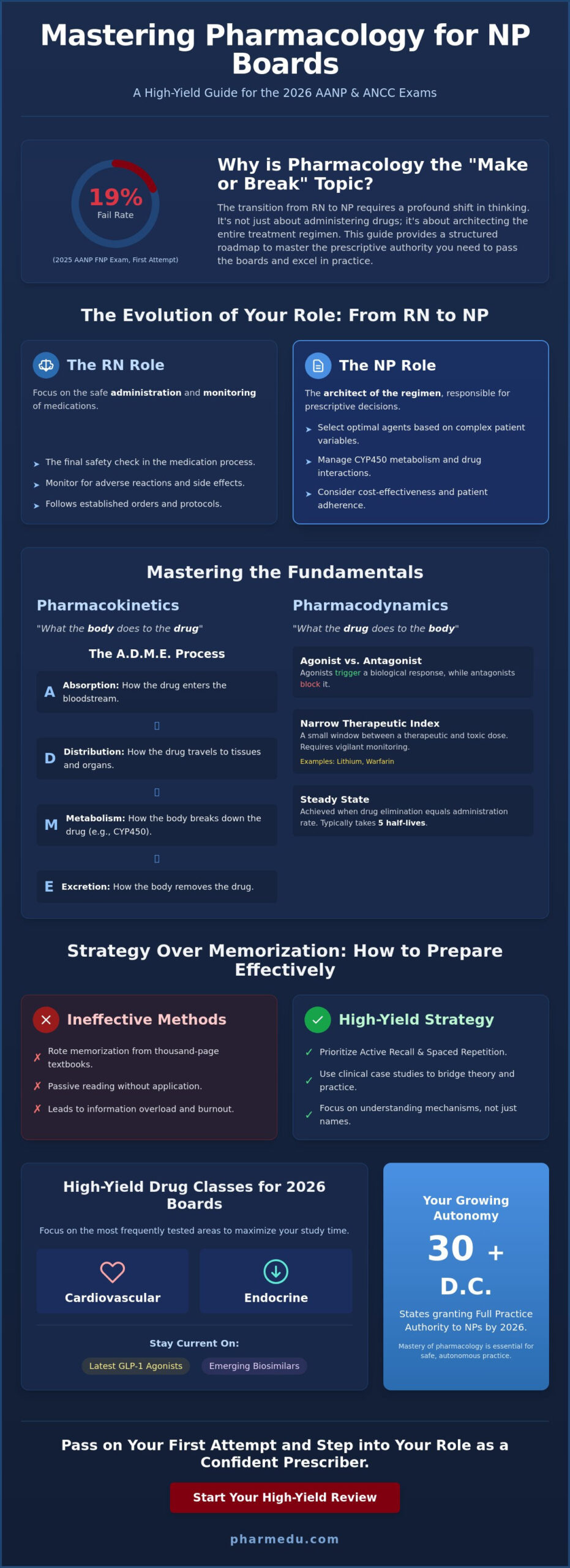
Did you know that in 2025, nearly 20% of candidates failed their first attempt at the AANP Family Nurse Practitioner exam? This sobering statistic highlights why a targeted pharmacology review for nurse practitioners is the most critical component of your board preparation. It’s natural to feel overwhelmed by the daunting transition from administering medications as an RN to making complex prescriptive decisions as a provider. Sifting through thousand-page textbooks often leads to information overload rather than the clinical confidence you need for the 2026 boards.
We’ve designed this guide as a structured, high-yield roadmap to help you master advanced pharmacokinetics and navigate the nuances of prescriptive authority across the 30 states that now grant full practice authority. You’ll gain the clarity needed to manage complex patients and the precision required to excel under exam pressure. We’ll preview the essential drug classes, including the latest GLP-1 agonists and emerging biosimilars, ensuring you’re fully prepared to pass your AANP or ANCC exam on the first attempt and step into your role as a confident, licensed prescriber.
Key Takeaways
- Understand the fundamental shift from medication administration to prescriptive decision-making required for the advanced practice role.
- Master the clinical application of pharmacokinetics by breaking down complex concepts like ADME and steady state into actionable provider logic.
- Learn why a high-yield pharmacology review for nurse practitioners should prioritize active recall and spaced repetition over rote memorization.
- Identify the most frequently tested drug classes for the 2026 AANP and ANCC exams, focusing on cardiovascular and endocrine management.
- Discover how to use clinical case studies and video vignettes to bridge the gap between textbook theory and real-world board questions.
The Shift to Advanced Pharmacology: Preparing for Prescriptive Authority
Advanced pharmacology represents the cornerstone of your transition from a bedside clinician to an autonomous provider. While undergraduate nursing focuses on the safe administration of medications, graduate-level Pharmacology demands a deeper understanding of therapeutic decision-making and legal responsibility. As a Nurse Practitioner (NP), your role involves synthesizing patient history, pathophysiology, and drug mechanisms to select the most appropriate treatment plan. This level of expertise is essential for meeting the rigorous standards set by the AANP and ANCC, where evidence-based prescribing is a primary metric of competency. By 2026, 30 states and the District of Columbia have granted full practice authority, making your mastery of these concepts a matter of professional survival and patient safety. Your ability to prescribe independently or within a collaborative agreement hinges on your performance during these high-stakes board exams.
RN vs. NP Pharmacology: What Changes?
The shift in your clinical mindset is profound. As an RN, you were the final safety check, monitoring for adverse reactions and side effects. As an NP, you’re the architect of the regimen. You’ll move beyond simple monitoring to selecting the optimal agent based on complex variables. This requires a granular focus on CYP450 metabolism and drug-drug interactions that could compromise patient outcomes. You must also account for socio-economic factors like cost-effectiveness and patient adherence, which are often the true barriers to therapeutic success. In 2026, this includes staying current on the rise of biosimilars as standard formulary strategies to manage medication costs for your patients. Understanding these nuances ensures you aren’t just following a protocol but are actively managing a patient’s long-term health through precise pharmacological intervention.
Why Advanced Pharm is the “Make or Break” Board Topic
Pharmacology isn’t just a single category on your certification exam; it’s integrated into every body system section you’ll encounter. Whether you’re managing heart failure or new indications for GLP-1 agonists, the boards test your ability to apply prescriptive logic under pressure. With first-time pass rates for the FNP exam hovering around 81% to 82% in 2025, the margin for error is slim. Utilizing a high-yield pharmacology review for nurse practitioners is the most effective way to prevent cognitive burnout. Instead of drowning in thousands of drug facts, you need a structured approach that emphasizes clinical reasoning. A methodical review ensures you don’t just memorize names, but understand the underlying pharmacodynamics that drive clinical outcomes. This structured preparation is what separates a student from a licensed professional ready to handle the complexities of modern primary care.
Understanding how these clinical decisions play out in practice is essential; for example, you can learn more about Fareed Clinic to see how proactive primary and urgent care services are delivered in a safe, comfortable environment.
Mastering the Fundamentals: Pharmacokinetics and Pharmacodynamics
To successfully navigate Prescriptive Authority for Nurse Practitioners, you must first master the mathematical and biological foundations of drug action. While the AANP and ANCC exams focus on clinical application, that application is built on the twin pillars of pharmacokinetics and pharmacodynamics. Pharmacodynamics is the study of what the drug does to the body. Conversely, pharmacokinetics tracks what the body does to the drug through the ADME process: absorption, distribution, metabolism, and excretion. A comprehensive pharmacology review for nurse practitioners requires you to visualize how these processes change based on patient age, genetics, and comorbidities.
Understanding these stages is vital for determining the appropriate dosing schedule. For instance, you’ll need to know that it typically takes five half-lives to reach a steady state, where the rate of drug elimination equals the rate of administration. In acute clinical scenarios, you might utilize a loading dose to achieve therapeutic levels more rapidly. You must also distinguish between agonists that trigger a biological response and antagonists that block it. Drugs with a narrow therapeutic index, such as lithium or warfarin, require vigilant monitoring because the window between a therapeutic dose and a toxic one is dangerously small.
The Clinical Importance of Cytochrome P450
The Cytochrome P450 (CYP450) enzyme system is a frequent source of board questions because of its critical role in polypharmacy. You’ll need to differentiate between inducers, which speed up metabolism and lower drug efficacy, and inhibitors, which slow it down and risk toxicity. For example, inhibitors like clarithromycin or grapefruit juice can dangerously increase levels of certain statins or calcium channel blockers. If you’re struggling to visualize these pathways, PharmEDU’s high-yield video vignettes break down these complex enzymatic interactions into manageable clinical pearls that stick with you on exam day.
Renal and Hepatic Considerations in Prescribing
Safe prescribing requires a constant assessment of your patient’s clearance capacity. You’ll calculate Glomerular Filtration Rate (GFR) or Creatinine Clearance (CrCl) using the Cockcroft-Gault equation to adjust doses for drugs like gabapentin or metformin. Hepatotoxic drug classes, such as certain antifungals or high-dose acetaminophen, necessitate baseline and periodic Liver Function Tests (LFTs). These considerations are especially critical in geriatric patients, who often have reduced renal blood flow, and pediatric patients with immature metabolic pathways. A thorough pharmacology review for nurse practitioners ensures you’re prepared to adjust therapy for these vulnerable populations without hesitation or error.
Strategy Over Memorization: How to Efficiently Review for NP Boards
Attempting to memorize thousands of individual drug facts is a primary cause of cognitive burnout. To succeed on the AANP or ANCC exams, your pharmacology review for nurse practitioners must prioritize clinical logic over rote memorization. High-yield studying involves identifying the concepts most likely to appear on the boards and mastering them through active recall. Instead of passively reading textbooks, you should actively test your knowledge. Spaced repetition techniques ensure that critical information moves into your long-term memory, allowing you to recall drug mechanisms under the pressure of a timed exam.
Different study tools provide different layers of understanding. Interactive Pharmacology Flashcards are ideal for drilling prototype drugs and dosages. However, High-Yield Video Vignettes offer the visual and conceptual context needed to understand why a drug works. To bridge the gap between theory and practice, use Pharmacology Practice Quizzes to identify your specific knowledge gaps. This diagnostic approach allows you to focus your energy on your weakest areas rather than wasting time on topics you’ve already mastered. Logic beats memorization every time.
5 Steps to a Perfect Pharmacology Study Session
A structured approach prevents the feeling of being overwhelmed. Follow these five steps to maximize your retention and clinical application:
- Step 1: Review the pathophysiology of the target condition to understand the biological “problem.”
- Step 2: Master the mechanism of action (MOA) to see how the drug “fixes” that problem.
- Step 3: Identify the prototype drug for the class, as board questions often focus on these representative agents.
- Step 4: Memorize critical contraindications and “black box” warnings that impact patient safety.
- Step 5: Apply your knowledge to Clinical Case Studies to simulate real-world prescribing decisions.
Avoiding the “Mnemonic Trap”
Acronyms and mnemonics are helpful for simple lists, such as common side effects. However, they often fail when you’re faced with complex clinical decision-making. The boards don’t just ask what a drug does; they ask why it’s the best choice for a specific patient. Instead of relying solely on catchy phrases, build a logical prescribing tree. This mental framework helps you choose between competing agents based on patient comorbidities and potential interactions. Start with the prototype. Understand the exceptions. This method builds the professional confidence required for both the board exams and your future practice as a licensed provider.
High-Yield Drug Classes for AANP and ANCC Certification
While clinical practice eventually covers a vast array of medications, your pharmacology review for nurse practitioners must prioritize the “heavy hitters” most likely to appear on board exams. These drug classes represent the core of primary care management. Mastery of these agents isn’t just about passing; it’s about establishing a safe foundation for your future prescriptive authority. The AANP and ANCC exams focus on your ability to select the correct agent, monitor its effects, and identify life-threatening contraindications.
The “Must-Know” Cardiovascular Agents
Cardiovascular questions often hinge on your ability to differentiate between similar-sounding agents. You must distinguish between Dihydropyridine (DHP) Calcium Channel Blockers, like amlodipine, which primarily target peripheral vasodilation, and Non-DHP agents, such as verapamil or diltiazem, which impact heart rate and contractility. Monitoring is equally critical. For patients on ACE inhibitors, you’ll need to assess serum potassium and creatinine levels regularly to prevent hyperkalemia or acute renal injury. For a deeper dive into these mechanisms, see our ACE Inhibitors Pharmacology: The High-Yield Guide.
Endocrine and psychotropic agents are also high-yield staples. You should be able to identify the onset and peak of different insulin types, from rapid-acting aspart to long-acting glargine. Metformin remains the first-line therapy for Type 2 Diabetes, but you must monitor for B12 deficiency and renal contraindications. In your pharmacology review for nurse practitioners, pay close attention to thyroid replacement therapy, specifically the need to monitor TSH every 6 to 8 weeks after dose adjustments. For psychotropic agents, focus on the safety profiles of SSRIs and SNRIs, including the risk of serotonin syndrome, and apply the Beers Criteria when considering benzodiazepines for geriatric patients.
Antibiotic Stewardship for the NP
The 2026 boards emphasize your role in antibiotic stewardship. You’ll need to know the first-line treatment for community-acquired pneumonia (CAP), typically amoxicillin or doxycycline in healthy adults, versus second-line options for those with comorbidities. Be prepared to identify the major side effects of fluoroquinolones, such as tendon rupture or QT prolongation, and macrolides. Remember that while cross-sensitivity between penicillins and cephalosporins exists, it’s generally low, approximately 1% to 10%, but requires careful clinical judgment in patients with a history of anaphylaxis.
Mastering these high-yield classes is much easier when you can visualize the clinical application. To gain access to comprehensive drills and expert breakdowns of every major drug class, consider a PharmEDU Annual Subscription to ensure you’re fully prepared for the 2026 boards.
Elevating Your Practice with PharmEDU’s Advanced Learning Tools
Success on the 2026 NP boards requires more than just a passing familiarity with drug names. It demands a sophisticated understanding of how those drugs interact with complex human systems. A truly effective pharmacology review for nurse practitioners must be as dynamic as the clinical environment itself. PharmEDU provides a structured ecosystem designed to bridge the gap between academic theory and the high-stakes reality of prescriptive authority. By focusing on the “why” behind every therapeutic choice, we help you transition from the rote memorization of your student years to the expert clinical reasoning required of a licensed provider.
Our High-Yield Video Vignettes are specifically engineered to simplify the most daunting drug mechanisms. Instead of sifting through dense text, you’ll see visual breakdowns of how agents like GLP-1 agonists or the latest biosimilars function at the cellular level. To prepare for the “real world” questions found on the AANP and ANCC exams, our Clinical Case Studies place you in the provider’s seat, forcing you to make decisions based on patient comorbidities and potential interactions. Because we know your time is limited, the entire platform features a mobile-compliant design. This allows you to squeeze in a high-yield study session during clinical rotations or between patient rounds without losing your progress.
The PharmEDU Advantage for NP Students
Our content is curated by experienced healthcare educators who understand exactly what the 2026 certification exams prioritize. You don’t have to guess which topics are high-yield; we’ve already done that work for you. Our Interactive Pharmacology Flashcards and Pharmacology Practice Quizzes are built to mirror the actual board exam formats, ensuring that the first time you see a complex pharmacokinetics question isn’t on test day. For those looking for a broader foundation, our guide on The Ultimate Pharmacology Study Guide for Nursing Students in 2026 provides the essential building blocks for advanced practice success.
Moving Beyond the Boards: Lifelong Learning
Your journey doesn’t end once you receive your certification. The transition to your first year of practice is often the steepest learning curve you’ll face. PharmEDU remains a vital clinical reference during this time, helping you stay current on new FDA approvals and critical drug recalls. Whether you choose a PharmEDU Monthly Subscription for a final board push or a PharmEDU Annual Subscription for ongoing professional support, you’re investing in your long-term clinical precision. We also offer Institutional Platform Licenses for universities looking to standardize excellence across their NP programs. Join PharmEDU today for comprehensive board prep and secure your future as a confident, expert prescriber.
Securing Your Future as a Licensed Prescriber
PharmEDU provides the specialized tools to make this professional transition seamless. Our platform was designed by healthcare educators to offer mobile-compliant micro-learning that fits into your active clinical rotations and busy schedule. With over 100 high-yield topics and interactive case studies, you’ll bridge the gap between textbook theory and real-world prescribing logic. Don’t leave your first-time pass rate to chance. Master NP Pharmacology with PharmEDU High-Yield Reviews and secure your professional future today. You’ve put in the years of hard work; now it’s time to demonstrate your expertise and step into your practice with total confidence.
Frequently Asked Questions
What is the best way to study for the NP pharmacology boards?
The most effective strategy involves prioritizing active recall and spaced repetition over passive reading. A high-yield pharmacology review for nurse practitioners should focus on understanding drug mechanisms and prototype agents rather than rote memorization. Testing your knowledge with clinical case studies helps bridge the gap between theory and prescriptive decision-making. This approach ensures you’re prepared for the specific clinical reasoning questions found on the AANP and ANCC exams.
How much of the AANP or ANCC exam is pharmacology?
Pharmacology is integrated throughout the entire certification exam rather than being a single isolated section. It’s woven into every body system, meaning you’ll encounter drug-related questions in nearly every category. While the exact percentage varies, mastering pharmacology is often the deciding factor for success. It directly impacts your ability to answer questions on chronic disease management and acute care correctly during your 2026 boards.
Do I need to memorize every drug name for the boards?
No, you don’t need to memorize every medication on the market. Instead, you should focus on mastering “prototype” drugs for each major class. The boards test your ability to apply pharmacological principles to representative agents. Understanding the mechanism of action, major contraindications, and “black box” warnings for these prototypes allows you to make logical clinical inferences about other drugs within the same class during the exam.
What are the most common drug classes tested on the NP exam?
Cardiovascular, endocrine, and antimicrobial agents are the most frequently tested classes on the NP boards. You’ll likely see several questions regarding ACE inhibitors, beta-blockers, insulin types, and first-line antibiotics for common infections. Psychotropic medications, particularly SSRIs and SNRIs, are also high-priority topics. Focusing your review on these core categories ensures you’re prepared for the bulk of the pharmacological content you’ll encounter on exam day.
How does PharmEDU differ from other pharmacology review courses?
PharmEDU distinguishes itself by focusing on the professional transition to prescriptive authority. Unlike basic review courses that rely on simple mnemonics, our platform uses high-yield video vignettes and clinical case studies designed by healthcare educators. We prioritize clinical reasoning and advanced pharmacokinetics. This provides the depth of knowledge required for nurse practitioners while maintaining a mobile-compliant format that fits into a busy professional schedule.
Can I use PharmEDU for my clinical rotations as well as board prep?
Yes, the mobile-compliant design makes PharmEDU an excellent resource for clinical rotations. You can quickly review drug mechanisms or dosing considerations between patient encounters. This real-world application reinforces what you’ve studied for the boards, making the information more likely to stick. Using the platform during rotations helps you develop the clinical confidence needed for your first year of independent practice as a provider.
Is there a specific study schedule I should follow for NP pharmacology?
A consistent, daily study routine is more effective than cramming in the weeks before the exam. Aim to focus on one major drug class per week, integrating pathophysiology and clinical application as you go. Use the first few days for conceptual understanding via video vignettes and the later days for active recall with flashcards and practice quizzes. This structured approach prevents burnout and ensures a comprehensive review of all high-yield topics.
How do I handle complex drug-drug interactions on the exam?
Handle complex interactions by mastering the CYP450 enzyme system, specifically distinguishing between inducers and inhibitors. When faced with a polypharmacy question, identify the primary metabolic pathway for the medications involved. Look for red flag drugs like clarithromycin or grapefruit juice that are known to cause significant toxicity. A structured pharmacology review for nurse practitioners provides the mental framework to solve these puzzles logically rather than relying on memory alone.