
How to Improve Your Pharmacology Exam Scores: A Comprehensive 2026 Strategy Guide
Did you know that while the first-time NAPLEX pass rate climbed to 85.7% in 2025, the challenge of managing hundreds of drug names remains the primary hurdle for most students? It’s exhausting to feel like you’re drowning in a sea of suffixes and side effects, especially when similar drug classes start to blur together during a high-stakes test. If you’ve ever felt that your hours of reading aren’t translating into the results you deserve, you aren’t alone. The secret to improving pharmacology exam scores isn’t found in more hours of highlighting; it’s found in shifting your focus toward conceptual categorization and active retrieval.
This guide provides the evidence-based study techniques and test-taking strategies you need to excel in your coursework and board exams. We’ll explore how to transform information overload into a structured framework for long-term retention, ensuring you feel prepared for both the classroom and clinical practice. By the end of this strategy guide, you’ll have a clear roadmap to replace exam anxiety with the professional confidence required for the 2026 testing cycle. Through logical structure and methodical preparation, you can master the complexities of pharmacology and secure your professional future.
Key Takeaways
- Understand why traditional rote memorization fails and how to effectively manage the cognitive load of complex pharmaceutical data.
- Discover how evidence-based techniques like Spaced Repetition and Active Recall serve as the foundation for improving pharmacology exam scores.
- Master the Prototype Drug Method to simplify your curriculum by using representative agents to predict the effects of entire drug classes.
- Learn professional test-taking strategies to decode complex question stems and identify “red flag” words that signal incorrect answer choices.
- Evaluate the impact of high-yield digital tools, including micro-learning vignettes and interactive case studies, on clinical retention and exam readiness.
Understanding the Cognitive Load of Pharmacology Education
Cognitive load in pharmacology represents the total amount of mental effort required to process and integrate complex drug data into working memory. For most students, this load feels overwhelming because of the sheer volume of nomenclature, drug interactions, and contraindications. The primary reason many students struggle with improving pharmacology exam scores is that they fall into the “volume trap.” This happens when you prioritize the quantity of hours spent reading over the quality of cognitive engagement. While reading a textbook might offer a temporary sense of familiarity, it rarely builds the deep structural understanding required for high-stakes board exams.
Rote memorization often fails because it treats drug names as isolated facts rather than parts of a functional system. When you rely on simple memorization, your brain lacks the “hooks” necessary to retrieve that information under the stress of an exam or in a fast-paced clinical setting. True success requires a strategic shift. You must move away from memorizing names and start focusing on understanding biological mechanisms. By mastering how a drug alters physiology, you create a logical framework that makes individual drug names much easier to manage.
Moving Beyond Rote Memorization
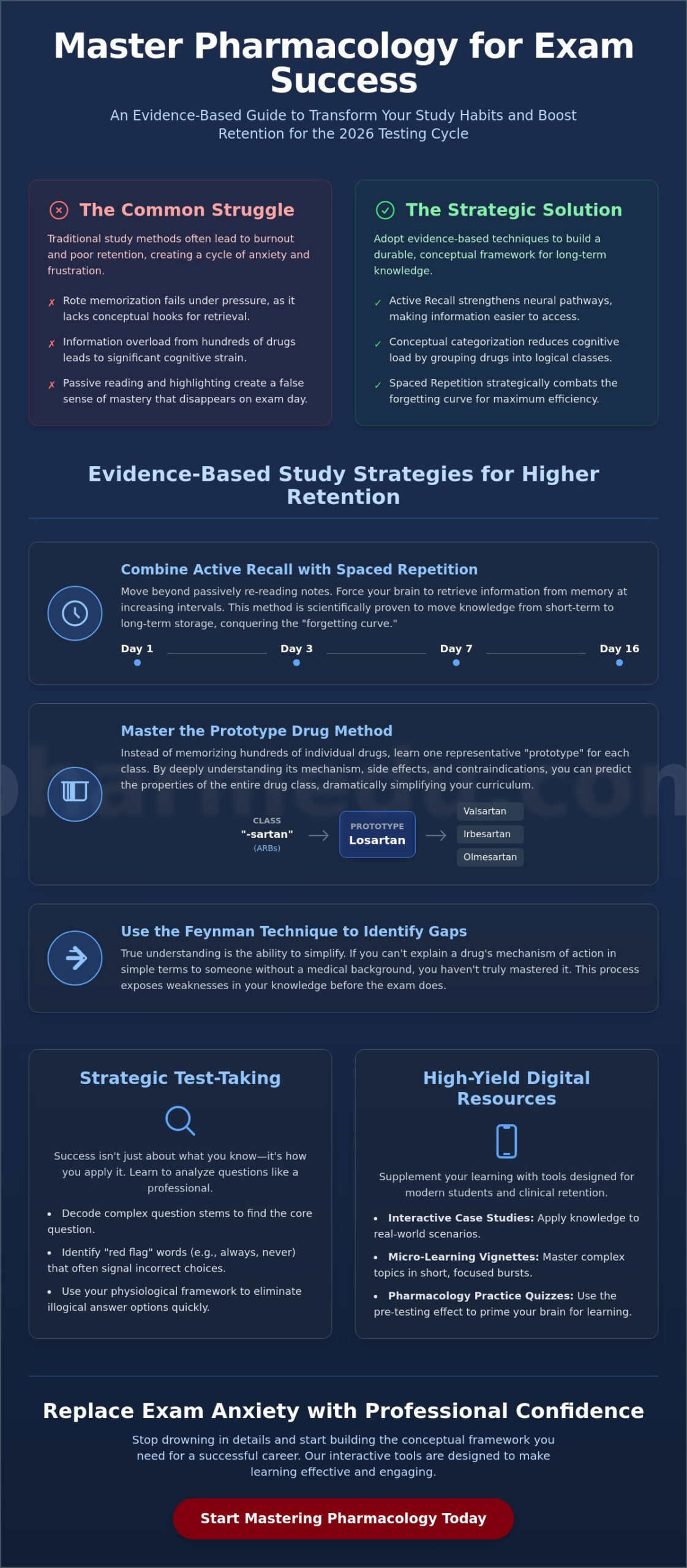
There’s a critical distinction between recognition and true recall that every student must understand. Recognition is the ability to identify a drug name when you see it on a multiple-choice list; recall is the ability to retrieve its mechanism of action and side effects from your own memory without any external cues. Passive reading is statistically the least effective way to move information into long-term storage because it doesn’t challenge the brain to perform any meaningful work. To combat this, many professionals turn to Evidence-Based Study Strategies to ensure information moves from short-term memory into permanent clinical knowledge. Active learning is the primary driver of exam success because it forces the mind to construct meaning rather than just absorb text.
The Power of Drug Class Categorization
Reducing mental strain is essential for long-term retention. Instead of viewing 300 drugs as individual entities, effective students group them by suffixes or prefixes. For example, recognizing that drugs ending in “-sartan” are Angiotensin II Receptor Blockers (ARBs) allows you to apply a single set of rules to an entire class of medications. This process of “anchoring” ensures that new information is attached to a stable foundation you already understand. However, this strategy only works if you have a firm grasp of human physiology. You can’t truly understand how a loop diuretic functions without first mastering the anatomy and ion transport of the renal tubule. Understanding the “where” and “how” of the body makes the “what” of the drug feel like a natural extension of your existing knowledge.
Evidence-Based Study Strategies for Higher Retention
Effective learning requires a departure from the comfort of highlighting and re-reading. While reviewing notes feels productive, it often creates an illusion of competence that vanishes during a high-stakes test. Improving pharmacology exam scores depends on your ability to move information from your notes into your long-term memory through active retrieval. This isn’t just about studying harder; it’s about using cognitive science to ensure your brain can access drug data when the pressure is on.
One of the most powerful tools in your arsenal is the Feynman Technique. If you can’t explain the mechanism of a beta-blocker to a peer in simple terms, you haven’t mastered it yet. This method identifies gaps in your knowledge by forcing you to simplify complex concepts until the core logic is clear. Similarly, you should view Pharmacology Practice Quizzes as learning tools rather than just final assessments. Taking a quiz before you’ve fully mastered the material triggers the “pre-testing effect,” which primes your brain to retain the correct answers more effectively when you finally encounter them in your study sessions.
Implementing Spaced Repetition for Drug Names
Spaced Repetition Systems (SRS) tackle the “forgetting curve” by scheduling reviews at increasing intervals. Instead of cramming 50 drugs in one night, you review a smaller set today, again in two days, and then in a week. When using Interactive Pharmacology Flashcards, follow the rule of “one concept per card.” Don’t list every side effect of a drug on a single card. Instead, create separate cards for the mechanism, the primary side effect, and the key contraindication. This prevents your brain from relying on context clues and ensures you truly know each individual fact. Integrating these reviews into a 15-minute daily routine is far more effective than a single five-hour weekend session.
Active Recall and Self-Testing Frameworks
You should start testing yourself long before you feel ready. This discomfort is where real learning happens. One effective strategy is “blurting.” After a study session, take a blank sheet of paper and write down everything you remember about a specific drug class without looking at your notes. This process exposes exactly what didn’t stick, allowing you to focus your energy only on your weakest areas. Academic leaders often advocate for structured frameworks like The Prototype Drug Method to organize these recall sessions. By focusing your active recall on a single representative agent, you build a mental anchor that makes it much easier to retrieve information about related medications while improving pharmacology exam scores.
The Prototype Drug Method: Simplifying Your Curriculum
A prototype drug acts as the gold standard representative for its entire pharmacological class. Instead of attempting to memorize every individual medication in a family, you focus your intellectual energy on mastering this single lead agent. This approach is highly effective for improving pharmacology exam scores because most drugs within a class share the same mechanism of action, primary therapeutic effects, and adverse reactions. By learning the “rules” of the prototype, you can logically predict the behavior of its “cousins” with minimal additional effort.
To master a prototype effectively, you should apply a rigorous 5-point checklist during your study sessions:
- Mechanism of Action (MOA): How the drug interacts with specific receptors or enzymes at a cellular level.
- Indications: The primary clinical reasons for administration and the specific conditions it treats.
- Side Effects: Both the common discomforts and the life-threatening adverse reactions that require immediate intervention.
- Contraindications: Specific patient populations or physiological conditions where the drug’s use is strictly prohibited.
- Nursing/Pharmacy Considerations: Crucial vital signs to monitor, specific lab values to track, and the most important patient education points.
Identifying High-Yield Prototype Drugs
Prioritizing high-yield drugs is essential for board exam readiness. You don’t need to know every obscure medication; you need to master the ones that appear most frequently in clinical practice and on national exams. For example, mastering Lisinopril provides the blueprint for all ACE inhibitors, while Metoprolol serves as the standard for Beta-blockers. You can find a comprehensive list of these essential agents in this pharmacology study guide for nursing students. Utilizing such resources allows you to apply Evidence-Based Study Strategies by focusing your time on the information that yields the highest return during testing.
Mapping Mechanisms of Action (MOA)
Visualizing the mechanism of action is the most effective way to anchor your knowledge. Instead of reading a paragraph about receptor binding, try creating a simple flowchart that tracks the drug’s path from administration to cellular response. When you understand exactly how a drug interacts with a receptor, the side effects stop being random facts and start becoming logical consequences of the drug’s function. Understanding the mechanism of action is the master key that unlocks every other piece of clinical drug data.
Strategic Test-Taking for Pharmacology Board Exams
Standardized testing environments demand more than just raw knowledge. Improving pharmacology exam scores requires a tactical understanding of how questions are structured; examiners often use specific patterns to test your clinical judgment rather than just your memory. When you encounter a complex question, your first task is to isolate the “query” within the stem. Many questions include distractors, such as irrelevant patient history or non-essential lab values, designed to mimic the information overload of a real clinical setting. You must train your eyes to find the actual question, which usually appears in the final sentence.
A “Safety First” mindset is the most reliable compass for nursing and pharmacy board questions. If a question asks for your priority action in a drug toxicity scenario, the correct answer almost always involves the ABCs (Airway, Breathing, Circulation) or immediate patient safety. You should also be wary of “Red Flag” words in distractor options. Absolute terms like “always,” “never,” or “only” are rarely correct in the nuanced world of medicine. Clinical practice is defined by exceptions and individual patient variables, so options that allow for professional judgment are statistically more likely to be the right choice.
Analyzing NCLEX and NAPLEX Question Patterns
Standardized exams frequently use the “Most Correct” format, where multiple answers might be technically true, but only one is the priority. In drug toxicity scenarios, you must distinguish between an assessment action and a therapeutic intervention. For advanced strategies on navigating these high-stakes environments, consult our NAPLEX prep course guide. Mastering these patterns ensures you don’t just know the drugs, but also understand how the board expects you to apply that knowledge under pressure.
Eliminating Distractors and Identifying Keywords
The process of elimination is your strongest tool when faced with multi-drug choices. Start by identifying “look-alike, sound-alike” (LASA) drug traps, such as confusing hydromorphone with morphine. These are common hurdles that can lead to avoidable errors if you’re rushing. If you encounter a drug you don’t recognize, fall back on your prefix and suffix knowledge. Even in 2026, the naming conventions for drug classes remain a stable foundation for intelligent guessing. To refine these skills, practicing with Pharmacology Practice Quizzes can help you build the mental stamina needed to maintain accuracy throughout a 100+ question exam. Effective time management means spending no more than 60 to 90 seconds per question, allowing you to maintain a steady rhythm without second-guessing your clinical intuition.
Maximizing Success with High-Yield Digital Resources
The evolution of medical education has rendered traditional study methods increasingly insufficient for the modern student. Improving pharmacology exam scores in 2026 requires a departure from heavy, static textbooks that lack the agility to reflect rapid clinical updates. Digital platforms now serve as essential partners, offering real-time data on your specific knowledge gaps. Instead of guessing which drug classes need more attention, you can use performance analytics to pinpoint weaknesses. This precision allows for a highly efficient study schedule that prioritizes your most significant areas of concern.
Integrating a comprehensive pharmacy review into your daily routine ensures that you’re engaging with the most current evidence-based information. These tools don’t just provide facts; they provide context, helping you understand how a drug’s mechanism of action translates into clinical outcomes. By moving beyond the physical page, you can access a dynamic environment where information is structured for maximum efficiency and retention.
Micro-Learning and Video Vignettes
The traditional two-hour lecture often leads to cognitive fatigue and poor retention. Micro-learning addresses this by delivering information in 5 to 10 minute bursts. High-Yield Video Vignettes are particularly effective because they focus on the most critical information required for board certification. This format respects the limited time available during clinical rotations, allowing you to master a specific concept between patient rounds. Mobile-compliant platforms ensure that your study materials are always accessible, turning small gaps in your day into productive learning opportunities that reinforce long-term memory.
Transitioning to Clinical Case Studies
Moving from theory to practice is often the most difficult part of pharmacology education. While flashcards help with nomenclature, Clinical Case Studies force you to apply that knowledge to complex patient scenarios. In a real-world setting, patients rarely present with a single condition or a single medication. Understanding drug-drug interactions and contraindications within a narrative context builds the professional confidence needed for both exams and practice. By simulating these encounters, you’re not just memorizing data; you’re developing the clinical intuition required to ensure patient safety. Ready to elevate your preparation? Subscribe to PharmEDU for high-yield pharmacology review and gain access to the tools designed for modern academic success.
Secure Your Clinical Future in 2026
Start your high-yield pharmacology review with PharmEDU today. You have the dedication to serve your patients; let us provide the structural support to help you achieve the scores you deserve.
Frequently Asked Questions
How can I stop mixing up drug names that sound similar?
Focus on differentiating Look-Alike, Sound-Alike (LASA) medications by highlighting the unique parts of the name. Use Tall Man lettering techniques mentally to emphasize differences, such as distinguishing between hydrOXYzine and hydrALAzine. By grouping drugs by their unique suffixes and therapeutic categories, you create clear mental boundaries that prevent confusion during high-stakes testing.
Is it better to study pharmacology by drug class or by body system?
Studying by drug class is generally more effective for initial learning because it allows you to master a single mechanism of action that applies to multiple medications. Once you understand the class prototype, you can transition to body systems to see how those drugs interact within a clinical context. This dual approach is a proven method for improving pharmacology exam scores.
How many hours a day should I spend studying pharmacology to pass?
Consistency is more important than the total number of hours spent. Aim for 60 to 90 minutes of high-intensity, active study each day rather than marathon sessions that lead to cognitive fatigue. This targeted approach prevents information overload and allows for better consolidation of complex drug data. Using micro-learning vignettes during this time can significantly maximize your efficiency.
What are the most common drugs that appear on pharmacology exams?
Standardized exams prioritize high-yield medications that have narrow therapeutic indices or significant safety profiles. You’ll frequently encounter drugs like Warfarin, Digoxin, Lithium, and various insulin types. Mastery of these specific agents is essential because they represent the most critical safety concerns in clinical practice and are staples of board-style question banks.
Can I improve my pharmacology score in just two weeks?
You can see significant progress in two weeks by shifting your focus exclusively to high-yield prototypes and active recall. Stop reading textbooks and start taking practice quizzes to identify your specific knowledge gaps immediately. This rapid-response strategy is highly effective for improving pharmacology exam scores when you’re working within a restricted timeframe.
Why do I understand the concepts but fail the practice questions?
Understanding a concept is passive, but answering a board-style question requires active application. Practice questions often include distractors that test your ability to prioritize nursing or pharmacy interventions over simple factual knowledge. You must move beyond simple recognition and learn to decode the question stem to identify the core clinical issue being tested.
How do I remember the side effects of every drug?
Don’t try to memorize side effects as an isolated list; instead, derive them from the drug’s mechanism of action. If a drug stimulates the sympathetic nervous system, you can logically predict side effects like tachycardia or hypertension. This mechanism-based logic reduces the need for rote memorization and ensures much better retention for both exams and clinical practice.
What is the most effective way to use flashcards for pharmacology?
The most effective way to use flashcards is to limit each card to a single, discrete fact. For example, create one card for a drug’s mechanism and a separate card for its primary contraindication. This prevents your brain from relying on context clues and forces true retrieval, which is essential for mastering complex pharmacological nomenclature and ensuring long-term memory.