Interactive Pharmacology Learning Tools: The 2026 Guide to Master High-Yield Concepts
Rote memorization is no longer enough to survive the rigors of modern medical education, let alone the clinical floor. You’ve likely spent hours staring at dense drug tables, yet you still feel a surge of anxiety when faced with a complex USMLE or NAPLEX case study. Incorporating interactive pharmacology learning tools into your routine is the most effective way to bridge this gap. It’s a common frustration; the sheer volume of high-yield concepts makes it feel like you’re trying to drink from a firehose while the stakes of your board exams continue to rise.
You can replace that uncertainty with clinical confidence by utilizing resources designed for active recall and professional mastery. This 2026 guide reveals how to transform your study habits by integrating high-yield video vignettes, interactive flashcards, and pharmacology practice quizzes into your daily workflow. We’ll show you how to move beyond passive reading using clinical case studies to ensure you’re fully prepared for both your upcoming exams and your future career as a healthcare professional.
Key Takeaways
- Understand how multi-modal digital resources prevent cognitive burnout by replacing dense textbooks with high-yield, manageable content.
- Master the principles of active recall and spaced repetition to move drug knowledge from short-term memory to long-term clinical application.
- Learn to select the most effective interactive pharmacology learning tools, choosing between video vignettes for conceptual clarity and practice quizzes for testing clinical reasoning.
- Build a data-driven study plan using diagnostic assessments to identify weak drug classes before diving into targeted remedial learning.
- Streamline your board exam preparation with a unified learning ecosystem that covers over 100 essential topics through a high-yield, micro-learning approach.
Why Interactive Pharmacology Learning Tools Are Essential in 2026
Interactive pharmacology learning tools are multi-modal digital ecosystems that integrate quizzes, flashcards, and high-yield videos. They don’t just present information; they require an active response from the user. In 2026, the study of Pharmacology has expanded to a level where static media can’t keep pace with the influx of new data. These tools provide a structured, manageable path through the noise, ensuring that critical information is retained rather than just glanced at.
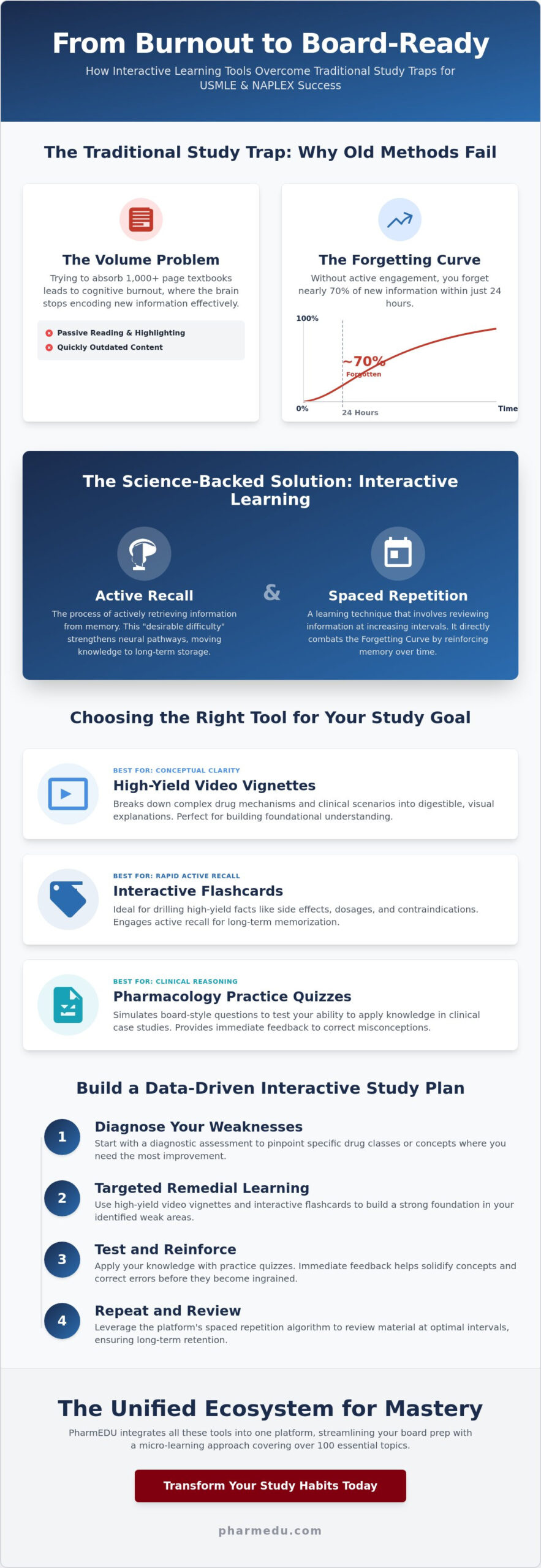
The “Volume Problem” is a documented phenomenon in medical education. A standard textbook often exceeds 1,000 pages of dense drug data, which is mathematically impossible for most students to master through reading alone. Trying to digest this much raw data leads to cognitive burnout, a state where the brain stops effectively encoding new information. Using interactive pharmacology learning tools breaks this overwhelming content into micro-learning modules. This approach prevents the mental fatigue associated with long-form reading and allows for better focus on high-yield concepts.
Real-time feedback is perhaps the most critical advantage of digital platforms. When you answer a question incorrectly in a practice quiz, the system corrects you immediately. This prevents the solidification of misconceptions. Over time, this constant interaction builds clinical intuition. You aren’t just memorizing side effects; you’re developing the ability to anticipate drug interactions and therapeutic outcomes in a fast-paced environment. This shift from rote memory to active reasoning is what differentiates a successful board candidate from one who struggles with application-based questions.
The Limitations of Traditional Pharmacology Textbooks
Traditional books often lead students into the “passive reading” trap. You might highlight half a page, yet fail to recall the mechanism of action ten minutes later. Physical books also suffer from a lack of agility. With new FDA approvals and revised clinical guidelines occurring monthly, a printed text is often outdated before it even hits the shelf. For a deeper look at this shift, read our comprehensive pharmacy review on how digital platforms outperform traditional methods in 2026.
Key Features of Modern Learning Platforms
Today’s platforms leverage gamification to maintain long-term engagement. Features like progress tracking and daily streaks transform a difficult chore into a sustainable habit. Mobile compatibility is also vital for the modern student. It allows you to review Interactive Pharmacology Flashcards during a ten-minute break on clinical rotations or while commuting. By integrating High-Yield Video Vignettes with self-assessment tools, these platforms ensure that conceptual understanding and factual recall happen simultaneously, creating a more robust knowledge base.
The Science of Active Recall and Spaced Repetition
Understanding how your brain encodes drug data is the first step toward clinical mastery. Hermann Ebbinghaus first described the “Forgetting Curve,” which suggests that we forget nearly 70% of new information within 24 hours if we don’t actively engage with it. Interactive pharmacology learning tools are specifically engineered to interrupt this decay. By forcing the brain to retrieve information rather than just scanning it, these digital resources flatten the curve and ensure that high-yield concepts move into long-term storage.
Active recall is the process of pulling information out of your mind. It’s the opposite of reading a textbook where you’re trying to put information in. Research supports this; a 2024 study on an interactive, animated web application demonstrated that students using active retrieval methods showed significantly better retention of autonomic pharmacology than those using traditional slides. This retrieval practice is what transforms a student’s understanding from a vague familiarity to a sharp, clinical tool.
Active Recall vs. Passive Review
- Highlighting a textbook creates an “illusion of competence.” You feel like you’re learning because the page is colorful, but your brain remains passive.
- Interactive pharmacology learning tools, such as practice quizzes, introduce “desirable difficulty.” This concept suggests that when the brain has to work harder to retrieve a drug’s mechanism of action, the neural pathway becomes stronger.
- Passive reading often skips over the “why” of a drug mechanism, whereas interactive tools force you to explain it to yourself.
Implementing Spaced Repetition Algorithms
Spaced repetition is a scheduling technique that presents information just as you’re about to forget it. Digital flashcards use confidence ratings to automate this process. If you mark a card as “easy,” the algorithm might wait four days to show it again. If it’s “hard,” you’ll see it in ten minutes. This efficiency means 15 minutes of daily interactive study is more effective than a five-hour weekend cram session. Automated scheduling removes the administrative burden of sorting physical cards, letting you focus entirely on the material.
For those preparing for clinical rotations, these methods are particularly valuable. You can find specific strategies in our pharmacology study guide for nursing students. If you want to start testing your knowledge immediately, exploring Pharmacology Practice Quizzes is an excellent way to apply these scientific principles today.
Comparing Interactive Modalities: Which Tool Fits Your Goal?
Not all interactive pharmacology learning tools serve the same purpose. To build a robust knowledge base, you must align the modality with your current cognitive objective. If you’re struggling to grasp how a drug class interacts with a physiological system, a text-based quiz won’t help as much as a visual explanation. Conversely, if you understand the concept but can’t remember specific side effects, a video is less efficient than targeted recall. Mastery comes from knowing when to watch, when to flip, and when to test.
The most effective study plans utilize three core pillars: High-Yield Video Vignettes, Interactive Flashcards, and Pharmacology Practice Quizzes. Videos serve as the conceptual foundation, while flashcards cement the raw facts through repetition. Quizzes then force you to apply that knowledge in a simulated clinical environment. By rotating through these modalities, you ensure that your understanding is both deep and accessible. Scholarly research into the PharmaMemory interactive learning tool highlights how combining visual stimulation with challenged recall significantly boosts long-term retention compared to traditional slides.
Clinical Case Studies represent the final stage of this progression. These scenarios bridge the gap between classroom theory and bedside practice, requiring you to synthesize information about multiple drug classes simultaneously. This is where high-yield content becomes vital. You don’t have time to learn every obscure drug ever synthesized. You must focus on the medications most likely to appear on board exams and in daily practice, ensuring your limited study time yields the highest possible professional return.
High-Yield Video Vignettes
Visual storytelling is a powerful ally when explaining complex drug classes. For instance, understanding the renin-angiotensin-aldosterone system is much easier when you can visualize the points of intervention for ACE inhibitors. Modern micro-learning segments, typically lasting five to ten minutes, prevent cognitive overload by focusing on one specific mechanism or clinical pearl at a time. Seeing a clinical scenario acted out provides context that a static page simply cannot replicate, making the information stickier and more intuitive.
Adaptive Quizzes and Board-Style Questions
Board exams like the NAPLEX or NCLEX don’t just ask for definitions; they require higher-order thinking. Pharmacology Practice Quizzes simulate the pressure of the actual exam and use adaptive algorithms to challenge your weak points. The real value lies in the detailed rationales provided for every answer choice. Understanding why three options are incorrect is just as important as knowing why one is right. This level of analysis prepares you for the nuanced decision-making required in high-stakes testing and real-world patient care.
How to Build an Interactive Study Plan for Board Exams
Creating a structured study plan shouldn’t be a guessing game. It requires a systematic approach that leverages interactive pharmacology learning tools to maximize your efficiency. Instead of starting on page one of a textbook, you should start with data. This method ensures you’re spending your limited time on the areas that will actually improve your board scores. By following a logical progression from diagnosis to simulation, you can build a knowledge base that is both deep and durable.
- Step 1: Diagnostic Assessment. Begin with a comprehensive practice quiz. This isn’t about getting a high score; it’s about identifying which drug classes or physiological systems are your weakest.
- Step 2: Conceptual Foundation. Once you’ve identified a gap, watch high-yield video vignettes for those specific areas. This builds the conceptual “why” before you try to memorize the “what.”
- Step 3: Fact Consolidation. Use interactive flashcards to cement the rote details like drug names, specific dosages, and rare but critical side effects.
- Step 4: Clinical Application. Integrate your pharmacology knowledge by solving clinical case studies. This step mimics the bedside decision-making process required in modern practice.
- Step 5: Simulated Testing. Finish your cycle with full-length, timed exams. This builds the mental stamina and pacing necessary for the actual board environment.
Integrating Interactivity into a Busy Schedule
Most students struggle because they wait for large, uninterrupted blocks of time to study. Modern interactive pharmacology learning tools allow you to utilize “hidden” time throughout your day. You can review a deck of flashcards during a commute or while waiting in line using a mobile app. Setting a small daily goal for card reviews keeps the spaced repetition cycle active without requiring a three-hour session. Try the “Study-Break Quiz” method: answer five quick questions every hour to keep your brain in a state of active retrieval.
Tracking Your Progress with Analytics
Data-driven studying removes the emotional stress of feeling unprepared. Use platform heatmaps to visualize your performance across different drug categories. If your cardiovascular section is bright red while your antibiotics are green, you know exactly where to focus tomorrow. Comparing your scores against national averages provides a realistic gauge of your board readiness. Seeing your mastery levels increase over time provides a psychological boost that keeps you motivated during the long weeks of exam preparation. To begin your structured journey, consider starting a PharmEDU Monthly Subscription to access these diagnostic and analytical features.
PharmEDU: The Unified Ecosystem for Interactive Learning
PharmEDU isn’t just a collection of study aids. It’s a partner in your professional journey. By centralizing high-yield video vignettes, interactive pharmacology flashcards, and clinical case studies into one interface, the platform removes the administrative burden of sourcing multiple study aids. This unified ecosystem delivers over 100 pharmacology topics through a high-yield, micro-learning framework. Each module is designed to be consumed in short bursts, ensuring that even the most complex mechanisms are broken down into manageable, retainable segments. It’s a modern approach to a historically difficult subject.
The entire platform is built with a mobile-compliant design. This means you can transition from a tablet in the library to a smartphone during a clinical rotation without losing your progress. In 2026, healthcare students don’t have the luxury of sitting at a desk for eight hours straight. You need interactive pharmacology learning tools that move with you. Every piece of content is created by experienced healthcare educators who understand the specific pressures of the modern medical curriculum. This ensures that the material isn’t just scientifically accurate; it’s pedagogically effective for the students of today.
Why PharmEDU Beats Traditional Review Courses
Traditional review courses often rely on expensive, live seminars that provide a massive influx of information over a single weekend. This often lead to the cognitive burnout we discussed earlier. PharmEDU replaces this “sink or swim” model with an affordable, supportive subscription. There is no fluff here. We focus strictly on the high-yield content you need to pass your boards and excel in practice. It’s a “digital mentor” approach that provides professional, scientifically grounded guidance at a fraction of the cost of legacy seminars. You get the depth of a textbook with the agility of a modern app.
Institutional Benefits: Elevating Pharmacy and Nursing Programs
For faculty and program directors, PharmEDU offers an Institutional Platform License that standardizes pharmacology education across an entire cohort. Administrative tools allow faculty to track student performance in real-time, identifying struggling students before they reach high-stakes exams. This data-driven oversight ensures that every student meets the rigorous professional standards required in modern healthcare. By integrating these interactive pharmacology learning tools into the curriculum, institutions can improve pass rates and better prepare their graduates for the complexities of clinical life. Explore PharmEDU subscription options for your board prep today.
Elevate Your Clinical Mastery and Professional Confidence
Mastering complex drug mechanisms doesn’t need to be a battle against an overwhelming textbook. By shifting from passive reading to the science-backed methods of active recall and spaced repetition, you ensure your knowledge is ready for the bedside. This strategic approach transforms your preparation from a stressful administrative burden into a structured path toward professional excellence. You’ve learned that selecting the right modality, whether it’s a high-yield video vignette or a practice quiz, is essential for bridging the gap between theory and clinical application.
Integrating interactive pharmacology learning tools into your daily routine provides the precision and feedback necessary for board success. PharmEDU offers a comprehensive ecosystem with over 100 high-yield topics, all built by healthcare educators to meet the highest professional standards. Its mobile-compliant design ensures that your education continues wherever your career takes you, allowing you to master concepts during clinical rotations or commutes without losing momentum.
Start Your Interactive Pharmacology Journey with PharmEDU
Take the next step in your professional development with confidence. Your journey toward clinical mastery starts with the right partner, and we’re here to support every step of your advancement.
Frequently Asked Questions
What makes a pharmacology learning tool truly “interactive”?
A tool is truly interactive when it requires an active cognitive response from the user rather than just passive consumption. Unlike reading a static page, interactive pharmacology learning tools use features like challenged recall, confidence ratings, and immediate feedback loops. This bidirectional flow of information forces your brain to retrieve data, which is the most effective way to correct misconceptions and solidify neural pathways in real-time.
Can interactive tools replace traditional pharmacology textbooks entirely?
Digital platforms are increasingly becoming the primary resource for students because they offer more agility than physical books. Traditional textbooks often take years to update, while digital tools can integrate new FDA approvals or clinical guidelines almost instantly. While books provide exhaustive detail, interactive platforms focus on high-yield concepts that are essential for clinical practice, making them a more efficient choice for modern medical education.
How do interactive flashcards differ from standard paper ones?
Digital flashcards utilize sophisticated algorithms to automate the spaced repetition process. While paper cards require you to manually sort and schedule your reviews, interactive versions track your performance and automatically show difficult cards more frequently. This ensures you’re focusing your energy on your weak areas rather than wasting time on drug classes you’ve already mastered, leading to much faster retention.
Are interactive pharmacology tools effective for NAPLEX and NCLEX prep?
These tools are specifically engineered to meet the demands of high-stakes board exams. By using interactive pharmacology learning tools like adaptive practice quizzes and clinical case studies, students can simulate the actual exam environment. The inclusion of detailed rationales for every answer choice helps candidates develop the higher-order thinking skills and clinical reasoning necessary to navigate complex, application-based board questions successfully.
How much time should I spend using interactive tools each day?
Consistency is more valuable than duration when it comes to long-term memory. Spending 15 to 30 minutes each day using interactive flashcards or quizzes is significantly more effective than a five-hour cram session. Because these tools leverage the science of spaced repetition, short and frequent engagements keep your knowledge fresh and prevent the natural decay of information over time.
Do these platforms offer progress tracking for institutional users?
Institutional Platform Licenses include comprehensive administrative dashboards designed for faculty and program directors. These tools allow educators to monitor student engagement and track performance across specific drug classes for an entire cohort. This data-driven oversight makes it easier to identify students who may need additional support and helps standardize the quality of pharmacology education across an entire nursing or pharmacy program.
Is PharmEDU mobile-friendly for studying on the go?
The platform features a fully mobile-compliant design that allows for seamless study across all devices. You can start a high-yield video vignette on a desktop and finish a deck of interactive flashcards on your smartphone during a clinical rotation break. This flexibility supports micro-learning, enabling you to turn small pockets of “hidden” time into productive study sessions without being tied to a desk.