
Antimicrobial Pharmacology High Yield: The 2026 Board Review Guide
Memorizing every single antibiotic in the pharmacopeia is the fastest way to fail your 2026 boards. You’re likely feeling the weight of information overload as you try to distinguish between five generations of cephalosporins or track which new agents like Gepotidacin just received FDA approval. This antimicrobial pharmacology high yield guide cuts through the academic noise to focus on the specific mechanisms, spectrums, and adverse effects that examiners actually prioritize. It’s common to feel overwhelmed when side effects blur together and every resistance mechanism starts to sound the same during your study sessions.
We’ll help you master the mental frameworks needed to identify drug classes by their suffixes and recall unique adverse events with precision. You’ll gain a clear understanding of the latest 2024 IDSA guidelines and the logic behind mechanism-based resistance, ensuring you’re prepared for any clinical vignette the exam throws your way. By focusing on these high-impact concepts, you can transform a daunting subject into a manageable, logic-driven component of your professional preparation. This approach ensures you spend less time on rote memorization and more time mastering the clinical applications that define board success.
Key Takeaways
- Categorize agents by their target sites and understand why the distinction between bactericidal and bacteriostatic drugs is vital for treating immunocompromised patients.
- Use the “L” and “P” rules to master cephalosporin generations and identify the specific penicillin outliers that provide anti-pseudomonal coverage.
- Streamline your study of antimicrobial pharmacology high yield concepts by using “Buy AT 30, CELL at 50” to organize protein synthesis inhibitors and their associated toxicities.
- Identify fluoroquinolones and sulfonamides through suffix recognition and sequential blockade logic to predict high-risk adverse effects like tendon rupture.
- Transition from rote memorization to clinical mastery by using PharmEDU High-Yield Video Vignettes and Practice Quizzes to simulate board-style vignettes.
Mastering Antimicrobial Classification by Mechanism of Action
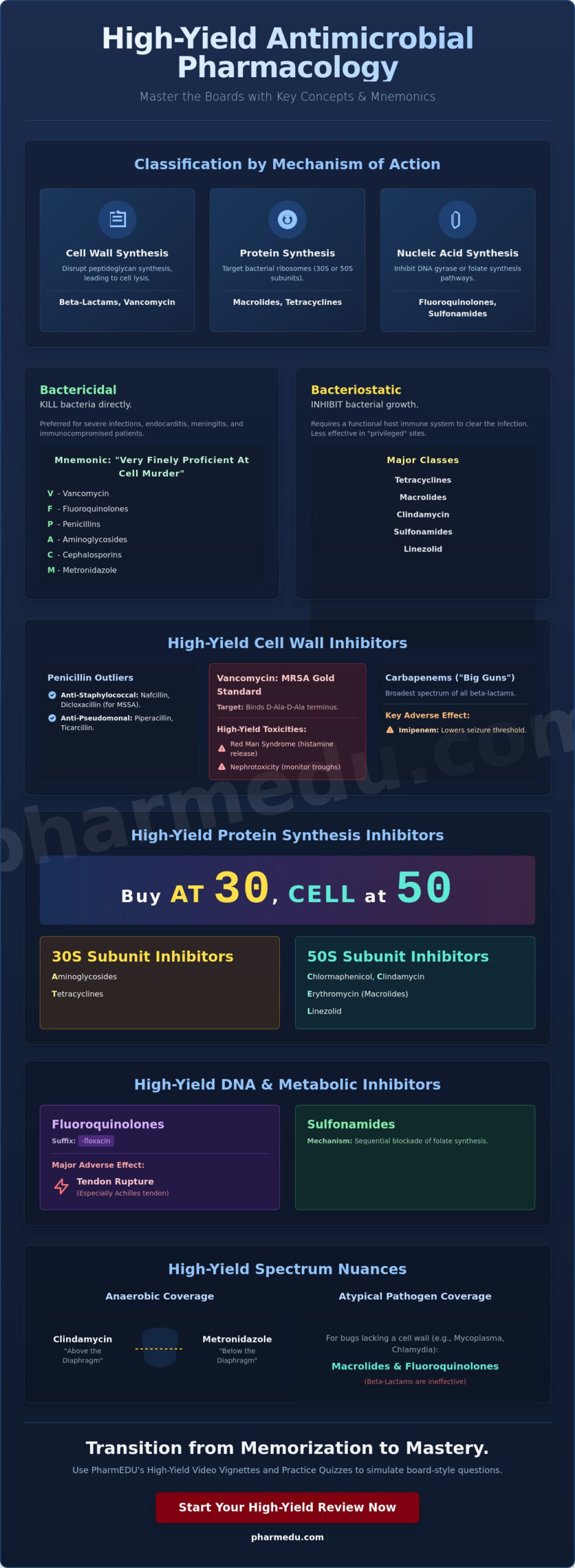
Understanding how drugs interact with pathogens is the first step toward exam success. Antimicrobials are classified by their target site: cell wall, protein synthesis, or nucleic acids. This structural approach simplifies a massive volume of information into three logical categories. For a foundational Antimicrobial overview, one must recognize that selective toxicity relies on targeting structures unique to microbes. This logic forms the core of any antimicrobial pharmacology high yield study strategy, allowing you to predict a drug’s behavior based on its class rather than relying on rote memorization.
Bactericidal vs. Bacteriostatic Framework
Differentiating between agents that kill bacteria and those that merely inhibit growth is a favorite board topic. Bactericidal drugs are often preferred in “privileged” sites or when the host immune system is compromised. You can remember the primary bactericidal classes using the mnemonic: “Very Finely Proficient At Cell Murder” (Vancomycin, Fluoroquinolones, Penicillins, Aminoglycosides, Cephalosporins, and Metronidazole). In contrast, bacteriostatic agents like Tetracyclines or Macrolides require a functional immune response to clear the infection. This distinction is critical for treating bacterial meningitis or endocarditis. In these cases, using a static drug could lead to treatment failure because the host’s local defenses are insufficient to finish the job.
The 2026 Spectrum of Activity Chart
The 2026 clinical landscape emphasizes antimicrobial stewardship, moving away from broad-spectrum “shotgun” therapy toward narrow-spectrum precision. Boards test your ability to match the right drug to the right “bug” based on specific coverage patterns. For Gram-positive infections, older penicillins remain a staple, while Aminoglycosides are the classic choice for aerobic Gram-negative coverage. When anaerobic bacteria are suspected, the high-yield distinction is anatomical. Clindamycin is typically used for infections “above the diaphragm,” while Metronidazole is the standard for those “below the diaphragm.”
Atypical pathogens like Mycoplasma or Chlamydia lack a traditional peptidoglycan cell wall. This makes them naturally resistant to Beta-lactams. Instead, you’ll need to reach for Macrolides or Fluoroquinolones, which target protein synthesis or DNA gyrase. Mastering these nuances is easier when you use PharmEDU Interactive Pharmacology Flashcards to reinforce the drug-to-bug connections. By focusing on these “Big Three” targets and their specific outliers, you’ll build the clinical intuition required to navigate complex board vignettes. This antimicrobial pharmacology high yield approach ensures you’re prepared for the 2026 exam cycle and beyond.
High-Yield Cell Wall Synthesis Inhibitors: Beta-Lactams and Glycopeptides
Cell wall inhibitors represent the most frequently tested category in antimicrobial pharmacology high yield reviews. These agents disrupt peptidoglycan synthesis by binding to penicillin-binding proteins (PBPs) or inhibiting the cross-linking of the cell wall. While standard penicillins are staples for Gram-positive coverage, board exams prioritize the outliers. For example, anti-staphylococcal penicillins like Nafcillin and Dicloxacillin are resistant to bacterial penicillinase, making them the primary choice for MSSA. On the other hand, extended-spectrum penicillins such as Piperacillin are essential for their activity against Pseudomonas, often appearing in vignettes involving hospital-acquired infections.
Vancomycin serves as the gold standard for MRSA, but its clinical management is fraught with high-yield side effects. It inhibits cell wall synthesis by binding to the D-Ala-D-Ala terminus of nascent peptidoglycan chains. You must remember to monitor trough levels to prevent nephrotoxicity, particularly when used alongside other renal toxins. Slow infusion is also mandatory to avoid “Red Man Syndrome,” a non-immunologic histamine release that results in flushing and pruritus. Carbapenems, often called the “big guns,” provide the broadest spectrum of all beta-lactams. However, Imipenem carries a specific risk of lowering the seizure threshold, especially in patients with renal impairment or CNS disease.
Cephalosporin Generation Breakdown
Mastering cephalosporins requires a clear understanding of how their spectrum shifts across generations. First-generation agents like Cefazolin are primarily used for Gram-positive infections and surgical prophylaxis. By the third generation, drugs like Ceftriaxone gain the ability to cross the blood-brain barrier, making them vital for treating meningitis. The fifth generation, represented by Ceftaroline, is a unique high-yield drug because it’s the only beta-lactam with MRSA coverage. A helpful shortcut is the “L” and “P” rule: earlier generations with “L” in their name focus on Gram-positives, while later generations with “P” or “T” sounds emphasize Gram-negative coverage.
Beta-Lactamase Inhibitors and Synergy
Bacteria frequently develop resistance by producing enzymes that hydrolyze the beta-lactam ring. This represents one of the most significant mechanisms of antimicrobial resistance encountered in modern medicine. To counter this, we use inhibitors like Clavulanate or Tazobactam, which “protect” the parent drug from degradation. If you find these combinations confusing, our High-Yield Video Vignettes offer a streamlined way to visualize these interactions. Regarding cross-reactivity, while the risk of a cephalosporin reaction in a penicillin-allergic patient is statistically low, you should still exercise caution if the patient experienced a true IgE-mediated anaphylactic response.
Protein Synthesis Inhibitors: Mnemonics and Major Side Effects
Mastering protein synthesis inhibitors requires a reliable system to organize dozens of drugs into two functional groups. Use the mnemonic “Buy AT 30, CELL at 50” to anchor your understanding of ribosomal subunit targets. This shorthand identifies that Aminoglycosides and Tetracyclines target the 30S subunit, while Chloramphenicol, Erythromycin (Macrolides), Linezolid, and Clindamycin act on the 50S subunit. This classification is a cornerstone of antimicrobial pharmacology high yield study guides, as examiners frequently test your ability to link a drug’s mechanism to its clinical toxicity.
Aminoglycosides are the “mean” glycosides. This class, including Gentamicin and Amikacin, is notorious for severe ototoxicity and nephrotoxicity. These drugs exhibit a significant post-antibiotic effect; this allows for once-daily dosing strategies to minimize renal exposure while maintaining efficacy against Gram-negative aerobes. In contrast, Tetracyclines like Doxycycline are often tested for their unique contraindications. You must remember to avoid these in pregnant patients and children under eight years old. They bind to calcium in developing teeth and bones, leading to permanent tooth discoloration and potential growth inhibition. Mastering these interactions is essential for anyone seeking an antimicrobial pharmacology high yield edge on exam day.
The 30S Subunit: Aminoglycosides and Tetracyclines
Tetracyclines inhibit the 30S subunit by blocking aminoacyl-tRNA binding. This prevents the addition of new amino acids to the growing peptide chain. Patients taking these medications must avoid dairy products, antacids, or iron supplements. These multivalent cations chelate the drug in the gut, significantly reducing its absorption and therapeutic effect. Aminoglycosides also target the 30S subunit but do so by causing mRNA misreading. Because they require oxygen for uptake, they are completely ineffective against anaerobic bacteria. If you find these distinctions difficult to visualize, our Interactive Pharmacology Flashcards can help reinforce the “drug to bug” connections through active recall.
The 50S Subunit: Macrolides, Clindamycin, and Linezolid
The 50S inhibitors are a diverse group with high-stakes side effects. Macrolides, often remembered as the “ACE” drugs (Azithromycin, Clarithromycin, and Erythromycin), are frequently associated with QT prolongation and GI upset. Erythromycin and Clarithromycin are potent CYP450 inhibitors, though Azithromycin is a notable exception to this rule. Clindamycin carries the strongest association with C. difficile overgrowth, which can lead to life-threatening pseudomembranous colitis. Finally, Linezolid is a high-yield favorite due to its weak monoamine oxidase inhibitor (MAOI) activity. Using it alongside SSRIs or other serotonergic agents creates a dangerous risk of Serotonin Syndrome. Practicing with Pharmacology Practice Quizzes is the most efficient way to ensure you can spot these contraindications in a clinical vignette.
DNA Synthesis and Metabolic Pathway Inhibitors
While previous sections focused on structural integrity and translation, this antimicrobial pharmacology high yield review now shifts to the genetic and metabolic machinery of the cell. Disrupting DNA replication and folic acid synthesis provides a potent way to eliminate pathogens, but these mechanisms often carry systemic risks. Understanding the specific enzymes targeted by these drugs is essential for distinguishing between classes during your 2026 board exams. You’ll find that examiners frequently focus on “black box” warnings and metabolic interactions that can lead to severe clinical complications.
Fluoroquinolones and Black Box Warnings
Fluoroquinolones are easily identified by their “floxacin” suffix, such as Ciprofloxacin and Levofloxacin. They exert their bactericidal effect by inhibiting DNA Gyrase (Topoisomerase II) in Gram-negative bacteria and Topoisomerase IV in Gram-positive organisms. This dual mechanism prevents the relaxation of supercoiled DNA, effectively halting replication. Despite their broad utility, they carry several high-yield warnings. You must prioritize the risk of tendonitis and tendon rupture, which is a significant black box warning. Additionally, these agents can cause peripheral neuropathy and significant CNS effects like tremors or confusion. They are strictly avoided in patients with Myasthenia Gravis because they can exacerbate muscle weakness by interfering with neuromuscular transmission.
Sulfonamides and Trimethoprim Synergy
The combination of Sulfamethoxazole and Trimethoprim (SMX-TMP) is a classic example of pharmacologic synergy. These drugs work together to create a sequential blockade of the bacterial folic acid synthesis pathway. Sulfonamides act as PABA analogs to competitively inhibit dihydropteroate synthase. Trimethoprim then follows by inhibiting dihydrofolate reductase. This combination is the primary choice for prophylaxis against Pneumocystis jirovecii pneumonia (PCP/PJP) in HIV patients. However, you must watch for Stevens-Johnson Syndrome (SJS), a life-threatening skin reaction. Another high-yield fact is the risk of hemolytic anemia in patients with G6PD deficiency, as these drugs induce oxidative stress in red blood cells.
Metronidazole is a specialized agent that targets anaerobic bacteria and protozoa. It works by forming free radical toxic metabolites that disrupt bacterial DNA. The most important clinical takeaway is the disulfiram-like reaction; patients must avoid alcohol entirely during treatment to prevent severe nausea, vomiting, and flushing. For uncomplicated urinary tract infections, Nitrofurantoin remains a first-line option. While effective in the bladder, it carries a high-yield risk of pulmonary fibrosis with chronic use, a complication that often appears in long-term therapy vignettes. Master these complex interactions by signing up for a PharmEDU Monthly Subscription to access our full library of Pharmacology Practice Quizzes.
Strategic Board Review: How to Study Antimicrobials with PharmEDU
Success on boards like the NAPLEX or USMLE doesn’t come from reading a list of drugs until your eyes glaze over. It comes from being able to apply that knowledge to a patient presenting with specific symptoms and a complex medical history. Integrating antimicrobial pharmacology high yield concepts into your daily routine is the only way to ensure long-term retention. Passive reading is a trap that many students fall into, leading to confusion when faced with a complex clinical vignette on exam day. Instead, you should focus on linking each drug to its specific clinical “bug” and unique adverse effects through active engagement and systematic review.
PharmEDU provides a suite of tools designed specifically to facilitate this transition from rote memorization to clinical mastery. Our High-Yield Video Vignettes provide rapid recall by breaking down complex mechanisms into digestible, visual stories that stick with you during high-pressure exams. For those struggling with the vast spectrum of antibiotic activity, our Interactive Pharmacology Flashcards utilize spaced repetition to reinforce your memory at the exact moment it starts to fade. Whether you’re using a PharmEDU Monthly Subscription or your university provides an Institutional Platform License, these resources ensure that antimicrobial pharmacology high yield facts become second nature before you sit for your boards.
Mnemonics and Visual Recall
Visual cues and micro-learning segments are essential for mastering drug-drug interactions without feeling overwhelmed. We structure our content to follow the “Day in the Life” of a drug, tracing its pharmacokinetics from absorption to excretion. This holistic view helps you understand why certain drugs require renal dosing or why others have significant GI side effects. For example, visualizing the “ACE” mnemonic for macrolides alongside their QT-prolongation risk creates a stronger mental anchor than reading a textbook. If you’re just starting your professional journey, check out our Pharmacology Study Guide for Nursing Students for a foundational look at these principles in a 2026 clinical context.
Practice Quizzes and Case-Based Mastery
Active recall through Pharmacology Practice Quizzes is scientifically proven to be superior to passive review. By simulating the exam environment with time-limited vignettes, you train your brain to identify key clinical markers quickly and accurately. Our Clinical Case Studies take this a step further, forcing you to make treatment decisions based on patient history, drug allergies, and local resistance patterns. This level of preparation is what separates a passing score from a top-tier result in a competitive field. For a deeper dive into modern study techniques and digital tools, see our Comprehensive Pharmacy Review to learn why digital platforms are outperforming traditional textbooks in 2026.
Secure Your Success on the 2026 Boards
Mastering antimicrobials is a vital cornerstone of clinical practice and a significant portion of your upcoming professional exams. By shifting your focus from rote memorization to mechanism-based logic, you can accurately predict drug spectrums and side effects across every pharmaceutical class. We’ve explored how target sites like the cell wall or protein synthesis subunits provide a logical framework for organizing hundreds of drugs into manageable categories. This antimicrobial pharmacology high yield approach ensures you’re prepared for the specific clinical vignettes and “drug-to-bug” questions that define modern licensing exams.
To truly solidify this knowledge, you need professional tools that prioritize active recall and long-term retention. PharmEDU offers a structured path to bridge the gap between classroom theory and board-day performance. Our platform provides access to over 100 High-Yield Video Vignettes, Interactive Spaced-Repetition Flashcards, and comprehensive Board-Style Practice Quizzes designed for the modern student. Master Antimicrobial Pharmacology with PharmEDU Today and turn your study hours into clinical confidence. You’ve done the hard work of learning the science; now it’s time to master the exam and advance your professional journey.
Frequently Asked Questions
What are the most common antimicrobial high-yield side effects to know for the boards?
High-yield side effects include Aminoglycoside-induced ototoxicity and the Disulfiram-like reaction seen with Metronidazole. Examiners also frequently test Clindamycin’s association with C. difficile and Vancomycin’s Red Man Syndrome. Recognizing these unique toxicities is a core part of antimicrobial pharmacology high yield preparation. It’s essential to link the specific drug to its signature adverse event to quickly navigate complex clinical vignettes during your 2026 exams.
How can I remember the difference between 30S and 50S protein synthesis inhibitors?
The most effective way to distinguish protein synthesis inhibitors is the mnemonic “Buy AT 30, CELL at 50.” This tells you that Aminoglycosides and Tetracyclines target the 30S subunit. Meanwhile, Chloramphenicol, Erythromycin (Macrolides), Linezolid, and Clindamycin act on the 50S subunit. Memorizing this single phrase eliminates the need to guess during high-pressure board exams and provides a reliable framework for classification.
Which antimicrobials are safe to use during pregnancy?
Penicillins and Cephalosporins are typically the safest options for treating infections during pregnancy. Most Macrolides, particularly Azithromycin, are also considered safe alternatives. You must strictly avoid Tetracyclines due to the risk of fetal tooth discoloration and bone growth inhibition. Fluoroquinolones are also contraindicated because of potential cartilage damage in the developing fetus, a fact frequently tested in obstetric pharmacology vignettes.
What is the high-yield “mnemonic” for Cephalosporin generations?
Use the “L” and “P” rules to track the shift in coverage across Cephalosporin generations. First-generation drugs often have “L” in their name, like Cefazolin, and focus on Gram-positive bacteria. As you move to later generations, the names often include “P” or “T” sounds, like Ceftriaxone or Cefepime, signaling increased Gram-negative activity. This shortcut helps you identify the correct generation and its expected spectrum without memorizing every individual drug name.
Why is the bactericidal vs. bacteriostatic distinction important for exam questions?
The distinction is critical because bactericidal agents are mandatory in infections where the host immune system cannot assist. In cases of bacterial meningitis, endocarditis, or neutropenic fever, you must use “cidal” drugs to ensure pathogen clearance. Exam questions often present a patient with one of these conditions and ask you to select the most appropriate agent from a list of static and cidal options to test your clinical judgment.
What are the classic “black box warnings” for Fluoroquinolones in 2026?
Fluoroquinolones carry several severe black box warnings that remain primary antimicrobial pharmacology high yield topics. The most famous is the risk of tendonitis and tendon rupture, especially in patients over 60 or those taking corticosteroids. They also carry warnings for irreversible peripheral neuropathy and CNS effects like seizures. Additionally, they are strictly avoided in Myasthenia Gravis patients because they can cause life-threatening muscle weakness by interfering with neuromuscular transmission.
How does PharmEDU help with antimicrobial pharmacology retention?
PharmEDU enhances retention through active recall and spaced repetition. Our Interactive Pharmacology Flashcards ensure you review difficult concepts just as you’re about to forget them, while High-Yield Video Vignettes simulate the actual board environment. This multi-modal approach transforms passive reading into practical knowledge. By using our Pharmacology Practice Quizzes, you can identify your weak points and master drug classes and side effects with precision before test day.
Can I use Macrolides if I have a Penicillin allergy?
Yes, Macrolides are excellent alternatives for patients with a documented Penicillin allergy. They are frequently used for respiratory tract infections or skin infections when Beta-lactams aren’t an option. While they have a different mechanism of action, they provide reliable coverage for many of the same common pathogens. Always check for potential CYP450 drug interactions, which are common with Erythromycin and Clarithromycin but less frequent with Azithromycin.