

Mastering Neuropharmacology Concepts for Exams: A High-Yield Guide for 2026
What if the key to acing your boards isn’t memorizing more drug names, but understanding fewer signaling rules? Most students feel buried under dense textbooks and struggle to distinguish between nearly identical drug classes. It’s frustrating when you can’t connect a mechanism of action to a clinical side effect during a high-pressure exam. You aren’t alone in feeling that the volume of information is overwhelming, especially with the 2026 ABPN exams scheduled for September and October.
This guide provides a structured framework to master neuropharmacology concepts for exams, helping you build a clear mental map of neurotransmission. You’ll learn how to predict drug effects based on receptor types rather than relying on rote memorization. We’ll preview the logic behind critical 2026 updates, including the subcutaneous formulation of Lecanemab and the novel sodium channel blocker Suzetrigine. By the end, you’ll see how our high-yield video vignettes and interactive pharmacology flashcards can transform your study sessions into a professional, results-driven process that ensures exam day confidence.
Key Takeaways
- Identify the five essential stages of the neurotransmitter life cycle to establish a logical foundation for all pharmacological interventions.
- Master the high-yield balances of the autonomic and central nervous systems, focusing on the competitive relationship between dopamine and acetylcholine in movement disorders.
- Implement the prototype drug strategy to synthesize complex neuropharmacology concepts for exams into a manageable and predictable mental framework.
- Stay informed on 2026 clinical updates and new drug approvals, including innovative subcutaneous therapies for Alzheimer’s disease and novel non-opioid pain medications.
- Transition from passive memorization to active mastery through targeted video vignettes and practice quizzes that simulate the rigor of professional board examinations.
Core Neuropharmacology Principles for Exam Preparation
Neuropharmacology is the specialized study of how chemical agents influence the functions of the central and peripheral nervous systems. While many students approach this subject by attempting to memorize hundreds of individual molecules, the most effective way to master neuropharmacology concepts for exams is to focus on the underlying physiological logic. By understanding how a drug interferes with normal signaling, you can predict its clinical effects and side profile without relying on rote memorization. Logic beats memorization every time.
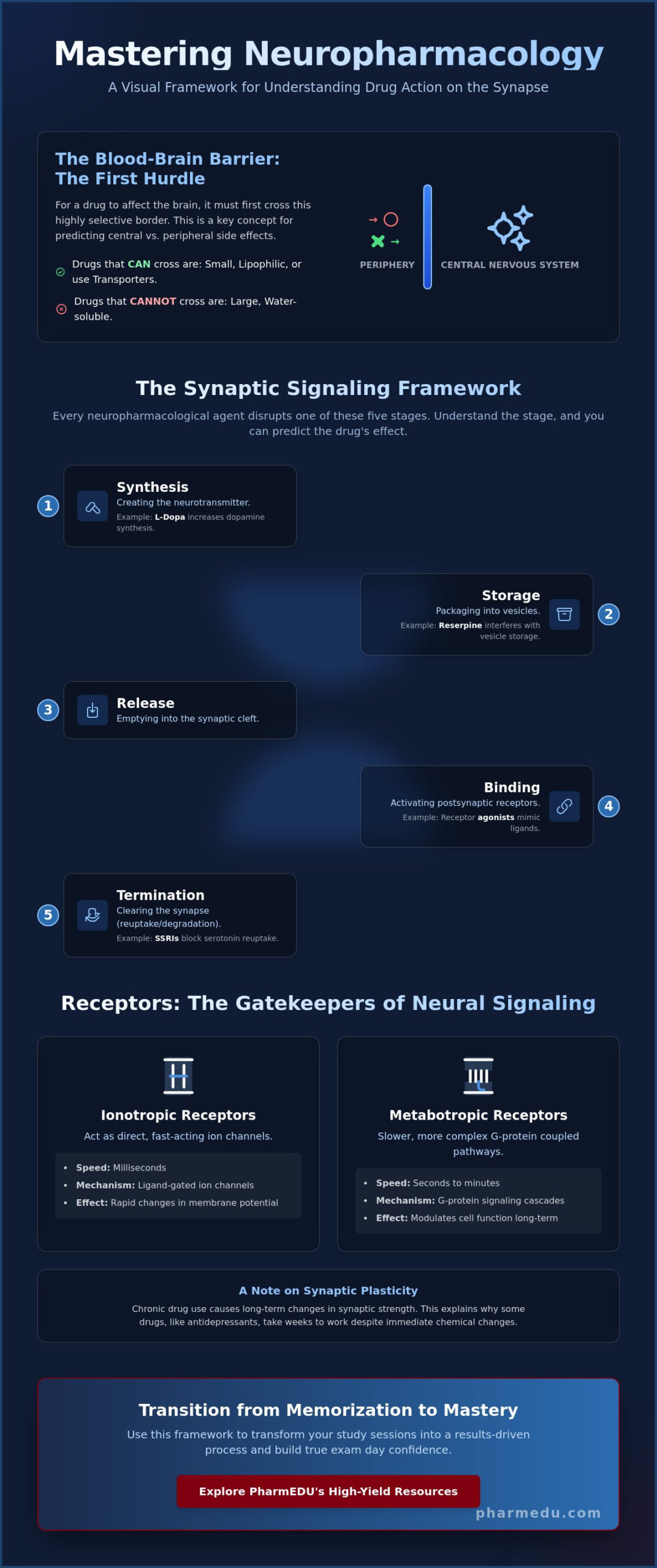
A fundamental pharmacokinetic concept for any board exam is the Blood-Brain Barrier (BBB). This highly selective semipermeable border prevents most solutes from crossing into the extracellular fluid of the central nervous system. For a drug to exert a central effect, it must be small, lipophilic, or utilize a specific transport system. Recognizing which drugs cross the BBB and which remain in the periphery is often the hidden logic behind exam questions regarding side effects like sedation or dry mouth. If a drug can’t cross the barrier, it won’t cause central symptoms.
The Synaptic Signaling Framework
To organize your study, treat every drug as a disruptor of the neurotransmitter life cycle. This cycle consists of five distinct stages: synthesis, storage, release, binding, and termination. Drugs typically target one of these steps to achieve a therapeutic result. For example, L-Dopa increases synthesis, while Reserpine interferes with storage. Understanding these Core Neuropharmacology Principles allows you to categorize medications based on their functional impact on the synapse rather than just their names.
Drugs modulate these stages in predictable ways. Reuptake inhibitors, such as SSRIs, prolong the presence of a neurotransmitter in the synaptic cleft by preventing its termination. In contrast, receptor agonists mimic the endogenous ligand to trigger binding directly. Synaptic plasticity refers to the persistent changes in synaptic strength and connection density that occur in response to chronic drug exposure or learning. This concept is vital for understanding why some drugs, like antidepressants, take weeks to show clinical benefits despite immediate changes in neurotransmitter levels. It’s a long-term structural shift, not just a quick chemical spike.
Receptors as Primary Pharmacological Targets
Receptors are the gatekeepers of neural signaling. They generally fall into two categories: ionotropic receptors, which act as fast-acting ion channels, and metabotropic receptors, which utilize G-protein coupled pathways for slower, more complex effects. Mastering the major families, including cholinergic, adrenergic, dopaminergic, and serotonergic receptors, is essential for any high-yield review of pharmacology.
A critical nuance for neuropharmacology concepts for exams is receptor selectivity. Most drugs are designed to target specific receptor subtypes to minimize off-target effects. However, selectivity is dose-dependent and often disappears at high concentrations. When a drug spills over to other receptor families, patients experience the side effects that examiners love to test. If you know the receptor type and its primary location, you can deduce the drug’s effect on the body with high precision.
Mastering the Autonomic Nervous System (ANS) High-Yields
The Autonomic Nervous System (ANS) represents the bread and butter of board exam neuropharmacology. While the Central Nervous System involves complex, multi-layered pathways, the ANS operates on a highly predictable, binary logic that examiners frequently exploit. Mastering these neuropharmacology concepts for exams requires you to move beyond simple “rest and digest” or “fight or flight” analogies. Instead, focus on the specific anatomical locations of receptors and the neurotransmitters that activate them to deduce physiological outcomes.
This system relies on two primary chemical messengers: Acetylcholine (ACh) and Norepinephrine (NE). The Parasympathetic Nervous System (PNS) uses ACh at both pre- and post-ganglionic synapses. Conversely, the Sympathetic Nervous System (SNS) utilizes ACh at the pre-ganglionic level but switches to NE for most post-ganglionic targets. This Autonomic Pharmacology Review provides a detailed look at how these pathways regulate involuntary functions across the body’s organ systems.
Adrenergic vs. Cholinergic Pathways
To predict organ-specific responses, you must internalize where specific receptors reside. A simple mnemonic helps: you have one heart (Beta-1) and two lungs (Beta-2). Alpha-1 receptors are primarily located in the vascular smooth muscle, causing vasoconstriction when stimulated. Understanding these locations is the fastest way to master neuropharmacology concepts for exams without drowning in drug lists.
- Heart: SNS (Beta-1) increases heart rate and contractility; PNS (M2) decreases heart rate.
- Lungs: SNS (Beta-2) causes bronchodilation; PNS (M3) causes bronchoconstriction.
- Pupils: SNS (Alpha-1) causes mydriasis (dilation); PNS (M3) causes miosis (constriction).
Anticholinergic side effects are a constant board topic because they appear in many non-neurological drug classes, such as antihistamines and tricyclic antidepressants. Symptoms like dry mouth, blurred vision, and urinary retention occur because these drugs block the M3 receptors that normally facilitate “wet” functions. When you see these symptoms, you should immediately think of Muscarinic blockade.
Predicting Side Effects via Receptor Localization
Successful students build side effect profiles from the ground up. If you know a drug is a non-selective Beta-blocker, you can deduce its risks. While it helps the heart (Beta-1), it also blocks Beta-2 receptors in the lungs. This explains why these medications are typically contraindicated in patients with asthma or COPD; blocking Beta-2 prevents necessary bronchodilation, potentially triggering a respiratory crisis.
While the ANS controls much of the cardiovascular response, it’s helpful to contrast these mechanisms with other classes. For instance, ACE inhibitors manage blood pressure through the renin-angiotensin-aldosterone system rather than direct autonomic receptor modulation. Understanding these distinctions prevents confusion during multi-step exam questions. Applying these concepts to clinical scenarios is the best way to ensure they stick. You can find these modules integrated into our NAPLEX prep course, which breaks down autonomic responses into digestible, testable units.
Central Nervous System (CNS) Disorders and Key Drug Classes
CNS disorders often feel chaotic because of the sheer number of neurotransmitters and pathways involved. To simplify neuropharmacology concepts for exams, you must categorize drugs by the specific chemical imbalance they aim to correct. In movement disorders, for instance, the central theme is the Dopamine-Acetylcholine balance. Parkinson’s disease results from a loss of dopaminergic neurons in the substantia nigra, which leads to a relative overactivity of acetylcholine. Effective treatment requires restoring this equilibrium by either increasing dopamine or blocking acetylcholine.
Psychiatric conditions typically follow the Monoamine Hypothesis. This theory suggests that a deficiency in serotonin, norepinephrine, or dopamine drives mood disorders. Understanding this hypothesis explains why most antidepressants target the reuptake or degradation of these specific amines. For a deeper dive into these systems, the MIT Neuropharmacology Lecture Notes offer excellent academic context for these neuropsychiatric frameworks. These resources help bridge the gap between basic biology and clinical application.
Safety is another high-yield area. When comparing CNS depressants, remember the distinction between benzodiazepines and barbiturates. Benzodiazepines increase the frequency of GABA-A channel opening, making them relatively safer in overdose. Barbiturates increase the duration of channel opening and can mimic GABA at high doses. This difference significantly increases the risk of fatal respiratory depression with barbiturates, a fact frequently tested on board exams.
Neurodegenerative Disease Management
Parkinson’s management centers on the Levodopa and Carbidopa combination. Levodopa crosses the blood-brain barrier to be converted into dopamine, while Carbidopa prevents its peripheral breakdown. Students must recognize the “on-off” phenomenon, where patients experience sudden fluctuations in motor function as drug levels oscillate. Alzheimer’s treatment takes a different path, focusing on cholinesterase inhibitors like Donepezil to boost acetylcholine levels or NMDA antagonists like Memantine to prevent glutamate-induced excitotoxicity.
Antipsychotic selection often hinges on side effect profiles. First-generation antipsychotics primarily block D2 receptors. This effectively treats positive symptoms but carries a high risk of extrapyramidal symptoms (EPS). Second-generation agents also target serotonin receptors. This broader mechanism typically improves negative symptoms and reduces EPS risk, though it introduces metabolic concerns like weight gain and dyslipidemia.
Psychopharmacology: Mood and Anxiety Agents
The evolution of antidepressants has moved from broad-spectrum MAOIs to highly selective SSRIs and SNRIs. While newer agents are safer, examiners love testing the traps of older classes. Serotonin syndrome is a life-threatening emergency characterized by hyperreflexia and autonomic instability, often triggered by mixing serotonergic drugs. Similarly, MAOIs require strict dietary avoidance of tyramine to prevent a hypertensive crisis. This occurs because inhibited monoamine oxidase cannot break down the tyramine found in aged cheeses and meats.
Lithium remains a gold standard for bipolar disorder but requires meticulous monitoring. Because it has a narrow therapeutic index, you must track serum levels, renal function, and thyroid status. Toxicity often presents with coarse tremors, ataxia, and confusion. Mastering these monitoring parameters is essential for neuropharmacology concepts for exams. These clinical correlations turn dry drug lists into predictable exam answers.
Avoiding Information Overdose: Synthesis Strategies for Success
Information overdose is the primary reason students struggle with neuropharmacology. Attempting to memorize over 200 drug names in isolation is inefficient and often leads to confusion during high-stakes testing. Successful candidates instead utilize the “Prototype Drug” method to organize their knowledge. By mastering one representative drug for each class, you create a mental anchor for all similar agents. For instance, if you understand the kinetics and dynamics of Fluoxetine, you essentially understand the entire SSRI class. This synthesis reduces the cognitive load and allows you to focus on the small nuances that differentiate individual drugs within that family.
This approach is particularly effective when combined with structured pharmacology study guides for nursing students, which distill vast amounts of data into high-yield summaries. Anchoring pharmacological facts to clinical correlations transforms abstract concepts into practical knowledge. When you associate a drug with a specific patient presentation, the information becomes much harder to forget. You aren’t just learning a mechanism; you’re learning how to solve a clinical puzzle.
Mechanism-Based Categorization
To master neuropharmacology concepts for exams, follow a three-step logical deduction process for every new class you encounter:
- Step 1: Identify the primary neurotransmitter involved (e.g., GABA).
- Step 2: Determine if the drug increases or decreases that transmitter’s effect (e.g., Benzodiazepines increase GABA activity).
- Step 3: Predict the physiological outcome based on receptor location (e.g., CNS inhibition leads to sedation and anxiolysis).
This deductive reasoning allows you to “build” the answer even if you don’t recognize the specific drug name in the question stem.
High-Yield Mnemonics and Clinical Correlations
Mnemonics serve as quick-access files for complex symptom clusters. For anticholinergic toxicity, remember the classic rhyme: “Blind as a bat, mad as a hatter, red as a beet, hot as a hare, dry as a bone.” For the opposite effect, a cholinergic crisis, use the SLUDGE mnemonic: Salivation, Lacrimation, Urination, Defecation, Gastric upset, and Emesis. These patterns are the exact clues examiners use in case vignettes.
On the exam, side effects are rarely just distractors; they’re diagnostic pointers. If a patient on an antidepressant presents with a hypertensive crisis, the vignette is pointing you toward an MAOI interaction with tyramine. Active recall through testing is significantly more effective than passive reading. Rather than highlighting a textbook, use pharmacology practice quizzes to challenge your memory and reinforce these neuropharmacology concepts for exams through simulated pressure. This method ensures that your knowledge is not just stored, but accessible when it matters most.
Elevate Your Board Prep with PharmEDU’s High-Yield Resources
Mastering neuropharmacology concepts for exams requires more than just a logical framework; it demands a reliable system for consistent retention. PharmEDU addresses the pervasive issue of information overdose by utilizing a specialized micro-learning strategy. This method breaks down complex signaling pathways into manageable units, ensuring that your study time is spent on the most testable material. By moving away from the exhaustion of traditional, dense lectures, you can focus on the precise details that examiners prioritize in 2026.
Our platform is designed to support you through every stage of your professional journey. Whether you are preparing for immediate classroom assessments or the final hurdles of licensure, our NAPLEX prep course provides dedicated neuro-specific modules that align with current board blueprints. The entire interface is mobile-compliant, allowing you to review high-yield facts during clinical rotations or while commuting. This flexibility ensures that your professional development remains a constant, manageable part of your daily routine.
Micro-Learning Vignettes for Rapid Mastery
Traditional long-form lectures often lead to cognitive fatigue and decreased retention. PharmEDU solves this with High-Yield Video Vignettes, which are concise, 5-10 minute sessions focused on a single mechanism or drug class. These videos are meticulously mapped to official examination requirements, providing the exact level of depth needed for success. For academic leaders, our institutional platform license offers a way to integrate these resources into university curricula, helping to boost pass rates across entire cohorts of students. It’s a modern solution for a demanding professional environment.
Interactive Flashcards and Practice Quizzes
Retention is a product of active engagement rather than passive reading. Our Interactive Pharmacology Flashcards utilize spaced-repetition logic to ensure you revisit difficult neuropharmacology concepts for exams at the optimal time for long-term storage. This system identifies your weak points and forces you to confront them until they become strengths. To bridge the gap between theory and practice, our Pharmacology Practice Quizzes and Clinical Case Studies mirror the complexity of real exam questions, including multi-step reasoning and side-effect identification.
Transitioning from a dedicated student to a licensed pharmacist is a significant milestone that requires both scientific knowledge and a commitment to continuous learning. PharmEDU acts as your digital mentor, providing the tools necessary to navigate the rigorous standards of the healthcare sector. We invite you to join our community of successful professionals who have replaced study-related stress with methodical, evidence-based preparation. Your career path deserves a partner that values precision and efficiency as much as you do.
Master Your Path to Clinical Excellence
Success on your 2026 boards depends on your ability to synthesize vast amounts of data into a functional mental map. By prioritizing the prototype drug method and mastering receptor localization logic, you’ve moved beyond the trap of rote memorization. These neuropharmacology concepts for exams are no longer isolated facts but predictable rules that guide your clinical reasoning. You now possess the framework needed to distinguish between complex drug classes with precision, even under high-pressure testing conditions.
PharmEDU is ready to support your transition from student to licensed professional. Our platform features over 100 high-yield pharmacology topics, expert-led video vignettes, and interactive quizzes designed for modern, mobile-compliant study. This methodical approach takes the administrative burden off your shoulders so you can focus on true mastery. Start Your PharmEDU Subscription and Pass Your Boards Now. You have the tools and the framework; it’s time to approach your exams with the confidence of a seasoned expert. Your professional future is within reach.
Frequently Asked Questions
What are the most common neuropharmacology topics on the NAPLEX?
The most common neuropharmacology topics on the NAPLEX include the management of Parkinson’s disease, epilepsy, major depressive disorder, and schizophrenia. You’ll also encounter significant questions regarding the autonomic nervous system and its systemic impacts. Mastering neuropharmacology concepts for exams requires prioritizing these high-prevalence areas because they form the foundation of clinical practice and safety.
How do I distinguish between Sympathetic and Parasympathetic drug effects?
Distinguish between these systems by identifying the “Fight or Flight” (Sympathetic) and “Rest and Digest” (Parasympathetic) responses. The Sympathetic system increases heart rate and dilates pupils via adrenergic receptors. The Parasympathetic system slows the heart and increases secretions through muscarinic receptors. Focus on the dominant receptor at each organ to predict the outcome of any drug class.
Why are anticholinergic side effects so frequently tested?
Anticholinergic side effects are frequently tested because they are a common denominator across diverse drug classes, including antihistamines, antipsychotics, and antidepressants. Examiners use these symptoms to test your ability to recognize drug-drug interactions and polypharmacy risks. Understanding the “dry” symptoms of muscarinic blockade is essential for identifying potential adverse events in complex clinical vignettes.
What is the difference between ionotropic and metabotropic receptors?
Ionotropic receptors are ligand-gated ion channels that provide immediate, fast-acting responses, while metabotropic receptors are G-protein coupled and produce slower, more sustained effects. Ionotropic examples include nicotinic and GABA-A receptors. Metabotropic examples include muscarinic and most adrenergic receptors. This distinction is vital for understanding the onset and duration of various pharmacological agents.
How can I remember the different adrenergic receptor subtypes?
Use the numerical mnemonic to remember adrenergic subtypes: you have one heart (Beta-1) and two lungs (Beta-2). Alpha-1 receptors are generally found in the peripheral vasculature, causing constriction when activated. This simple anatomical mapping allows you to deduce the cardiovascular and respiratory effects of agonists and antagonists without memorizing individual drug profiles.
What is Serotonin Syndrome and why is it an exam priority?
Serotonin Syndrome is a life-threatening condition caused by excessive serotonergic activity, often resulting from drug interactions like mixing MAOIs with SSRIs. It’s an exam priority because it requires immediate clinical recognition of symptoms like hyperreflexia, tremors, and autonomic instability. Being able to identify this emergency is a critical safety competency for any healthcare professional.
Can I pass my pharmacology exam using only flashcards?
You likely can’t pass a rigorous pharmacology exam using only flashcards because these tests require high-level clinical application rather than simple recall. While flashcards are excellent for neuropharmacology concepts for exams, you must supplement them with active recall. We recommend using PharmEDU’s interactive practice quizzes and clinical case studies to simulate the multi-step reasoning required on board exams.
How does the Blood-Brain Barrier affect neuropharmacology drug design?
The Blood-Brain Barrier (BBB) dictates drug design by requiring central agents to be small, lipophilic, or capable of utilizing specific transport proteins. If a drug is designed to treat peripheral conditions, designers often make it polar to prevent it from crossing the BBB and causing central side effects like sedation. This pharmacokinetic principle explains why second-generation antihistamines cause less drowsiness than their predecessors.