

Evidence-based practice in pharmacology: use guidelines and research
Sound pharmacology decisions depend on more than knowing what a drug does. Evidence-based practice in pharmacology means asking a focused clinical question, finding and critically appraising relevant evidence, applying it to the patient, and assessing the outcome. Research informs the decision, while clinical expertise and the patient’s needs shape how the evidence is used.
Considering guidance, research findings, and individual circumstances together can feel demanding. A clear method makes the process more manageable: guidelines help frame care, medical databases and scientific publications help locate evidence, and pharmacology education builds the knowledge needed to interpret it. This article explains how these resources work together, how to shape a clinical question, and what to consider when weighing research for an individual patient.
Key Takeaways
- Assess randomized clinical trials by looking beyond their conclusions: examine how the study was designed, who participated, and whether its findings apply to the clinical question.
- Use clinical practice guidelines to organize treatment decisions, while weighing the evidence alongside patient preferences, risks, benefits, and practical considerations.
- Search medical databases with focused concepts and appropriate filters to locate relevant research, then consider publication date and study type when evaluating what you find.
- Build pharmacology knowledge through repeated practice and case-based learning to strengthen your ability to interpret evidence and apply it in patient care.
What is Evidence Based Practice?
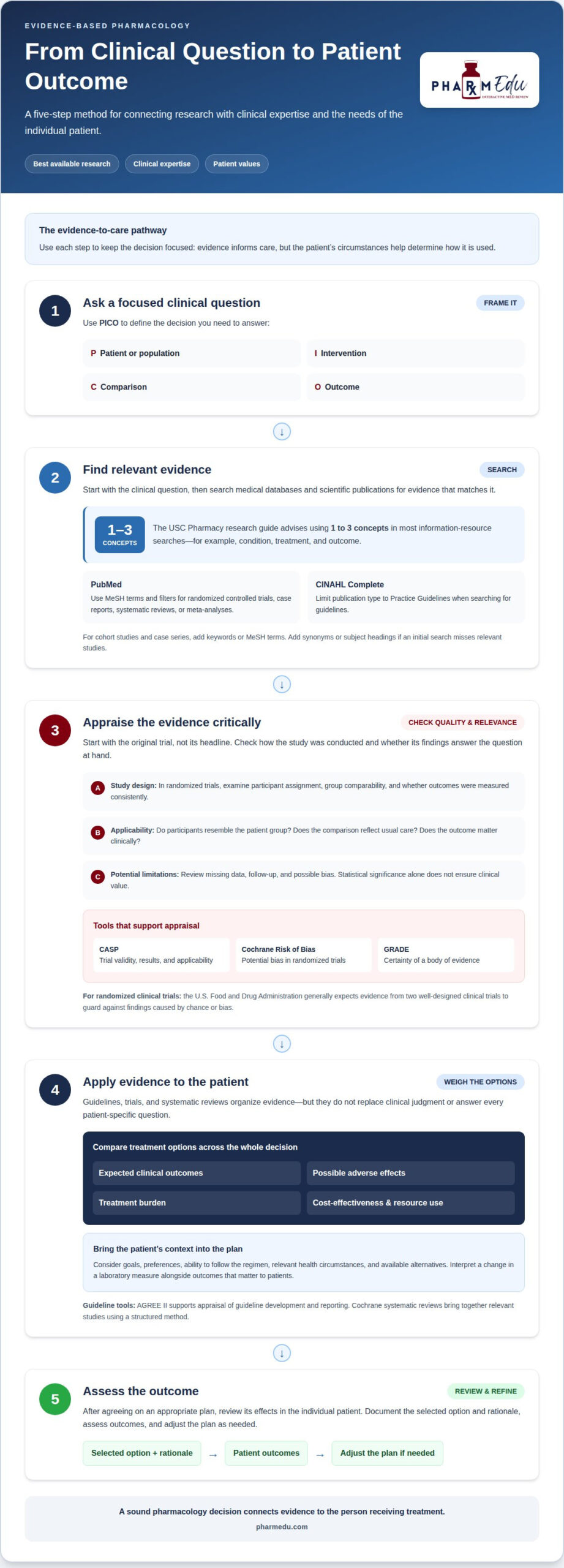
Evidence-based practice in pharmacology connects the best available research with clinical expertise and patient values. It follows five steps: ask a focused question, find evidence, appraise it, apply it to the patient, and assess the outcome. For drug therapy, this means evaluating both study findings and their relevance to the person receiving treatment.
Clinicians evaluate drug evidence by examining study design, results, and potential bias. For randomized controlled trials, they consider how participants were assigned, whether groups were comparable, and whether outcomes were measured consistently. The U.S. Food and Drug Administration generally expects evidence from two well-designed clinical trials to guard against findings caused by chance or bias.
Start appraisal with the original trial, not its headline. Check whether participants resemble the patient group in question, whether the comparison reflects usual care, and whether the reported outcome matters clinically. Then examine missing data, follow-up, and possible bias. A statistically significant result may still have limited value if the outcome measured does not answer the clinical question.
- CASP checklists: guide readers through questions about trial validity, results, and applicability.
- Cochrane Risk of Bias tool: helps assess potential bias across key parts of a randomized trial.
- GRADE: supports judgments about the certainty of a body of evidence.
A critically appraised article summarizes a study and its practical implications. In a journal club, use it to discuss an original trial, compare interpretations, and identify unanswered questions. For example, when reviewing a therapy trial, ask whether its participants and outcomes match the clinical decision at hand.
Evidence appraisal and implementation tools have different purposes. PICO helps frame a focused question by defining the patient or population, intervention, comparison, and outcome. JBI evidence-based recommended practices translate available evidence into clinical procedures. To assess appraisal skills, use a CASP checklist and record your judgments, then compare them with a journal club discussion. This process can reveal which appraisal steps need more practice.
Clinical practice guidelines
Clinical practice guidelines organize research into recommendations for specific care decisions. They help clinicians connect evidence with clinical expertise and patient values, rather than replacing judgment. When considering a medication, weigh the patient’s goals, preferences, ability to follow the regimen, and relevant health circumstances alongside the population the guideline addresses.
The core steps of evidence-based pharmacotherapy are to define the clinical question, locate and assess relevant evidence, compare treatment options, agree on an appropriate plan, and review its effects. PICO can structure the question around the patient or population, intervention, comparison, and outcome. This makes it easier to judge whether a guideline or study addresses the decision at hand.
Randomized controlled trials test interventions under controlled conditions and can help estimate treatment effects. Cochrane systematic reviews bring together relevant studies using a structured method, helping clinicians assess findings across trials instead of relying on one journal article. Neither source answers every patient-specific question: study populations, measured outcomes, and treatment settings still matter.
Compare medication benefits, harms, and cost-effectiveness by considering expected clinical outcomes, adverse effects, treatment burden, and resource use. Weigh these factors against patient priorities and available alternatives. For example, interpret a reduction in a laboratory measure alongside outcomes that matter to patients, rather than treating it as the whole clinical picture.
Statistical analyses help clarify how much confidence to place in reported results. A confidence interval shows the range of effect estimates compatible with the data, while an absolute effect can make differences easier to interpret in practice. GRADE helps assess certainty across a body of evidence and the strength of recommendations. AGREE II supports appraisal of guideline development and reporting. Cochrane reviews can inform that appraisal, and a university library can help locate the underlying publications. In practice, document the selected option and rationale, then assess outcomes and adjust the plan as needed.
Use of scientific publications and medical databases
Evidence-based medicine uses current, relevant research to inform decisions about individual patients. In pharmacy practice, that means using publications to examine a medicine’s effectiveness, harms, and suitability, rather than relying on familiarity alone. A database search begins with a defined clinical question, such as whether one drug reduces symptoms compared with another.
Keep the search focused. The USC Pharmacy research guide advises using 1 to 3 concepts in most information-resource searches. For a question about a medicine’s effectiveness, concepts might include the condition, treatment, and outcome. Add synonyms or subject headings when initial results miss relevant studies. PubMed’s Medical Subject Headings, or MeSH, help retrieve articles indexed under related concepts.
Choose filters that match the evidence you need. The USC Pharmacy guide recommends PubMed filters for randomized controlled trials and case reports. For cohort studies and case series, add keywords or MeSH terms. Use PubMed’s Systematic Review or Meta-Analysis filter to find those study types. In CINAHL Complete, limit the publication type to Practice Guidelines when searching for guidelines.
Each tool supports a different task:
- PubMed: find biomedical articles, then narrow results by study type.
- CINAHL Complete: identify practice guidelines through its publication-type limit.
- MeSH: expand a search using consistent subject terms.
- ACP Journal Club: locate critically appraised research; the USC Pharmacy guide lists holdings from May 2008-present.
After retrieving a publication, appraise its date, study design, population, and outcomes. A recent article may not answer the question if its patient groups differ from those receiving care. Compare its methods and results with other relevant publications, then consider whether the findings apply to the treatment decision. This approach keeps evidence-based medicine connected to practical pharmacy decisions while separating research findings from assumptions about effectiveness.
Pharmacology education and evidence-based practice
Pharmacology education helps learners turn foundational knowledge into structured clinical reasoning. A useful learning task connects a drug’s mechanism, intended effect, and potential risks to a defined case. For example, after reviewing a medication class, explain which treatment goal it addresses and what evidence would help assess that choice.
Active practice makes knowledge gaps easier to spot. Interactive flashcards can reinforce drug mechanisms and key safety concepts, while Pharmacology Practice Quizzes test how well learners distinguish related drug classes. Clinical Case Studies give learners a setting to apply concepts, explain their reasoning, and identify details that could change a treatment decision.
Build skills in stages. First, establish the pharmacology concepts relevant to a case. Next, examine the evidence supporting a treatment approach. Then explain how the findings relate to the case, including limitations in the study population or outcome. This progression connects classroom knowledge with careful interpretation, rather than relying on memorized facts.
Published literature can also help learners develop better questions. When reviewing a systematic review, note which populations or outcomes need more study, then turn that gap into a focused question for further reading. Discussing the question with peers can clarify why interpretations differ and what evidence could help resolve them.
Assess learning through a short reflection after each exercise: identify the concept understood, the reasoning step that felt difficult, and the next topic to revisit. Repeating this process across drug classes helps make study more purposeful. To apply pharmacology concepts through structured practice, explore quizzes and clinical cases.
PharmEDU: Pharmacology Practice Quizzes
PharmEDU offers Pharmacology Practice Quizzes to help learners reinforce pharmacology knowledge through focused practice. Use quizzes alongside research and guidelines to revisit drug mechanisms, therapeutic effects, and safety concepts, then identify topics for further study. They support learning, not patient-specific medical decision-making.
The PharmEDU Monthly Subscription and PharmEDU Annual Subscription provide access to the platform’s educational curriculum for individual learners. Institutions can use an Institutional Platform License to provide access for their learners. These options can complement coursework, exam preparation, or continued pharmacology review.
Choose practice questions when you want to strengthen recall or assess your understanding of pharmacology concepts. Pairing them with scientific reading can help connect foundational knowledge to evidence appraisal. Contact PharmEDU to discuss its Pharmacology Practice Quizzes and learning options.
Make Your Next Learning Step Deliberate
Turn a clinical question into a focused learning goal. Choose a drug class, mechanism, or safety concept you want to study more closely, then identify what you want to understand. A defined goal makes it easier to connect pharmacology knowledge with evidence relevant to your learning.
A durable approach to evidence-based practice in pharmacology also includes reflection. After studying a topic, note what became clearer, which question remains, and what you’ll revisit next. This simple record can guide future study and help you recognize how your understanding is developing.
Keep learning connected to practice without treating educational material as a substitute for patient-specific clinical judgment. PharmEDU provides digital pharmacology learning resources to support continued study. Explore learning options with PharmEDU, and take your next step with a clear learning focus.
Frequently Asked Questions
What is evidence-based practice in pharmacology?
Evidence-based practice brings together research, clinical judgment, and the patient’s situation to inform medication decisions. A study may show that a therapy works for a particular group, but clinicians still consider whether that group resembles the patient and whether the outcome matters to them. Evidence informs the decision; it does not make the decision by itself.
What sources provide reliable evidence for pharmacology decisions?
Useful sources include peer-reviewed original studies, systematic reviews, clinical guidelines, and medical databases such as PubMed. Check whether a publication examines the medication, population, and outcome relevant to the decision. For example, a trial measuring short-term symptom change may not answer a question about longer-term outcomes. Follow a review’s references to the original study when a recommendation needs closer examination.
How are clinical guidelines applied to medication selection and dosing?
Guidelines help identify recommended treatment options and the circumstances each recommendation addresses. Clinicians compare those criteria with the patient’s clinical needs, current medicines, and treatment goals. A guideline can inform selection and dosing, but its recommendations must be interpreted in context. If the patient’s circumstances differ from those described, that difference matters to the decision and its follow-up.
How does evidence-based pharmacology account for patient preferences and comorbidities?
Evidence-based practice treats patient priorities and coexisting conditions as part of the decision, not as details to consider afterward. A person’s treatment goals, ability to follow a regimen, and other health needs can affect which option is suitable. For instance, a patient may prioritize fewer daily doses, while a comorbidity may make certain risks more important to consider during treatment planning.
What are common limitations and biases in pharmacology research?
Research may have limited applicability when its participants differ from the patients receiving care. Other concerns include short follow-up, missing data, selective reporting, and outcomes that do not capture what patients value. A study may report an effect without showing how a medicine performs alongside other treatments. Appraising these limitations helps clarify what the findings support and where uncertainty remains.
How is evidence-based pharmacology used in U.S. clinical practice?
In U.S. clinical practice, clinicians use research and guidelines to inform medication decisions, then consider each patient’s needs and preferences. A practical approach is to document the clinical reason for a medication choice, review relevant patient factors, and monitor outcomes after treatment begins. This can support communication among care-team members and make later treatment reviews more focused.