Understanding Clinical Drug Trials, From Safety to Participation
A drug’s first human study is only one stage of its evaluation. Understanding clinical drug trials means seeing how research moves from early safety testing through studies of effectiveness and longer-term monitoring; the National Cancer Institute describes four clinical trial phases. People may participate to access a study treatment or contribute to research, but the purpose and potential risks depend on the specific trial.
It’s reasonable to ask how a treatment moves from laboratory research to human testing and what safeguards guide that process. Before a clinical trial begins, researchers study the investigational treatment in a laboratory. Human studies then follow a protocol, with participant monitoring and informed consent.
This article explains how preclinical research connects to the four phases, why people join trials, and how safety protections work. It also clarifies the roles of placebos, randomization, and blinding, so you can understand how a study is structured and what participation may involve.
Key Takeaways
- Understand how each trial phase builds on earlier evidence and addresses a different research goal.
- Recognize how informed consent, participant monitoring, and oversight help protect people in a study.
- See how placebos, random assignment, and blinding support fairer comparisons between treatment groups.
- Connect laboratory research to human studies, then use clinical case studies to strengthen your pharmacology learning.
What are clinical trials and why do people participate?
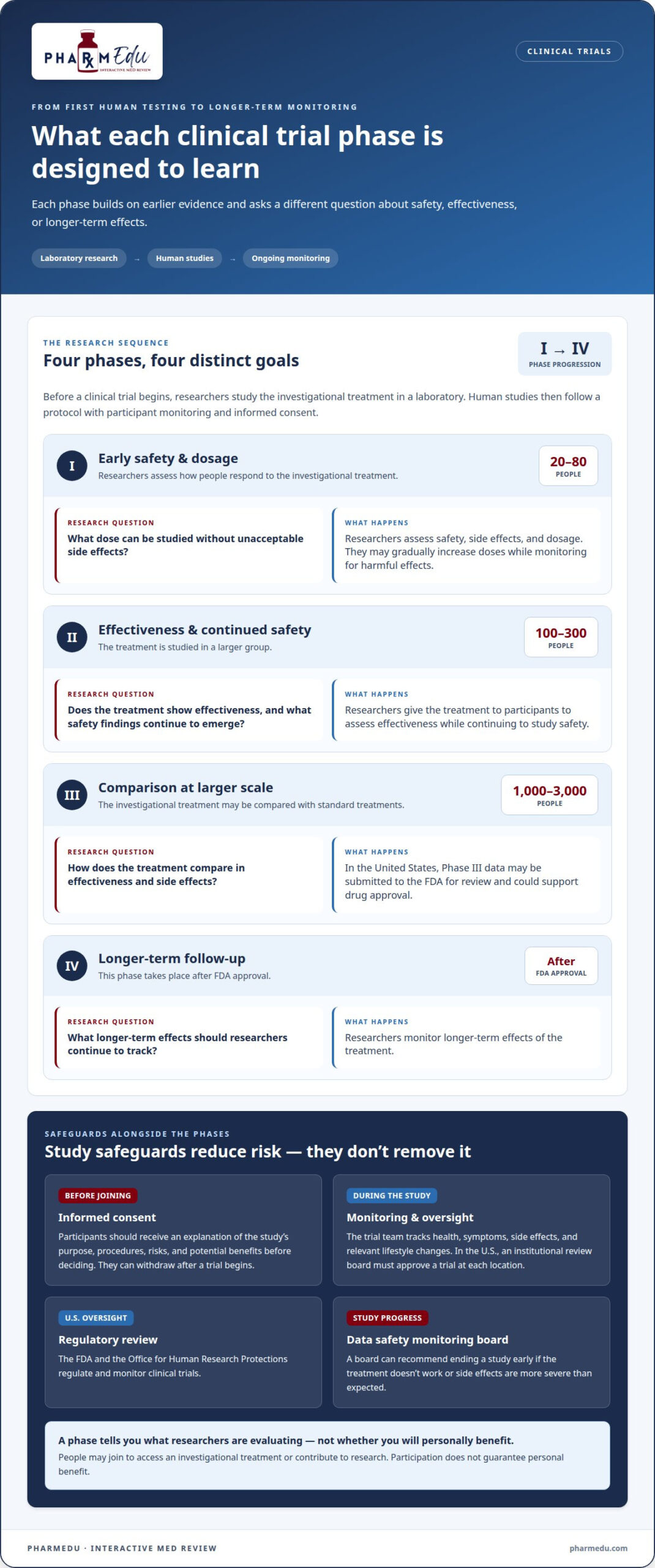
Clinical trials test medical approaches in people, including drugs, drug combinations, devices, and new uses for existing treatments. The National Cancer Institute describes four phases of clinical trials. Each phase addresses different questions, from early safety testing to monitoring a treatment after approval.
In Phase I, researchers usually test a treatment in a small group, with one fact set describing 20-80 people. They assess safety, side effects, and dosage. Phase II studies give a treatment to 100-300 people to assess effectiveness and continue studying safety. In Phase III, studies involving 1,000-3,000 people can compare the investigational treatment with standard treatments, examining effectiveness and side effects. In the United States, Phase III data may be submitted to the Food and Drug Administration (FDA) for review and could support drug approval. Phase IV studies take place after FDA approval and help researchers track longer-term effects.
People join trials for different reasons. Some hope to access an investigational treatment; others want to contribute to research that may inform future care. A study may also test a new use for an existing drug rather than a new medicine. Participation doesn’t guarantee personal benefit, and a trial’s phase indicates what researchers are evaluating.
Participants may receive compensation for their time and travel, particularly in Phase I studies. Study information should specify which trial-related costs are covered and who pays them. Don’t assume compensation covers every expense. Before deciding, ask the study team about payment, travel reimbursement, and any costs associated with participation.
Before joining, ask who funds the study, who reviewed and approved it, and how researchers monitor participant safety and study results. Clarify what procedures and drug administration involve, which side effects the team is watching for, and what happens if you withdraw. These answers can help you weigh the protocol’s demands against your reasons for participating.
Participant safety and ethical protections
Clinical trial safeguards are built into study planning, informed consent, and ongoing oversight. Researchers also assess whether a treatment’s potential benefits justify its known and emerging risks.
Safety and Dosage Evaluation
Safety and dosage evaluation examines how participants respond to different amounts of an investigational treatment. In Phase I, researchers may gradually increase doses while monitoring for harmful effects. This helps them identify a dose that avoids unacceptable side effects. The amount used matters because it can affect both treatment response and risk.
Researchers continue to assess side effects and effectiveness in later phases. Trial results describe outcomes in the study population. Statistical significance means an observed difference is unlikely to be explained by chance alone under the analysis used. It doesn’t, by itself, show that the difference matters clinically or that a treatment is safe and effective for everyone.
Safety Monitoring and Oversight
Safety monitoring means reviewing participants’ health and reactions to treatment throughout a study. The trial team tracks symptoms, side effects, and relevant lifestyle changes, and can respond to reactions while a participant’s regular healthcare team manages ongoing medical issues. This clarifies which team handles trial-related monitoring and which provides routine care.
In the United States, an institutional review board must approve a trial at each study location before it takes place there. The Food and Drug Administration and the Office for Human Research Protections regulate and monitor clinical trials. A data safety and monitoring board can recommend ending a study early if the treatment doesn’t work or side effects are more severe than expected.
Informed consent helps people make an informed decision. Before joining, a person should receive an explanation of the study’s purpose, procedures, risks, and potential benefits. Participants can withdraw after a trial begins. Ask how to report safety concerns, who reviews the study’s progress, and what support is available if side effects occur. Approval and monitoring can reduce risks, but they don’t make a treatment risk-free.
Placebos, randomization, and blinding
These methods shape how researchers compare treatments and interpret results. In a randomized trial, chance assigns participants to groups; blinding limits who knows each assignment.
Control Groups and Placebos
A control group gives researchers a basis for comparing outcomes with those in the group receiving the study medicine. Depending on the design, its participants may receive standard treatment or a placebo. Randomization assigns participants to groups by chance, reducing the influence of personal choice on group placement.
For example, a Phase II study may assign participants to an experimental drug, standard treatment, or placebo. Comparing the groups helps researchers assess whether observed effects are related to the study medicine. A placebo has no active ingredients and is designed to look like the study medicine, helping keep the comparison consistent.
Placebo Use
In a controlled study, placebo use means giving some participants an inactive treatment designed to look like the active treatment. This can help researchers distinguish a medicine’s effects from changes that might happen without its active ingredients.
A placebo alone may not be appropriate when a condition requires active standard-of-care treatment. In that case, researchers may compare the study medicine with standard treatment rather than leave participants without an active option. The protocol explains the groups and treatments, so people can understand the design before enrolling.
Blinding adds another layer of protection against bias. In a single-blind trial, participants don’t know their group, but researchers do. In a double-blind trial, neither participants nor researchers know who receives the study medicine or placebo. Blinding can limit bias when participants report symptoms or professionals assess outcomes. Researchers can find out group assignments if safety requires it, and trials are unblinded after completion or when blinding is no longer necessary.
Most Phase II studies are randomized, and Phase III studies are usually randomized and blinded. These methods support fair comparisons, but they don’t mean every participant receives the same treatment. The trial protocol describes the groups and procedures. Reviewing it helps clarify what participation involves.
Preclinical studies and clinical trials
Before an investigational treatment reaches people, preclinical studies assess its potential in a laboratory. Understanding clinical drug trials involves recognizing that these findings guide decisions about human testing, but don’t establish how a treatment will affect patients. Developing a new medicine takes at least 10 years on average, and less than 12% of candidate medicines entering Phase I are approved by the FDA.
Moving from laboratory research to clinical research requires a defined study plan. A clinical trial protocol describes the study’s purpose, eligibility criteria, participant protections, tests and treatments, expected duration, and information researchers will collect. Sponsors also seek approval from government regulatory agencies and ethics committees before human trials begin. In the United States, FDA approval is required before researchers can start clinical trials.
Screening determines whether a person meets the study’s eligibility criteria. It may involve reviewing medical history, conducting a physical exam, and ordering laboratory tests such as blood work or imaging. Eligibility guidelines can consider age, sex, overall health, the condition being studied, and current treatments. For example, a study may enroll people with a specific disease but exclude those whose existing medication could affect the results.
After enrollment, participants follow the protocol, which sets out the planned study activities and treatment procedures. Researchers collect information according to that plan to assess outcomes consistently across participant groups. Understanding clinical drug trials also means recognizing how study findings can contribute to FDA review: evidence from completed studies may inform decisions about a treatment. Follow-up can track long-term effects and gather additional data on effectiveness.
The key distinction is purpose: preclinical research evaluates a treatment’s potential before human testing, while clinical trials study its effects in people under a defined protocol. Promise in the laboratory alone doesn’t show patient benefit; each clinical study addresses specific questions about a treatment.
PharmEDU: Clinical Case Studies
PharmEDU’s Clinical Case Studies let healthcare students and professionals apply pharmacology knowledge to clinical scenarios after learning how drug trials are designed. They help connect treatment mechanisms, potential effects, and patient contexts, reinforcing concepts behind clinical research.
Use case-based learning to move beyond definitions and practise interpreting pharmacology in context. PharmEDU’s broader curriculum also includes video vignettes, interactive flashcards, content reviews, and quizzes. Individual learners can choose monthly or annual subscriptions, and organizations can access the platform through an institutional license.
For information about PharmEDU, contact the team.
Carry Your Trial Knowledge Into Practice
A stronger understanding of clinical drug trials can help you interpret emerging evidence and discuss it with care. Rather than treating every finding as a final answer, consider the question a study set out to address, whom its results may inform, and what further evidence could add. This habit of careful interpretation supports sound clinical learning and keeps uncertainty in perspective.
Keep building that judgment through deliberate pharmacology study. Connect new concepts to patient scenarios, revisit areas that feel unclear, and make space for learning as evidence develops. For an educational next step, contact PharmEDU to learn more. A steady, curious approach can make complex research easier to understand and apply thoughtfully.
Frequently Asked Questions
How does the research process work?
Research begins with a question about a treatment, condition, or health outcome. Laboratory studies assess a treatment’s potential before researchers consider testing it in people. Clinical research then follows a study plan and gathers information to answer defined questions. Researchers might examine whether a medicine changes a measurable disease indicator, how participants respond, or whether further study is warranted.
How is my safety protected?
Safety protections include review before a trial begins and continued oversight while it runs. In the United States, an institutional review board must approve the study at its location, while the FDA and Office for Human Research Protections regulate and monitor clinical trials. Participants can ask how to report a new symptom, who will respond, and how the study team communicates safety updates.
Phase 1: Is This Treatment Safe?
Phase I testing focuses on safety and dosage, but it can’t establish that a treatment is safe for everyone. Researchers assess how participants respond and look for side effects as they evaluate an appropriate dose. For example, a reaction observed after a dose may affect what researchers test next. The study’s purpose and participant group also shape what its findings can tell you.
What are the risks?
Risks depend on the treatment, the condition being studied, and the procedures required by the protocol. They may include side effects from the investigational treatment or burdens related to study visits and tests. Some effects may be unknown before people take part. Review the risks described for the specific study, ask how unexpected problems are handled, and consider how participation fits your health needs.
What is an Institutional Review Board?
An Institutional Review Board (IRB) reviews a clinical trial before it takes place at a study location. Its role includes considering participant protections and study risks. In the United States, each study location must have IRB approval before the trial takes place there. If you’re considering enrolling, ask which board reviewed the study and how to raise a concern during participation.
What is informed consent?
Informed consent is the process of explaining a study’s purpose, procedures, risks, and potential benefits so a person can decide whether to participate. It gives you the opportunity to understand what the study involves and ask questions before deciding. Consent doesn’t eliminate the possibility of harm, and participants can withdraw after a trial begins. Ask for clarification if any study detail is unclear.