
Dermatologic Pharmacology for PAs: A Clinical Study Guide
Dermatologic pharmacology for PAs is easier to retain when you connect drug classes to clinical questions instead of studying medication names in isolation. The challenge is to link a medication’s class and mechanism to its intended role, patient-specific risks, monitoring, and counseling considerations. That connection gives each fact a place in your clinical reasoning.
If medication classes blur together or study materials don’t translate easily to patient cases, a consistent framework can help. Organize what you learn around why a treatment may be used and which safety details require attention, rather than treating every drug as a separate fact to memorize.
This guide organizes dermatologic drug classes by mechanism and use, highlights safety and monitoring considerations, and connects pharmacology concepts to clinical scenarios. It also offers a study approach based on active recall and application. Short sessions using flashcards, quizzes, and case studies can make complex concepts more manageable while keeping your focus on the reasoning behind treatment decisions.
Key Takeaways
- Organize dermatologic medications by therapeutic class and mechanism to make their roles easier to compare.
- Use condition categories such as acne, atopic dermatitis, psoriasis, and skin infections to connect treatment options with clinical reasoning.
- For dermatologic pharmacology for PAs, separate broad class knowledge from drug-specific contraindications, warnings, and monitoring needs.
- Follow a repeatable study sequence: classify the drug, explain its mechanism, apply it to a case, then review safety.
- Use a sustainable study plan to revisit difficult concepts and track questions that need further review.
Dermatologic Pharmacology for PAs: Build a Clinical Framework First
Dermatologic pharmacology covers medications used to manage skin disorders. Because these conditions have different causes and patterns, learning the subject involves more than matching a drug name to a diagnosis. A broad overview of Dermatology can orient you to the field. Pharmacology adds the practical questions: What process does a medication target? Why might it be selected? How is it given? Which risks and patient factors need attention?
This framework connects foundational coursework with exam preparation and supervised clinical practice. In a case-based question, don’t stop at recognizing a medication class. Explain its intended role and identify the cautions that need review. In practice, that knowledge supports informed discussion and clinical decision-making within your training, supervision, and applicable scope of practice. Educational material builds understanding, but it doesn’t replace current prescribing information, clinical references, or guidance from a supervising clinician.
Connect mechanisms of action to treatment goals
A mechanism of action describes how a medication affects a biological target or process. Link that mechanism to the treatment goal to understand why a class may be considered for a particular problem. Also distinguish symptom relief, such as reducing discomfort, from modification of an underlying disease process. These goals aren’t interchangeable. Before applying a concept, verify the medication’s indication, route, and precautions in current prescribing information.
Organize medication knowledge around the patient
Drug knowledge becomes more useful when you consider who might receive a medication. Age, pregnancy potential, comorbidities, and concurrent medications are important study factors because they can affect how clinicians assess suitability and risk. Use them to guide questions, not to make assumptions or reach an individualized prescribing decision based on a study summary alone.
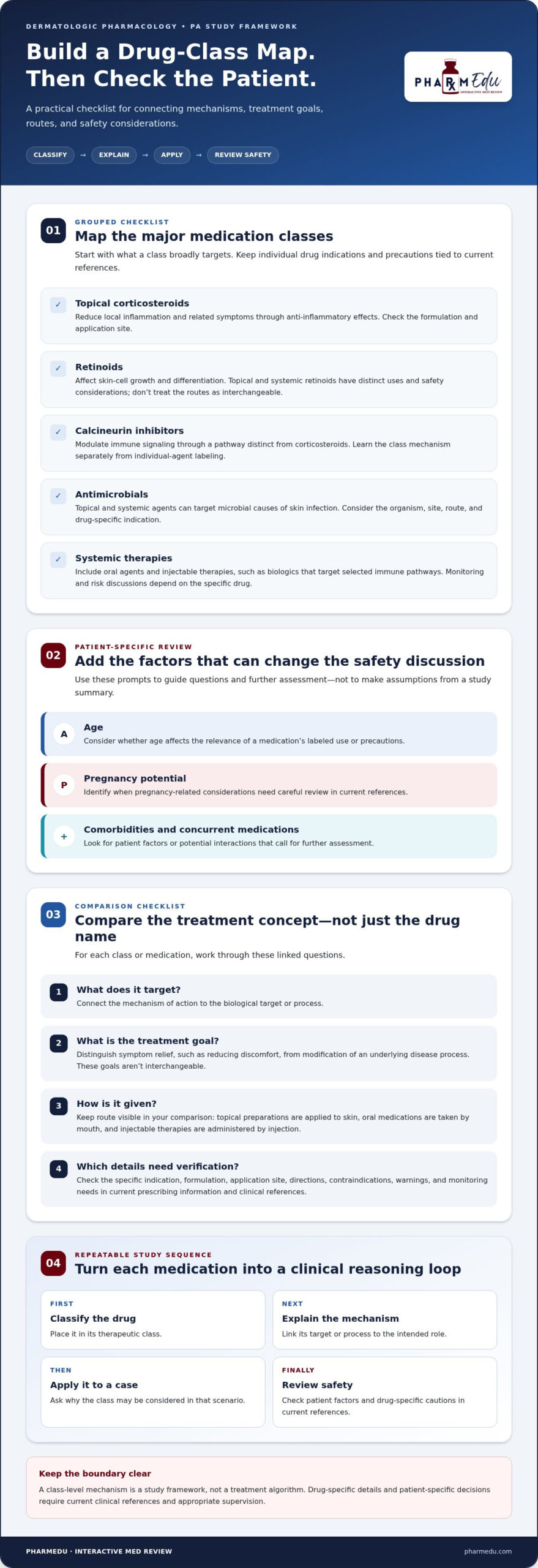
- Age: Consider whether age affects the relevance of a medication’s labeled use or precautions.
- Pregnancy potential: Identify when pregnancy-related considerations need careful review in current references.
- Comorbidities and concurrent medications: Look for patient factors or potential interactions that call for further assessment.
Keep general pharmacology principles separate from patient-specific decisions. A study guide can explain a class-level mechanism, but it can’t account for a patient’s complete history, examination, or treatment plan. PA practice authority and supervision requirements also vary by state, so responsibilities depend on the applicable state framework and practice setting. Include that context in your professional learning alongside medication knowledge.
Use dermatologic pharmacology for PAs as a reasoning framework: connect the medication to its target and intended role, identify patient factors that could matter, then verify drug-specific details in current clinical references before applying the information in supervised care.
Which Dermatologic Drug Classes Should PAs Understand?
Build a class map before memorizing individual drug names. Dermatologic medications can be grouped by what they broadly target and how they’re delivered. This makes it easier to compare treatment concepts while keeping drug-specific indications, contraindications, and precautions tied to current prescribing information and clinical references.
Start with these major groups:
- Topical corticosteroids: Reduce local inflammation and related symptoms through anti-inflammatory effects. Formulation and application site matter to safe use.
- Retinoids: Affect skin-cell growth and differentiation. Topical and systemic retinoids have distinct uses and safety considerations, so don’t treat the routes as interchangeable.
- Calcineurin inhibitors: Modulate immune signaling through a pathway distinct from corticosteroids. Learn the class mechanism separately from the labeling of individual agents.
- Antimicrobials: Include topical and systemic agents directed at microbial causes of skin infection. The organism, site, route, and drug-specific indication all matter.
- Systemic therapies: Include oral agents and injectable therapies, such as biologics that target selected immune pathways. Monitoring and risk discussions depend on the specific drug.
This map is a study starting point, not a treatment algorithm. A broad class mechanism doesn’t establish that every drug in the class is appropriate for every condition or patient. Check terminology, indications, warnings, and monitoring requirements in up-to-date authoritative references.
Compare topical therapies by mechanism and route
Topical corticosteroids primarily address inflammation, while topical retinoids affect skin-cell processes. Calcineurin inhibitors offer another mechanism, with immune signaling as the conceptual focus. These distinctions help organize your learning, but don’t determine a patient-specific choice. Review the product’s formulation, labeled application site, directions, and precautions instead of assuming products in the same class are used identically.
Include route in your class comparison. A topical preparation is applied to the skin, an oral medication is taken by mouth, and an injectable therapy is administered by injection. Routes differ in delivery and potential systemic exposure. They aren’t interchangeable versions of the same treatment, and the route used for one agent doesn’t establish the route or role of another.
Map systemic therapies to broad treatment categories
Systemic options include oral antimicrobials, systemic retinoids, and biologic therapies. Keep these categories distinct as you study: they differ in broad therapeutic purpose, mechanism, and the risks or monitoring that may need review. Don’t transfer a safety rule from one systemic class to another. Check current drug-specific labeling and specialty guidance for the medication you’re studying.
To reinforce class distinctions in manageable review sessions, use interactive pharmacology flashcards for active recall across pharmacology concepts. Then consult authoritative references for current drug-specific details.
How Should PAs Compare Dermatologic Treatment Options?
Start a comparison with the clinical problem, not a preferred medication. In a learning case, identify the condition category and treatment goal first. Then consider disease severity, previous therapy, route, formulation, and patient-specific factors. This sequence helps you compare options without assuming one class fits every patient with the same diagnosis.
Use the table as a conceptual study aid, not a prescribing guide. Mechanisms are described broadly, and a condition may involve several treatment goals or classes. Confirm specific indications, warnings, and current recommendations in authoritative references.
| Condition category | Class to consider conceptually | Common route category | Learning focus |
|---|---|---|---|
| Acne | Retinoids; antimicrobials | Topical or systemic, depending on the agent | Separate effects on skin-cell processes from antimicrobial goals; check the specific indication. |
| Atopic dermatitis | Topical corticosteroids; calcineurin inhibitors | Topical | Compare anti-inflammatory mechanisms and review formulation, application site, and labeling. |
| Psoriasis | Topical agents; systemic retinoids; biologic therapies | Topical, oral, or injectable, depending on the agent | Relate route and broad treatment target to disease severity and previous therapy. |
| Skin infections | Antimicrobials | Topical or oral, depending on the agent and case | Keep antimicrobial treatment distinct from anti-inflammatory or disease-modifying goals. |
Match the learning case to the treatment goal
Before naming a class, state what the case asks treatment to accomplish. Is the focus reducing inflammation, addressing a microbial cause, relieving symptoms, or modifying an ongoing disease process? For example, an atopic dermatitis case can prompt a comparison of anti-inflammatory classes, while a skin infection case points to an antimicrobial goal. These are learning prompts, not individualized recommendations.
Next, identify clinical details that could change the reasoning, such as diagnosis certainty, severity, response to previous therapy, and relevant patient factors. Ask what additional information you’d need before comparing options. This is central to dermatologic pharmacology for PAs: it connects class knowledge to a case without turning a study example into a one-size-fits-all answer.
Account for route, formulation, and patient factors
Route is a separate comparison point, not a shortcut for judging potency or suitability. Topical therapies vary by formulation and application site, while oral and injectable agents have different administration and safety considerations. In a case exercise, check the intended site of use and product labeling rather than assuming all topical products are used the same way.
Then consider relevant comorbidities, concurrent medications, and pregnancy-related factors. These details can raise questions about risks, interactions, or monitoring, but they don’t determine an answer without a full clinical assessment. Verify drug-specific recommendations against current guidance and prescribing information.
How Can PAs Study Dermatologic Pharmacology and Retain Safety Details?
Use the same sequence for each medication: classify the drug, explain its mechanism, apply it to a case, then review safety. This gives each fact a place in your mental framework and shows what you still need to verify. Separate broad class knowledge, such as a general mechanism, from drug-specific contraindications, warnings, adverse effects, and monitoring requirements.
Try this four-step review:
- Classify: Name the therapeutic class and route.
- Explain: Describe the broad target or mechanism and treatment goal.
- Apply: Use a short vignette to connect the class to a clinical scenario without assuming it’s automatically the right choice.
- Check safety: Consult current references for the specific drug’s risks and monitoring details.
Use case-based active recall instead of rereading alone
Turn a class heading into a question before looking at your notes: “What does this class target, how is it given, and what broad treatment goal might it serve?” Retrieve the answer from memory, then test your reasoning with a vignette. Spaced retrieval means returning to material across separate study sessions. Mixed-question practice helps you distinguish classes instead of relying on a single topic cue.
Review missed quiz questions to pinpoint the error. Did you misclassify the drug, confuse its mechanism with its goal, overlook the route, or miss a safety consideration? Correct that step, then answer a fresh question that tests the same reasoning. Interactive pharmacology flashcards and quizzes support short active-recall sessions, while case studies help you practice applying concepts.
Create a safety review checklist for each medication
Keep class-level principles separate from drug-specific safety information. For each medication, build a concise checklist using current authoritative references:
- Adverse effects: Record the effects identified in current prescribing information.
- Interactions: Note relevant interactions and the sources used to verify them.
- Warnings and contraindications: Capture drug-specific precautions without generalizing them to the whole class.
- Monitoring: Document monitoring topics described in current labeling or professional guidance.
- Patient factors: Add prompts to consider relevant comorbidities, concurrent medications, and pregnancy-related factors.
Use these notes as study aids, not substitutes for clinical judgment or a patient’s complete assessment. Medication labeling and professional recommendations can change, so revisit your source when reviewing a drug and update notes when guidance is revised. For clinical verification, consult current FDA-approved labeling and relevant professional guidance rather than relying on memory alone.
Apply this method to your dermatologic pharmacology for PAs review with PharmEDU pharmacology quizzes and case studies. Use retrieval practice to strengthen recall and case work to apply concepts.
Make Dermatologic Pharmacology Review Part of a Sustainable PA Study Plan
A consistent plan is more useful than an ambitious schedule that’s hard to maintain. Build a weekly rhythm that cycles through class review, retrieval practice, and case-based application. Each activity has a distinct purpose: review organizes concepts, active recall tests what you can retrieve without notes, and cases help connect knowledge to clinical reasoning.
A flexible weekly sequence could look like this:
- Class review: Choose one medication class and summarize its broad mechanism, route, and treatment goals.
- Retrieval practice: Use flashcards or self-testing to recall class features, then mark details that remain uncertain.
- Case application: Work through a clinical vignette and explain which factors shape the reasoning, without treating the exercise as a prescribing recommendation.
- Consolidation: Revisit missed questions and unresolved safety details using current references.
Keep a short question log while you study. Record what you couldn’t explain, which source you need to consult, and what you’ll revisit in your next session. This turns knowledge gaps into specific tasks instead of prompting another broad reread. If you want to strengthen general drug-science foundations alongside dermatology study, the comprehensive pharmacology guide offers a broader starting point.
Adapt review sessions to a busy clinical or academic schedule
Give each study session one focused objective, such as comparing two mechanisms or recalling safety questions for a class. Rotate formats to keep the work purposeful: watch a video vignette to review a concept, use flashcards for retrieval, answer quiz questions, then apply your reasoning to a case. Short sessions can fit around other responsibilities. Return to difficult concepts instead of trying to cover everything at once.
Use your performance patterns to choose what to review next. If you repeatedly confuse a mechanism, revisit the foundational concept. If you understand the class but miss a case question, practice identifying the treatment goal or patient factors before choosing an answer. Track what you can now explain and which questions still need verification.
Continue learning with structured digital pharmacology resources
PharmEDU is a digital pharmacology learning platform with over 100 topics, high-yield video vignettes, interactive flashcards, quizzes, and clinical case studies. Its mobile-compliant design and microlearning format support review in manageable segments across varied schedules. Use these formats to strengthen general pharmacology knowledge and applied study, and verify dermatology-specific indications and safety details in current clinical references.
To add flexible review formats to your study routine, explore PharmEDU’s pharmacology learning platform. A steady plan for dermatologic pharmacology for PAs can help you identify gaps, revisit challenging concepts, and connect learning to cases.
Carry Your Learning Into the Next Case
Make your next step small and specific: choose one medication concept you can’t yet explain clearly, then review it until you can connect the drug’s role to the clinical question and identify what still needs verification. This habit turns dermatologic pharmacology for PAs into ongoing professional learning rather than a one-time study task.
Strong clinical reasoning also means knowing the limits of memory. Keep current references close, and use learning resources to strengthen understanding, not replace drug-specific verification or supervised clinical judgment. A steady approach can help you build confidence while staying attentive to patient-specific considerations and evolving guidance.
For flexible digital review, explore PharmEDU’s pharmacology learning platform. Choose a PharmEDU subscription and add structured video, flashcard, quiz, and case-based review to your study routine.
Frequently Asked Questions
What does dermatologic pharmacology cover for PAs?
Dermatologic pharmacology for PAs covers medications used in skin care, including their mechanisms, routes, and safety considerations. Learners connect medication knowledge to skin conditions and clinical reasoning. The level of detail you need depends on your coursework, the current exam blueprint, and your supervised responsibilities. To check your understanding, choose a drug class and explain what you’d verify before applying it to a clinical case.
Is dermatologic pharmacology included on the PANCE?
The PANCE assesses medical knowledge according to the NCCPA’s published content blueprint, and dermatologic medications may relate to tested disease and treatment concepts. That doesn’t mean a particular medication will appear as a standalone question. Review the current blueprint and your PA program’s guidance to identify relevant content. Then use pharmacology review to reinforce the clinical concepts connected to those topics instead of relying on predictions about specific drug questions.
How can PA students memorize dermatologic medications more effectively?
Group medications by class and therapeutic purpose rather than trying to retain a disconnected list of names. Cover your notes and explain a class in your own words, then use a new vignette to test whether you can apply that explanation. Keep a separate record of missed questions and the reason for each error. Revisit weak points in later sessions, and confirm drug-specific details in current references.
What is the difference between topical and systemic dermatologic medications?
Topical medications are applied to the skin, while systemic medications are taken or administered so their effects can extend beyond the application site. Route alone doesn’t establish a drug’s purpose or suitability. For example, don’t assume an oral medicine is simply a stronger version of a topical one. Compare each medication’s approved use, directions, warnings, and monitoring considerations using current prescribing information.
How should PAs keep dermatologic medication knowledge current?
Check current prescribing information and relevant professional guidance when reviewing a drug or preparing for patient care. Look for changes to indications, warnings, monitoring recommendations, and precautions that could affect a patient’s circumstances. Note the reference and the date you reviewed it so you can identify when a study summary may need updating. Educational materials help organize learning, but patient-care decisions require current references and appropriate clinical assessment.
Can PharmEDU help PAs study pharmacology?
Yes. PharmEDU’s digital platform supports pharmacology learning through video vignettes, interactive flashcards, quizzes, and clinical case studies across over 100 topics. Use these formats to structure review, check recall, and practice applying concepts. PharmEDU is an educational resource, not a source of medical consultation, and it shouldn’t replace current clinical references or appropriate supervision when making patient-care decisions.