The Essential Pharmacology Curriculum Supplement: Enhancing Healthcare Education in 2026
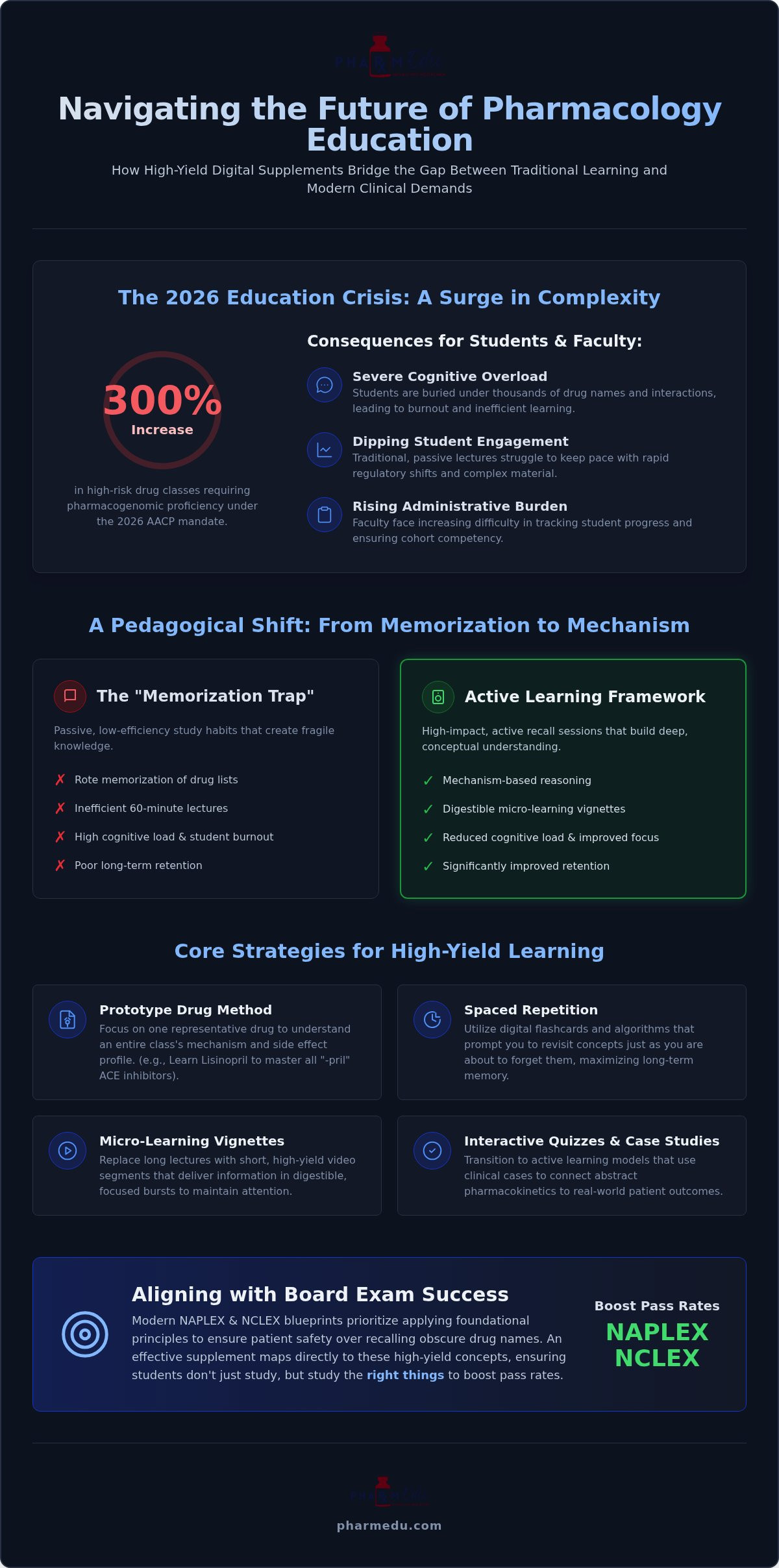
Did you know that the 2026 AACP accreditation mandate represents a 300% increase in high-risk drug classes requiring pharmacogenomic proficiency compared to just two years ago? For faculty and students alike, this sheer volume of information is no longer just a challenge; it’s a barrier to clinical competency. Traditional lectures often struggle to keep pace with these rapid regulatory shifts, leaving educators searching for a robust pharmacology curriculum supplement that bridges the gap between static textbooks and the rigorous demands of modern board exams.
It’s exhausting to watch student engagement dip while the administrative burden of tracking progress only climbs. You want your students to feel confident and prepared, not crushed by the weight of endless drug classes. In this guide, you’ll learn how to integrate high-yield digital supplements into your curriculum to improve retention and boost NAPLEX and NCLEX pass rates. We’ll examine the shift toward mechanism-first learning, the impact of micro-learning vignettes, and how to streamline your delivery for the 2026 testing cycle.
Key Takeaways
- Discover how to implement a pharmacology curriculum supplement to mitigate cognitive overload and focus student attention on high-yield clinical concepts.
- Learn to apply the Prototype Drug Method and visual mnemonics to help students anchor complex biochemical pathways and drug mechanisms.
- Bridge the gap between traditional lectures and board exam success by mapping supplemental resources directly to updated NAPLEX and NCLEX blueprints.
- Transition toward active learning models that utilize interactive quizzes and case studies to significantly improve long-term knowledge retention.
- Streamline faculty workflows using institutional tracking tools that provide real-time data on student progress and cohort performance.
The Role of a Pharmacology Curriculum Supplement in Modern Education
A pharmacology curriculum supplement is a specialized digital platform designed to bridge the gap between abstract theory and clinical application. In 2026, healthcare education faces a significant crisis of volume. The latest AACP mandate alone represents a 300% increase in high-risk drug classes requiring pharmacogenomic proficiency compared to just two years ago. Students are often buried under thousands of drug names and interactions; this leads to severe cognitive overload. A targeted supplement doesn’t replace the core syllabus. Instead, it reinforces it through high-yield video vignettes, active recall exercises, and realistic clinical cases.
The 2026 testing blueprints for the NAPLEX and NCLEX have shifted toward high-yield learning. Exams now prioritize a student’s ability to apply the Foundational Principles of Pharmacology to patient safety rather than merely recalling obscure drug names. An effective supplement must align with these standards to ensure students aren’t just studying, but studying the right things. By focusing on the most clinically relevant data, these tools help students manage the vast amount of information required for modern practice.
Addressing the ‘Memorization Trap’ in Pharmacy and Nursing
Rote memorization is a fragile strategy for future clinicians. When students learn through lists, they often lose the logic of how a drug actually interacts with the body. Supplemental tools break this cycle by fostering mechanism-based reasoning. This approach helps students understand why a drug causes specific effects based on its chemical class. Within this framework, high-yield learning is the prioritization of drug prototypes over exhaustive, encyclopedic lists. By mastering a single prototype, a student can effectively understand an entire class of medications, making clinical application much more intuitive.
The Impact of Cognitive Load on Student Retention
Traditional 60-minute lectures are often inefficient for long-term memory. Research shows that micro-learning segments prevent student burnout during pharmacology coursework by delivering information in digestible, focused bursts. Digital flashcards and spaced repetition algorithms capitalize on how the brain actually encodes data. These tools ensure that students revisit difficult concepts just as they are about to forget them. Integrating a pharmacology curriculum supplement doesn’t mean adding more hours to a student’s day. It replaces passive, low-efficiency study habits with high-impact, active recall sessions that fit into the margins of a busy clinical schedule.
Pedagogical Strategies for Teaching Complex Drug Mechanisms
Mastering drug mechanisms requires more than reading a list of interactions. It demands a structured approach that moves from physiological principles to specific therapeutic interventions. A well-designed pharmacology curriculum supplement facilitates this by providing the scaffolding necessary for students to build a deep, conceptual understanding. This method starts with the body’s baseline state and layers on the drug’s influence. It ensures students don’t just memorize facts but understand clinical consequences. Evidence from the National Institutes of Health supports the integration of Active Learning in Pharmacology to improve long-term retention and application skills.
Connecting pharmacokinetics (PK) and pharmacodynamics (PD) to real-world outcomes is the final step in this pedagogical shift. Students shouldn’t view half-lives as mere numbers. They need to understand how these values dictate dosing intervals and patient compliance. By using a pharmacology curriculum supplement that features clinical case studies, educators show the direct link between drug metabolism and therapeutic success. This practical connection transforms abstract science into actionable clinical knowledge.
The Prototype Drug Method: A Faculty Blueprint
Faculty often struggle to cover every drug in a class due to severe time constraints. The prototype method solves this by focusing on one representative drug that embodies the class-wide mechanism of action and side effect profile. For instance, using ACE inhibitors as a model allows students to learn the “-pril” suffix and the associated risk of cough or angioedema across the entire category. This strategy reduces cognitive load and allows more time for analyzing complex clinical outcomes. It’s a precise way to manage the 2026 volume of drug data.
Visualizing Mechanism of Action (MOA)
Static textbook diagrams often fail to convey the dynamic nature of receptor binding and signal transduction. High-yield video vignettes bring these processes to life, showing how molecules move and interact in real-time. When students see a visualization of a competitive antagonist displacing an agonist, the concept sticks far better than a paragraph of text. Encouraging students to draw these pathways themselves further cements the knowledge. If you’re looking to enhance your teaching toolkit, you might explore digital resources that offer pre-made animations and vignettes for these complex topics.
Active Learning vs. Traditional Lecturing: A Comparative Framework
Traditional lecturing often creates a passive environment where students merely transcribe data without processing it. Research into the “forgetting curve” suggests that without active engagement, learners can lose up to 70% of new information within 24 hours. Active recall, however, forces the brain to retrieve knowledge, which significantly strengthens neural pathways. Retention matters. It’s the difference between a student passing a mid-term and a clinician making a safe bedside decision. By integrating a robust pharmacology curriculum supplement into the daily workflow, institutions can shift the burden of foundational learning to the student’s own time.
The “Flipped Classroom” model relies heavily on this shift. In this framework, students use digital supplements to master drug classes and mechanisms before they even step into the lecture hall. This allows faculty to use precious classroom hours for high-level discussion and complex problem-solving. While some institutions worry about the resources needed to scale active learning for large cohorts, digital platforms solve this by automating the delivery of content. Leveraging a pharmacology curriculum supplement to automate low-stakes assessments reduces student exam anxiety while providing faculty with immediate data on student comprehension.
Implementing Case-Based Learning (CBL)
Case-based learning bridges the gap between the classroom and the clinic through vignette-style questions. These scenarios force students to consider drug-drug interactions and patient safety in a controlled, risk-free environment. Digital supplements provide faculty with ready-made cases that are already mapped to national standards. This saves hours of administrative prep time. Instead of writing new scenarios every semester, educators can deploy validated clinical case studies that mirror the complexity of modern healthcare.
Retrieval Practice and Gamification
Long-term memory is built through repeated, spaced retrieval. Tools like interactive pharmacology flashcards allow students to test their knowledge in short, mobile-friendly bursts. This micro-learning approach prevents the cognitive burnout associated with cramming. Gamification adds another layer of engagement. Implementing gamified quizzes during comprehensive pharmacy review sessions turns a dry study period into a competitive, high-energy activity. Faculty can monitor this progress through digital leaderboards and completion metrics, ensuring no student falls behind the rest of the cohort.
5 Steps to Building a High-Yield Supplemental Framework
Transitioning from a traditional syllabus to a modern, digitally enhanced model requires more than just adding videos. It demands a methodical approach that respects both faculty time and student cognitive limits. By implementing a structured roadmap, institutions can ensure their pharmacology curriculum supplement provides measurable value rather than just extra noise. This process begins with an honest audit of current student performance data to identify specific ‘bottleneck’ topics. These are the areas where students consistently struggle, such as complex autonomic nervous system pathways or pharmacokinetic calculations.
- Audit the Core: Review historical exam data to pinpoint where the cohort loses the most points.
- Map to Blueprints: Ensure every supplemental module aligns with the current NAPLEX and NCLEX competency statements.
- Go Mobile: Prioritize tools that students can access during clinical rotations or commutes.
- LMS Integration: Embed micro-learning segments directly into Canvas or Blackboard for a seamless experience.
- Monitor Mastery: Use analytics to see which students are engaging and which are falling behind.
Aligning with National Board Certification Blueprints
A high-quality pharmacology curriculum supplement must mirror the weightings of the professional exams your students will eventually face. Cardiovascular and endocrine systems often carry significant weight in board scoring and clinical practice. Ensuring curriculum alignment with 2026 board exam standards is critical for maintaining institutional accreditation and high pass rates. When selecting a NAPLEX prep course or supplemental resource, verify that the content reflects the most recent testing blueprints. This alignment ensures that student effort is directed toward the topics that matter most for licensure.
Integrating Digital Tools into Faculty Workflows
Faculty burnout is a real threat to educational quality. Supplemental tools should reduce administrative load, not increase it. Pre-recorded high-yield vignettes allow instructors to “flip” the classroom without spending dozens of hours creating their own video content. Automation is the key here. By using platforms that track student progress, faculty can identify at-risk learners weeks before the final exam. This proactive approach creates a cohesive learning experience across both physical classrooms and digital spaces. If you’re ready to streamline your department’s output, you can view our institutional license options to see how we support faculty workflows.
Leveraging PharmEDU for Institutional and Student Success
PharmEDU serves as a strategic partner in bridging the gap between foundational drug theory and clinical mastery. While traditional textbooks provide the raw data, this platform transforms that information into a high-yield pharmacology curriculum supplement that’s both accessible and actionable. The Institutional Platform License offers more than just access; it provides a centralized library of 100+ high-yield pharmacology topics. This resource doesn’t just help students pass their next exam. It establishes a baseline of professional excellence that they’ll carry throughout their careers. Recurring subscription access ensures that as the science of medicine evolves, the learner’s knowledge base remains current and evidence-based. By utilizing High-Yield Video Vignettes and Clinical Case Studies, faculty can provide students with a consistent learning experience that matches the rigors of the 2026 clinical environment.
Administrative Tools for Faculty Oversight
Educators often face the challenge of managing diverse student needs within a single cohort. PharmEDU’s administrative tools solve this by providing real-time data on individual student engagement and quiz scores. You don’t have to wait for mid-term results to see who’s struggling. This oversight allows faculty to tailor classroom discussions to specific student weaknesses, making every lecture hour more efficient. Additionally, the platform simplifies the accreditation process. By providing documented progress reports and engagement metrics, institutions can easily demonstrate their commitment to student success and regulatory compliance. These reports offer a clear audit trail of student achievement, which is vital during site visits and program reviews. It’s not just about tracking; it’s about proving the efficacy of your teaching methods through hard data.
Empowering Students for Career Readiness
The modern healthcare student is mobile and time-constrained. Providing resources that fit into a clinical rotation or a busy commute is essential. PharmEDU’s mobile-compliant design meets the evolving pharmacist’s education requirements while also supporting nursing students in their high-stakes pharmacology coursework. By bridging the educational gap across disciplines, the platform ensures that all members of the healthcare team share a common, rigorous understanding of drug action. The inclusion of Pharmacology Practice Quizzes and Interactive Pharmacology Flashcards allows students to engage in retrieval practice whenever they have a few minutes of downtime. This micro-learning approach is proven to reduce the cognitive load discussed in earlier sections, fostering the critical thinking skills needed for safe patient care. You can discover how PharmEDU can transform your program’s pharmacology curriculum and help your students achieve their full clinical potential.
Empowering the Next Generation of Clinicians
The landscape of healthcare education in 2026 demands a shift from passive memorization to active clinical application. By prioritizing the prototype drug method and integrating mechanism-based reasoning, faculty help students overcome the overwhelming volume of pharmacological data. A well-designed pharmacology curriculum supplement serves as the essential bridge between theoretical knowledge and the high-stakes environment of board exams. We’ve seen how micro-learning vignettes and automated tracking tools reduce administrative burdens while significantly improving cohort performance and NAPLEX/NCLEX readiness.
PharmEDU offers a platform designed by healthcare educators specifically for healthcare students. With over 100 high-yield pharmacology topics and comprehensive faculty tracking tools, it’s a reliable partner for institutional growth. You’ll gain the precise insights needed to identify at-risk learners early, ensuring no student falls behind. It’s time to move beyond static textbooks and embrace a modern, digital-first approach to mastery.
Explore PharmEDU Institutional Licenses for Your Healthcare Program to see how we can help you streamline your curriculum delivery. Your commitment to educational excellence is the foundation of safer patient outcomes and professional success.
Frequently Asked Questions
What is a pharmacology curriculum supplement and why is it necessary?
A pharmacology curriculum supplement is a targeted digital resource designed to reinforce core concepts and bridge the gap between abstract theory and clinical practice. It’s necessary in 2026 because of the sheer volume of data students must master. For example, the latest AACP mandate represents a 300% increase in high-risk drug classes requiring pharmacogenomic proficiency. These tools help manage this cognitive load by focusing on high-yield information rather than exhaustive drug lists.
How do I choose the right digital supplement for my pharmacy or nursing program?
Selecting the right supplement requires a focus on curriculum alignment and accessibility. You should prioritize platforms that map their content directly to national board blueprints like the NAPLEX and NCLEX. Mobile compliance is also essential for students on clinical rotations. Look for resources that offer diverse learning formats, such as interactive flashcards and high-yield video vignettes, which cater to different learning styles while providing faculty with robust administrative tracking tools.
Can digital pharmacology supplements be integrated into Canvas or Blackboard?
Yes, high-quality digital supplements are designed to integrate seamlessly with major Learning Management Systems like Canvas and Blackboard. This integration allows faculty to embed micro-learning segments directly into their existing course modules. It streamlines the student experience by providing a single point of access for all educational materials. This cohesive approach ensures that supplemental videos and quizzes feel like a natural extension of the core syllabus rather than a separate, disconnected task.
How does micro-learning improve student performance on the NAPLEX and NCLEX?
Micro-learning improves performance by delivering information in short, focused bursts that prevent cognitive burnout. This method aligns with the brain’s natural ability to encode data through spaced repetition. When students engage with high-yield content in five-minute intervals, they’re more likely to retain complex mechanisms of action. This consistent, low-stakes engagement builds the long-term memory necessary for success on high-stakes licensure exams where rapid, accurate recall of drug classes is vital for patient safety.
What are high-yield video vignettes and how should they be used in the classroom?
High-yield video vignettes are concise, dynamic animations that illustrate complex biochemical pathways and drug-receptor interactions. In the classroom, faculty can use these as anchor points to introduce a new drug class or to flip the lecture. Instructors often assign these vignettes as pre-class viewing, which frees up lecture time for case-based discussions. This strategy ensures that students arrive with a foundational understanding of the mechanism of action, allowing for deeper clinical analysis.
Do pharmacology supplements replace traditional textbooks?
No, digital supplements don’t replace traditional textbooks; they act as a bridge between static text and clinical application. While textbooks provide comprehensive reference data, a pharmacology curriculum supplement focuses on the most clinically relevant, high-yield information. This helps students prioritize what they truly need to know for board exams and safe practice. The supplement transforms dense academic theory into manageable micro-learning segments that are much easier to digest and retain during busy clinical years.
How can faculty track student progress using PharmEDU’s institutional tools?
Faculty utilize the Institutional Platform License to gain deep insights into cohort-level performance through a centralized dashboard. This tool tracks individual student engagement, quiz scores, and module completion rates in real-time. By monitoring these metrics, instructors can identify at-risk learners early and adjust their teaching strategies to address specific knowledge gaps. This data-driven approach simplifies the accreditation process by providing documented evidence of student progress and engagement throughout the academic year.
What are the most effective active learning strategies for pharmacology?
The most effective strategies include retrieval practice through interactive flashcards and the use of clinical case studies to simulate real-world decision-making. Implementing the prototype drug method is also highly efficient, as it focuses on one representative drug to illustrate an entire class. Gamified quizzes further increase engagement by turning review sessions into active, competitive exercises. These methods move students away from rote memorization and toward a deeper, mechanism-based understanding of how drugs interact with the body.