
Mastering Pharmacology Exam Questions: The High-Yield 2026 Guide
What if the secret to passing your boards isn’t memorizing more drug names, but learning how to think like a seasoned clinician? Many students spend hundreds of hours staring at spreadsheets, yet they still freeze when they encounter complex pharmacology exam questions during the NAPLEX or NCLEX. It’s exhausting to juggle thousands of mechanisms of action while worrying about those notorious “Select All That Apply” items. You’ve likely felt the frustration of knowing the textbook definition of a drug class but struggling to apply that knowledge to a multi-layered patient scenario.
This guide provides the professional strategies and clinical reasoning frameworks you need to navigate high-stakes exams with precision and confidence. We’ll help you move past rote memorization and build the mental stamina required to succeed on your first attempt. We’ll explore how to master high-yield drug classes efficiently and bridge the gap between academic theory and real-world clinical practice. By the end of this guide, you’ll have a clear roadmap for the 2026 testing cycle that prioritizes logic over list-making.
Key Takeaways
- Understand the 2026 shift toward “Next Generation” testing formats that prioritize clinical judgment and complex application over simple rote recall.
- Identify high-yield drug classes, including Autonomic Nervous System and Cardiovascular agents, to focus your study time where it matters most.
- Master pharmacology exam questions by replacing passive reading with science-backed active recall and spaced repetition strategies.
- Learn clinical reasoning frameworks like the ABCs (Airway, Breathing, Circulation) to accurately prioritize patients in complex case-based scenarios.
- Utilize expert-curated rationales and high-yield video vignettes to bridge the gap between theoretical knowledge and professional practice.
The Evolution of Pharmacology Exam Questions in 2026
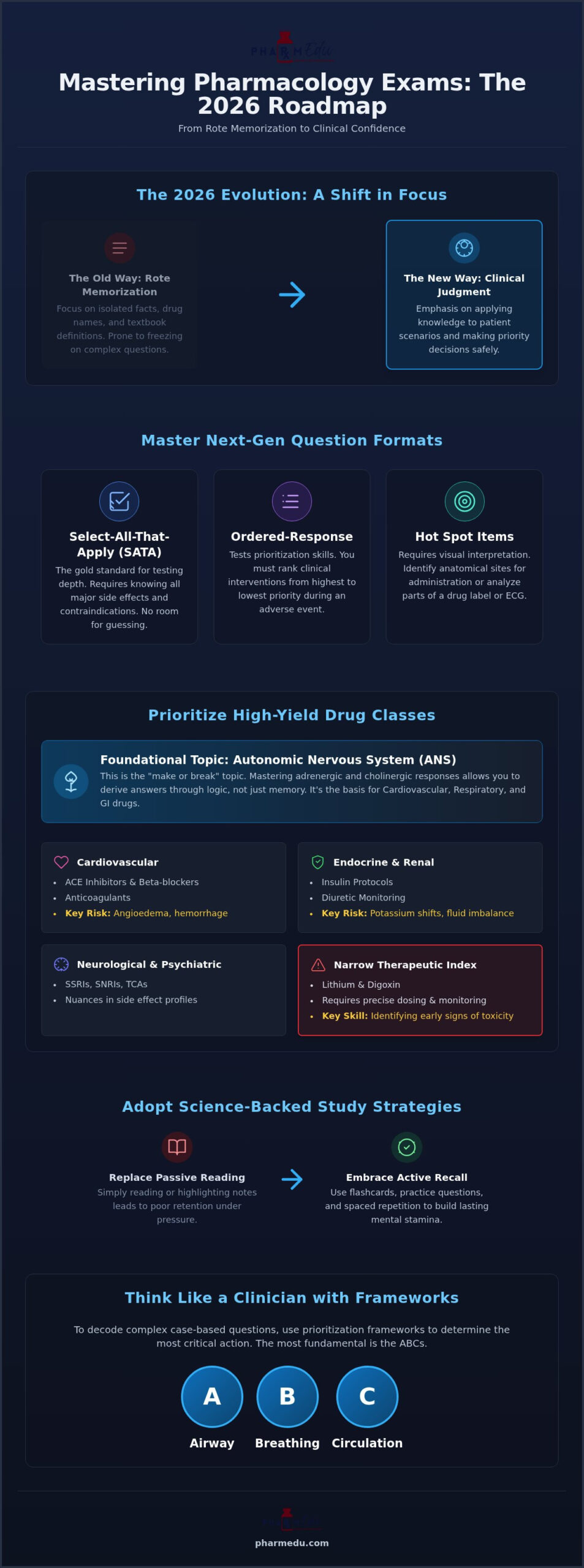
The landscape of medical and pharmaceutical licensure is undergoing a transformative shift. In 2026, major examining bodies like the NABP for the NAPLEX, the NCSBN for the NCLEX, and the FSMB for the USMLE have moved decisively away from testing isolated facts. The focus has transitioned to clinical judgment, where candidates must demonstrate they can safely apply knowledge in high-pressure environments. Modern pharmacology exam questions now challenge your ability to synthesize patient data rather than just identifying a drug’s suffix or class.
While you still need to understand the fundamental principles of pharmacology, the exams prioritize how those principles affect a living patient. It’s no longer enough to know that a medication is an anticoagulant; you must now recognize which specific lab values or physical symptoms necessitate holding a dose. This shift reflects a broader industry commitment to reducing medication errors and enhancing patient safety through rigorous, application-based testing.
From Rote Memorization to Clinical Judgment
The era of “what is this drug” questions has largely ended. Examiners now favor the “what is the priority action” approach. This is most evident in the Next Gen unfolding case studies, where a single patient’s story evolves across multiple screens. You’ll receive new lab results or provider notes and must adjust your pharmacological plan in real-time. Success requires a deep understanding of how a drug interacts with a specific patient’s pathophysiology. High-yield pharmacology is the precise intersection of drug mechanism and patient safety.
Common Question Formats You Will Encounter
To master pharmacology exam questions, you must become comfortable with diverse item types that test more than just memory. Distractors in 2026 are more sophisticated. They often present actions that are clinically “correct” in a general sense but aren’t the priority for the specific patient described. You will frequently encounter these formats:
- Select-All-That-Apply (SATA): These remain the gold standard for testing depth. They require you to know every major side effect or contraindication for a drug class, leaving no room for lucky guesses.
- Ordered-Response: You might be asked to rank clinical interventions from highest to lowest priority during an acute toxicity event or an adverse reaction.
- Hot Spot Items: These items often involve identifying the correct anatomical site for administration or interpreting a specific part of a drug label or an ECG strip.
Understanding these formats is half the battle. When you recognize how a question is structured to catch superficial knowledge, you can approach your prep with a more analytical mindset.
High-Yield Drug Classes: Prioritizing Your Study Efforts
Efficiency is the hallmark of a successful candidate. With thousands of medications in the pharmacopeia, your strategy must prioritize high-yield drug classes that appear most frequently in pharmacology exam questions. Focusing your energy on the most clinically significant agents ensures you’re prepared for the items that carry the most weight in the 2026 testing cycle.
The Autonomic Nervous System (ANS) is the foundational “make or break” topic. It serves as the physiological basis for cardiovascular, respiratory, and gastrointestinal drugs. If you don’t grasp the adrenergic and cholinergic responses, you’ll likely struggle to predict the side effects of more specialized agents. Mastering the ANS allows you to derive answers through logic rather than relying solely on memory.
Cardiovascular pharmacology remains a heavily tested domain. You must achieve mastery over ACE Inhibitors, beta-blockers, and anticoagulants. Examiners prioritize these because they carry significant safety risks, such as angioedema or life-threatening hemorrhage. For endocrine and renal agents, focus heavily on insulin protocols and diuretic monitoring, specifically regarding potassium shifts and fluid balance.
Neurological and Psychiatric Pharmacology
Board exams frequently test the nuances between SSRIs, SNRIs, and TCAs. Pay special attention to narrow therapeutic index drugs like Lithium and Digoxin. These medications require precise dosing and serum level monitoring, making them perfect candidates for complex clinical scenarios. Identifying early signs of toxicity is a critical skill. You’ll often see questions asking for the priority nursing or pharmacy intervention when a patient presents with bradycardia or visual disturbances related to these specific agents.
Antimicrobial and Immunomodulator Essentials
Simplify the vast world of antimicrobials by categorizing them by mechanism of action. Use the suffix method to quickly identify Penicillins (-cillin), Cephalosporins (cef-), and Fluoroquinolones (-floxacin). Beyond nomenclature, you must recognize life-threatening adverse reactions like Stevens-Johnson Syndrome. Patient education is equally high-yield; for instance, knowing how to counsel a patient on immunosuppressant therapy regarding infection risks is essential for modern practice. Practicing with Pharmacology Practice Quizzes is an effective way to test your retention of these critical suffixes and safety profiles.
Science-Backed Strategies for Active Recall
Passive reading is the enemy of retention. Many students spend hours highlighting textbooks, yet they still struggle to recall critical details when facing pharmacology exam questions. To break this cycle, you must adopt active recall. Start by testing yourself on a topic before you even study the material. This pre-testing effect primes your brain to identify gaps in your knowledge, making your subsequent study sessions far more targeted and efficient. It’s a method that shifts your focus from recognition to actual retrieval.
Grouping medications by their suffixes and prefixes is another essential tactic for high-stakes prep. Instead of memorizing individual agents, learn the characteristics of the entire class. For example, understanding the shared properties of ‘statin’ drugs or ‘prazole’ proton pump inhibitors allows you to answer questions about medications you’ve never encountered before. You can further enhance this process through multi-modal learning. Pairing High-Yield Video Vignettes with practice questions ensures that you’re engaging both your visual and analytical faculties simultaneously.
The Power of Spaced Repetition and Digital Flashcards
Digital platforms offer a significant advantage over traditional paper notes. Interactive Pharmacology Flashcards use sophisticated algorithms to show you difficult cards more frequently, ensuring you master your weak points before the exam. Research in cognitive science demonstrates that spaced repetition can improve long-term retention by approximately 50% compared to traditional cramming methods. A structured 4-week review schedule, focusing on one major drug class each week, provides the discipline needed to build a robust knowledge base without the risk of burnout.
Mnemonics and Visual Association Techniques
Sticky mnemonics help bridge the gap when you’re trying to recall complex adverse effects. The classic ‘can’t see, can’t spit, can’t pee, can’t poop’ remains a reliable way to recall anticholinergic side effects under the pressure of a timed exam. Visual association techniques are equally powerful for complex systems like the Renin-Angiotensin-Aldosterone System (RAAS). Concept mapping allows you to connect pharmacology directly to pathophysiology, helping you understand why a drug is prescribed rather than just what it does. This deep connection is what separates top-performing students from those who simply memorize lists.
Clinical Reasoning: Decoding Case-Based Exam Questions
Decoding pharmacology exam questions in 2026 requires more than a memory for drug classes. It demands a systematic approach to clinical reasoning. When you encounter a long clinical vignette, your first task is stem analysis. You must isolate the “need to know” from the “nice to know.” For instance, a patient’s age and primary diagnosis are vital, but their history of a minor surgery ten years ago is often just “fluff” designed to distract you. Focusing on the current clinical presentation allows you to see the actual problem the question is asking you to solve.
The most effective way to build this skill is by integrating Clinical Case Studies into your daily routine. This practice helps you identify the “Priority Patient” using the ABCs: Airway, Breathing, and Circulation. If a question presents four patients with different drug side effects, the one experiencing an airway issue always takes precedence. For Select-All-That-Apply (SATA) items, use the “Rule of Elimination.” Treat every single option as an independent True/False statement. This removes the pressure of trying to guess how many answers are correct and forces you to rely on your specific drug knowledge for each choice.
Prioritizing Interventions and Safety
Safety is the cornerstone of clinical judgment. You’ll often be asked when to “hold” a medication. This decision usually hinges on specific lab values, like a potassium level for a diuretic, or vital signs, such as a heart rate below 60 for Digoxin. Recognizing the earliest signs of drug toxicity, like the yellow-green halos of digitalis or the tinnitus of aspirin, is equally critical. Remember that in many board scenarios, patient education is the “correct” answer because it’s the primary way to prevent future adverse events. You aren’t just giving a pill; you’re ensuring the patient understands why they need it.
Mastering Dosage Calculations and Errors
While clinical logic is essential, you can’t ignore the math. The dimensional analysis method is a “no-fail” approach for complex calculations because it allows you to track units and avoid simple conversion errors. Pay close attention to weight-based dosing in pediatrics and IV drip rates, as these are common traps. Medication errors remain the most tested safety topic in pharmacology licensure exams. Mastering these calculations ensures you don’t lose easy points on items that require absolute precision. To refine these skills, you can access the clinical case studies on PharmEDU to see how math applies to real patient outcomes.
Elevate Your Prep with PharmEDU’s Digital Learning Platform
Success on board exams requires more than just clinical logic. It requires the right tools to sustain your momentum. PharmEDU serves as a digital mentor, providing a structured environment where theory meets professional application. The platform provides over 100 high-yield topics curated by professional healthcare educators, ensuring that your study time is never wasted on outdated or irrelevant material. It’s a comprehensive resource designed to bridge the gap between classroom learning and the demands of modern practice.
When you engage with pharmacology exam questions on our platform, you aren’t just seeing a right or wrong answer. You’re leveraging Pharmacology Practice Quizzes that include expert-written rationales. These explanations teach you the logic behind every clinical decision. This approach builds the deep understanding needed for the 2026 Next Gen item types, where understanding the “why” is just as important as the “what.”
Busy students often struggle to find large blocks of study time. Our mobile-compliant design allows you to watch High-Yield Video Vignettes during 15-minute clinical breaks or while commuting. This micro-learning approach keeps drug mechanisms fresh in your mind without requiring a desk or a heavy textbook. For faculty and administrators, our comprehensive tracking tools provide clear insights into both individual and institutional performance, making it easier to identify and support areas of weakness.
Why Expert-Curated Content Beats UGC
Studying from unverified student notes or user-generated content (UGC) platforms is a gamble. These resources often contain errors, outdated guidelines, or lack the clinical depth required for high-stakes licensure. PharmEDU eliminates this uncertainty by providing expert-led content that is updated in real-time. When the FDA approves a new drug or a clinical guideline changes, our materials reflect those shifts immediately. The efficiency of a structured NAPLEX Prep Course far outweighs the fragmented experience of random quiz searches. It provides a logical path from foundational concepts to advanced clinical reasoning.
Start Your Journey to Exam Mastery
Preparation is about more than just passing a test. It’s about building the clinical confidence you’ll need throughout your professional life. We offer flexible subscription options, including PharmEDU Monthly and Annual Subscriptions, as well as Institutional Platform Licenses for schools. These options ensure you have access to Interactive Pharmacology Flashcards and clinical case studies whenever you need them. Whether you’re a nursing student facing the NCLEX or a pharmacy student preparing for the NAPLEX, we provide the precision tools necessary for success in the 2026 cycle. Ready to ace your boards? Start your PharmEDU subscription today!
Secure Your Professional Future in 2026
Navigating the 2026 licensure cycle requires a shift from simple rote memorization to a deep mastery of clinical logic and patient safety. By focusing on high-yield drug classes and implementing active recall strategies, you’ve already taken the first steps toward conquering the most difficult pharmacology exam questions. This journey is about more than just a passing score; it’s about building the professional foundation needed to provide exceptional patient care in a high-stakes environment.
As you finalize your preparation, remember that precision and consistency are your greatest assets. PharmEDU provides the structured support you need through 100+ high-yield topics and expert-led video vignettes that simplify complex mechanisms. Our mobile-optimized learning platform allows you to maintain progress during even the busiest clinical rotations, ensuring that every study session counts. Master Pharmacology with PharmEDU; Start Your Review today to secure your success and move forward with professional confidence. You’ve invested the effort in your education, and now it’s time to unlock the results you deserve.
Frequently Asked Questions
What are the most commonly tested drug classes on the NAPLEX and NCLEX?
Cardiovascular agents, antimicrobials, and drugs affecting the autonomic nervous system are the most frequently encountered categories. You should also prioritize endocrine medications like insulin and renal agents like diuretics. These classes carry significant patient safety risks, which makes them prime targets for pharmacology exam questions. Focusing on these high-yield areas ensures you spend your study time on the topics that contribute most to your final score.
How many pharmacology practice questions should I do per day?
Aim for 20 to 30 high-yield questions daily while focusing on deep rationale review. It’s more effective to understand why an answer is correct than to mindlessly click through hundreds of items. As your exam date approaches, you can increase this volume to 50 or more questions per day to build mental stamina. Consistency is key; daily practice helps cement drug mechanisms into your long-term memory through active recall.
Is it better to memorize drug names or mechanisms of action?
Mastering mechanisms of action is far more effective than rote memorization of individual names. While suffixes and prefixes provide a helpful shortcut, understanding the physiological impact of a drug class allows you to answer complex application questions. This approach is particularly important for pharmacology exam questions in the 2026 cycle. If you understand the mechanism, you can logically predict side effects and contraindications even for medications you haven’t seen before.
How do I handle ‘Select All That Apply’ (SATA) pharmacology questions?
Handle these items by treating every option as an independent True or False statement. This method reduces the anxiety of trying to guess how many selections are correct. Focus strictly on what you know about the drug class or patient scenario for each individual choice. Avoid overthinking or looking for patterns in the answers. If an option is a known side effect or priority action, select it and move on.
Can I pass my pharmacology boards using only free resources?
While some students use free resources, they often lack the quality control and expert rationales needed for high-stakes licensure. Many free sites rely on user-generated content, which can be outdated or clinically inaccurate. Using a professional platform ensures you are studying the most current FDA guidelines and evidence-based practices. Investing in expert-curated content provides a safer, more efficient path to passing your boards on the first attempt without the risk of misinformation.
How much time should I dedicate to studying for a pharmacology final?
You should ideally begin your focused review at least three to four weeks before the final. Dedicating one to two hours daily to active recall and spaced repetition is more effective than marathon cramming sessions. This timeline allows you to cover one major drug class each week while leaving time for comprehensive practice quizzes. Breaking the material into manageable segments helps reduce anxiety and improves your ability to retain complex pharmacological data.
What is the best way to remember narrow therapeutic index drugs?
The most effective strategy involves grouping these drugs by their specific lab monitoring requirements and early toxicity symptoms. Create a dedicated study sheet for agents like Lithium, Digoxin, and Warfarin. Focus on the narrow window between a therapeutic dose and a toxic one. Learning to recognize the earliest clinical signs of toxicity, such as visual changes or specific arrhythmias, is essential for answering priority-based clinical questions correctly on your board exams.
How does PharmEDU compare to traditional textbooks for exam prep?
PharmEDU offers a more dynamic and efficient experience than traditional textbooks. Our platform features high-yield video vignettes and interactive flashcards that adapt to your learning pace. Unlike static books, our digital content is updated in real-time to reflect the latest clinical guidelines and FDA approvals. The mobile-compliant design also allows you to study during clinical breaks, making it a more practical choice for the busy schedules of modern healthcare students.