

Pharmacology Calculations: 2026 High-Yield Mastery Guide
The Institute of Medicine estimates that the average hospitalized patient experiences at least one medication error every single day. For many nursing students, mastering pharmacology calculations for nurses feels like the most daunting hurdle between them and their professional license. It’s natural to feel a sense of math anxiety when you realize that medication administration can take up nearly half of your direct patient care time. You aren’t just solving for a variable; you’re protecting a human life.
We recognize that the pressure to perform on the NCLEX and in high-stakes clinical rotations is immense. This 2026 high-yield mastery guide provides the clarity you need by simplifying complex formulas into logical, repeatable steps. You’ll gain the specific tools to master essential conversion methods and safety protocols, ensuring you walk into your exams with confidence and your clinicals with precision. We will explore the latest 2026 standards, including The Joint Commission’s safety goals and the updated NCLEX focus on clinical judgment, giving you a clear path to academic success and professional excellence.
Key Takeaways
- Understand why the metric system remains the non-negotiable gold standard for patient safety and how to execute error-free conversions between grams, milligrams, and micrograms.
- Compare the “Desire over Have” formula with Dimensional Analysis to determine which systematic method best suits your clinical workflow and mental processing.
- Master high-yield formulas for IV flow rates and weight-based dosing to ensure precise medication delivery in complex acute care settings.
- Integrate the “Six Rights” of medication administration with 2026 Joint Commission safety goals to mitigate the risk of preventable clinical errors.
- Learn how to apply pharmacology calculations for nurses within the context of the 2026 NCLEX updated test plan by leveraging interactive digital vignettes and practice quizzes.
Essential Systems of Measurement and Conversions
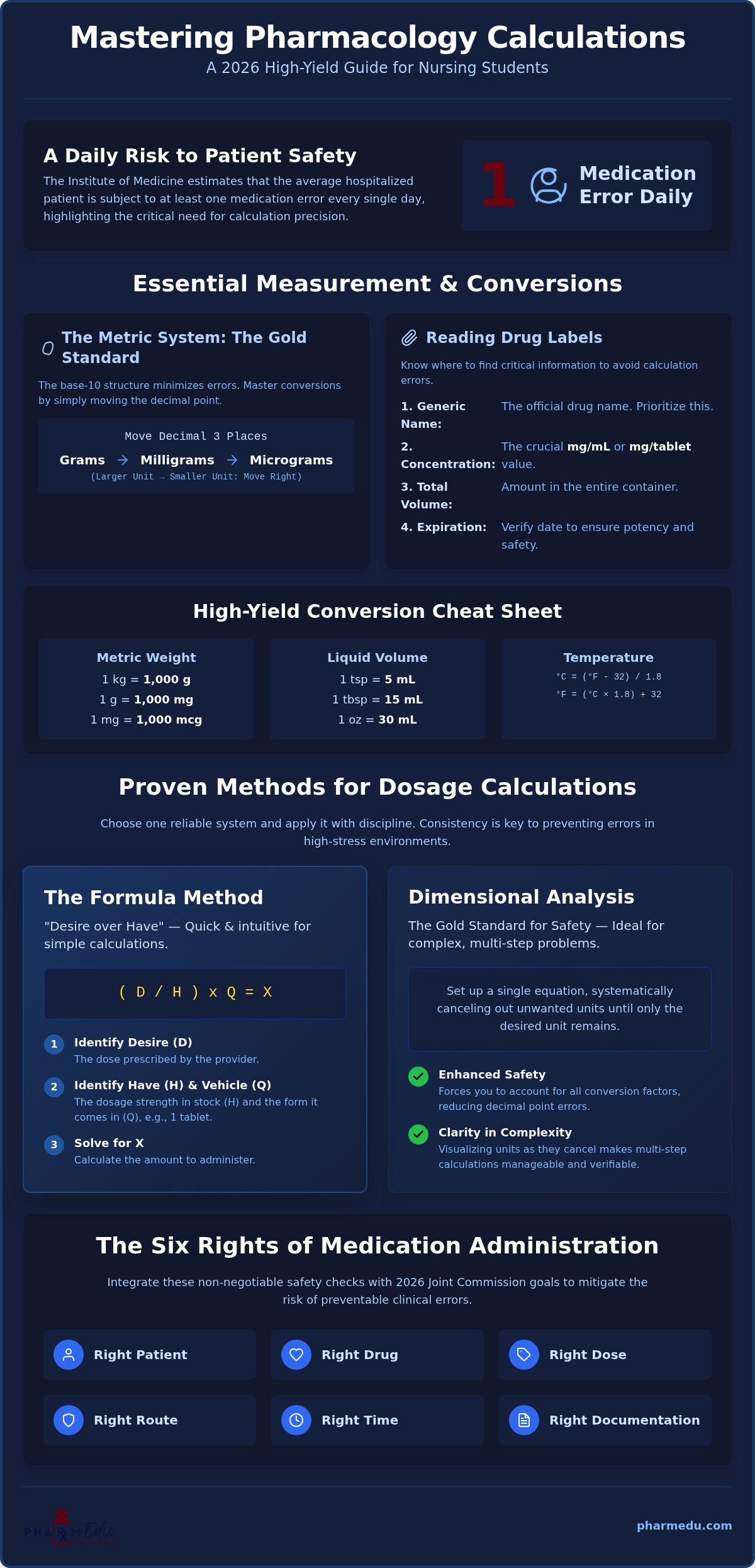
Precision in pharmacology calculations for nurses begins with a firm grasp of the metric system. Unlike the outdated apothecary system, which often causes confusion with inconsistent units like grains or drams, the metric system is the global gold standard for clinical safety. It relies on a logical, base-10 structure that minimizes the risk of mathematical errors during high-pressure shifts. Understanding the technical distinction between a dose vs. dosage is essential for calculating the correct amount of medication a patient receives based on their specific clinical needs.
The metric system is built on units of ten, making the “Move the Decimal” rule your most valuable tool for rapid conversions. To convert from a larger unit to a smaller unit, such as grams to milligrams, you move the decimal point three places to the right. Conversely, when moving from a smaller unit to a larger one, like micrograms to milligrams, you move the decimal three places to the left. This systematic approach prevents the common “tenfold error” that occurs when a decimal is misplaced. While clinical settings use metric units almost exclusively, you must still memorize common household-to-metric conversions. Patients often rely on familiar items at home, so you need to be ready to translate a 5 mL dose into a single teaspoon for a caregiver.
The High-Yield Conversion Cheat Sheet
Success on pharmacology exams requires instant recall of these core values. Memorizing these weights and volumes ensures you don’t waste time during the NCLEX or at the bedside:
- Metric Weight: 1 kg = 1,000 g; 1 g = 1,000 mg; 1 mg = 1,000 mcg.
- Liquid Volume: 1 teaspoon (tsp) = 5 mL; 1 tablespoon (tbsp) = 15 mL; 1 ounce (oz) = 30 mL.
- Temperature: To convert Fahrenheit to Celsius, subtract 32 and divide by 1.8. To go from Celsius to Fahrenheit, multiply by 1.8 and add 32.
Reading and Interpreting Drug Labels
Proven Methods for Dosage Calculations
Mastering pharmacology calculations for nurses isn’t about being a math genius; it’s about choosing a reliable system and applying it with discipline. While several mathematical frameworks exist, the most effective clinicians select one primary method to reduce cognitive load and prevent errors. Switching between different methods in a high-stress environment increases the likelihood of a calculation slip. Whether you prefer the simplicity of the formula method or the rigorous structure of dimensional analysis, your goal is absolute precision and patient safety.
Step-by-Step: The Formula Method
The “Desire over Have” method is the most popular choice for straightforward dosage problems. It’s quick, intuitive, and works well for single-step calculations where the units of measure already match. To use this method effectively, follow three clear steps:
- Step 1: Identify the Desire (D). This is the specific dose prescribed by the healthcare provider.
- Step 2: Identify the Have (H) and the Vehicle (Q). “Have” is the dosage strength you have in stock, and “Vehicle” is the quantity or volume in which that dose is contained.
- Step 3: Set up the equation: (D / H) x Q = X.
For example, if a provider orders 500 mg of a medication and you have 250 mg tablets in stock, your equation is (500 / 250) x 1 tablet. The result is 2 tablets. This method is highly effective for oral medications and simple injections.
Dimensional Analysis for Safety
Dimensional Analysis (DA) is the gold standard for complex, multi-step problems that involve unit conversions. Unlike other methods, DA allows you to set up a single equation where you cancel out unwanted units until you’re left with the desired unit of measure. This approach is significantly safer because it forces you to account for every conversion factor, such as grams to milligrams, within the equation itself. By visualizing the units as they disappear, you reduce the risk of common decimal point errors. When you’re calculating a dose that requires pulling from multiple vials or converting between different systems of measurement, DA keeps your logic linear and verifiable. It’s a “fail-safe” way to ensure your final answer matches the required clinical outcome.
Ratio and proportion offer a visual alternative for those who prefer solving for “X” using cross-multiplication. It involves setting up two equal ratios: Have : Quantity :: Desire : X. While this is a valid approach, consistency remains your best defense against medication errors. Pick the method that makes the most sense to your brain and stick with it until it becomes second nature. If you find these equations confusing, you can practice with interactive pharmacology practice quizzes that simulate real-world dosing scenarios.
Mastering IV Flow Rates and Weight-Based Dosing
IV therapy requires a shift from static dosages to dynamic flow rates. When you’re managing pharmacology calculations for nurses, you’ll primarily calculate rates in milliliters per hour (mL/hr) for electronic infusion pumps. However, in emergency or resource-limited settings, manual gravity lines require you to calculate drops per minute (gtt/min). This transition requires an understanding of the “Drop Factor,” which is the number of drops it takes to equal 1 mL of fluid. Macro-drip tubing usually delivers 10, 15, or 20 gtt/mL, while micro-drip tubing is standardized at 60 gtt/mL. Selecting the wrong tubing factor can result in a significant medication error, so always verify the packaging before you start your math. If you are looking for a reliable distributor of medical supplies, you can read more. To determine drops per minute, use the formula: (Total Volume in mL × Drop Factor) / Time in Minutes.
Calculating the total infusion time is just as vital as setting the initial rate. If you have a 1,000 mL bag running at 125 mL/hr, you divide the volume by the rate to find that the bag will last exactly eight hours. When you’re managing secondary medications, or “piggybacks,” you must account for the volume and the specific time the primary line is paused. Accurate completion time estimates allow you to anticipate bag changes and maintain continuous therapy without interruption. If you’re unsure how much fluid remains during your shift, you can calculate the “Remaining Time” by dividing the current volume in the bag by the hourly rate.
Pediatric and Critical Care Calculations
Pediatric care introduces the added complexity of weight-based dosing. Since children’s bodies process medications differently than adults, dosages are almost always calculated as mg/kg/day or mg/kg/dose. Your first step is always an accurate conversion from pounds (lbs) to kilograms (kg) by dividing the patient’s weight by 2.2. A mistake at this stage cascades through every subsequent calculation, potentially leading to toxic levels or subtherapeutic treatment. The Safe Dose Range protocol is a clinical safety standard used to verify that a prescribed pediatric medication dose falls between the minimum and maximum therapeutic limits established by the manufacturer. If a dose falls outside this range, you must clarify the order with the provider before administration. Practicing these scenarios with PharmEDU’s High-Yield Video Vignettes helps you visualize the setup for complex IV problems on the go.
Preventing Medication Errors in Clinical Practice
Clinical excellence is built on a foundation of safety, and medication administration is where that foundation is most frequently tested. While the “Six Rights” of medication administration, including the right patient, right drug, right dose, right route, right time, and right documentation, are taught early in nursing school, their application in pharmacology calculations for nurses is where the real work begins. High-alert medications like insulin, heparin, and concentrated electrolytes require a mandatory independent double-check. This isn’t a sign of incompetence; it’s a regulated safety protocol designed to catch the subtle mathematical slips that can occur during a 12-hour shift.
Standardizing how you write and read numbers is another critical layer of defense. You must always use a leading zero for dosages less than one (0.5 mg) and never use a trailing zero for whole numbers (5 mg). A misplaced decimal point in a “.5 mg” order can easily be misread as “5 mg,” leading to a catastrophic tenfold overdose. Similarly, rounding rules must be applied with care. In most adult clinical settings, you’ll round to the nearest tenth for volumes greater than 1 mL, but you must always defer to your facility’s specific policy for high-potency or pediatric medications.
Common Calculation Pitfalls to Avoid
The most frequent errors in pharmacology calculations for nurses often stem from simple unit confusion. Misinterpreting micrograms (mcg) for milligrams (mg) is a life-threatening oversight that can result in a thousand-fold error. Additionally, using non-standard abbreviations in your documentation can lead to miscommunication during handoffs. You should avoid using “U” for units or “IU” for international units, as these can be mistaken for zeros or fours. Sticking to standardized, clear notation is your best defense against avoidable clinical mistakes.
Clinical Decision Support and Technology
Modern healthcare relies heavily on smart pumps to provide a safety net for IV therapy. These devices use pre-programmed drug libraries to alert you if a programmed rate falls outside of safe parameters. However, technology is never a replacement for clinical judgment. Manual verification remains your primary responsibility as a licensed professional. You can sharpen these critical thinking skills by using a pharmacology study guide for nursing students to reinforce your safety habits. Consistent practice with Interactive Pharmacology Flashcards ensures that your mental calculations remain sharp, even when the technology isn’t available.
Preparing for Board Exams with PharmEDU
The transition from classroom theory to the NCLEX requires a strategic shift in how you approach pharmacology calculations for nurses. Board exam questions are rarely isolated math problems; they are clinical judgment scenarios designed to test your ability to prioritize patient safety under pressure. You might encounter “fill-in-the-blank” items where a single misplaced decimal leads to an incorrect answer, or multiple-choice questions where the distractors represent common calculation errors. Developing the habit of “Mental Estimation” is your first line of defense. Before you even touch the on-screen calculator, ask yourself if the expected result sounds clinically plausible. If your calculation suggests administering five vials for a standard dose, your clinical intuition should signal a need to re-evaluate your equation immediately.
PharmEDU: Your Digital Pharmacology Mentor
We designed our platform to act as a digital mentor, guiding you through the complexities of medication math through micro-learning segments that fit into a busy clinical schedule. Our High-Yield Video Vignettes allow you to visualize the math in real-time, bridging the gap between abstract formulas and bedside application. You can reinforce your memory of essential conversion factors using Interactive Pharmacology Flashcards, while our Clinical Case Studies ensure you’re practicing pharmacology calculations for nurses within a realistic patient-care context. This multi-modal approach transforms rote memorization into functional, professional expertise that stays with you long after the exam is over.
Final Exam Day Strategies
Success on exam day often comes down to the details you might overlook when nervous. Always read the entire question stem twice to identify exactly what is being asked, as boards often include “white noise” data that isn’t required for the final calculation. Pay close attention to the units requested in the answer box; providing a value in milligrams when the system asks for micrograms will result in a lost point regardless of your mathematical accuracy. The “Read Twice, Calculate Once” rule serves as a mandatory mental pause to ensure that your mathematical setup aligns perfectly with the clinical order before you commit to a final answer. Start your PharmEDU subscription today to master nursing pharmacology and approach your board exams with the precision and confidence of a seasoned professional.
Elevate Your Clinical Precision Today
Mastering pharmacology calculations for nurses is a journey from initial math anxiety to clinical mastery. By internalizing the metric system and selecting a primary calculation method like dimensional analysis, you’ve already built a robust defense against the most common medication errors. These skills are not just academic requirements for the NCLEX; they are the practical tools you’ll use every day at the bedside to ensure patient safety and excel in your professional career.
Achieving this level of expertise requires consistent, high-yield practice that fits your busy clinical schedule. Master Pharmacology Calculations with PharmEDU through our High-Yield Video Vignettes, Interactive Practice Quizzes, and Clinical Case Studies. Our platform serves as your digital mentor, simplifying complex dosing into manageable micro-learning segments. We’re here to support your professional growth and help you approach every dosage question with absolute confidence. Your commitment to precision today defines the quality of care you’ll provide for years to come. You’ve done the hard work of learning the theory; now it’s time to perfect your practice.
Frequently Asked Questions
How do I calculate a dosage if the unit ordered is different from the unit on hand?
You must always convert the units to match before starting your calculation. If the order is in grams but the medication is supplied in milligrams, convert the grams to milligrams first to prevent a tenfold error. This step ensures that your numerator and denominator are in the same unit of measure. Once the units are uniform, you can proceed with the “Desire over Have” formula or Dimensional Analysis to find the correct dose.
What is the most common formula used in nursing pharmacology?
The “Desire over Have” formula is the most widely used method for basic pharmacology calculations for nurses. It is expressed as (Desired Dose / Dose on Hand) x Quantity = X. This formula is ideal for straightforward oral or injectable medications where no complex unit conversions are required. While it is efficient for simple problems, many educators recommend transitioning to Dimensional Analysis for multi-step clinical scenarios to enhance patient safety.
Is dimensional analysis better than the formula method for nurses?
Dimensional analysis is often considered superior for complex, multi-step problems because it minimizes the risk of decimal point errors. By setting up a single equation that cancels out unwanted units, you maintain a logical flow from the provider’s order to the final administration unit. While the formula method is faster for simple doses, dimensional analysis provides a more rigorous safety framework for calculating weight-based or high-potency medications in acute care settings.
How do I calculate IV drip rates if I don’t have an infusion pump?
To calculate a manual IV drip rate, you must know the total volume to be infused, the time in minutes, and the drip factor of the tubing. The formula is (Total Volume in mL x Drop Factor) / Time in Minutes = Drops per Minute (gtt/min). You then manually adjust the roller clamp while counting the drops in the drip chamber for one full minute to ensure the infusion matches your calculated rate.
What are the rounding rules for pediatric dosage calculations?
Pediatric rounding requires extreme precision because small errors can lead to toxic outcomes. Generally, you should round to the nearest hundredth for dosages less than 1 mL and to the nearest tenth for larger volumes. You must always consult your specific facility policy or the medication’s manufacturer guidelines. Some high-alert pediatric drugs require carrying the calculation out to three decimal places before rounding to ensure the safest possible dose is administered.
How much pharmacology math is on the NCLEX?
The number of pharmacology calculations for nurses on the NCLEX varies for each candidate, as the exam uses computerized adaptive testing. While calculation items may only represent a small percentage of total questions, they are often high-stakes fill-in-the-blank or alternate format items. Mastery of these math problems is essential because there is no partial credit. An incorrect decimal or unit conversion will result in the entire question being marked wrong.
Can I use a calculator during my nursing school pharmacology exams?
Most nursing schools and the NCLEX provide an on-screen calculator for pharmacology exams. However, you aren’t typically allowed to bring your own physical calculator into the testing environment. It is vital to practice using basic four-function calculators during your study sessions so you don’t rely on advanced features. Focusing on setting up the equation correctly on paper remains more important than the actual button-pressing on the device.
What is a “High-Alert” medication in nursing calculations?
A high-alert medication is a drug that carries a significant risk of causing serious patient harm when used in error. Examples include insulin, anticoagulants like heparin, and concentrated electrolytes. Because the consequences of a mathematical mistake are so severe with these substances, standard clinical protocol requires an independent double-check by a second licensed nurse. This process ensures that both the mathematical setup and the final dose are verified before administration.