

Pharmacology Mnemonics for Nurses: High-Yield 2026 Guide
What if the difference between a confident clinical shift and a devastating medication error wasn’t just how hard you studied, but how you organized the information in your mind? For many nursing students, the sheer volume of medications feels like a relentless tide of prefixes and suffixes that all start to sound the same by the third hour of cramming. It’s completely normal to feel overwhelmed, especially when you realize the FDA approved 46 novel drugs in 2025 alone, including complex new therapies like Brensocatib and the non-opioid analgesic suzetrigine. You aren’t alone in feeling that “information overload” is an understatement.
You need a strategy to cut through the noise and anchor these facts into your long-term memory. This guide introduces high-yield pharmacology mnemonics for nurses designed to help you master the most challenging drug classes and side effects for nursing school success and the 2026 NCLEX. We’ll provide a structured breakdown of proven memory tricks, explain the clinical rationale behind common drug interactions, and preview how to stay ahead of the latest 2026 approvals like the mFlusiva mRNA vaccine. By the end of this article, you’ll have a mental toolkit that transforms anxiety into clinical confidence and ensures you’re prepared for the evolving demands of modern healthcare.
Key Takeaways
- Understand how cognitive scaffolding and “chunking” techniques reduce mental fatigue during high-stakes exams and clinical rotations.
- Master high-yield pharmacology mnemonics for nurses to accurately differentiate between complex cardiovascular agents and various antibiotic classes.
- Develop rapid recall for critical care scenarios using the “LEAN” method to ensure patient safety during emergency medication administration.
- Align your study habits with 2026 NCLEX priorities by integrating memory tricks that cover the latest FDA-approved drug classes and indications.
- Build a sustainable study system using spaced repetition and clinical case studies to move beyond temporary memorization toward true professional mastery.
What are Pharmacology Mnemonics and Why Do They Work?
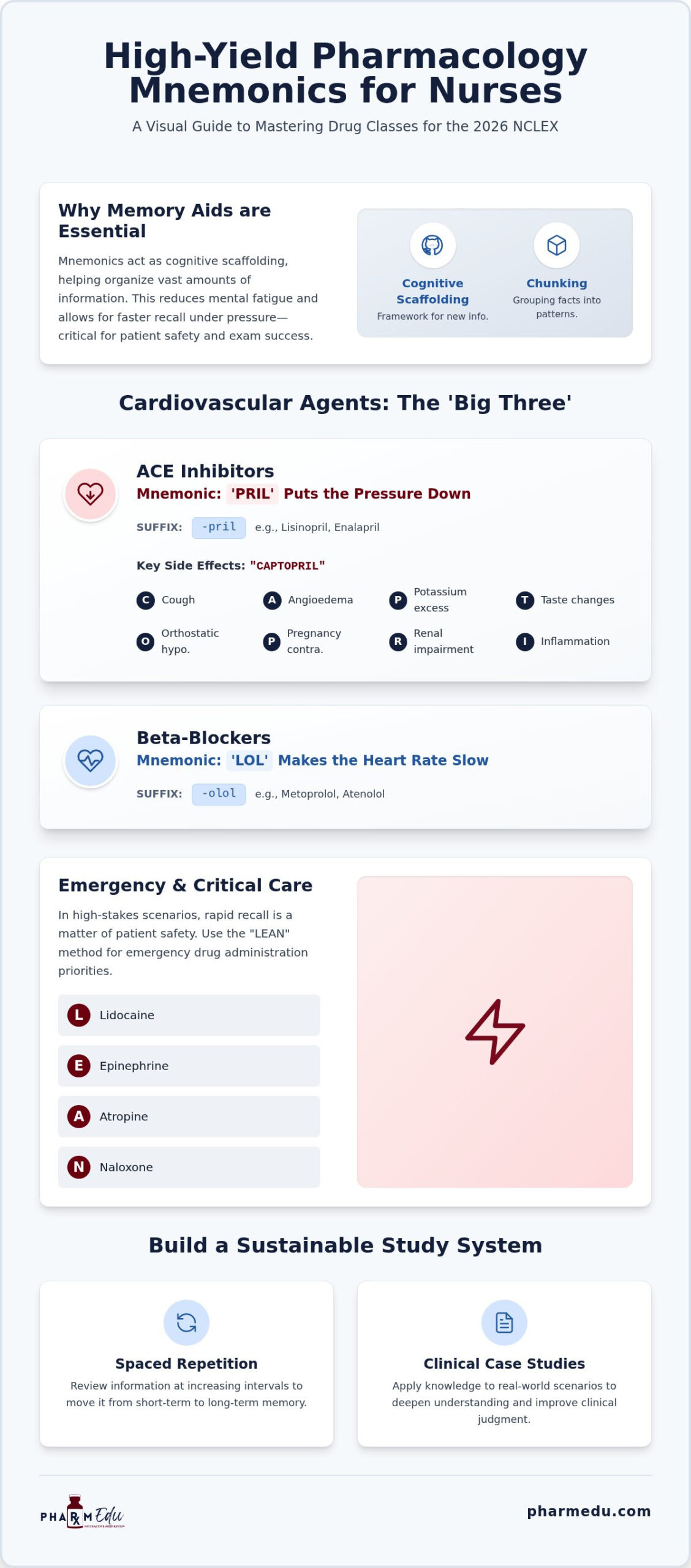
Pharmacology mnemonics for nurses serve as essential cognitive scaffolding, providing a structured framework to organize the vast, often overwhelming stream of medical data encountered during clinical training. These tools aren’t just clever rhymes; they’re sophisticated memory retrieval systems. By linking new, complex information to familiar concepts, you create a mental map that’s much easier to access under pressure. This approach is grounded in the psychological principle of “chunking,” which involves grouping individual drug names or side effects into meaningful clusters to reduce the cognitive load on your working memory. Instead of trying to memorize twenty separate facts about a drug class, you memorize one cohesive pattern.
The 2026 NCLEX continues to prioritize clinical judgment over simple rote memorization. While you must know the core facts, the exam tests how you apply them in complex patient scenarios. Mnemonics allow you to retrieve foundational knowledge instantly, freeing your brain to focus on the higher-level analysis required by Next-Generation NCLEX items. Pharmacology mnemonics for nurses are essential safety tools that ensure rapid, accurate medication administration in the high-stakes environment of modern healthcare.
The Role of Memory Aids in Patient Safety
Patient safety is the primary driver behind the use of these memory aids. In clinical environments, “look-alike, sound-alike” (LASA) drug errors remain a significant risk. Using a clear List of medical mnemonics helps nurses differentiate between similar medications before a mistake reaches the patient. This transition from classroom recall to bedside application is where mnemonics truly shine. Even seasoned experts rely on these patterns because they provide a reliable safety net during fatigue or high-acuity shifts when the risk of error increases.
Types of Mnemonics Used in Nursing
There isn’t a one-size-fits-all approach to memorization. Most students find success by mixing different styles to suit their personal learning preferences:
- Acronyms and Acrostics: Simple letter-based cues help maintain order during rapid assessments. For example, using “PANS” to remember specific drug classes or symptoms ensures no critical detail is missed.
- Visual Associations: This style uses vivid, often humorous mental imagery to link a drug’s name to its physiological effect, making the information “stick” through visual memory rather than just text.
- Keyword Suffixes: Identifying patterns in suffixes, such as “-pril” for ACE inhibitors or “-olol” for beta-blockers, allows for the quick categorization of hundreds of medications.
To reinforce these concepts, tools like PharmEDU’s Interactive Pharmacology Flashcards use these very associations to build long-term retention. Additionally, High-Yield Video Vignettes explain the “why” behind a specific mnemonic, ensuring you understand the underlying mechanism of action rather than just the rhyme.
Cardiovascular and Respiratory Mnemonics: The ‘Big Three’
Cardiovascular medications represent a significant portion of both NCLEX questions and daily clinical administration tasks. Mastering pharmacology mnemonics for nurses in this category is essential for ensuring patient safety and accurate hemodynamic monitoring. We focus on the “Big Three” classes that regulate blood pressure and heart rate: ACE inhibitors, beta-blockers, and calcium channel blockers.
ACE Inhibitors: ‘PRIL’ Puts the Pressure Down
ACE inhibitors are easily identified by the “-pril” suffix, such as Lisinopril and Enalapril. A simple way to remember their primary action is that “PRIL” puts the pressure down by inhibiting the renin-angiotensin-aldosterone system. To understand the deep-dive mechanics of this process, see our ACE Inhibitors Pharmacology Guide. For side effects, use the “CAPTOPRIL” acronym: Cough, Angioedema, Potassium excess, Taste changes, Orthostatic hypotension, Pregnancy contraindication, Renal impairment, and Inflammation. The dry, hacking cough is the most common reason patients discontinue therapy, as it results from bradykinin accumulation in the lungs.
Beta-Blockers: ‘LOL’ Makes the Heart Rate Slow
Beta-blockers end in “-olol,” like Metoprolol or Atenolol. Think of these medications as making the heart “LOL” because it’s no longer under the stress of high adrenaline. Nurses must remember the “4 B’s” of Beta-blockers: Bradycardia, Blood pressure (lowering), Bronchoconstriction, and Blood sugar (masking hypoglycemia). Because these drugs slow the heart’s conduction, checking the apical pulse for one full minute before administration is a non-negotiable safety step. If the heart rate is below 60 beats per minute, you should hold the dose and notify the provider.
Calcium Channel Blockers: ‘Very Nice Drugs’
This class includes Verapamil, Nifedipine, and Diltiazem. You can remember them by the phrase “Very Nice Drugs.” These agents provide a “calming” effect on the heart muscle and vasculature by preventing calcium from entering the cells, which reduces the force of contraction and dilates the arteries. While effective, you must monitor patients for peripheral edema and constipation, which are frequent adverse effects of this “calming” mechanism. For more clinical tips, you can explore these Pharmacology Nursing Mnemonics to strengthen your understanding of various drug classes.
- Heart Rate: Critical for beta-blockers and non-dihydropyridine CCBs (Verapamil/Diltiazem). Always verify the pulse is within safe parameters.
- Blood Pressure: Mandatory for all three classes. Monitor for orthostatic hypotension to prevent patient falls.
Visualizing the physiological impact of these drugs makes memorization much more effective. PharmEDU’s High-Yield Video Vignettes provide clear, clinical context that helps these mnemonics stick during high-pressure exams.
Antibiotics and CNS Drugs: Mastering the Complexity
Antibiotics represent one of the most diverse and high-risk categories in nursing pharmacology. With dozens of classes and overlapping side effects, distinguishing between a routine adverse reaction and a life-threatening toxicity is a critical skill. For example, understanding the difference between Red Man Syndrome and a true allergic reaction is vital for clinical judgment. Red Man Syndrome is a rate-dependent infusion reaction to Vancomycin characterized by flushing and pruritus; it typically requires slowing the infusion rate. In contrast, a true allergy involves IgE-mediated symptoms like wheezing and urticaria, necessitating immediate cessation of the drug. Mastering these distinctions requires a structured approach, and using The Ultimate Pharmacology Study Guide for Nursing Students can help you organize these classes by their specific mechanisms and toxicities.
Aminoglycosides: ‘A Mean Old Mycin’
Aminoglycosides, including Gentamicin, Neomycin, and Tobramycin, are potent antibiotics used for serious infections. To remember their high toxicity profile, think of them as “A Mean Old Mycin.” This mnemonic reminds you that these drugs are “mean” to two specific organs: the ears (ototoxicity) and the kidneys (nephrotoxicity). When you see these drugs, immediately think of monitoring hearing and renal function, specifically creatinine levels and urine output.
Monitoring is essential for safety. Nurses must follow the “Peak and Trough” rule to ensure the drug stays within a narrow therapeutic window. The trough is typically drawn 30 minutes before the next dose, while the peak timing depends on the route of administration. These specific parameters are frequently tested on the NCLEX and are highlighted in many Oxford Medical Education pharmacology mnemonics collections. If the trough is too high, the next dose must be held to prevent permanent organ damage.
Benzodiazepines: ‘PAM and LAM’ are Asleep
Central Nervous System (CNS) drugs are best grouped by their neurotransmitter impact. Benzodiazepines, which enhance the effect of GABA, almost always end in “-pam” or “-lam,” such as Diazepam, Lorazepam, and Alprazolam. Think of “PAM and LAM” as your patients who are now asleep. These medications are used for anxiety, seizures, and alcohol withdrawal, but their sedative properties require vigilant nursing care.
The primary side effects follow the “3 S’s”: Sedation, Sleepiness, and Suppression of ABCs (Airway, Breathing, and Circulation). Because these drugs can cause significant respiratory depression, you must have the reversal agent ready in high-acuity settings. Remember the antidote with the phrase: “Flumazenil for the Flu-maz-enil.” This rhyme helps you associate the reversal agent with the benzodiazepine class instantly. Using pharmacology mnemonics for nurses doesn’t just help with exams; it builds the fast-acting clinical reflexes you need for bedside safety. PharmEDU’s Interactive Pharmacology Flashcards are specifically designed to reinforce these “PAM and LAM” associations through active recall, ensuring you’re prepared for any clinical scenario.
Emergency and Critical Care: Mnemonics to ‘LEAN’ On
In high-acuity environments, the luxury of time disappears. When a patient’s status deteriorates, you don’t have the opportunity to consult a reference guide or double-check a textbook. This is why pharmacology mnemonics for nurses are considered the foundation of a high-yield review; they provide the rapid-fire recall necessary to act decisively in seconds. Mastering these critical care anchors ensures that your clinical judgment remains sharp, even when the adrenaline of a code blue or a respiratory arrest kicks in.
Emergency Drugs: The ‘LEAN’ Acronym
One of the most vital memory tools in critical care is the ‘LEAN’ acronym, which identifies medications that can be administered via an endotracheal (ET) tube if intravenous or intraosseous access is unavailable. The acronym stands for Lidocaine (used for ventricular arrhythmias), Epinephrine (the primary agent for cardiac arrest), Atropine (for symptomatic bradycardia), and Naloxone (to reverse opioid overdose). When using these drugs in a code situation, your priority is ensuring the patient is hyper-oxygenated before and after administration to facilitate drug absorption through the lung mucosa.
Under 2026 ACLS protocols, the ‘LEAN’ drugs remain the standardized secondary route for emergency medication delivery when intravenous or intraosseous access cannot be established. While this route is considered a last resort, knowing this list by heart prevents delays in life-saving therapy. You can refine your timing and priority actions by reviewing PharmEDU’s High-Yield Video Vignettes, which walk through these emergency algorithms in real-time clinical contexts.
Opioids: The ‘MORPHINE’ Side Effect Profile
Managing severe pain requires a deep understanding of opioids, especially as new non-opioid alternatives like suzetrigine enter the market in 2026. The ‘MORPHINE’ mnemonic provides a comprehensive view of the adverse effects you must monitor: Miosis (pinpoint pupils), Orthostatic hypotension, Respiratory depression, Physical dependence, Histamine release (causing itching), Inability to urinate (urinary retention), Nausea, and Emesis. Among these, respiratory depression is the most critical nursing concern.
Your priority nursing assessment must always be the respiratory rate over the patient’s reported pain level. If the respiratory rate drops below 12 breaths per minute, you should hold the medication and prepare the Naloxone from your ‘LEAN’ list. This interconnected nature of mnemonics is what makes them so effective for patient safety. Practice your response to these high-acuity scenarios with PharmEDU’s Clinical Case Studies to ensure your bedside skills match your theoretical knowledge.
How to Build Your Own High-Yield Study System
Lists of pharmacology mnemonics for nurses are incredibly useful, but they’re only as effective as the system you use to retain them. To move beyond mere rote memorization, you must implement a systematic review process that transitions these facts into your long-term clinical memory. One of the most effective strategies is the “Spaced Repetition” method. This technique involves revisiting your memory aids at specific, increasing intervals; for example, one hour after learning, then one day, then one week later. This approach combats the “forgetting curve” and ensures that when you see a complex drug class on the 2026 NCLEX, the associated mnemonic surfaces instantly.
Integrating these tricks with Interactive Pharmacology Flashcards is the modern alternative to traditional, static textbooks. Digital platforms allow you to filter topics by high-yield categories, ensuring you spend more time on difficult agents like the 46 novel drugs approved in 2025 and less time on what you’ve already mastered. This targeted focus is essential for managing the information overload inherent in nursing school.
The PharmEDU Method: Videos + Flashcards
Success in pharmacology requires a three-step approach to micro-learning. First, watch a high-yield video vignette to understand the “why” behind a drug’s mechanism of action. Understanding the underlying physiology makes the memory trick feel logical rather than arbitrary. Second, use a specific mnemonic to anchor the core facts. Finally, reinforce that knowledge with targeted practice quizzes that mirror board exam formats. This method ensures you aren’t just recognizing names on a screen but developing the clinical judgment required for safe medication administration.
Creating Personal Mnemonics for Clinicals
While standard acronyms are excellent, the most “sticky” memories often come from your own clinical experiences. If you have a patient who experienced a specific side effect, associate that clinical encounter with the drug class. Visualizing the drug’s action or drawing out the physiological impact can also create a powerful mental hook. As you prepare for the 2026 landscape, including the expected approval of the mFlusiva mRNA vaccine and once-weekly insulins like efsitora alfa, staying updated is non-negotiable. To access our full library of 100+ topics and stay current with the latest FDA decisions, sign up for PharmEDU’s monthly subscription and start building your personalized, high-yield study system today.
Elevate Your Clinical Practice with Strategic Memory Tools
Mastering drug classes doesn’t have to be a source of constant anxiety. By utilizing structured pharmacology mnemonics for nurses, you transform overwhelming data into actionable clinical safety anchors. From the “Big Three” cardiovascular agents to the life-saving “LEAN” acronym for emergency care, these patterns ensure you’re prepared for the 2026 NCLEX and the complexities of modern bedside practice. True mastery comes from combining these memory tricks with a systematic review process like spaced repetition to ensure long-term retention.
PharmEDU is your dedicated partner in this professional journey, offering a mobile-compliant platform designed specifically for the busy nursing student. You can access over 100 pharmacology topics delivered through high-yield video vignettes that explain the underlying physiology behind every drug class. Reinforce your recall with interactive flashcards that make studying efficient and effective, no matter where your clinical rotation takes you. It’s time to replace information overload with structured, reliable knowledge.
Master Pharmacology Today with PharmEDU’s High-Yield Review and approach your next clinical shift with the confidence you’ve worked hard to earn. You have the tools; now it’s time to apply them for better patient outcomes.
Frequently Asked Questions
What are the most common pharmacology mnemonics for the NCLEX?
Common NCLEX mnemonics include “PANS” for aminoglycosides, “CAPTOPRIL” for ACE inhibitors, and the “4 B’s” for beta-blockers. These tools prioritize high-yield drug classes that frequently appear on the exam. By using pharmacology mnemonics for nurses, students can quickly categorize medications by their mechanism of action and primary toxicities. These aids are essential for navigating the complex pharmacology section of the Next-Generation NCLEX efficiently.
Are pharmacology mnemonics effective for long-term memory?
Mnemonics are highly effective for long-term memory when combined with active recall and spaced repetition. They act as “mental hooks” that organize information into manageable chunks, reducing cognitive load during stressful clinical situations. While rote memorization fades, a well-structured mnemonic provides a permanent framework for retrieving drug facts. To achieve true mastery, you should reinforce these memory aids with interactive tools like PharmEDU’s High-Yield Video Vignettes.
How can I remember the side effects of ACE inhibitors?
You can remember the side effects of ACE inhibitors using the “CAPTOPRIL” acronym. It stands for Cough, Angioedema, Potassium excess, Taste changes, Orthostatic hypotension, Pregnancy contraindication, Renal impairment, and Inflammation. The dry cough is particularly significant as it’s the leading cause of patient non-compliance. Recognizing these symptoms early allows nurses to provide better patient education and collaborate with providers to adjust therapy when necessary.
What is the ‘LEAN’ mnemonic in emergency nursing?
The ‘LEAN’ mnemonic identifies medications that can be administered via an endotracheal tube during emergency scenarios. It stands for Lidocaine, Epinephrine, Atropine, and Naloxone. This tool is vital in critical care settings when intravenous access isn’t immediate. While 2026 ACLS protocols prioritize IV or IO routes, ‘LEAN’ provides a standardized alternative for delivering life-saving agents during a code blue or respiratory arrest when other access fails.
How do I distinguish between similar-sounding drug suffixes?
Distinguishing between similar-sounding suffixes requires focusing on the specific physiological “anchor” of the drug class. For instance, “-olol” medications (beta-blockers) slow the heart rate, while “-pril” drugs (ACE inhibitors) primarily lower blood pressure. Using pharmacology mnemonics for nurses that link the suffix to its action, like “LOL makes the heart slow,” prevents confusion. Visualizing the target organ or using PharmEDU’s interactive flashcards helps solidify these distinctions through repetitive, targeted practice.
Can I use mnemonics for dosage calculations?
Mnemonics are less common for dosage calculations, which rely more on systematic methods like dimensional analysis or the “Desired over Have” formula. However, you can use acronyms like “Kilo-Hecto-Deca-Unit-Deci-Centi-Milli” to remember metric conversions. While memory tricks help with drug facts, calculation accuracy requires a consistent mathematical process. Focus on mastering the conversion steps to ensure patient safety and prevent high-acuity medication errors in clinical practice.
Why is the 2026 NCLEX different for pharmacology questions?
The 2026 NCLEX emphasizes clinical judgment and the application of knowledge through the Next-Generation format. Pharmacology questions now focus more on how a nurse prioritizes care based on drug effects rather than simple identification. You’ll encounter case studies where you must interpret lab values, like creatinine for aminoglycosides, to make safe decisions. Mnemonics support this by providing the foundational facts needed to analyze these complex patient scenarios quickly and accurately.
How many mnemonics should I try to learn at once?
You should aim to learn no more than three to five new mnemonics per study session to avoid cognitive overload. This “micro-learning” approach ensures that each memory aid is fully integrated into your long-term memory before you add new information. Quality of retention is far more important than the quantity of tricks you can recite. Using a structured system like PharmEDU allows you to pace your learning effectively across 100+ critical pharmacology topics.