

Mastering AANP Pharmacology: High-Yield Guide (2026)
Did you know that the AANP FNP-C pass rate for first-time test takers dropped to 81% in 2025? This downward trend highlights how challenging it’s become to master the clinical reasoning required for modern AANP pharmacology questions. You’ve likely spent countless hours staring at drug charts, yet the anxiety of applying that knowledge to a complex case study remains. It’s a common struggle to feel buried under the weight of hundreds of drug classes while worrying that one weak area could delay your career.
We understand that you need more than just a list of medications; you need a clear path to success. This guide promises to equip you with the exact strategies and high-yield drug classes necessary to conquer your pharmacology prep and pass the AANP exam on your first attempt. We’ll explore the 2026 exam blueprint, identify the most critical medications for your boards, and introduce mobile-friendly tools that turn study sessions into clinical confidence. By the end of this article, you’ll have the roadmap needed to transition from a nervous student to a prepared, prescribing nurse practitioner.
Key Takeaways
- Understand the 2026 AANP blueprint to prioritize the clinical domains where pharmacotherapeutics plays the most significant role.
- Master high-yield cardiovascular and endocrine drug classes to ensure you’re prepared for the most frequently tested medications.
- Learn a two-step analytical framework to deconstruct complex AANP pharmacology questions by isolating patient-specific variables and clinical problems.
- Replace passive textbook reading with active recall and micro-learning techniques to improve long-term retention and prevent cognitive burnout.
- Gain prescribing confidence by practicing with detailed clinical rationales that go beyond simple memorization.
Understanding the AANP Pharmacology Exam Blueprint
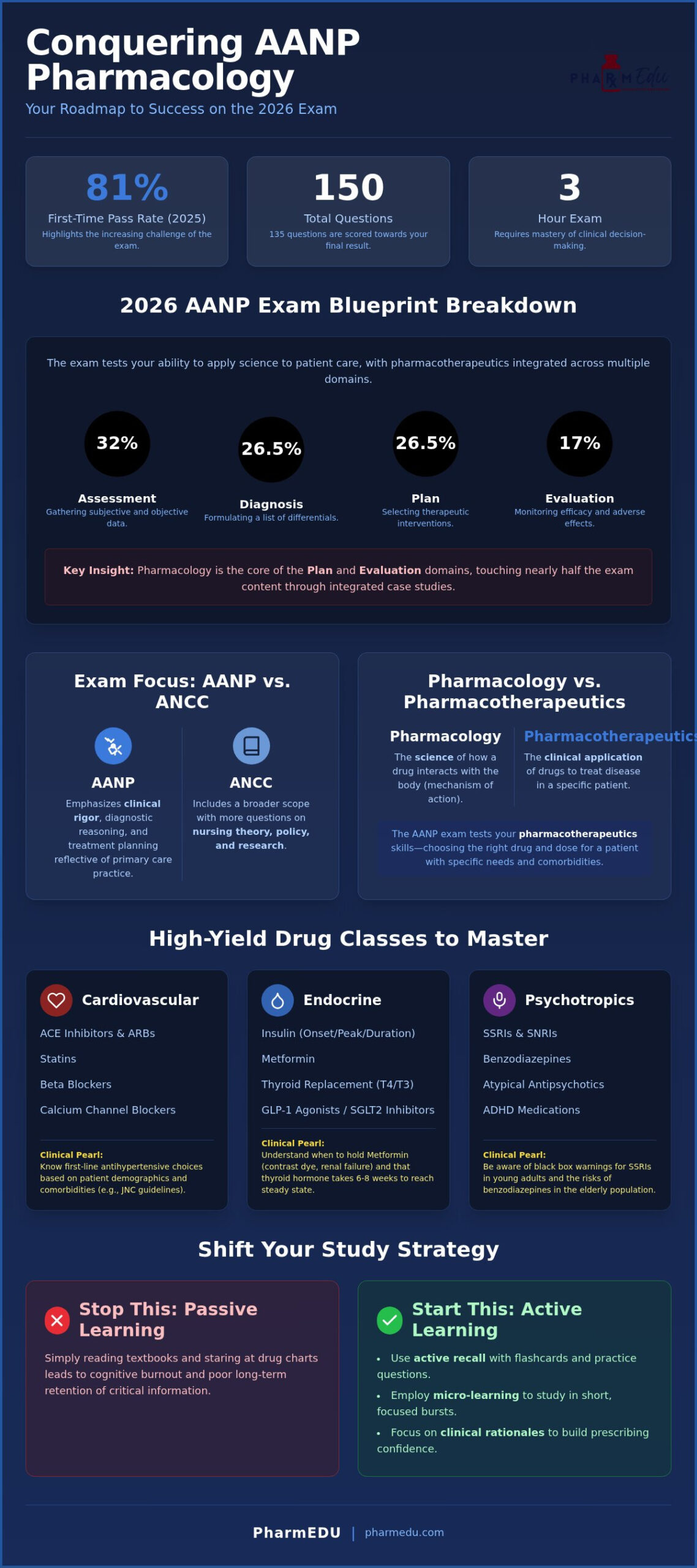
The AANP FNP-C exam consists of 150 questions, with 135 of those contributing to your final score over a three-hour testing window. For the 2026 testing cycle, the blueprint remains heavily weighted toward clinical domains that require immediate decision-making. Because pharmacotherapeutics is the primary tool for the planning and evaluation phases of care, it effectively touches nearly half of the exam. You won’t just encounter isolated AANP pharmacology questions that ask for a drug’s class; instead, you’ll face integrated cases where you must choose the right medication based on a patient’s specific comorbidities.
The American Academy of Nurse Practitioners Certification Board (AANPCB) designs this exam to reflect primary care practice. This means the focus is on long-term management of chronic conditions rather than acute, hospital-based interventions. While a foundational comprehensive overview of pharmacology is necessary to understand drug mechanisms, the boards test your ability to apply that science to a living patient. The 2026 blueprint focuses on these core domains:
- Assessment (32%): Gathering subjective and objective data.
- Diagnosis (26.5%): Formulating a list of differentials.
- Plan (26.5%): Selecting the best therapeutic intervention.
- Evaluation (17%): Monitoring for efficacy and adverse effects.
Pharmacology vs. Pharmacotherapeutics
AANP vs. ANCC: Pharmacology Focus
Comparing the AANP and ANCC exams reveals a clear difference in philosophy. The AANP is widely recognized for its clinical rigor, prioritizing diagnostic reasoning and treatment planning. In contrast, the ANCC includes more questions on nursing theory, policy, and research. If you’re preparing for the AANP, your study of pharmacology should be through the lens of a primary care provider. Most AANP pharmacology questions will place you in a clinic setting where you must decide which medication is safest for a patient with multiple competing health issues. This clinical focus is why many students find the AANP exam more reflective of their actual daily practice as an NP.
High-Yield Drug Classes to Master for AANP Practice
Success on the boards requires moving past simple alphabetical drug lists. You must prioritize the medications that appear most frequently in primary care settings. AANP pharmacology questions often center on chronic disease management and the safety of long-term therapies. Cardiovascular agents like ACE inhibitors, ARBs, and Statins are staples of the exam. In the endocrine category, you’ll need to master Insulin onset times, Metformin contraindications, and the nuances of Thyroid replacement titration. Psychotropic medications, specifically SSRIs and SNRIs, are also high-yield topics. Understanding the safety profile of Benzodiazepines, especially in geriatric populations, is a common focus for examiners.
For endocrine cases, Metformin remains the gold standard for Type 2 Diabetes, but the exam will test your knowledge of when to pause therapy. You should know to hold Metformin prior to imaging with contrast or in cases of advanced renal failure. Thyroid replacement therapy requires precise monitoring of TSH levels. It’s vital to remember that it takes approximately six to eight weeks to reach a steady state after a dose change. In the psychotropic category, focus on the black box warnings associated with SSRIs in younger patients. Distinguishing between the side effect profiles of SSRIs and SNRIs is also important; for example, SNRIs may cause a dose-dependent increase in blood pressure.
Antihypertensives and the JNC Guidelines
Selecting the correct first-line therapy depends heavily on patient demographics and comorbidities. While guidelines continue to evolve, the boards still emphasize the foundational principles of the JNC framework. For instance, ace inhibitors are preferred for patients with diabetes or chronic kidney disease due to their renal protective effects. However, you must be prepared for distractors like the “ACE cough” or angioedema. Following the AANP Medication Safety Guidelines ensures you’re making evidence-based choices. If you find these guidelines overwhelming, using structured study tools can help you apply these standards to realistic patient scenarios.
Antibiotic Stewardship in Primary Care
Matching the right antibiotic to the infection is a core competency for any future NP. You’ll see cases involving Sinusitis, UTIs, and Community-Acquired Pneumonia (CAP). Focus your prep on the “big five” classes: Penicillins, Cephalosporins, Macrolides, Fluoroquinolones, and Sulfonamides. Cross-sensitivity is a favorite topic for examiners. If a patient has a true IgE-mediated allergy to Penicillin, you must know which Cephalosporins carry a risk of reaction. Beta-lactams exert their bactericidal effect by inhibiting the synthesis of the bacterial cell wall through binding to penicillin-binding proteins. Understanding this mechanism helps you predict why certain bacteria develop resistance and how to choose the next line of therapy effectively.
How to Analyze AANP Pharmacology Practice Questions
Approaching a clinical vignette requires a systematic deconstruction of the prompt. When you encounter AANP pharmacology questions, your first task is to identify the “patient” within the stem. Age, comorbidities, and current medication lists are rarely filler; they’re the variables that dictate the correct answer. A treatment that’s appropriate for a healthy 40-year-old may be contraindicated for a 75-year-old with a reduced glomerular filtration rate. Once you’ve established the patient profile, isolate the core clinical problem. Determine if the question is asking for a new treatment plan, a diagnostic step for a side effect, or an adjustment due to a drug-related complication.
Evaluating distractors is where many students lose points. These options are often clinically “correct” in a general sense but inappropriate for the specific patient described. The AANP exam frequently asks for the “most” appropriate or “first-line” intervention. This forces you to prioritize safety and evidence-based guidelines over other plausible but secondary options. Success comes from a disciplined process of elimination. If an answer choice ignores a patient’s allergy or a significant drug interaction mentioned in the stem, you can safely discard it, regardless of how standard the treatment seems.
Spotting Drug-Drug Interactions (DDIs)
Polypharmacy is a major theme, particularly in geriatric case studies. You’ll need to recognize common DDI patterns, such as the interaction between Warfarin and various antibiotics or herbals. The Cytochrome P450 (CYP450) system is a favorite for board examiners. You don’t need to memorize every enzyme, but you should understand how inhibitors and inducers affect drug levels. For the most current safety alerts and labeling changes, consulting FDA Resources for Healthcare Professionals is a standard practice that mirrors the evidence-based approach expected on the exam. Understanding these interactions allows you to predict toxicity or therapeutic failure before it occurs.
Managing Adverse Drug Reactions (ADRs)
Distinguishing between expected side effects and life-threatening reactions is a critical NP skill. Boards often test high-yield ADRs like ACEI-induced cough, Statin-related myalgias, or the flushing associated with rapid Vancomycin infusion. When facing “all of the following except” questions, use a true/false strategy for each option. This helps you maintain focus on the outliers. Remember that the AANP exam prioritizes patient safety. If one option involves a life-threatening reaction like angioedema or Stevens-Johnson Syndrome, that clinical priority will likely drive the correct answer choice. Practice identifying these red flags through our Pharmacology Practice Quizzes to sharpen your diagnostic instincts.
Effective Study Techniques for Long-Term Pharmacology Retention
The volume of information required for board certification often leads to significant cognitive fatigue. To combat this, you should adopt a micro-learning strategy that breaks down complex drug classes into manageable five to ten minute segments. This approach is particularly effective for busy students who must balance clinical hours with intensive study sessions. Instead of spending hours in passive reading, focus on active recall. Testing your knowledge before you feel “ready” forces the brain to build stronger neural pathways. This mental effort is exactly what you’ll need when facing AANP pharmacology questions that require rapid diagnostic reasoning under pressure.
Visual learners often find that traditional textbooks fail to illustrate the dynamic nature of drug mechanisms. High-Yield Video Vignettes bridge this gap by providing a visual narrative of how medications interact with physiological systems. By seeing the mechanism in action, you move from rote memorization to true conceptual understanding. Your study schedule should reflect your personal data; prioritize the drug classes where your practice scores are lowest to ensure a well-rounded knowledge base by exam day.
Active Recall and Spaced Repetition
Mastering the “forgetting curve” is essential for long-term retention. Without reinforcement, the brain naturally discards information that isn’t frequently accessed. Using Interactive Pharmacology Flashcards allows you to leverage spaced repetition, ensuring you review difficult concepts just as they’re about to slip from your memory. This method transforms your preparation from a stressful cram session into a methodical process of reinforcement. For a structured approach to your finals and boards, consult our pharmacology study guide for nursing students to streamline your review.
Case-Based Learning for Clinical Application
The AANP exam doesn’t exist in a vacuum; it mirrors the complexities of a primary care clinic. Practicing with Clinical Case Studies mimics the real exam environment by forcing you to synthesize patient data, comorbidities, and medication profiles simultaneously. This builds a mental “drug library” where medications are filed by clinical presentation rather than alphabetical lists. Case-based learning is superior for NP students because it bridges the gap between theoretical knowledge and the practical decision-making required for safe, effective prescribing. To start building your clinical confidence today, consider a PharmEDU Annual Subscription for unlimited access to our complete case library.
Elevating Your Prep with PharmEDU’s AANP Resources
PharmEDU is designed to be your digital mentor during the final, most critical stage of your education. By offering access to over 100 high-yield pharmacology topics, our platform ensures you aren’t wasting time on low-probability material. Instead of wading through thousands of pages of text, you can focus on the core concepts that actually appear on the exam. Our Pharmacology Practice Quizzes provide more than just a score; they offer detailed clinical rationales that explain the logic behind every correct and incorrect answer. This depth is essential for mastering the diagnostic reasoning needed to navigate complex AANP pharmacology questions.
The platform’s mobile-compliant design is a significant advantage for students currently completing clinical rotations. You can review a High-Yield Video Vignette between patient encounters or tackle a quick quiz during your commute. This integration of learning into your daily life helps prevent the burnout often associated with marathon study sessions. By simplifying complex drug mechanisms into digestible segments, PharmEDU helps you build a solid foundation of knowledge that persists long after the testing center doors close. You’ll find that our Clinical Case Studies mirror the 2026 blueprint, providing the realistic practice you need to feel prepared.
The PharmEDU Monthly Subscription Advantage
Choosing a digital platform over traditional methods is a strategic decision for the modern student. While a comprehensive pharmacy review often involves heavy, static textbooks that quickly become outdated, our digital micro-learning approach is dynamic. The PharmEDU Monthly Subscription provides affordable access to professional-grade study materials, allowing you to utilize Interactive Pharmacology Flashcards and video content without a massive upfront investment. It’s a precise, efficient way to bridge the gap between academic theory and the high-stakes environment of the boards.
Passing the AANP on Your First Try
Confidence on test day is the product of rigorous, targeted preparation. PharmEDU users consistently report higher confidence levels because they’ve practiced with the same clinical rigor they face on the actual exam. Having a digital mentor in your pocket means you’re never alone in your studies. Whether you need a quick refresher on high-yield drug classes or a deep dive into AANP pharmacology questions, the answers are always available. We’re committed to your professional success and your transition into a competent, prescribing nurse practitioner. Secure your future in primary care by choosing a PharmEDU Monthly Subscription or PharmEDU Annual Subscription today.
Take Command of Your Board Preparation
Success on your NP boards requires more than just memorizing drug names; it demands the clinical intuition to apply pharmacotherapeutics to complex patient scenarios. By mastering the 2026 blueprint and focusing on high-yield drug classes, you’re building a solid foundation for safe practice. Implementing active recall and micro-learning strategies will ensure you’re prepared to handle the most challenging AANP pharmacology questions with both precision and speed.
You don’t have to face this journey alone. PharmEDU provides the structured support you need through High-Yield Video Vignettes for every major drug class and Interactive Flashcards optimized for mobile study. Our Comprehensive Practice Quizzes with detailed rationales turn every mistake into a valuable learning opportunity. Start your PharmEDU Monthly Subscription today and master AANP pharmacology! You’ve put in the hard work throughout your program, and now it’s time to cross the finish line with absolute confidence. We’re proud to be your partner as you transition from student to certified nurse practitioner.
Frequently Asked Questions
How many pharmacology questions are on the AANP exam?
There isn’t a fixed number of standalone pharmacology questions because pharmacotherapeutics is integrated into the broader clinical domains. However, based on the 2026 blueprint, therapeutic planning and evaluation account for approximately 43.5% of the scored items. You can expect medications to play a central role in nearly half of the clinical vignettes you encounter during the 180 minute testing window.
What are the most common drug classes tested on the AANP FNP exam?
Cardiovascular and endocrine agents are the most frequently tested drug classes on the AANP FNP exam. You should focus your preparation on antihypertensives, lipid lowering agents, and diabetes medications like insulin and metformin. Additionally, antibiotics used for common primary care infections and psychotropic medications like SSRIs appear often in patient management scenarios requiring clinical decision making.
How should I study for AANP pharmacology if I am short on time?
Focus on high yield drug classes and practice with AANP pharmacology questions that use clinical vignettes. If you’re short on time, prioritize micro learning segments and active recall rather than reading long chapters. Using targeted Pharmacology Practice Quizzes helps you identify your weakest areas quickly so you can spend your limited study hours where they’ll have the most impact.
Is the AANP exam harder than the ANCC for pharmacology?
The AANP exam is often perceived as more rigorous for pharmacology because it focuses strictly on clinical application and prescribing. While the ANCC includes questions on nursing theory and policy, the AANP prioritizes diagnostic reasoning and treatment planning. This clinical focus requires you to have a deeper understanding of drug drug interactions and patient specific contraindications in a primary care setting.
Can I use flashcards as my primary study tool for AANP pharmacology?
Flashcards are an excellent secondary tool for memorizing drug classes and mechanisms, but they shouldn’t be your only resource. Because the boards test your ability to apply knowledge to patient cases, you must combine flashcards with Clinical Case Studies. This approach ensures you’re practicing the transition from simple drug recall to making complex prescribing decisions for patients with multiple comorbidities.
What happens if I fail the pharmacology portion of the AANP certification?
You cannot fail just one portion of the exam; the AANP certification is graded as a single comprehensive score. If your total scaled score is below 500, you’ll receive a performance report showing your strengths and weaknesses in each domain. This feedback is essential for focusing your retake preparation on the specific clinical areas where your pharmacotherapeutic knowledge was insufficient.
Are the pharmacology questions on AANP related to pediatric dosing?
How often does the AANP update its pharmacology question bank?
The AANPCB regularly reviews and updates its question bank to reflect current evidence based clinical guidelines and FDA safety communications. While the core blueprint undergoes a major review every few years, individual items are continuously evaluated for clinical relevance. Staying updated with the latest primary care guidelines is the best way to ensure your knowledge aligns with the current version of the exam.