
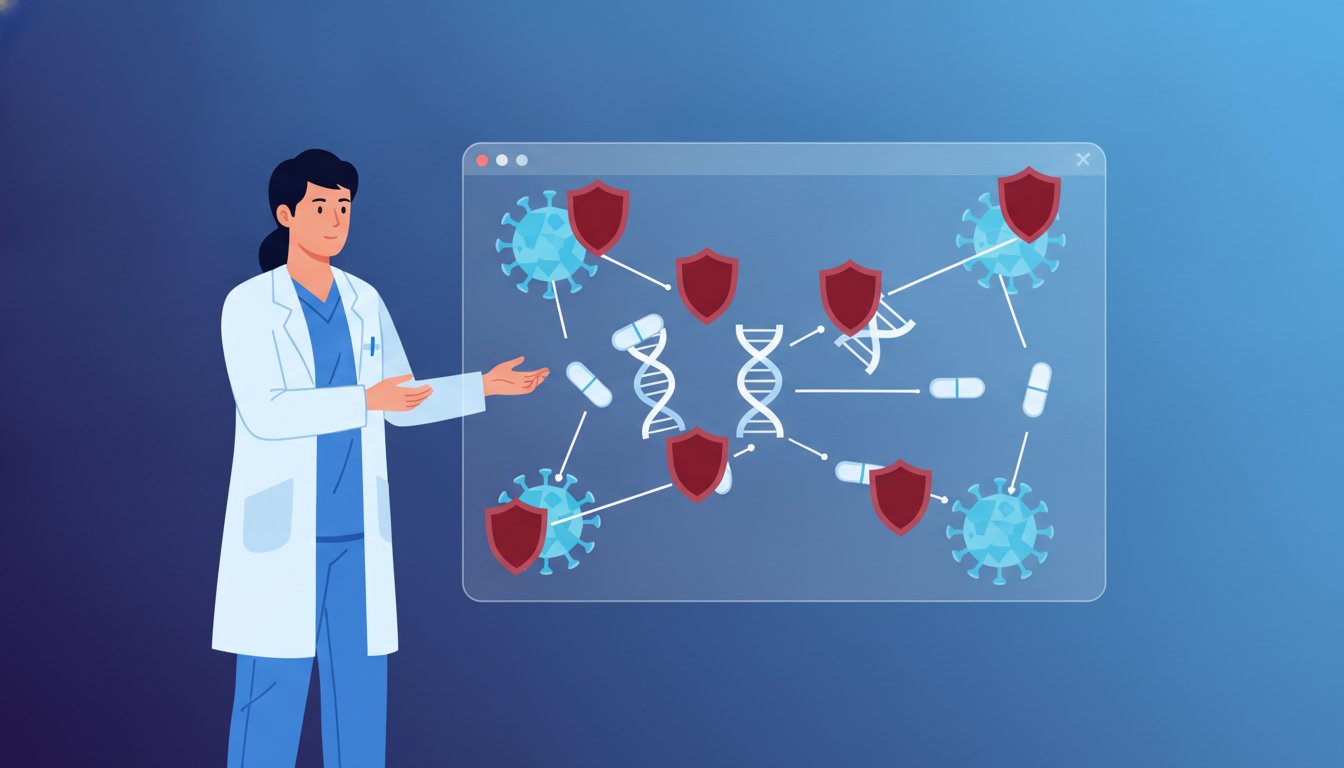
Pharmacology of Antiviral Medications: The High-Yield 2026 Guide
What if the secret to mastering the pharmacology of antiviral medications isn’t memorizing an endless list of drug names, but rather thinking like a viral hijacker? Most medical students and clinicians feel buried under the weight of ever-expanding drug classes. It’s particularly overwhelming with the 2026 updates to HIV protocols and the rapid arrival of new COVID-19 prophylaxis options. You aren’t alone if you struggle to distinguish between various anti-retroviral mechanisms or find yourself forgetting which specific adverse effects are board-essential.
We’ve designed this guide to transform that frustration into clinical confidence. You’ll gain a clear understanding of the viral lifecycle and learn how specific drugs act as strategic lifecycle disruptors. We promise a comprehensive deep dive that moves beyond dry academic lists into a logical framework for easier recall during high-stakes exams and daily practice.
We’ll examine the latest 2026 clinical standards, including the FDA’s recent approval of Xocova for post-exposure prophylaxis and the newest generic influenza treatments. From the updated WHO recommendations for dolutegravir-based HIV regimens to the current 95% cure rates for Hepatitis C, this guide provides the high-yield facts you need to excel in a rapidly shifting therapeutic landscape.
Key Takeaways
- Understand the principle of selective toxicity and why it makes viral targets fundamentally different from bacterial ones.
- Differentiate between various nucleoside analogues to understand why certain prodrugs offer superior bioavailability in clinical settings.
- Master the pharmacology of antiviral medications by learning a foolproof framework for distinguishing between NRTI and NNRTI mechanisms.
- Explore the 2026 breakthroughs in Hepatitis C and COVID-19 therapy, focusing on the direct-acting agents that have revolutionized patient outcomes.
- Gain the tools to predict viral resistance patterns and identify high-yield drug interactions essential for both the clinic and board exams.
Fundamentals of Antiviral Pharmacology and the Viral Lifecycle
Antiviral pharmacology is the study of agents that inhibit viral replication without destroying the host cell. Unlike bacteria, which often possess unique cell walls or independent metabolic pathways, viruses are obligate intracellular parasites. They don’t just live inside us; they hijack our ribosomes, enzymes, and energy sources to survive. This fundamental biological reality is why the pharmacology of antiviral medications presents such a unique clinical challenge. We aren’t just targeting an invader. We’re trying to stop a hijacker who is using our own cellular machinery to build more copies of itself.
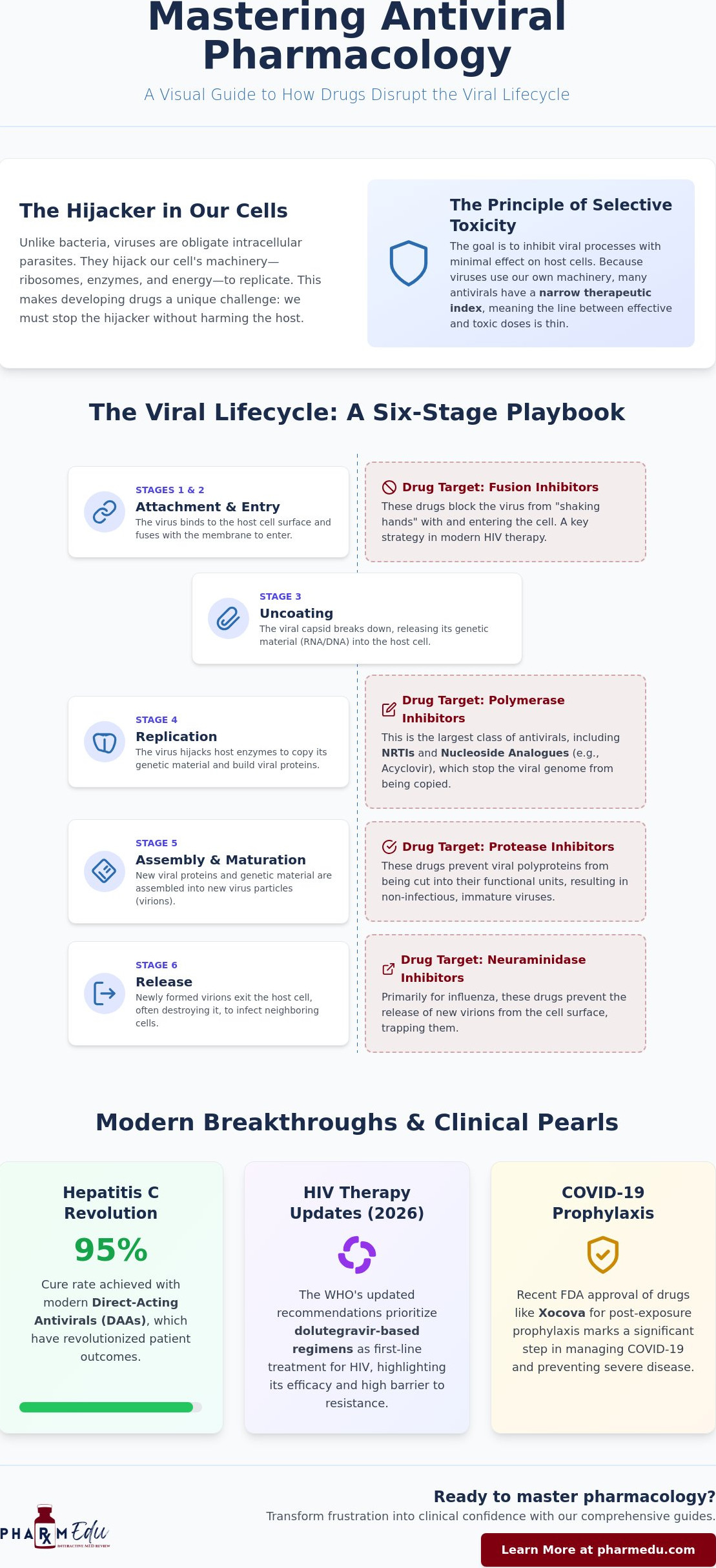
To master these drugs, you must first visualize the six stages of the viral lifecycle: attachment, entry, uncoating, replication, assembly, and release. Each stage represents a potential therapeutic target. By understanding the underlying pharmacology and how these agents interfere with host-cell processes, clinicians can better predict and manage adverse effects. For a broader perspective on these classifications, this Antiviral drug overview provides a foundational look at how these agents have evolved over decades of research.
Selective Toxicity and the Host-Cell Challenge
The central goal of any antimicrobial therapy is selective toxicity. In the context of viral replication, selective toxicity is the ability of a drug to target viral-specific proteins or processes while sparing the host’s cellular functions. Because viruses rely so heavily on host machinery for protein synthesis and genome replication, achieving this balance is remarkably difficult. This reliance often leads to higher toxicity profiles and a narrower therapeutic index compared to many common antibiotics.
The therapeutic index represents the ratio between the dose that causes toxicity and the dose that provides a therapeutic effect. A narrow index means there’s little room for error. When a drug interferes with a viral enzyme that closely resembles a human enzyme, the risk of side effects skyrockets. This explains why many antivirals cause bone marrow suppression or renal issues; the drug is inadvertently “hitting” the host while trying to stop the virus.
Mapping Drug Classes to the Replication Cycle
High-yield exam questions often focus on where a drug strikes within the replication cycle. Understanding this map allows you to categorize medications by their function rather than just memorizing a list. Entry inhibitors, such as those used in modern HIV therapy, prevent the virus from ever fusing with the host membrane. Polymerase inhibitors, including the widely used nucleoside analogues, target the replication phase by stopping viral genome doubling.
- Attachment and Entry: Fusion inhibitors prevent the initial “handshake” between the virus and the cell.
- Replication: This is where most drugs, including NRTIs and DNA polymerase inhibitors, perform their work.
- Assembly and Maturation: Protease inhibitors prevent the viral polyprotein from being cleaved into functional units, effectively stopping the virus from becoming infectious.
- Release: Neuraminidase inhibitors stop the newly formed virions from leaving the host cell to infect neighbors.
Mastering the pharmacology of antiviral medications requires recognizing that these drugs are strategic disruptors. They don’t kill the virus directly; they simply break the assembly line at a specific, vulnerable point.
Anti-Herpesvirus Agents: Nucleoside Analogues and Beyond
The cornerstone of anti-herpes therapy lies in the inhibition of viral DNA polymerase. These medications are designed to stop the virus from doubling its genome, effectively halting the production of new virions. When studying the pharmacology of antiviral medications for herpes simplex virus (HSV) and varicella-zoster virus (VZV), you’ll primarily encounter nucleoside analogues. These drugs mimic the natural building blocks of DNA but contain structural modifications that prevent further strand elongation. Acyclovir, valacyclovir, and famciclovir share this core objective, yet they differ significantly in their pharmacokinetic profiles and clinical utility.
Valacyclovir and famciclovir were developed to overcome the poor oral bioavailability of acyclovir. Valacyclovir is a prodrug that undergoes rapid first-pass metabolism in the liver to become acyclovir, achieving serum levels three to five times higher than oral acyclovir itself. This improvement allows for less frequent dosing, which greatly enhances patient compliance. While these agents are excellent for HSV and VZV, they aren’t the first choice for all herpesviruses. For more complex infections like Cytomegalovirus (CMV), clinicians rely on ganciclovir and its oral prodrug, valganciclovir. These “heavy hitters” are more potent but carry a much narrower therapeutic index, as explored in this detailed Pharmacology of Antiviral Drugs from the NIH.
The Acyclovir Mechanism: A Lesson in Activation
The safety of acyclovir is rooted in its requirement for viral activation. It enters the cell as an inactive compound and must undergo a three-step phosphorylation process to become the active acyclovir triphosphate. The first and most critical step is performed by viral thymidine kinase (TK). Since human cells don’t possess this specific enzyme, the drug remains largely inactive in uninfected cells. This explains why acyclovir has such a high degree of selective toxicity. Acyclovir triphosphate acts as a competitive inhibitor of viral DNA polymerase and, once incorporated into the growing DNA strand, causes immediate chain termination because it lacks the 3′-hydroxyl group necessary for further attachment.
Clinical Pearls and Adverse Effects of Anti-Herpes Drugs
Despite their safety, these drugs require careful monitoring. IV acyclovir can cause crystalline nephropathy if the drug precipitates in the renal tubules. You can prevent this by ensuring the patient remains well-hydrated during administration. When dealing with CMV, ganciclovir is the standard of care, but its use is frequently limited by dose-dependent bone marrow suppression. This is a common board exam topic; always look for neutropenia or thrombocytopenia in patients on CMV prophylaxis. For strains that have evolved resistance by losing their thymidine kinase enzyme, alternative agents like foscarnet or cidofovir are used. These drugs don’t require phosphorylation by viral enzymes, though they carry a significantly higher risk of nephrotoxicity.
Mastering these distinctions is vital for both clinical rotations and high-stakes exams. If you’re looking for a structured way to review these drug classes, our Pharmacology Practice Quizzes offer a streamlined approach to testing your knowledge on mechanism and toxicity.
Anti-Retroviral Therapy (ART): Mastering HIV Pharmacology
HIV treatment has transformed from a fatal prognosis into a manageable chronic condition. This shift was driven by the rapid evolution of the pharmacology of antiviral medications, moving from toxic monotherapies to the highly effective, multi-class regimens used today. Modern ART focuses on suppressed viral replication through the simultaneous targeting of different stages in the HIV lifecycle. According to the 2026 WHO guidelines, dolutegravir-based regimens remain the preferred first-line treatment due to their high genetic barrier to resistance and superior side effect profile.
Reverse Transcriptase Inhibitors: NRTIs and NNRTIs
Reverse transcriptase is the enzyme responsible for converting viral RNA into DNA. Nucleoside Reverse Transcriptase Inhibitors (NRTIs), such as Abacavir or Tenofovir, act as decoy building blocks. They’re incorporated into the growing DNA chain but lack the necessary attachment point for the next nucleotide, which causes immediate chain termination. Non-Nucleoside Reverse Transcriptase Inhibitors (NNRTIs), like Efavirenz, work through allosteric inhibition. They bind to a specific site on the enzyme, physically changing its shape so it can’t function. Clinicians must monitor NRTI patients for lactic acidosis and hepatic steatosis. NNRTIs are more frequently associated with skin rashes and CNS side effects, including vivid dreams or sleep disturbances.
Protease and Integrase Inhibitors: Post-Translational Targets
Protease inhibitors (PIs) target the virus after it has already replicated. They stop the “clipping” of long viral polyproteins into the functional units required for a mature, infectious virion. Because PIs like Darunavir are rapidly metabolized by the liver, they’re often “boosted” with Ritonavir or Cobicistat. These boosters inhibit the CYP3A4 enzyme to maintain therapeutic drug levels. However, PIs are notoriously linked to metabolic complications, including insulin resistance and lipodystrophy. Integrase Strand Transfer Inhibitors (INSTIs), such as Dolutegravir and Bictegravir, prevent the integration of viral DNA into the host genome. They’ve become the gold standard in 2026 because they offer rapid viral suppression with fewer metabolic risks than older drug classes.
Entry and Fusion Inhibitors: Blocking the Door
Some medications prevent the virus from ever entering the host cell. Maraviroc is a CCR5 antagonist that blocks the co-receptor HIV uses for entry. It’s unique because it targets a host protein rather than a viral one, requiring a tropism test to ensure the patient’s specific viral strain uses the CCR5 receptor. Enfuvirtide is a fusion inhibitor that prevents the viral envelope from merging with the cell membrane. For students currently in a naplex prep course, mastering the pharmacology of antiviral medications means focusing on these high-yield drugs: Tenofovir, Dolutegravir, and Darunavir. These agents represent the backbone of modern therapy and are frequently featured in clinical case vignettes.
Pharmacology of Hepatitis and Respiratory Antivirals
The landscape of hepatitis and respiratory therapy has shifted dramatically with the arrival of precision-targeted agents. While previous generations relied on the broad, often poorly tolerated effects of interferon, modern pharmacology of antiviral medications focuses on inhibiting specific viral enzymes. This evolution has turned Hepatitis C into a curable condition and provided clinicians with potent tools to manage seasonal influenza and evolving coronaviruses. Understanding these drug classes requires a focus on their specific molecular targets and the clinical implications of their pharmacokinetic profiles.
Direct-Acting Antivirals (DAAs) for Hepatitis C
Hepatitis C (HCV) therapy is now defined by Direct-Acting Antivirals (DAAs), which boast cure rates exceeding 95% as of June 2026. These agents are categorized by their specific viral targets. NS3/4A inhibitors, such as glecaprevir, block the protease enzyme responsible for polyprotein processing. NS5A inhibitors, like pibrentasvir, target a protein essential for viral replication complex assembly. Finally, NS5B inhibitors, including sofosbuvir, act as polymerase inhibitors to stop RNA synthesis. On June 23, 2026, the European Commission expanded the use of MAVIRET (glecaprevir/pibrentasvir) for acute HCV in both adults and children, making it a versatile tool for achieving Sustained Virologic Response (SVR).
SVR is the primary pharmacological goal, defined as the absence of detectable HCV RNA 12 to 24 weeks after completing therapy. However, the clinical use of DAAs requires vigilance regarding drug-drug interactions. Many DAA regimens are packaged with ritonavir to “boost” drug levels by inhibiting the CYP3A4 enzyme. While effective for maintaining therapeutic concentrations, this inhibition can lead to dangerous elevations of co-administered medications, such as statins or certain immunosuppressants.
Respiratory Antivirals: Influenza and SARS-CoV-2
Influenza management currently relies on two distinct mechanisms. Oseltamivir, a neuraminidase inhibitor, prevents viral egress by blocking the enzyme that cleaves the sialic acid tether between the budding virus and the host cell. In contrast, Baloxavir marboxil inhibits cap-dependent endonuclease, stopping viral mRNA transcription entirely. On June 22, 2026, the FDA approved the first generic version of Baloxavir, significantly increasing patient access ahead of the upcoming flu season. These drugs are most effective when administered within 48 hours of symptom onset.
COVID-19 therapeutics have also seen major 2026 updates. Paxlovid remains a staple, utilizing the synergistic relationship between nirmatrelvir, a protease inhibitor, and ritonavir, which serves as a pharmacokinetic enhancer. Additionally, the FDA approved Xocova (ensitrelvir) on May 29, 2026, as the first oral antiviral for post-exposure prophylaxis. For Hepatitis B, the standard of care remains NRTIs like Entecavir and Tenofovir. These drugs act as competitive inhibitors of viral DNA polymerase; they’re incorporated into the growing DNA strand as “decoy” nucleotides, leading to immediate chain termination. Because these agents also target HIV reverse transcriptase, clinicians must screen for co-infection to avoid inducing HIV resistance through unintended monotherapy.
Staying current with these rapid regulatory changes is essential for safe prescribing. If you want to master these mechanisms through active recall, explore our Interactive Pharmacology Flashcards to solidify your understanding of drug targets and 2026 clinical guidelines.
Clinical Mastery and Exam Preparation Strategies
Mastering the pharmacology of antiviral medications requires more than just rote memorization. It demands a functional understanding of how these agents behave in a complex biological environment where resistance and drug interactions are constant threats. Viruses are masters of adaptation. They outsmart our interventions through point mutations in target enzymes, such as reverse transcriptase or protease, which can render a once-effective drug useless. This is exactly why multi-drug combination therapy is the non-negotiable standard of care in modern clinical practice. By the time a patient presents with symptoms, the viral load has often already peaked, making the timing of pharmacological intervention critical for success.
Navigating Drug-Drug Interactions (DDIs)
The Cytochrome P450 (CYP) system is the primary metabolic highway for many antivirals, particularly protease inhibitors and certain non-nucleoside reverse transcriptase inhibitors. Clinicians must be vigilant when prescribing these agents alongside other medications. Rifampin is a potent CYP inducer that can drop antiviral levels to sub-therapeutic ranges, leading to treatment failure and the emergence of resistance. Conversely, St. John’s Wort is a common herbal supplement that patients often fail to report, yet it can significantly interfere with the efficacy of ART. Antacids are another frequent culprit; they can alter the gastric pH required for the absorption of drugs like atazanavir or chelate with integrase inhibitors, preventing them from entering the bloodstream entirely. Effective management requires a systematic review of all over-the-counter products and supplements during every clinical encounter.
Preparation for Boards: High-Yield Summary
For those utilizing our pharmacology study guide for nursing students, we recommend creating a visual “Mechanism of Action” map. Grouping drugs by their specific lifecycle target allows for much faster recall during high-pressure exams. Instead of memorizing individual names, focus on the suffixes and the primary cellular “door” they block. You should pay close attention to Black Box Warnings and pregnancy categories. For instance, the risk of severe neutropenia with ganciclovir or the fatal hypersensitivity reactions associated with abacavir (linked to the HLA-B*5701 allele) are frequent board topics. Understanding these nuances doesn’t just help you pass a test; it ensures you can provide safe, evidence-based care in a real-world setting.
PharmEDU’s High-Yield Video Vignettes simplify these intricate pathways by placing them in a clear clinical context. We bridge the gap between dry academic theory and the fast-paced reality of the clinic. Ready to ace your boards? Join PharmEDU today for interactive flashcards and quizzes! Our platform is built to take the administrative and cognitive burden off your shoulders, allowing you to focus on what truly matters: your professional growth and patient safety.
Advancing Your Clinical Expertise in Antiviral Therapy
Mastering the pharmacology of antiviral medications requires a shift from memorizing names to understanding the strategic disruption of viral lifecycles. We’ve explored how these agents evolve, from the activation of nucleoside analogues to the precision of modern integrase inhibitors and the latest 2026 respiratory therapeutics. Staying updated with these regulatory changes and clinical guidelines ensures you remain a reliable partner in patient care while preparing for the rigors of board examinations.
Success in this complex field depends on structured, high-yield study habits. Our platform offers a comprehensive library covering 100+ pharmacology topics through micro-learning video vignettes, interactive flashcards, and clinical case studies. These tools are designed to remove the administrative burden from your professional development, allowing you to focus on practical knowledge and exam readiness. Unlock High-Yield Antiviral Video Vignettes and Quizzes on PharmEDU to solidify your expertise and approach your next clinical challenge with absolute confidence. Your journey toward mastery is a continuous process, and we’re here to support every step of your professional path.
Frequently Asked Questions
What is the primary mechanism of action for antiviral medications?
Antiviral medications primarily work by inhibiting specific stages of the viral lifecycle, such as entry, uncoating, or genome replication. Most of these agents are virustatic; they don’t kill the virus directly but instead limit its ability to replicate. This suppression allows the host’s immune system to effectively manage or clear the infection. Understanding these mechanisms is the first step in mastering the clinical application of these drugs.
How do nucleoside reverse transcriptase inhibitors (NRTIs) differ from NNRTIs?
NRTIs act as competitive inhibitors that function as “decoy” building blocks, while NNRTIs bind allosterically to a different site on the reverse transcriptase enzyme. NRTIs require intracellular activation through phosphorylation to become effective. In contrast, NNRTIs don’t require this activation and instead physically change the enzyme’s shape to prevent it from building viral DNA. This distinction is a frequent focus on board exams.
Why do some antiviral drugs require ‘boosting’ with Ritonavir?
Ritonavir is used as a pharmacokinetic enhancer because it’s a potent inhibitor of the cytochrome P450 3A4 enzyme. By slowing the liver’s metabolism of other antivirals, particularly protease inhibitors, it maintains higher drug concentrations in the bloodstream. This “boosting” effect allows for more convenient dosing schedules and ensures the primary medication remains at therapeutic levels for longer periods.
What are the most common side effects of anti-retroviral therapy (ART)?
Side effects often depend on the specific drug class, but metabolic issues like insulin resistance, lipodystrophy, and dyslipidemia are common clinical concerns. Patients may also experience gastrointestinal upset or renal toxicity. Monitoring these adverse reactions is a fundamental part of the pharmacology of antiviral medications, as clinicians must balance viral suppression with long-term patient safety and compliance.
Can antiviral medications cure viral infections like HIV or Herpes?
Most antivirals manage chronic infections rather than curing them, though Hepatitis C is a major exception. For viruses like HIV and Herpes, medications suppress replication to undetectable levels but can’t reach the latent viral reservoirs integrated into the host’s genome. In contrast, modern direct-acting antivirals for Hepatitis C achieve a sustained virologic response, which is considered a clinical cure in over 95% of cases.
What is the importance of viral thymidine kinase in Acyclovir pharmacology?
Viral thymidine kinase is the specific enzyme that initiates acyclovir’s activation by performing the first of three required phosphorylation steps. Because this enzyme is absent in healthy human cells, acyclovir remains inactive unless it enters a cell infected by a virus. This mechanism provides the high selective toxicity that makes acyclovir safe for the host while being deadly to the virus.
How do neuraminidase inhibitors like Oseltamivir work against the flu?
Oseltamivir works by inhibiting the neuraminidase enzyme, which is necessary for the release of new viral particles from the host cell. By blocking this enzyme, the drug prevents the “egress” of virions, effectively trapping them and stopping the spread of infection to adjacent respiratory cells. For maximum efficacy, these inhibitors should be started within 48 hours of the first symptoms.
What are the pharmacological targets for modern Hepatitis C treatments?
Modern Hepatitis C treatments target three critical non-structural proteins: NS3/4A protease, NS5A replication complex, and NS5B polymerase. Using combinations that hit these targets simultaneously prevents the virus from developing resistance. This multi-pronged approach is a hallmark of the pharmacology of antiviral medications in 2026, leading to the highly successful cure rates seen in clinical practice today.