
How to Overcome Pharmacology Anxiety: A Strategic Guide for Healthcare Students
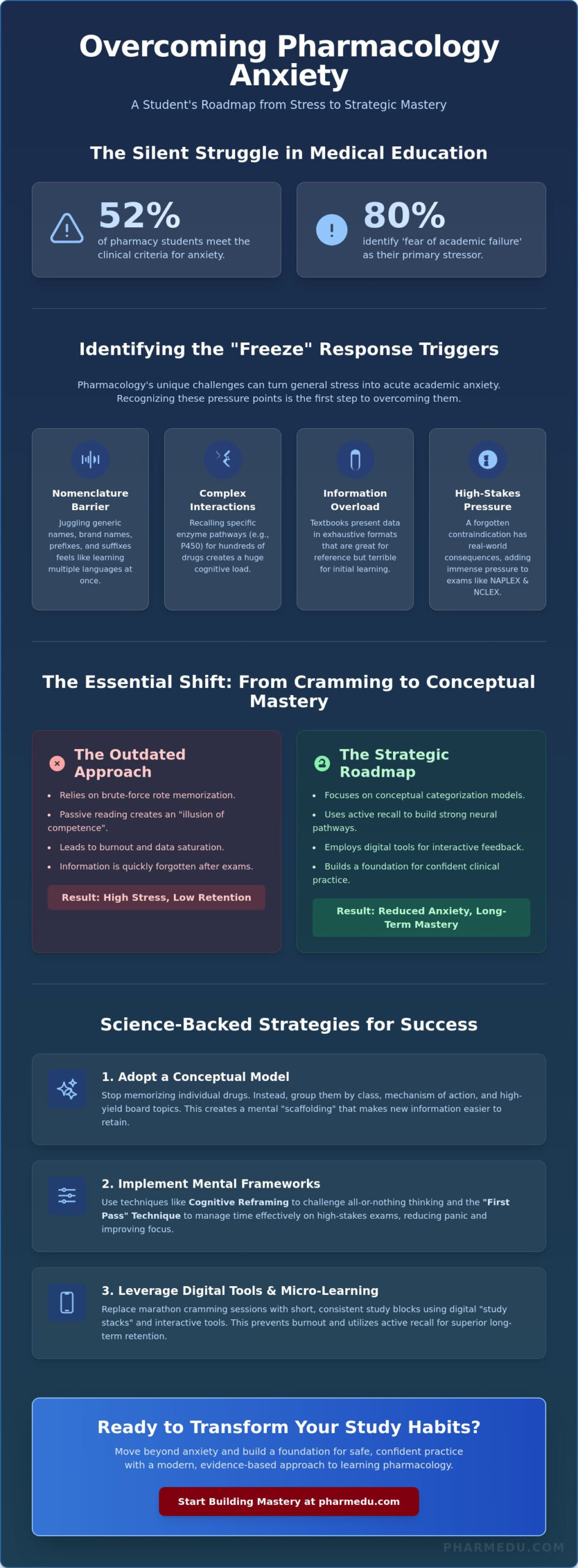
Did you know that 52% of pharmacy students meet the clinical criteria for anxiety, with nearly 80% identifying the fear of academic failure as their primary stressor? If you feel paralyzed by the sheer volume of drug classes or the high stakes of the NAPLEX and NCLEX, you’re experiencing a common response to an outdated approach to learning. It’s exhausting to rely on rote memorization when the clinical requirements demand deep, structural understanding. You aren’t alone in feeling that traditional study habits simply can’t keep pace with modern medical curricula.
We understand that your professional progress depends on more than just passing a test; it’s about building a foundation for safe, confident practice. This guide explains how to overcome pharmacology anxiety by replacing frantic cramming with a strategic, evidence-based roadmap. You’ll learn to master the psychological and academic shifts needed to transform this subject from an overwhelming burden into a manageable, high-yield asset. We will explore the essential active recall techniques and digital “study stacks” that ensure long-term retention while significantly reducing your stress during exams.
Key Takeaways
- Identify the specific cognitive triggers, such as complex nomenclature and drug interactions, that lead to the “freeze” response during intensive study sessions.
- Discover how to overcome pharmacology anxiety by transitioning from inefficient rote memorization to a conceptual categorization model focused on high-yield board topics.
- Implement mental frameworks like cognitive reframing and the “First Pass” technique to maintain composure and manage time effectively during high-stakes exams.
- Leverage digital tools and micro-learning segments to prevent burnout while building long-term retention through consistent, interactive feedback loops.
Understanding Pharmacology Anxiety: Why It Happens to the Best Students
Pharmacology anxiety is a specific subset of performance anxiety that manifests when the sheer volume of drug data exceeds a student’s cognitive processing capacity. While understanding test anxiety is a helpful starting point, this subject presents a unique hurdle. It isn’t just about the fear of a ticking clock. It’s the cognitive “freeze” that happens when you’re asked to recall the specific cytochrome P450 interactions for a complex drug regimen. Even for high-achieving students, the transition from biological concepts to the abstract, data-heavy world of pharmacodynamics can trigger a significant psychological block.
Top students often struggle the most because their primary tool, rote memorization, fails them here. This creates a cycle of frustration. You’ve always been able to “out-study” the material, but pharmacology doesn’t respond to brute force. Recognizing that your anxiety is a response to an inefficient system, rather than a lack of ability, is the first step in learning how to overcome pharmacology anxiety. Validation is key; you aren’t struggling because you’re unprepared, but because the traditional methods of learning don’t match the complexity of the content.
The Psychology of Information Overload
When the brain encounters unorganized, high-density data, it naturally seeks shortcuts. This often leads to the “illusion of competence,” where you feel you understand a mechanism because it looks familiar on the page, yet you cannot explain it without prompts. Passive reading creates a false sense of security that vanishes during an exam. In the classroom, this manifests as physical symptoms like a racing heart when a professor mentions a new drug class or a sense of mental fog during case studies. Your brain is essentially hitting a “circuit breaker” to protect itself from data saturation.
Why Pharmacology is Uniquely Stressful
The stakes in this field are objectively higher than in many other subjects. In anatomy, a forgotten muscle name is a lost point; in pharmacology, a forgotten contraindication represents a potential patient safety risk. This weight, combined with the “foreign language” nature of nomenclature like monoclonal antibodies or kinase inhibitors, creates a perfect storm of stress. For those preparing for the NAPLEX or NCLEX, the pressure to master this volume is immense. Understanding how to overcome pharmacology anxiety requires a shift in perspective, moving away from the fear of failure and toward a structured, conceptual mastery of the material.
Identifying the Triggers: Why Pharmacology Feels Overwhelming
While the psychological impact of information overload is significant, the specific triggers within the pharmacology curriculum often turn general stress into acute academic anxiety. Many students find themselves trapped in “all-or-nothing” thinking, believing that if they cannot recall every minor side effect of a third-generation cephalosporin, they’re destined to fail in clinical practice. This perfectionism is exacerbated by the fact that 79.7% of students in high-pressure healthcare programs cite the fear of failure as their primary stressor. Traditional textbooks often contribute to this burnout by presenting drug data in exhaustive, encyclopedic formats that are excellent for reference but counterproductive for initial mastery.
Specific “killer” drug classes, such as autonomics and antiarrhythmics, are notorious for causing academic paralysis. These topics require a deep mastery of physiology that many students feel they’ve lost, leading to a persistent fear of the subject itself. Learning how to overcome pharmacology anxiety starts with identifying these specific pressure points. Instead of viewing the syllabus as a monolith, we can break it down into manageable components. Utilizing structured pharmacology study tips for nursing students helps categorize these triggers into logical groups, which immediately reduces the cognitive load on the brain.
The Nomenclature Barrier
The transition between generic and brand names creates a significant cognitive bottleneck. It’s like learning two languages simultaneously. The stress of memorizing prefixes and suffixes, like -olol or -pril, across hundreds of drug families is a primary source of frustration. However, these naming conventions are actually logical codes. Once you decode the stems, you can identify the class and primary mechanism of a drug just by looking at its name. This realization lowers the stakes of memorization. To reinforce this skill, using Interactive Pharmacology Flashcards provides the rapid-fire repetition needed to make these names second nature.
The Mechanism of Action (MOA) Maze
Anxiety often peaks when students focus on “what” a drug does instead of “why” it does it. This leads to rapid forgetting and confusion between similar drug classes. For example, distinguishing between ACE inhibitors and ARBs becomes a source of panic if you haven’t mastered the underlying renin-angiotensin-aldosterone system. When you understand the physiological pathway, the drug’s role becomes a logical conclusion rather than a random fact. Shifting your focus to the physiological “why” is a cornerstone of how to overcome pharmacology anxiety, as it builds a framework that supports long-term retention rather than temporary cramming.
Science-Backed Study Strategies to Neutralize Academic Stress
The core of academic stress usually stems from the belief that every detail in a 1,000-page textbook is equally important. It isn’t. To truly understand how to overcome pharmacology anxiety, you must adopt a “High-Yield” philosophy. This strategy involves prioritizing the information most likely to appear on professional board exams like the NAPLEX or NCLEX. Instead of drowning in a sea of secondary side effects, focus on the “black box” warnings, unique contraindications, and the defining characteristics of a drug class. This strategic narrowing of focus immediately lowers the psychological barrier to entry and makes the workload feel manageable.
Building a pharmacology study guide for nursing students that actually works requires moving away from passive reading. When you stop trying to “absorb” information and start trying to “retrieve” it, your brain begins to build the long-term confidence needed for clinical practice. This shift from rote memorization to active engagement is the most effective way to ensure that your knowledge remains accessible even under the pressure of a timed exam.
Implementing Active Recall and Spaced Repetition
Active recall is the most potent antidote to the “illusion of competence” we discussed earlier. When you force your brain to retrieve a drug’s mechanism of action without looking at your notes, you’re strengthening the neural pathways required for long-term retention. Spaced repetition serves as the logistical partner to this technique. It directly combats the “Forgetting Curve,” which suggests that we lose approximately 70% of new information within 24 hours if it isn’t reviewed. Cramming might help you pass a minor quiz, but it spikes cortisol levels and leads to rapid forgetting. Scheduling short “mini-reviews” using Interactive Pharmacology Flashcards ensures that the data moves into your long-term memory, preventing the crushing panic that usually arrives the week before a major exam.
Categorization and Concept Mapping
You can significantly reduce your cognitive load by grouping drugs by their “prototypes” rather than studying them as isolated facts. A prototype drug serves as the primary representative of its group, embodying the core mechanism of action and side effects that apply to its entire chemical family. By mastering the prototype, you only need to learn the minor variations or exceptions for the other drugs in that class. Visual concept maps are invaluable here; they allow you to link the mechanism of action directly to side effects and contraindications in a single, logical flow. This method reduces the number of individual facts you need to memorize, helping you see the subject as a logical puzzle rather than a list of random names. Using Clinical Case Studies can further solidify these maps by showing how these prototypes behave in real-world scenarios.
Mental Frameworks and Test-Day Anxiety Management
Mastering the material is only half the battle; the other half is managing the psychological response during the assessment itself. Many students view pharmacology exams as a threat to their career, which triggers a fight-or-flight response that impairs executive function. Shifting your perspective through cognitive reframing is a vital step in how to overcome pharmacology anxiety. Instead of seeing a list of drugs as a threat, view it as a clinical puzzle where the pieces (mechanism, side effects, and indications) fit together logically. This mental shift allows you to approach questions with the analytical mindset of a clinician rather than the defensive posture of a stressed student.
Time-pressure anxiety often leads to careless errors. To combat this, use the “First Pass” technique. Move through the exam quickly, answering only the questions you’re 100% certain about. This builds immediate momentum and ensures you secure the “easy” points. On your second pass, tackle the more complex calculations and mechanisms. When you encounter multiple-choice questions with “distractor” options, cover the answers first and try to recall the drug’s class and primary suffix. This prevents your brain from being swayed by similar-sounding names or plausible-but-incorrect side effects.
Tackling Clinical Case Studies Without Panicking
Clinical case studies are often the most intimidating part of an exam because they bury the relevant drug data in a dense patient history. The key is to extract the signal from the noise. Identify the patient’s primary diagnosis and current medications first. Don’t let the fear of missing a single detail paralyze you; focus on the high-yield interactions and contraindications. Adopting the NAPLEX prep course mindset means practicing with realistic vignettes until the process of filtering information becomes a reflex. You can sharpen these skills by working through Clinical Case Studies that mirror the complexity of professional board exams.
Physical Techniques for Acute Anxiety
If you feel a “freeze” response during the exam, use box breathing: inhale for four seconds, hold for four, exhale for four, and hold for four. This physical intervention resets your autonomic nervous system. Your posture also matters; sitting upright and taking up space can lower cortisol levels and increase your sense of control. While these strategies are effective for situational stress, it’s important to recognize when academic pressure crosses into clinical territory. If your anxiety persists despite using these frameworks, seeking professional guidance is a proactive step in your career development. To build the long-term confidence needed to stay calm under pressure, consider starting a PharmEDU Monthly Subscription for consistent, high-yield practice.
Leveraging Digital Tools to Build Mastery and Confidence
Modern technology offers a powerful solution to the traditional “wall of text” that often triggers academic paralysis. When exploring how to overcome pharmacology anxiety, the transition to digital, micro-learning segments is a critical strategic move. Studying in 5 to 10 minute bursts prevents the cognitive fatigue that leads to burnout. These short intervals match the brain’s natural attention span for high-density information. Gamified learning environments and instant feedback loops also provide a psychological safety net. When you receive immediate confirmation of a correct answer, it replaces the uncertainty that fuels stress with a sense of measurable progress.
Mobile-compliant tools allow you to turn “dead time,” like a commute or a quick break, into low-stress study sessions. This prevents the “all-or-nothing” study marathons that often lead to a spike in cortisol. By integrating a “study stack” of digital tools, you can maintain a consistent rhythm of learning that feels like a natural part of your day rather than an administrative burden. Our High-Yield Video Vignettes are specifically designed to reduce this sense of overwhelm by distilling complex drug data into clear, actionable clinical insights.
The Role of High-Yield Video Vignettes
Visual and auditory learning styles are particularly effective for pharmacology because they break the monotony of dense textbooks. High-yield vignettes simulate real-world clinical scenarios, which helps build the confidence you’ll need at the bedside. Instead of just reading about a drug’s side effects, you see how those effects manifest in a patient. This multi-sensory approach reduces the anxiety associated with abstract memorization. PharmEDU simplifies the most complex drug mechanisms by focusing on the core “why” behind each interaction, ensuring that you don’t just memorize facts but actually understand the science. To start building this foundation today, you can explore a PharmEDU Annual Subscription for full access to our interactive library.
Building a Foundation for Your Career
The ultimate goal of your education isn’t just to pass a board exam; it’s to become a safe and effective practitioner. Shifting your focus toward patient safety can actually lower your academic stress. When you view pharmacology as a tool for clinical excellence, the pressure to be “perfect” on a test is replaced by a commitment to professional growth. Using comprehensive pharmacy review tools supports this lifelong learning journey by providing a reliable reference point long after graduation.
Mastery is a marathon, not a sprint. You won’t learn every drug class overnight, and that’s okay. By using structured Pharmacology Practice Quizzes and staying consistent with your digital “study stack,” you’ll find that how to overcome pharmacology anxiety becomes a matter of process rather than willpower. Stay focused on the progress you’re making each day. With the right tools and a strategic mindset, you can transform this subject from your greatest challenge into your strongest professional asset.
Transform Your Approach to Clinical Mastery
Mastering pharmacology is a fundamental step in your journey to becoming a safe and effective healthcare provider. By moving away from the exhaustion of rote memorization and embracing a high-yield, conceptual framework, you can reclaim your confidence in the classroom and at the bedside. We’ve explored how identifying specific triggers and implementing active recall strategies are essential components of how to overcome pharmacology anxiety once and for all. Success in this subject doesn’t require brute force; it requires a structured system that supports your brain’s natural learning patterns.
Our platform is designed to take the administrative and psychological burden off your shoulders. With over 100 high-yield topics, interactive flashcards, and mobile-compliant micro-learning segments, you have everything you need to succeed in one place. Master pharmacology without the stress; start your PharmEDU subscription today and gain access to the practice quizzes and video vignettes that bridge the gap between theory and clinical practice. You’ve already done the hard work of entering a demanding profession. Now, let us provide the precision tools you need to excel in your career with clarity and peace of mind.
Frequently Asked Questions
How can I stop blanking out during my pharmacology exams?
Start by answering the easiest questions first to build immediate momentum. This “First Pass” strategy prevents the cognitive freeze often caused by encountering a difficult question early in the test. If you feel a mental block, use box breathing or physical grounding techniques to reset your autonomic nervous system. Practicing with high-yield vignettes helps simulate the exam environment, making the actual assessment feel like a familiar clinical routine rather than a threat.
Is it possible to learn pharmacology without rote memorization?
You can move beyond rote memorization by focusing on drug prototypes and underlying physiological mechanisms. Instead of memorizing dozens of individual medications, master the representative drug for each class. This allows you to deduce the properties of related drugs based on their shared chemical suffixes and prefixes. Understanding the “why” behind a drug’s mechanism makes the information stick far longer than simple repetition ever could.
How many hours a day should I study pharmacology to reduce stress?
Quality of study is more important than duration when learning how to overcome pharmacology anxiety. Aim for one to two hours of focused, active recall per day rather than exhausting marathon sessions. Short, consistent reviews prevent the “Forgetting Curve” from taking hold of your progress. Using micro-learning segments allows you to study in ten-minute bursts, which reduces the cortisol spikes associated with overwhelming, multi-hour study blocks.
What are the best mnemonics for difficult drug classes?
The most effective mnemonics focus on drug suffixes that reveal a medication’s classification. For example, recognizing that drugs ending in “-olol” are beta-blockers or “-pril” are ACE inhibitors provides an immediate mental anchor. Beyond simple acronyms, visual mnemonics that link a drug’s mechanism to a specific clinical image are highly effective. These mental hooks provide a quick reference point during high-pressure exams when your memory might otherwise falter.
Can digital learning platforms really help with test anxiety?
Digital platforms reduce anxiety by providing instant feedback and structured progress tracking. When you use interactive flashcards or practice quizzes, the immediate confirmation of your knowledge builds genuine confidence. This gamified approach replaces the uncertainty of traditional reading with a sense of measurable mastery. It allows you to identify weak points early, preventing the last-minute panic of discovering gaps in your knowledge right before a major exam.
What should I do if I fail a pharmacology exam due to panic?
If you fail due to panic, the first step is to separate your academic ability from your physiological response. Review your exam performance to determine if the errors were due to a lack of knowledge or a failure in test-taking strategy. Adjust your preparation by incorporating more realistic simulation tools, such as clinical case studies. This builds the mental resilience needed to stay calm and focused during future high-stakes assessments.
How do I distinguish between normal study stress and an anxiety disorder?
Normal study stress is typically situational and subsides once the exam is over. However, if your anxiety persists for weeks, impacts your sleep, or causes physical symptoms like panic attacks outside of the classroom, it may be a clinical issue. Research indicates that up to 52% of pharmacy students experience clinical levels of anxiety. If these symptoms interfere with your daily functioning, seeking professional support is a proactive and necessary step.
What is the most effective way to memorize drug side effects?
The most effective way to learn side effects is to link them logically to the drug’s mechanism of action. Most side effects are simply extensions of the drug’s primary physiological effect or its impact on non-target receptors. If you understand how a drug interacts with the autonomic nervous system, the side effects become logical conclusions rather than random facts. This conceptual approach is a fundamental part of how to overcome pharmacology anxiety.