
The Hardest Pharmacology Topics for Nursing Students: A 2026 Survival Guide
The FDA has approved over 20,000 prescription drug products for marketing, yet Anatomy and Physiology, the very foundation of your medical education, is passed by only about 50% of students who take it. It’s no surprise that identifying and mastering the hardest pharmacology topics for nursing students becomes a primary source of anxiety. You’re likely facing massive information overload as you try to distinguish between confusing drug suffixes while fearing a potential medication error during clinical rotations. It’s a stressful reality for many, but it doesn’t have to define your academic career.
This guide provides the high-yield strategies you need to conquer these challenging concepts and pass your midterms with confidence. You’ll learn how to move beyond simple memorization to meet the clinical application standards of the April 1, 2026 NCLEX test plan update. We’ll preview the most difficult drug classes, from anticoagulants like Rivaroxaban to complex respiratory protocols, and show you how to build the professional expertise needed to excel in patient care. By focusing on interconnected body systems rather than isolated drug names, you’ll transform your study habits and secure your future as a competent healthcare provider.
Key Takeaways
- Understand why transitioning from descriptive anatomy to chemical synthesis creates the significant cognitive leap required for pharmacology success.
- Identify the specific mechanisms behind the hardest pharmacology topics for nursing students, including Autonomic Nervous System agents and complex cardiovascular medications.
- Master the essential concepts of pharmacokinetics and pharmacodynamics to ensure patient safety and precision during clinical drug administration.
- Implement high-yield study strategies like the “Suffix Method” and concept mapping to organize thousands of drug facts into logical, retrievable categories.
- Discover how professional tools like video vignettes and interactive flashcards streamline your preparation for the updated 2026 NCLEX-RN pharmacology requirements.
Why Pharmacology is Consistently Ranked as the Hardest Nursing Course
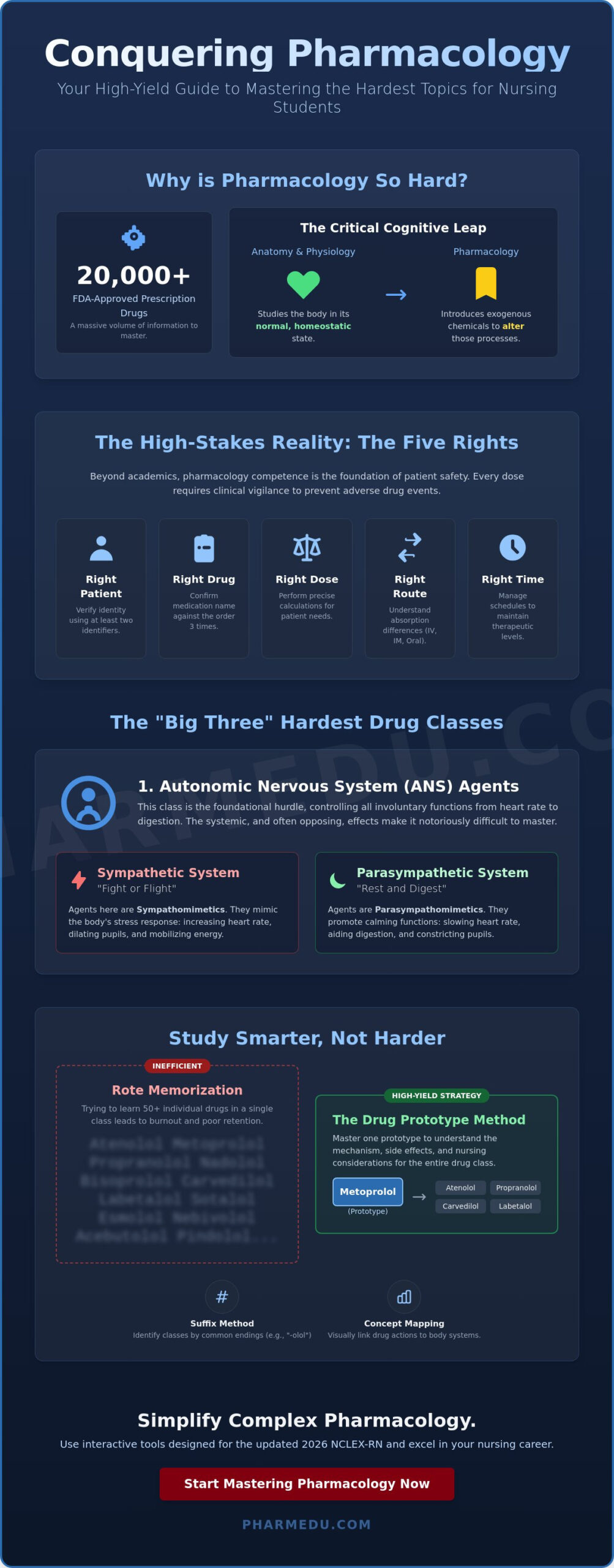
Nursing students often find themselves overwhelmed by the transition from foundational sciences to clinical application. Pharmacology isn’t a standalone subject; it requires a sophisticated synthesis of anatomy, physiology, and chemistry. While your previous courses focused on how the body works in a homeostatic state, this discipline demands a major cognitive leap into how exogenous chemicals alter those biological processes. This shift from a “normal” to an “altered” state is exactly what makes these the hardest pharmacology topics for nursing students to master. You aren’t just learning a list of names; you’re learning the chemical language of modern medicine.
The complexity increases when you realize that a single drug class rarely affects just one organ. A medication designed to lower blood pressure might simultaneously alter renal function or trigger a persistent cough reflex in the lungs. To truly understand these multi-system interactions, students should consult a comprehensive overview of pharmacology that details the foundational principles of how drugs interact with living organisms. In the 2026 clinical environment, nursing pharmacology serves as the final safeguard between a prescribed therapy and a potentially life-altering medication error.
The Volume of Information vs. Clinical Application
The sheer volume of data can lead to rapid burnout if you rely solely on rote memorization. Modern nursing curricula now prioritize the “Drug Prototype” method to manage this load. Instead of attempting to memorize 50 individual medications, you focus on mastering five class prototypes that represent the mechanism of action for the entire group. Understanding the core pharmacology of a prototype allows you to predict the side effects and nursing considerations for dozens of related drugs. This strategic approach is essential for maintaining patient safety in fast-paced hospital settings, where you won’t have time to look up every suffix.
The High Stakes of Medication Administration
The pressure of learning isn’t just academic; it’s deeply rooted in the “Five Rights” of medication administration. You’re responsible for ensuring every dose is precise, which adds a layer of stress that other courses lack. Preventing adverse drug events (ADEs) is a primary nursing duty that requires more than just a passing grade. As you transition from a student to a licensed professional, your ability to identify the hardest pharmacology topics for nursing students and tackle them head-on becomes the foundation of your clinical competence. Consider these critical checks you’ll perform daily:
- Right Patient: Verifying identity using at least two identifiers to prevent mix-ups.
- Right Drug: Confirming the medication name against the order three separate times.
- Right Dose: Performing complex calculations to ensure the amount matches the patient’s specific needs.
- Right Route: Understanding how absorption varies significantly between IV, IM, and oral paths.
- Right Time: Managing schedules to maintain therapeutic drug levels in the patient’s bloodstream.
The “Big Three” Hardest Drug Classes for Nursing Students
While the FDA oversees thousands of approved medications, nursing students consistently identify three specific categories as the most challenging to master. These classes require more than just memorizing a list of names; they demand an understanding of complex physiological feedback loops and rapid-response clinical scenarios. The Autonomic Nervous System (ANS) serves as the foundational hurdle for most students because it controls every involuntary function, meaning these drugs have systemic effects that are difficult to predict without a solid grasp of neurochemistry.
Mastering the Autonomic Nervous System (ANS)
The ANS is split into the sympathetic “fight or flight” and the parasympathetic “rest and digest” systems. Students often struggle to differentiate between sympathomimetics, which mimic the stress response, and parasympatholytics, which block the relaxation response. When you administer these agents, you must monitor clinical indicators like heart rate, pupil dilation, and bowel sounds. If you’re feeling stuck on these neurotransmitter pathways, checking an open-access pharmacology textbook can provide the deep-dive biological context needed to visualize these interactions. Understanding why a drug causes both bronchodilation and tachycardia is the key to passing your exams.
Cardiac Pharmacology: Rhythm and Pressure
Cardiac medications are among the hardest pharmacology topics for nursing students due to their narrow therapeutic windows and high-alert status. Understanding how ACE inhibitors manipulate the Renin-Angiotensin-Aldosterone System (RAAS) is vital when treating patients with multiple comorbidities. You aren’t just lowering blood pressure; you’re managing fluid balance and electrolyte levels. High-alert meds like Digoxin or antiarrhythmics require precise nursing priorities, including apical pulse checks and monitoring for toxicity signs like yellow-green halos. Our interactive pharmacology flashcards can help you drill these specific monitoring requirements until they become second nature.
Antimicrobials and the Complexity of Resistance
Antimicrobials introduce the challenge of “selective toxicity,” where the goal is to kill the pathogen without harming the host. You must distinguish between bacteriostatic actions, which inhibit growth, and bactericidal actions, which kill the pathogen outright. Aminoglycoside therapy adds another layer of difficulty with the requirement for peak and trough level monitoring to prevent ototoxicity and nephrotoxicity. Beyond the biology, nurses must master patient education regarding resistance patterns. You’ll need to explain why completing the full course of therapy is non-negotiable for preventing the rise of multi-drug resistant organisms. These nuances are what make antimicrobials one of the hardest pharmacology topics for nursing students to grasp during their clinical rotations.
Beyond Memorization: Conceptual Hurdles in Pharmacokinetics
Mastering drug names and classes is only half the battle. To excel in clinical practice, you must understand the movement of drugs through the body, which is why kinetics is consistently cited among the hardest pharmacology topics for nursing students. Pharmacokinetics, often remembered by the acronym ADME (Absorption, Distribution, Metabolism, and Excretion), describes what the body does to the drug. Conversely, pharmacodynamics focuses on what the drug does to the body through agonists and antagonists. One of the most critical hurdles is the “First-Pass Effect.” When a patient takes a medication orally, it travels through the portal vein to the liver, where a significant portion is metabolized before ever reaching systemic circulation. This explains why an oral dose of a medication might be 50 mg while its intravenous counterpart is only 2 mg. Misunderstanding this relationship isn’t just an academic error; it’s a clinical safety risk that can lead to profound dosing mistakes.
The ADME Process and Patient Variables
Patient variables like age and organ health drastically change how ADME functions. In 2026, clinical judgment requires nurses to look beyond the Medication Administration Record and evaluate the patient’s physiological state. For example, a patient with a serum creatinine level above 1.2 mg/dL likely has impaired renal excretion, meaning a standard dose could quickly become toxic. Similarly, malnourished patients with low albumin levels face higher risks because there are fewer protein binding sites. This leaves more “free drug” active in the bloodstream, which can lead to unexpected adverse reactions even when you follow the prescribed dosing. Checking labs before administration is a non-negotiable step for professional safety.
Understanding the Therapeutic Index and Half-Life
The Therapeutic Index (TI) measures the margin of safety between a drug’s effective dose and its lethal dose. Drugs with a narrow therapeutic index, such as Lithium or Warfarin, require constant monitoring because the window for success is incredibly small. You’ll also need to calculate half-life to predict when a drug reaches a steady state, which typically takes about four to five half-lives. If you don’t grasp these calculations, you won’t be able to explain to a patient why their medication isn’t working immediately or why they need frequent blood draws for trough levels. These conceptual hurdles are what separate a student who memorizes from a professional who understands. Our high-yield video vignettes break these complex calculations down into manageable, five-minute lessons to ensure you never fall behind.
Strategic Study Techniques for High-Difficulty Topics
Traditional study methods like re-reading textbooks often lead to an illusion of competence. To truly master the hardest pharmacology topics for nursing students, you must pivot toward active recall and cognitive integration. While memorizing individual side effects feels productive, it rarely translates to clinical success or passing scores on the Next-Gen NCLEX. Instead, you should utilize a pharmacology study guide for nursing students that emphasizes the relationship between drug mechanisms and physiological outcomes. Concept mapping is particularly effective here. By drawing the direct link between a drug’s mechanism and the specific body system it alters, you create a mental framework that survives the pressure of a timed exam.
Leveraging Suffixes and Class Prototypes
The Suffix Method is your most powerful tool for categorizing the vast pharmacopeia. By identifying common chemical endings, you can accurately predict the actions and side effects of approximately 80% of drugs within a class. For instance, seeing “-pril” immediately signals an ACE inhibitor, while “-statin” points to HMG-CoA reductase inhibitors. However, professional excellence requires knowing the exceptions. While most beta-blockers end in “-olol”, some medications like sotalol have unique antiarrhythmic properties that require additional monitoring. Focus your energy on the class prototype to understand the “must-know” adverse reactions that apply to the entire group. This prevents the cognitive burnout associated with memorizing hundreds of nearly identical drug profiles.
Case Studies and NCLEX-Style Practice
Moving from theory to practice requires a shift in how you process information. The 2026 NCLEX update focuses heavily on clinical judgment, asking “What will the nurse do first?” rather than simply identifying a drug’s purpose. This is particularly evident in “Select All That Apply” (SATA) questions, which are common when testing the hardest pharmacology topics for nursing students. You need to practice with high-quality pharmacology questions that simulate these complex scenarios. Analyzing why a specific intervention is the priority will help you bridge the gap between a classroom lecture and a real-world clinical unit. Success in 2026 depends on your ability to synthesize data and make safe, rapid decisions under pressure.
Don’t leave your exam success to chance. You can master these challenging concepts today by signing up for a PharmEDU Monthly Subscription to access our full library of interactive practice tools and high-yield video vignettes.
How PharmEDU Simplifies Complex Pharmacology for Nursing Success
The transition from classroom theory to clinical mastery requires a platform that understands the specific pressures of modern nursing education. PharmEDU doesn’t just provide a list of facts; it offers a structured environment designed to dismantle the hardest pharmacology topics for nursing students through evidence-based pedagogical methods. Our high-yield video vignettes break down complex mechanisms of action into digestible, five-minute segments. This approach ensures you aren’t lost in a sea of academic jargon but instead gain a precise understanding of how a drug interacts with specific physiological pathways. By focusing on these high-yield vignettes, you can visualize the movement of a drug through the body, turning abstract concepts into concrete clinical knowledge.
Micro-Learning for Maximum Retention
Traditional two-hour lectures often lead to cognitive fatigue and poor retention. PharmEDU replaces this outdated model with micro-learning modules that prioritize efficient content delivery. Whether you’re reviewing on your phone between clinical shifts or studying at home, our interactive flashcards use active recall to reinforce suffix identification and dosing protocols. This efficiency is why we also offer an institutional platform license, allowing nursing programs to integrate our expert-led content directly into their curriculum for better student outcomes. These tools are specifically designed to fit into the busy schedules of healthcare professionals who need to maintain their professional edge without drowning in administrative or academic burden.
Preparing for Boards and Beyond
Success in pharmacology is the cornerstone of passing the April 1, 2026 NCLEX update. Our clinical case studies mirror real-world scenarios, forcing you to prioritize nursing interventions rather than just identifying drug classes. This foundational knowledge is essential whether you aim to remain at the bedside or follow our complete 2026 career guide to transition into advanced practice or pharmacy. By mastering the hardest pharmacology topics for nursing students now, you ensure a career defined by clinical excellence and patient safety. Our pharmacology practice quizzes provide immediate feedback, ensuring you identify your knowledge gaps before they ever impact a patient.
The 2026 clinical landscape is more demanding than ever, with new drug approvals appearing at an unprecedented rate. PharmEDU keeps your knowledge up-to-date by integrating the latest FDA-approved therapies into our practice materials. Our mobile-compliant platform means you can turn fifteen minutes of transit time into a high-yield study session. This flexibility allows you to maintain professional development without sacrificing your personal schedule or administrative efficiency. We act as your digital mentor, helping you navigate the constantly changing world of healthcare regulations and scientific results with confidence and precision.
Start your PharmEDU subscription today and master the hardest topics with ease.
Securing Clinical Excellence in Your Nursing Career
Mastering the hardest pharmacology topics for nursing students requires a shift from rote memorization to a deep, conceptual understanding of how chemicals interact with human physiology. By focusing on class prototypes and the strategic use of suffixes, you can streamline your study sessions and significantly reduce cognitive fatigue. This approach isn’t just about passing a midterm; it’s about ensuring patient safety during every medication pass in your future clinical practice.
PharmEDU provides the precise tools you need to bridge the gap between classroom theory and real-world application. Our platform features over 100 high-yield pharmacology video vignettes and interactive flashcards designed for active recall. With NCLEX-style practice quizzes and a mobile-compliant design, you can build your expertise anywhere, at any time. Don’t let information overload hinder your progress toward becoming a licensed professional. Master pharmacology with PharmEDU’s high-yield review platform.
You have the dedication to succeed, and we have the resources to guide you through the complexities of modern medicine. Your professional journey is just beginning, and we’re here to ensure you walk into every exam and clinical rotation with total confidence.
Frequently Asked Questions
Is pharmacology the hardest class in nursing school?
Pharmacology is consistently ranked as one of the three most difficult courses in nursing school, alongside Pathophysiology and Medical-Surgical Nursing. It requires students to apply complex chemistry and physiology concepts to clinical scenarios rather than relying on simple memorization. The challenge lies in understanding how chemicals alter body systems, which represents a significant cognitive shift from previous foundational science courses.
How do I pass pharmacology if I am bad at math?
You can pass by mastering dimensional analysis, which is the standard method used for 90% of nursing dosage calculations. Pharmacology math doesn’t require advanced calculus; it focuses on precise unit conversions like milligrams to micrograms. Practicing with structured quizzes helps you build the accuracy needed to ensure patient safety and avoid dosing errors during high-stakes clinical rotations.
What are the most common drug suffixes I need to know for the NCLEX?
You should prioritize mastering suffixes like -olol for beta-blockers, -pril for ACE inhibitors, -sartan for ARBs, and -statin for cholesterol medications. These endings allow you to identify the majority of cardiac drugs you’ll encounter on the 2026 NCLEX update. Learning these patterns is much more efficient than attempting to memorize thousands of individual brand names and generic labels.
How much time should I spend studying pharmacology each week?
Successful students typically dedicate 10 to 15 hours per week to pharmacology, ideally broken into 2-hour daily sessions. Consistent, short study periods are more effective for retaining the hardest pharmacology topics for nursing students than long marathon sessions. This methodical approach prevents the information overload that often leads to burnout during the middle of the semester.
What happens if I fail my pharmacology exam?
Most programs offer a remediation path, but you must immediately analyze your performance report to identify specific knowledge gaps. Determine if your errors were due to a lack of conceptual understanding or difficulty with the clinical judgment required for “Select All That Apply” questions. Using high-yield video vignettes can help you target these weak areas effectively before your next attempt.
Can PharmEDU help with my specific nursing school curriculum?
PharmEDU aligns with the core competencies of the 2026 NCLEX-RN and national nursing standards used by accredited programs. While every school has a unique syllabus, the mechanisms of action and nursing considerations for drug prototypes are universal across all medical education. Our platform provides the supplemental expertise needed to navigate any curriculum with professional confidence and precision.
What is the best way to memorize drug side effects?
The most efficient method is grouping side effects by body system or drug class rather than memorizing them for every individual medication. For example, understanding the “drying” effects of anticholinergics helps you predict side effects for dozens of different drugs. This strategy is essential for mastering the hardest pharmacology topics for nursing students without feeling overwhelmed by data.
Why are antiarrhythmics considered so difficult to learn?
Antiarrhythmics are challenging because they alter the heart’s electrical conductivity at the cellular level across four distinct classes. You must understand the cardiac action potential to grasp how sodium, potassium, and calcium channel blockers function. The risk of proarrhythmic effects, where the medication causes a new arrhythmia, adds a layer of clinical pressure that requires absolute precision.