Mastering the NAPLEX Exam: The Comprehensive 2026 Guide to Pharmacy Licensure
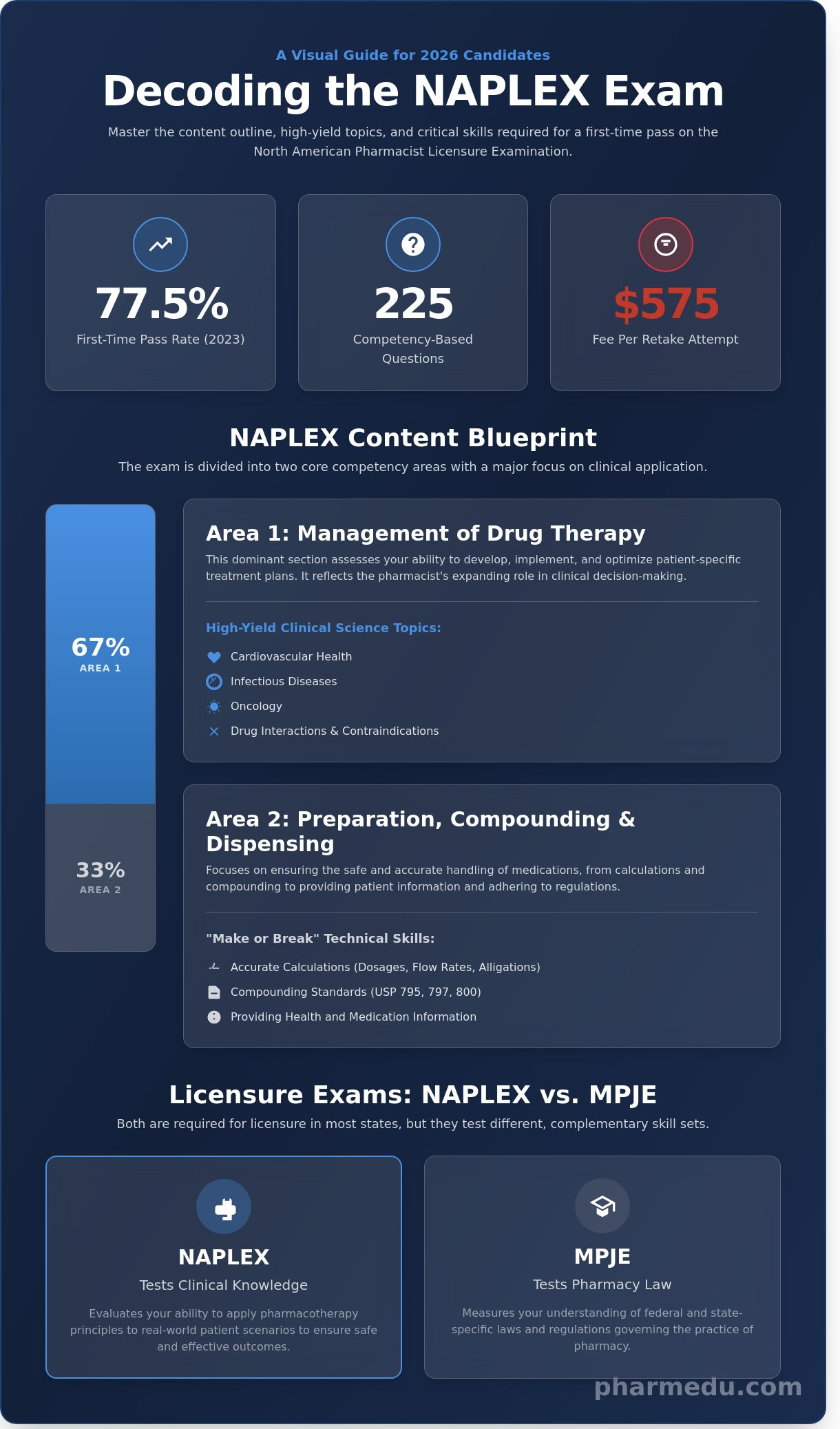
In 2023, the first-time pass rate for graduates of ACPE-accredited programs sat at 77.5%, a figure that underscores the increasing complexity of modern board assessments. You’ve spent four years absorbing thousands of pages of clinical guidelines, yet staring at a massive stack of textbooks often feels more like drowning than preparing. It’s natural to feel a sense of urgency regarding the naplex exam, especially when you consider that a single retake involves a $575 fee and significant career delays. You deserve a clear path that respects your time and your professional goals.
This guide offers the structured support you need to master the 2026 requirements with confidence. We’ll break down the specific NABP application milestones, identify the high-yield pharmacology clusters you’ll actually see on test day, and provide a realistic 12-week study schedule. You’ll gain the clinical edge necessary to move past the information overload and secure your license on the first attempt.
Key Takeaways
- Learn the exact step-by-step process for creating your NABP e-Profile and securing eligibility through your state board to ensure a seamless application.
- Discover why prioritizing Area 1: Management of Drug Therapy is critical, as it comprises approximately 67% of the naplex exam content.
- Implement a structured 12-week study roadmap that replaces ineffective passive reading with active, high-yield pharmacology strategies for a first-time pass.
- Identify the essential clinical science and pharmacy practice domains required to meet national professional standards for modern licensure in 2026.
- Explore how to leverage specialized educational resources to bridge the gap between pharmacy school and successful board certification.
What is the NAPLEX Exam and Why Does it Matter?
The North American Pharmacist Licensure Examination (NAPLEX) serves as the rigorous national standard for pharmacy practice across the United States. Developed by the National Association of Boards of Pharmacy (NABP), this assessment ensures that every candidate possesses the clinical skills and judgment required for safe practice. Since its inception, the NABP has maintained the exam’s integrity by evolving the content to match the shifting demands of the healthcare sector. For those entering the field in 2026, the naplex exam represents more than an academic hurdle; it’s a comprehensive validation of professional readiness.
This isn’t a simple knowledge test where rote memorization leads to success. It’s a competency-based exam. This means the 225 questions focus on how you apply clinical data to patient scenarios rather than just recalling drug names. The NABP structures the test to evaluate your ability to identify drug interactions, calculate precise dosages, and provide evidence-based recommendations. By focusing on application, the exam filters for practitioners who can think critically under pressure. It’s designed to simulate the decision-making process you’ll face in a retail or clinical pharmacy setting.
The Purpose of Pharmacist Licensure
Licensure acts as the primary mechanism for ensuring public safety in the medication use process. It creates a uniform benchmark that every pharmacist must meet, regardless of which of the 140+ accredited pharmacy schools they attended. This standardized assessment protects patients from clinical errors by verifying that every new pharmacist can handle complex therapy management. The process also marks the critical transition from a supervised student or intern to an independent practitioner with the legal authority to dispense medications. The NAPLEX exam is the final gateway to professional pharmacy practice in the United States.
NAPLEX vs. MPJE: Understanding the Difference
While both exams are necessary for licensure, they target different areas of expertise. The NAPLEX measures clinical knowledge and pharmacotherapy outcomes. In contrast, the Multistate Pharmacy Jurisprudence Examination (MPJE) focuses on the legalities of the profession, covering federal and state-specific regulations. Most candidates choose to sit for the naplex exam first to establish their clinical foundation before diving into the nuances of pharmacy law. These two assessments work in tandem to provide state boards with a complete profile of your capabilities. As of 2024, 49 states require both scores to grant a license, ensuring that you’re both clinically proficient and legally compliant before you step behind the counter.
Decoding the NAPLEX Content Outline and Domains
Success on the naplex exam requires more than memorization; it demands a deep understanding of the National Association of Boards of Pharmacy (NABP) competency statements. The 2026 iteration of the test remains divided into two core areas, but the weight distributed to clinical judgment has never been higher. Area 1, titled “Management of Drug Therapy,” constitutes approximately 67% of the total score. This section evaluates your ability to develop, implement, and optimize patient-specific treatment plans. Area 2 focuses on the “Safe and Accurate Preparation, Compounding, Dispensing, and Administration of Health and Medication Information.” While it covers a smaller percentage, it’s often where candidates lose critical points due to technical errors. For the most current blueprint details, consult the Official NAPLEX application and information page.
The 2026 updates shifted the focus toward clinical decision-making. Examiners expect you to act as a primary care provider would, assessing patient data to make definitive therapeutic choices. This evolution reflects the expanding scope of pharmacy practice across the United States; you’re no longer just a dispenser but a vital clinical consultant.
High-Yield Clinical Science Topics
Clinical science isn’t just about knowing drug names. In 2026, the exam places a significant portion of its clinical focus on chronic disease states. You’ll encounter complex cases involving cardiovascular health, infectious diseases, and oncology. You must master pharmacokinetics and pharmacodynamics math, as these calculations directly impact dosing adjustments for renal or hepatic impairment. Identifying drug-drug interactions and contraindications isn’t optional. It’s a fundamental requirement for patient safety.
Calculations and Compounding Mastery
Calculations are the “make or break” element for many graduates. You’ll need to solve for milliequivalents, alligations, and flow rates with 100% accuracy. Compounding questions now lean heavily on regulatory compliance. You must be fluent in USP 795 for non-sterile preparations, USP 797 for sterile compounding, and USP 800 for handling hazardous drugs. Mastery of these standards ensures you’re prepared for the legal and safety rigors of modern pharmacy practice. If you’re looking to refine these skills, exploring accredited preparatory resources can provide the structured guidance needed to bridge the gap between theory and practice.
How to Apply for the NAPLEX: A Step-by-Step Guide
Applying for the naplex exam is a rigorous administrative process that demands precision. It’s not just a test of clinical knowledge; it’s a test of your ability to follow complex regulatory protocols. By 2026, the NABP has streamlined much of this through digital interfaces, but the sequence remains strict. Missing a single deadline or miscalculating a fee can delay your licensure by months.
- Step 1: Create and verify your NABP e-Profile. This digital identity serves as the central hub for your scores, transcripts, and credentials. Ensure your name matches your government-issued ID exactly.
- Step 2: Submit your application for eligibility. You must apply through the specific state board of pharmacy where you seek licensure. Each state has unique requirements, such as background checks or specific internship hours.
- Step 3: Pay the fees and wait for your ATT. The standard application fee for the naplex exam in 2026 is $475. Once the NABP confirms your eligibility, they’ll email your Authorization to Test (ATT).
- Step 4: Schedule with Pearson VUE. Use the details in your ATT to book a seat at a testing center. Seats fill up quickly during the summer months.
- Step 5: Review the 2026 Candidate Application Bulletin. For the most accurate and up-to-date procedural requirements, candidates should consult the Official NAPLEX Information provided by the NABP.
Managing the Eligibility Timeline
Timing is everything. You should request your official transcripts from your college of pharmacy at least 4 weeks before graduation. During the peak graduation window between May and July, processing times for the ATT often extend to 15 business days. A common administrative error is a name mismatch between the e-Profile and the transcript. This single typo can halt the process, forcing a manual review that adds 10 days to your wait time.
Scheduling with Pearson VUE
Choose your test center wisely. Many candidates prefer mid-morning slots to avoid rush-hour stress. When you arrive, you’ll need two forms of identification. One must be a government-issued photo ID with a signature, like a passport or driver’s license. Security protocols are strict; you’ll undergo a palm vein scan and provide a digital signature. Don’t bring a physical calculator into the room. The exam interface provides a built-in, on-screen scientific calculator that you must use for all pharmaceutical calculations.
Developing a High-Yield NAPLEX Study Schedule
Success on the naplex exam depends less on the volume of hours spent reading and more on the strategic application of clinical knowledge. A structured 12-week roadmap is the gold standard for most candidates. During the first four weeks, focus on high-stakes topics like cardiology, infectious diseases, and endocrinology. The middle phase, weeks five through eight, should shift toward specialized areas including oncology, HIV/AIDS, and toxicology. The final month must prioritize daily calculations and targeted review based on your personal performance data. For a comprehensive breakdown of this approach, our ultimate NAPLEX study schedule guide provides customizable templates that highlight the most critical competencies.
Passive reading is the least effective way to study pharmacology. Studies in educational psychology indicate that students who only read review books retain as little as 10% of the material after 48 hours. To combat this, you’ve got to integrate active recall and spaced repetition into your daily routine. This method forces the brain to retrieve information, which strengthens neural pathways and ensures that complex mechanisms of action remain accessible during high-pressure moments. If you’re balancing clinical rotations with board prep, the high-yield strategies outlined in this 2026 case study on how to pass NAPLEX now demonstrate how real students have successfully managed this challenge.
Active Learning Strategies for Pharmacology
Don’t just memorize drug lists; apply them. Use clinical case studies to simulate real-world pharmacy practice. This approach forces you to consider patient-specific factors like renal function or drug-drug interactions. High-yield video vignettes are excellent for visualizing complex drug mechanisms in under 10 minutes. For drug-class mnemonics, use digital flashcards. These tools use algorithms to show you difficult cards more frequently, ensuring you master “statin” side effects or cephalosporin generations through consistent, timed exposure. Supplementing this approach with targeted NAPLEX practice questions is one of the most effective ways to identify knowledge gaps and build the clinical reasoning skills required for a first-attempt pass.
Measuring Your Progress
Data should dictate your study transitions. If your practice quiz scores in areas like federal law or sterile compounding fall below a 75% threshold, it’s a clear signal to pivot your focus. The Pre-NAPLEX, provided by NABP, remains the most accurate predictor of success. You must take this under timed conditions to build necessary exam stamina. Since the actual naplex exam is a 6-hour, 225-question marathon, you need to train your brain to maintain precision through the final hour of testing.
PharmEDU: Your Partner for Clinical Mastery and NAPLEX Success
Transitioning from the final year of pharmacy school to professional practice requires a shift in mindset. While academic courses provide a foundation, the naplex exam demands the ability to synthesize complex data under pressure. PharmEDU acts as a digital mentor during this critical period. We bridge the gap between classroom theory and the pharmacy counter by offering over 115 high-yield topics curated for the 2026 standards. Our platform focuses on clinical mastery, ensuring you don’t just memorize drug classes but understand how to apply them to diverse patient profiles.
P4 students often face 40 hour work weeks on clinical rotations, leaving little energy for traditional four hour study blocks. We solved this by implementing micro-learning segments. These 10 to 15 minute modules allow you to study effectively during a commute or a lunch break. Research into cognitive load suggests that these shorter, focused sessions can improve long-term retention by 25% compared to marathon cramming. By moving beyond rote memorization toward true clinical understanding, you’re preparing for both the boards and your future career as a healthcare provider. For those managing busy residency schedules, our structured NAPLEX study schedule templates are designed to fit into a life already filled with professional responsibilities.
Interactive Tools for the Modern Candidate
- Case-Based Quizzes: Our questions mirror the complexity of the naplex exam, forcing you to evaluate patient charts and lab values rather than just recalling facts.
- Mobile-Compliant Design: The entire interface is optimized for smartphones, allowing for seamless transitions between devices without losing your progress.
- High-Yield Video Library: For visual learners, our concise videos break down difficult pharmacokinetics and calculations into manageable steps.
- Interactive Flashcards: Digital decks utilize spaced repetition algorithms to ensure you see the most challenging material more frequently.
Start Your Licensure Journey Today
Success on the board exams shouldn’t be a matter of chance. It’s the result of structured, evidence-based preparation. PharmEDU offers flexible options to fit your specific needs. Individual students can choose between monthly and annual subscription plans, providing full access to our comprehensive question bank and video resources. We also partner with colleges of pharmacy through institutional licensing. These programs allow schools to track cohort progress and identify students who may need additional support to improve overall pass rates.
Don’t leave your professional future to outdated study methods. Join a community that prioritizes precision, professional development, and clinical excellence. Join PharmEDU and start your high-yield NAPLEX review today!
Step Into Your Role as a Licensed Pharmacist
Navigating the 2026 licensure landscape requires a precise strategy focused on the 6 core competency domains. Success on the naplex exam isn’t just about the hours you log; it’s about the quality of your clinical reasoning. Most successful candidates dedicate at least 12 weeks to a structured review that balances pharmacotherapy with complex federal regulations. By mastering these specific areas, you’re not just passing a test, you’re ensuring patient safety from your first day on the job.
PharmEDU provides the specialized tools you need to reach this milestone with confidence. Our platform features over 100 high-yield pharmacology topics and interactive clinical case studies designed for modern learners. You can study anywhere with our mobile-compliant micro-learning segments and reinforce your memory using digital flashcards. We’ve streamlined the preparation process so you can focus on what matters most: your professional growth and clinical mastery.
Master pharmacology and pass the NAPLEX with PharmEDU
Your hard work throughout pharmacy school has led to this moment. Trust your preparation, stay consistent with your study schedule, and prepare to join the ranks of healthcare leaders in 2026.
Frequently Asked Questions
Is the NAPLEX exam hard to pass on the first try?
Passing the naplex exam on your first attempt requires rigorous preparation, as the 2023 national pass rate for first-time candidates stood at 77.5%. This figure represents a noticeable decline from the 88.3% pass rate recorded in 2020, reflecting the increasing complexity of clinical questions. You’ll need to master both therapeutic knowledge and intricate pharmaceutical calculations to succeed. Most successful candidates dedicate 3 to 4 months of structured study time to ensure they’re part of the passing majority.
How many questions are on the NAPLEX exam in 2026?
The 2026 naplex exam consists of 225 total questions delivered in a computerized format. Out of these items, 200 questions directly determine your final score while 25 serve as non-scored pretest items for future test development. You’ve got exactly 6 hours to complete the assessment, which includes two optional 10-minute breaks to help maintain focus. It’s a high-stakes marathon that tests your clinical decision-making and mathematical precision under significant time pressure.
What is a passing score for the NAPLEX?
You won’t receive a numerical score because the NABP transitioned to a standard pass/fail reporting system in January 2022. To pass, you must demonstrate a minimum level of entry-level competence across all competency areas defined by the board’s rubric. This change means your official transcript will simply show a “Pass” or “Fail” status rather than the old scaled score of 75. It’s designed to ensure every licensed pharmacist meets the same rigorous safety standards regardless of their specific test version.
Can I use my own calculator during the exam?
You’re prohibited from bringing a personal calculator into the testing room at any Pearson VUE center. Instead, the testing software provides a built-in scientific calculator on the computer screen for all math-related problems. If you prefer a physical device, you can request a handheld TI-30XS Multiview calculator from the test center staff before your session begins. It’s a good idea to practice with the Pearson VUE tutorial online so you’re familiar with the digital interface before your appointment.
How long do I have to wait for my NAPLEX results?
Official results typically appear in your NABP e-Profile within 7 business days after your testing date. Some candidates in specific states might wait up to 14 days if their state board of pharmacy handles the primary notification process. Don’t call the NABP or the test center for updates, as they can’t release scores over the phone for security reasons. Checking your online portal daily after the first week is the most efficient method to receive your status.
What happens if I fail the NAPLEX exam?
If you don’t pass, you must wait exactly 45 days before you’re eligible to retake the assessment. You’ll receive a Candidate Performance Report that breaks down your performance into four levels across the different competency areas. This document is vital for identifying whether you struggled with “Area 1: Obtain, Interpret, or Assess Data” or “Area 4: Prepare, Dispense, or Administer Medications.” Use this specific data to restructure your study plan and address your clinical weaknesses before your next attempt.
Should I take the NAPLEX or the MPJE first?
Most graduates choose to sit for the clinical exam before tackling the Multistate Pharmacy Jurisprudence Examination (MPJE). Taking the clinical test first allows you to utilize the foundational knowledge fresh from your rotations and final year of pharmacy school. Statistics show that roughly 85% of candidates schedule their clinical assessment within 30 days of graduation. Once that’s finished, you can focus your mental energy entirely on the specific pharmacy laws and regulations of your practicing state.
How many times can I attempt the NAPLEX?
You’re limited to a maximum of 5 attempts to pass the exam in your lifetime. Additionally, the NABP regulations state you can’t take the test more than 3 times within any 12-month period. If you fail 3 times, you’ll have to wait a full year from your first attempt before the board grants you another opportunity. These strict limits emphasize why professional preparation and structured e-learning modules are essential for your long-term career progression and licensing success.