
Hematology and Oncology Pharmacology: Core Concepts for Healthcare Learners
What if the most useful way to learn cancer drugs isn’t to memorize longer lists, but to connect each class to what it targets and what it can affect? Hematology and oncology pharmacology can be difficult to organize because mechanisms, treatment contexts, and safety concerns vary widely across drug classes.
That complexity is real. Cytotoxic chemotherapy, targeted agents, immunotherapies, and medicines used for hematologic malignancies each require a different lens. High-risk adverse effects can also be hard to distinguish when facts are studied in isolation. A clear framework makes the material more manageable.
This article builds a structured foundation in major antineoplastic drug classes by connecting mechanisms to treatment context and key safety concepts. You’ll also find a practical way to review dense material in short, focused sessions and revisit core ideas over time. The goal is to support your pharmacology study, not replace current clinical references or patient-specific guidance.
Key Takeaways
- Distinguish blood cancers from nonmalignant blood disorders, since their treatment goals and medication approaches differ.
- Organize antineoplastic medicines into major classes, then connect each class’s mechanism to its therapeutic rationale.
- Use a comparison framework to separate shared adverse-effect categories from class-specific and individual-drug risks.
- Make hematology and oncology pharmacology easier to review by mapping a class, learning its mechanism, testing recall, and revisiting missed concepts.
- Use focused review formats, including video vignettes, flashcards, quizzes, and case studies, within PharmEDU’s broader pharmacology curriculum.
What Does Hematology and Oncology Pharmacology Cover?
Hematology and oncology pharmacology studies medicines used to treat blood disorders and cancer. It brings together practical questions: what a drug acts on, what effect it is intended to produce, how exposure can shape response, and what adverse effects or interactions may occur. Learning these connections gives healthcare students and professionals a framework for organizing a broad field without treating every medicine as interchangeable.
The scope includes cancer care and nonmalignant blood conditions, but their treatment approaches differ. Leukemias and lymphomas are hematologic malignancies, so they are both blood cancers and part of oncology. Iron-deficiency anemia is a nonmalignant blood disorder with different causes and treatment goals. A shared specialty vocabulary does not mean the same medicines or management strategies apply to both.
How hematology and oncology pharmacology overlap
Both areas rely on core pharmacology principles: a drug interacts with a target, produces an intended response, and may also cause toxicity. The amount and duration of drug exposure, patient characteristics, and interactions with other medicines can influence that response. These principles help learners ask consistent questions across diagnoses while keeping disease-specific treatment choices distinct.
For example, a medicine might be designed to interfere with a process that helps malignant cells grow. That mechanism can explain its rationale in a particular cancer, but it does not establish that the drug is suitable for a different cancer or a nonmalignant blood condition. Oncology provides broader context for cancer as a clinical field; pharmacology focuses on how medicines act within that care.
Core terms learners should recognize
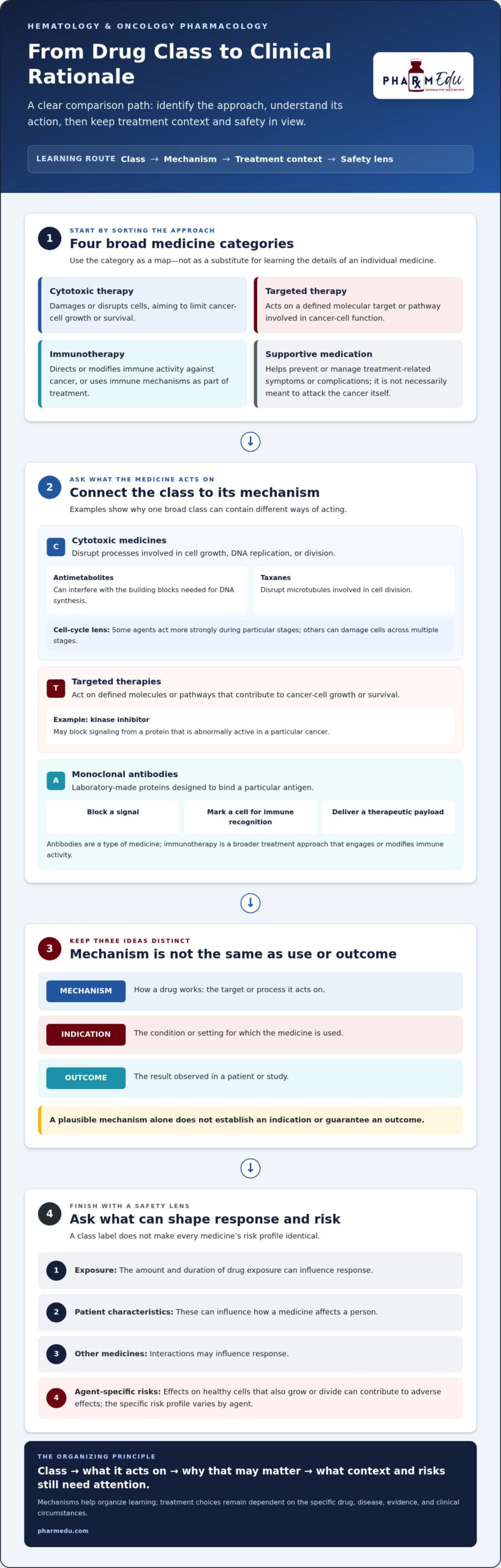
Use these terms to sort medicines by broad approach, then learn the details of individual agents:
- Cytotoxic therapy uses drugs that damage or disrupt cells, with the aim of limiting cancer-cell growth or survival.
- Targeted therapy acts on a defined molecular target or pathway involved in cancer-cell function.
- Immunotherapy directs or modifies immune activity against cancer, or otherwise uses immune mechanisms as part of treatment.
- Supportive medication helps prevent or manage treatment-related symptoms or complications; it is not necessarily intended to attack the cancer itself.
Keep three concepts separate. A mechanism of action describes how a drug works. A clinical indication identifies the condition or setting for which it is used. A treatment outcome is the result observed in a patient or study. A plausible mechanism alone does not establish an indication or guarantee an outcome.
Hematology-oncology pharmacology is the study of medicines used in blood disorders and cancer care, including how their mechanisms, intended uses, effects, and risks relate. This overview supports learning, not patient-specific decisions. Clinical judgment and current, authoritative references remain essential when applying pharmacology to an individual patient.
How Major Hematology and Oncology Drug Classes Work
Drug classes are easier to compare when you ask what each medicine acts on and how that action may help control disease. In hematology and oncology pharmacology, categories can overlap in practice, but they are not interchangeable. A medicine’s mechanism, target, and therapeutic rationale depend on the specific drug and clinical context.
Cytotoxic medicines and cell-cycle concepts
Traditional chemotherapy includes cytotoxic medicines that disrupt processes involved in cell growth, DNA replication, or division. The cell cycle describes the stages through which a cell grows, copies its DNA, and divides. Some agents act more strongly during particular stages, while others can damage cells across multiple stages. For example, antimetabolites can interfere with the building blocks needed for DNA synthesis, while taxanes disrupt microtubules involved in cell division.
These examples show why “cytotoxic” is a broad category, not a single mechanism. Effects on healthy cells that also grow or divide can contribute to adverse effects, but the specific risk profile varies by agent. The Hematology/Oncology Pharmacy Association (HOPA) provides professional education and resources for learners exploring foundational oncology concepts, including cell-cycle principles.
Targeted therapies and molecular targets
Targeted therapies act on defined molecules or pathways that contribute to cancer-cell growth or survival. A kinase inhibitor, for example, may block signaling from a protein that is abnormally active in a particular cancer. This makes the drug’s target central to understanding its rationale, but a target’s presence alone does not establish which treatment is appropriate. The disease, evidence, and individual clinical circumstances also matter.
A drug target is the specific molecule or pathway a medicine acts on; the treatment goal is the broader clinical purpose of using it. Keeping these ideas separate prevents a mechanism from being mistaken for a guaranteed patient outcome.
Monoclonal antibodies and immunotherapies
Monoclonal antibodies are laboratory-made proteins designed to bind a particular antigen. Depending on the antibody, binding may block a signal, mark a cell for immune recognition, or deliver a therapeutic payload. Antibodies are a type of medicine, while immunotherapy describes a broader treatment approach that engages or modifies immune activity. Some monoclonal antibodies function as immunotherapies, but the terms do not mean the same thing.
Checkpoint inhibitors and CAR T-cell therapies are examples of immunotherapy approaches that work through different mechanisms. Checkpoint inhibitors can release signals that restrain immune responses; CAR T-cell therapy uses modified T cells designed to recognize a target. Their shared connection to immunity does not make their actions, risks, or treatment contexts equivalent.
To study each class, note its broad mechanism, the disease context in which it is used, and the safety questions it raises. Then refine your notes for individual agents rather than assuming every member of a class behaves identically. Short, focused review with oncology pharmacology learning resources can help reinforce these distinctions over time.
How to Compare Mechanisms, Treatment Context, and Safety
A comparison framework turns a long drug list into a set of useful questions: what does the medicine affect, in what treatment context is it used, and what safety information is specific to that agent? The table offers a starting point, not a prescribing guide. Each row describes broad concepts; individual drugs within a class can differ in mechanism, route, interactions, and toxicity.
| Class | Broad mechanism | Context | Safety concepts |
|---|---|---|---|
| Cytotoxic agents | Disrupt cellular processes involved in growth or division. | Used in cancer treatment; the rationale depends on the disease and agent. | Consider effects on healthy tissues, including possible blood-count changes, while checking the specific drug’s risks. |
| Targeted therapies | Act on defined molecular targets or signaling pathways. | Target and disease context inform the therapeutic rationale. | Review agent-specific toxicities, organ effects, and potential interactions. |
| Monoclonal antibodies | Bind selected antigens; effects vary by antibody. | May block signals, engage immune activity, or carry a therapeutic payload. | Check the product’s administration-related and other specific safety information. |
| Immunotherapies | Engage or modify immune activity against cancer. | Includes approaches that differ in how they influence immune cells. | Some agents can cause immune-mediated effects; verify risks for the individual medicine. |
Why treatment context changes pharmacology questions
The diagnosis, treatment goal, and patient factors shape how a medicine’s properties are interpreted. For example, two targeted agents may act on different proteins, have different routes, and carry distinct monitoring considerations, even though both are described as targeted therapy. In hematology and oncology pharmacology, class labels help organize learning, but they cannot establish a treatment choice for an individual.
Organizing adverse effects and interactions
Sort safety questions into three groups: effects that may relate to the mechanism, effects involving a particular organ system, and interactions with other medicines or substances. Then connect each concern to the specific agent and an up-to-date authoritative reference. This helps prevent a possible class pattern from becoming a universal rule in your notes.
Route matters because oral, intravenous, and other forms can differ in absorption, administration, and practical handling. Interactions may also affect drug exposure or toxicity, so learners should consider the medication list and relevant product information as part of a complete review. These are study concepts, not individualized instructions.
Class-level generalizations can guide questions, but they cannot replace agent-specific review of risks, interactions, and administration. Confirm time-sensitive indications, warnings, monitoring details, and interaction information against current prescribing information and authoritative clinical references before applying them. Separate general learning principles from details that require verification for a particular medicine.
How to Study Hematology and Oncology Pharmacology Efficiently
A broad field becomes easier to review when you organize it before memorizing individual medicines. For hematology and oncology pharmacology, use a repeatable cycle: map the class, explain its mechanism, test your recall, then return to concepts you missed. Short, spaced sessions help you revisit material without trying to master every detail at once.
Build a class-by-class review map
Create one row per drug class, with columns for its broad mechanism, treatment context, routes to recognize, and safety questions. Keep class-level principles separate from individual drug facts, such as a specific interaction or warning. This structure helps you see patterns without mistaking them for rules that apply to every agent.
Start with the framework, not an exhaustive drug list. Use current authoritative references to fill in agent-specific details and resolve conflicting notes. Mark time-sensitive information for verification rather than relying on an old flashcard or unverified summary.
Use retrieval practice to identify gaps
Turn your notes into questions before looking at the answers: “What does this class act on?” “What is its general treatment rationale?” “Which safety details require checking for the individual drug?” Try to recall the answer first, then compare it with a trusted source. This makes uncertainty visible and gives each review session a clear focus.
- Map the class. Write its name and broad mechanism in your own words.
- Add context. Note the general treatment setting without assuming one use applies to every disease.
- Test recall. Use flashcards, quizzes, or case questions to retrieve concepts without first rereading the material.
- Revisit missed points. Correct the answer and record why your first response was incomplete or inaccurate.
Keep class principles and drug-specific facts visibly distinct in notes or flashcards. For instance, one card can test a drug class’s broad action; another can ask about a particular medicine’s route or verified safety information. This separation reduces the risk of applying a class-level generalization to every agent.
Use brief, spaced reviews rather than relying on passive rereading alone. Rotate between mechanism questions and application prompts, such as identifying which part of a medication profile needs further verification. Case studies can help connect facts to clinical context, but they are learning tools, not a substitute for patient-specific judgment.
For a wider foundation, connect oncology review with PharmEDU’s broader pharmacology curriculum. PharmEDU includes short video vignettes, interactive flashcards, quizzes, and case studies to support focused practice. Explore pharmacology review resources to continue building a structured study routine.
How PharmEDU Supports Ongoing Oncology Pharmacology Review
Building a foundation in hematology and oncology pharmacology takes more than one pass through a set of notes. PharmEDU includes Oncology among its over 100 pharmacology topics, with several learning formats to help learners revisit concepts and practice applying them. The platform is mobile-compatible, provides 24/7 access, and allows unlimited review of each micro-learning unit. You can focus a study session on one topic without trying to complete everything at once.
Content is created by physicians, pharmacists, and instructional designers. Each format supports a different review goal, making it easier to vary how you engage with dense material while keeping your learning focused.
Match learning formats to review goals
Choose an activity based on what you need to strengthen, not just what you have already reviewed:
- Short video vignettes offer a concise way to revisit a difficult explanation or clarify a concept before testing recall.
- Interactive flashcards prompt active recall of key terms, mechanisms, and distinctions between drug classes.
- Content reviews provide a structured way to revisit foundational information and connect related concepts.
- Pharmacology quizzes help you check what you can retrieve independently and identify topics that need another pass.
- Clinical case studies help learners connect pharmacology concepts with clinical reasoning in an educational context.
For example, after reviewing a mechanism, use flashcards to test the core concept, then a quiz to reveal gaps. A case study provides another opportunity to reason through how pharmacology information relates to a clinical scenario. These activities support study and review; they do not replace current clinical references or patient-specific judgment.
Build a flexible review routine
Keep your routine manageable. Select one topic or class, choose the format that matches your goal, and return later to concepts that remain unclear. A short video can refresh a difficult explanation; a quiz can test recall; a case study can help you connect ideas. Repeating this process in focused sessions makes it easier to maintain progress without treating the curriculum as a single sitting.
Because each micro-learning unit can be reviewed without limit, you can revisit material as your study needs change. For healthcare learners working through a broad pharmacology curriculum, PharmEDU combines Oncology with a range of review formats in one online platform. Explore PharmEDU pharmacology review to continue your learning.
Make Your Next Review Session Count
Let your next study session begin with one focused question: Which concept would make the rest of this material easier to understand? Choose a class, mechanism, or safety principle, then turn it into a question you can answer from memory. Check your answer against a current authoritative reference and note what still needs clarification. Small, deliberate steps can make hematology and oncology pharmacology more approachable while helping you build sound study habits.
Keep learning active. Rather than waiting for a long block of free time, return to one concept when your schedule allows and revisit it until you can explain it clearly. Consistent review supports ongoing development, but clinical decisions still require current guidance and patient-specific judgment.
Continue your learning with PharmEDU’s pharmacology review. Choose a topic to revisit and take the next step toward a stronger, more confident foundation.
Frequently Asked Questions
What is hematology and oncology pharmacology?
Hematology and oncology pharmacology examines how medicines are used in cancer care and blood disorders, including their intended effects, precautions, and interactions. For learners, it also means distinguishing a medicine’s general properties from its role in a specific diagnosis. A useful study question is: “What information would I need to verify before applying this drug fact to a clinical situation?” That keeps foundational learning separate from patient-specific decisions.
What drug classes are commonly studied in oncology pharmacology?
Common study areas include cytotoxic chemotherapy, targeted agents, monoclonal antibodies, immunotherapies, and hormonal therapies. Learners may also review supportive medicines used to address symptoms or treatment complications. To organize these classes, ask what type of information distinguishes them: a cellular process, a molecular target, an immune pathway, or a hormone-related signal. Add individual drug names as examples only after checking a reliable reference.
How do targeted therapies differ from traditional chemotherapy?
Traditional chemotherapy broadly disrupts processes that cells need to grow or divide, while targeted therapies act on defined molecular targets or pathways. These descriptions explain broad approaches, not a simple division between “nonspecific” and “harmless”: targeted medicines can also cause serious adverse effects, and cytotoxic drugs differ from one another. In study notes, compare the specific agent’s target, clinical use, route, and safety information rather than assuming its class label tells the whole story.
Are hematology and oncology pharmacology the same subject?
They overlap, but they are not identical. Oncology pharmacology focuses on medicines used in cancer care, including blood cancers such as leukemia and lymphoma. Hematology also covers nonmalignant blood conditions, which have distinct causes and treatment approaches. For example, medicines used to manage anemia should not be grouped automatically with antineoplastic drugs just because both topics fall within hematology. Organize notes by disease context as well as medication class.
What adverse effects should learners study for cancer medicines?
Study safety by checking the specific medicine for effects such as changes in blood counts, gastrointestinal symptoms, organ-system toxicity, infusion or administration reactions, and interactions. These are categories to investigate, not a checklist that applies equally to every cancer drug. Check what authoritative drug information identifies as common, serious, or requiring monitoring, and distinguish established risks from possible class patterns. Verify current warnings and monitoring details before using them in clinical learning or practice.
How can I study oncology pharmacology effectively?
Choose a small topic, write a few questions from memory, and answer them before reviewing your notes. For one drug, questions might include: What is its target? What condition is it used for? Which safety detail needs verification? Check your answers against current references, then record the reason for any mistake. Return to missed questions during later study sessions. This approach makes review more focused than rereading an entire chapter each time.
Can pharmacology review resources help with exam preparation?
Yes. Review resources can support preparation by giving learners ways to revisit concepts, retrieve facts, and apply knowledge to practice questions or cases. Use them alongside course objectives and assigned materials, and treat errors as prompts to study a topic more closely. PharmEDU is designed to support pharmacology coursework and preparation for board or licensing exams. Educational tools can strengthen review, but they cannot guarantee an exam result or replace required course guidance.
What is the difference between a drug’s mechanism of action and its indication?
A mechanism of action describes how a medicine produces an effect in the body; an indication describes the condition or clinical setting for which it is used. For instance, a drug may inhibit a particular enzyme, while its indication identifies a disease in which that action has a clinical role. Keep these as separate entries in study notes. Knowing the mechanism alone does not establish approved use, clinical suitability, or the outcome for an individual patient.