NCLEX Pharmacology Questions: High-Yield Practice & Strategy Guide for 2026
Success on the NCLEX isn’t about how many drug names you can recite; it’s about how well you understand the physiological “why” behind them. You’ve likely felt the weight of thousands of medications pressing down on you while practicing NCLEX pharmacology questions, especially with the 2026 NCLEX-RN passing standard remaining at 0.00 logits. It’s exhausting to navigate similar-sounding names while worrying about how those drugs appear in complex Next-Generation case studies. You aren’t alone in this anxiety, as the volume of information required for modern practice is immense.
We’re here to lighten that burden by showing you exactly how to master these concepts through clinical logic rather than simple repetition. By focusing on mechanisms and safety, you can approach even the most daunting priority questions with confidence and precision. Our goal is to provide the professional clarity you need to succeed in a demanding regulatory environment and ensure you’re prepared for the responsibilities of licensure.
This guide provides an expert breakdown of high-yield concepts, teaches you to spot critical “red flag” side effects, and offers a systematic framework for the latest NGN clinical judgment scenarios. You’ll move beyond memorization to develop the deep clinical reasoning skills that the 2026 test plan demands.
Key Takeaways
- Understand that pharmacology is no longer a standalone topic but is strategically integrated across categories like Management of Care and Reduction of Risk Potential.
- Focus your study efforts on high-yield drug classes with narrow therapeutic indexes, particularly cardiovascular, endocrine, and antimicrobial agents.
- Develop a mechanism-based approach to NCLEX pharmacology questions to ensure you can prioritize patient safety over simple rote memorization.
- Learn to identify subtle clinical cues within Next-Generation NCLEX case studies to determine when a patient’s change in status is related to medication effects.
- Bridge the gap between theoretical knowledge and clinical application by using visual tools like high-yield video vignettes and interactive case studies.
The Role of Pharmacology in the 2026 NCLEX-RN and NCLEX-PN Exams
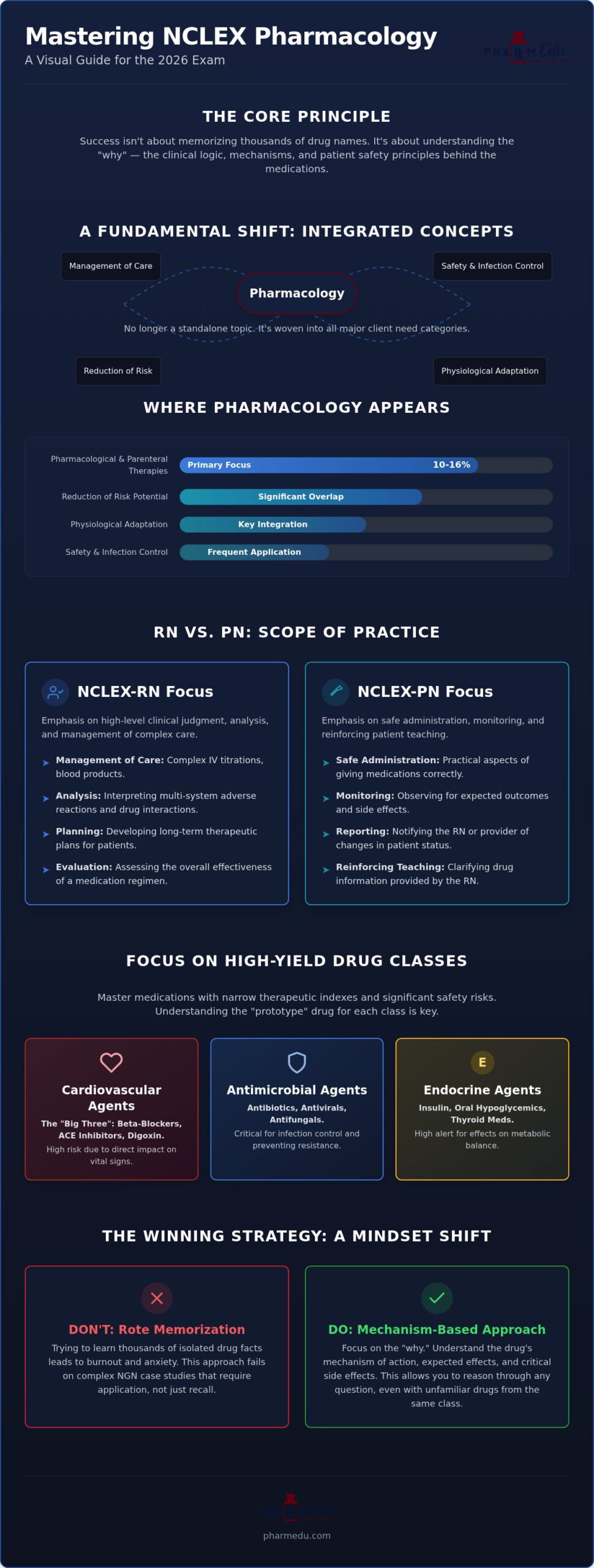
The National Council Licensure Examination (NCLEX) underwent a subtle but significant update on April 1, 2026. While the core structure remains consistent with the Next Generation NCLEX (NGN) framework, the 2026 test plan places a heavier emphasis on clinical judgment within the context of medication safety. You won’t find a standalone “pharmacology section” when you sit for your exam. Instead, pharmacological concepts are woven into every major client need category, requiring you to apply knowledge in real time to complex patient scenarios.
NCLEX pharmacology is the application of drug knowledge to ensure patient safety and therapeutic outcomes. This means the exam doesn’t just ask you to identify a drug name or a class. It asks how that drug affects a patient’s specific physiological state and what your priority action should be when things go wrong. When you encounter NCLEX pharmacology questions, you’re being tested on your ability to function as a safe, competent entry-level nurse who can synthesize data and act decisively.
NCLEX Test Plan: Where Pharmacology Hides
Medications appear most prominently in the “Pharmacological and Parenteral Therapies” category, which typically accounts for 10% to 16% of the exam. However, you’ll also find them hidden in “Safety and Infection Prevention and Control,” where the focus is on safe administration and preventing injury. In the “Reduction of Risk Potential” category, the exam tests your ability to monitor for adverse effects and recognize when a patient’s lab values indicate a medication toxicity. Finally, “Physiological Adaptation” incorporates pharmacology through the lens of managing chronic conditions and acute medical emergencies. It’s a holistic approach that mirrors the reality of clinical practice.
RN vs. PN: Differences in Pharmacology Testing
While both exams share the same goal of ensuring safety, the scope of the NCLEX pharmacology questions differs. The NCLEX-RN focuses heavily on the management of care, including complex IV titrations, blood product administration, and the analysis of multi-system adverse reactions. RN candidates are expected to demonstrate high-level clinical reasoning regarding drug interactions and long-term therapeutic planning.
In contrast, the NCLEX-PN focus centers on safe medication administration, reinforcing patient teaching, and diligent monitoring. PN questions often highlight the practical aspects of care, such as observing for expected outcomes and reporting changes in patient status. Despite these differences, both exams use “Priority” questions that force you to choose the single most important action to keep a patient alive. Whether you’re an RN or PN candidate, the 2026 standard requires you to look past the drug label and see the patient behind the prescription.
High-Yield Drug Classes: What You Will Actually See on the Exam
Attempting to memorize every drug in the pharmacopoeia is a recipe for burnout. High-scoring candidates instead focus on medications with narrow therapeutic indexes or those that carry significant safety risks. When you face NCLEX pharmacology questions, the exam is looking for your ability to manage high-stakes medications safely. By understanding the “prototype” drug for each class, you can accurately predict the actions and side effects of every other medication in that family.
This strategy allows you to categorize new information quickly. If you know the characteristics of one ACE inhibitor, you essentially know them all. This conceptual approach is the most efficient way to handle the massive volume of data required for the 2026 exam. It shifts your focus from rote memorization to the clinical reasoning the NGN format demands.
Cardiovascular and Endocrine Powerhouses
The “Big Three” of cardiac pharmacology, Beta-blockers, ACE inhibitors, and Digoxin, frequently appear on the exam because of their direct impact on vital signs. For a comprehensive breakdown of blood pressure management, our Pillar Guide on ACE Inhibitors explains the mechanisms you’ll need to know. You’ll often be asked to prioritize assessments, such as checking an apical pulse before administering Digoxin or monitoring for a dry cough with ACE inhibitors.
Endocrine questions often target insulin onset and peak times. You must know exactly when a patient is at the highest risk for hypoglycemia after an injection to ensure timely monitoring. Similarly, anticoagulants like Heparin and Warfarin require strict knowledge of laboratory values like aPTT and PT/INR. These medications are prime candidates for safety-focused questions because the margin for error is incredibly slim.
Psychotropic and Respiratory Priorities
Psychiatric medications like Lithium require precise dosing; any value outside the 0.6 to 1.2 mEq/L therapeutic range is a red flag you can’t ignore. When studying SSRIs, focus on patient education regarding serotonin syndrome and the timeline for therapeutic effects. These are the “real-world” details the NCLEX uses to determine if you can safely discharge a patient with a new prescription.
For respiratory distress, the exam tests your understanding of the sequence of care. You’ll always administer the bronchodilator before the corticosteroid to ensure the airway is open for the second medication. When reviewing antibiotics, prioritize the “mycin” family, focusing on ototoxicity and nephrotoxicity. These are the critical safety outcomes the exam prioritizes over simple drug-bug matching. If you’re struggling to visualize these interactions, our High-Yield Video Vignettes can help bridge the gap between theory and clinical reality.
Deciphering Next-Generation NCLEX (NGN) Pharmacology Case Studies
The Next-Generation NCLEX (NGN) format has transformed how candidates interact with medication data. Instead of isolated prompts, you’ll now face unfolding case studies that simulate a real clinical shift. These scenarios require you to sift through electronic health records (EHR), provider orders, and laboratory results to determine a patient’s trajectory. When answering NCLEX pharmacology questions within this framework, your focus must shift from simple drug identification to recognizing subtle clinical shifts.
Mastering these cases involves more than just knowing a drug’s class. You have to understand how that drug interacts with the patient’s current condition, their other medications, and their lab values. In the 2026 exam, the ability to spot a “change in status” caused by a medication is often the difference between a correct and incorrect clinical judgment.
Analyzing Unfolding Pharm Case Studies
Success in NGN pharmacology requires a three-step systematic approach to the clinical judgment measurement model. First, you must recognize cues by identifying specific data points in the patient’s history that impact medication safety. For example, if a patient is prescribed a loop diuretic, you should immediately look for their most recent potassium level in the lab tab.
Second, you need to analyze those cues to determine if the drug is achieving its therapeutic goal or causing toxicity. A “change in status” isn’t always a new disease process; it’s often a side effect or an adverse drug reaction. Finally, you must prioritize hypotheses by deciding which drug-related risk poses the greatest threat to the patient’s life. This structured thinking prevents you from getting lost in the “noise” of a dense patient chart.
Scoring Models for NGN Pharmacology
One of the most significant features of the current exam is the use of polytomous scoring, commonly known as partial credit. In older versions of the exam, missing a single option in a “Select All That Apply” question meant zero points. Now, the +/- scoring method allows you to earn credit for the correct options you identify while deducting points for incorrect ones. This makes your precision more valuable than ever before.
Matrix and extended multiple-response questions often ask you to link a medication to a specific rationale. You aren’t just choosing an intervention; you’re explaining the “because” behind it. To build the stamina needed for these complex formats, many students are moving away from traditional methods and using Comprehensive Pharmacy Review tools that offer realistic NGN simulations. These digital platforms provide the interactive environment necessary to master the logic of unfolding cases before your test date.
Proven Strategies for Answering NCLEX Pharmacology Questions
Rote memorization is a trap that many students fall into, only to find themselves paralyzed when the exam presents a drug name they’ve never seen before. Success requires a shift in mindset: you must move from asking “What is this drug?” to “What is the mechanism of this class?” This logic-based system allows you to deduce the correct answer even when the specific medication is unfamiliar. The ADPIE framework in pharmacology dictates that you must assess the patient’s baseline, identify potential contraindications, plan for safe administration, implement the dose correctly, and evaluate for both therapeutic outcomes and adverse reactions.
When you’re stuck between two seemingly correct options, apply the “Safety First” filter. The NCLEX isn’t just testing your knowledge; it’s testing your safety as a practitioner. Ask yourself which answer choice directly prevents the most life-threatening complication or keeps the patient alive. This prioritization is the hallmark of the 2026 exam and is essential for navigating high-stakes NCLEX pharmacology questions.
The ‘Mechanism over Memorization’ Approach
If you understand the physiological “why” behind a drug class, you don’t need to memorize a list of twenty different side effects. For example, knowing that ACE inhibitors block aldosterone production helps you realize that the body will retain potassium. This understanding makes it easy to predict that hyperkalemia is a primary risk, regardless of whether the drug is Lisinopril or Enalapril. This conceptual bridge is what transforms a struggling student into a confident clinician.
Focus your energy on “Hold Parameters” rather than just drug indications. The NCLEX frequently asks when a nurse should withhold a medication. If you know that a specific cardiac drug significantly slows conduction, you’ll naturally look for a heart rate below 60 bpm as a reason to stop. Building this foundational knowledge is easier when you use a structured Pharmacology Study Guide for Nursing Students to organize your review by body systems and mechanisms.
Decoding Drug Names: Prefix and Suffix Mastery
The exam almost exclusively uses generic drug names, so you must stop relying on brand names during your preparation. Mastering common suffixes is the most efficient way to categorize medications on the fly. The “-olol” rule helps you instantly identify Beta-blockers and their shared side effects, such as bradycardia and bronchospasm. Similarly, distinguishing between “-pril” (ACE inhibitors) and “-sartan” (Angiotensin II Receptor Blockers) is vital, as their clinical implications and side-effect profiles differ slightly regarding the “ACE cough.”
By recognizing these linguistic cues, you can categorize nearly any medication you encounter. This skill is particularly useful in NGN case studies where multiple medications are listed in a patient’s chart. To sharpen these analytical skills, you can test your knowledge with our interactive Pharmacology Practice Quizzes, which are designed to mirror the current exam’s difficulty level.
Elevating Your Prep with PharmEDU’s Interactive Learning Platform
Mastering the theoretical side of drug classes is only half the battle; the final step is bridging the gap between reading a textbook and applying that knowledge to complex NCLEX pharmacology questions. PharmEDU acts as your digital mentor, providing a structured environment where you can practice clinical reasoning without the administrative overwhelm of traditional study methods. By shifting from passive consumption to active application, you’ll develop the “nursing gut” required to prioritize care in high-pressure NGN scenarios.
Our platform is built around the needs of busy healthcare students who require precision and efficiency. Instead of wading through 1,000-page manuals, you can access our High-Yield Video Vignettes. These micro-learning segments break down complex drug mechanisms in under five minutes, using visual cues to ensure the information sticks. When paired with our Interactive Flashcards, which utilize spaced repetition to build long-term retention, you’ll find that memorizing therapeutic ranges and “red flag” side effects becomes second nature rather than a chore.
Why Micro-Learning Beats Traditional Test Banks
Traditional test banks often provide static questions that fail to explain the “why” behind a correct answer. PharmEDU’s approach focuses on 10-minute study sessions that fit into the gaps of a demanding clinical rotation. This micro-learning model is specifically designed to combat the cognitive fatigue that leads to errors on the boards. We prioritize “High-Yield” content, meaning you spend your time studying the 100+ topics most likely to appear on the 2026 exam rather than getting lost in obscure pharmacology.
For those who need to strengthen their underlying science, our General Pharmacology Guide provides the core concepts necessary for mastery. Once your foundation is solid, our Clinical Case Studies allow you to practice in an environment that mirrors the actual NGN interface. You’ll learn to navigate electronic health records and prioritize interventions just as you will on test day, ensuring there are no surprises when the clock is ticking.
Getting Started with PharmEDU
Success on the NCLEX requires a partner that understands the evolving regulatory landscape. Our platform is fully mobile-compliant, allowing you to review high-yield topics during your commute or between classes. Whether you choose a PharmEDU Monthly Subscription or an annual plan, you’ll gain immediate access to our entire library of videos, quizzes, and NGN-style cases. This flexibility ensures that your preparation is consistent, methodical, and tailored to your specific schedule.
Don’t leave your licensure to chance or outdated study methods. Start your PharmEDU subscription today and master NCLEX pharmacology! By choosing a platform that prioritizes clinical judgment and safety, you’re not just preparing for an exam; you’re preparing for a successful career in nursing.
Securing Your Professional Future in 2026
Navigating the 2026 licensure exam requires more than just a list of drug names; it demands a deep commitment to clinical judgment and patient safety. By mastering the physiological mechanisms behind medication classes and refining your approach to NGN case studies, you’ve already taken the most important step toward success. You now have the framework to handle even the most complex NCLEX pharmacology questions by prioritizing interventions that preserve life and minimize risk.
Our platform is designed to support this journey by replacing dry, academic text with 100+ High-Yield Video Vignettes and NGN Optimized Case Studies. This mobile-ready micro-learning platform fits seamlessly into your clinical schedule, ensuring that your preparation is both efficient and precise. You don’t have to face the complexities of pharmacological regulation alone when you have a digital mentor by your side.
Start Your PharmEDU Pharmacology Review Now and transform your study habits into clinical mastery. We’re proud to be your partner in this professional milestone. Your future as a safe, competent nurse is within reach.
Frequently Asked Questions
How many pharmacology questions are on the NCLEX-RN in 2026?
Approximately 13% to 19% of the NCLEX-RN exam consists of questions from the Pharmacological and Parenteral Therapies category. This translates to roughly 10 to 30 items depending on the length of your adaptive test. Because medication concepts are also integrated into categories like Safety and Infection Prevention, the total number of items involving drugs is often higher than the official percentage suggests.
What are the most important drugs to memorize for the NCLEX?
Prioritize medications with narrow therapeutic indexes and high safety risks instead of memorizing every drug in existence. High-yield targets include cardiovascular agents like Digoxin, anticoagulants like Warfarin, and endocrine medications such as rapid-acting insulin. Focus on “prototype” drugs within these classes, as the exam tests your ability to apply safety principles to an entire group based on one representative medication’s mechanism.
How do I answer ‘Select All That Apply’ (SATA) pharmacology questions?
Treat each option in a SATA question as an independent True or False statement based on the clinical scenario. For NCLEX pharmacology questions, focus on the physiological effect of the drug rather than looking for a pattern in the number of correct choices. With the current +/- scoring model, you earn points for correct selections and lose points for incorrect ones; only choose certain options.
What is the best way to study pharmacology for nursing students?
The most effective method is focusing on drug mechanisms and classifications instead of isolated drug names. Use visual tools like high-yield video vignettes to understand how a drug interacts with body systems, then reinforce that knowledge with active recall through flashcards. This “why” based approach builds the clinical judgment needed to handle complex NGN case studies where you must interpret a patient’s medical record.
Does the NCLEX use brand names or generic drug names?
The NCLEX almost exclusively uses generic drug names to ensure national consistency and professional accuracy. While you might occasionally see a brand name in parentheses, you shouldn’t rely on them during your preparation. Focus on mastering prefixes and suffixes, such as “-pril” or “-sartan,” which allow you to identify a medication’s class and predict its therapeutic effects and contraindications even if the name is unfamiliar.
How do I handle pharmacology questions for drugs I have never heard of?
Identify the drug’s prefix or suffix to determine its classification first. If you still don’t recognize the medication, apply a “safety-first” filter by choosing the answer that prioritizes the patient’s airway, breathing, or circulation. Look for clues in the patient’s lab values or vital signs provided in the prompt. Most questions test your ability to apply general nursing safety principles rather than obscure facts.
What are the most common pharmacological ‘Hold Parameters’ tested on the NCLEX?
Common hold parameters include an apical pulse below 60 bpm for Digoxin or Beta-blockers and a systolic blood pressure below 90 or 100 mmHg for antihypertensives. You should also be prepared to withhold medications based on critical lab values, such as abnormal potassium levels for diuretics or elevated INR levels for anticoagulants. The exam prioritizes these parameters because they represent the final safety check before administration.
How does the NGN partial credit scoring work for pharmacology questions?
Next-Generation NCLEX (NGN) questions use polytomous scoring, which allows you to earn partial credit for partially correct answers. In multi-select items, you receive one point for every correct option selected and lose one point for every incorrect option. The total score for a single question cannot drop below zero. This system rewards clinical precision and discourages guessing, making it essential to only select answers supported by evidence.