

Diuretics Pharmacology: High-Yield Review for Healthcare Students (2026)
What if the secret to acing your next exam isn’t memorizing a list of fifty drugs, but mastering five specific electrolyte gates in the nephron? Most healthcare students treat diuretics pharmacology like a random collection of suffixes and side effects, leading to a frustrating mix-up between loop and thiazide mechanisms during high-stakes board questions. It’s often overwhelming to track electrolyte shifts while simultaneously visualizing the intricate anatomy of the renal system.
You don’t have to struggle with these electrolyte shifts anymore. This guide provides a high-yield review of diuretics pharmacology designed for the 2026 clinical landscape, incorporating the latest race-neutral hypertension guidelines and new formulations like nasal bumetanide. We’ll simplify the “Renal Map” to give you a clear understanding of where every major class acts. By the end of this review, you’ll have the confidence to differentiate drug-class prototypes and navigate complex clinical scenarios with ease.
Key Takeaways
- Visualize the “Renal Map” to identify exactly where specific agents inhibit sodium reabsorption within the nephron’s distinct segments.
- Master the five essential drug classes and their prototypes to build a solid foundation in diuretics pharmacology for your upcoming board exams.
- Learn to match specific agents to clinical conditions, such as using thiazides for essential hypertension and loop diuretics for acute pulmonary edema.
- Utilize high-yield mnemonics like “OH DANG!” to recall critical electrolyte shifts and potential complications like ototoxicity or gout.
- Discover how to transition from passive reading to active recall using high-yield video vignettes and interactive pharmacology study tools.
The Renal Map: Understanding Nephron Physiology and Diuretic Sites
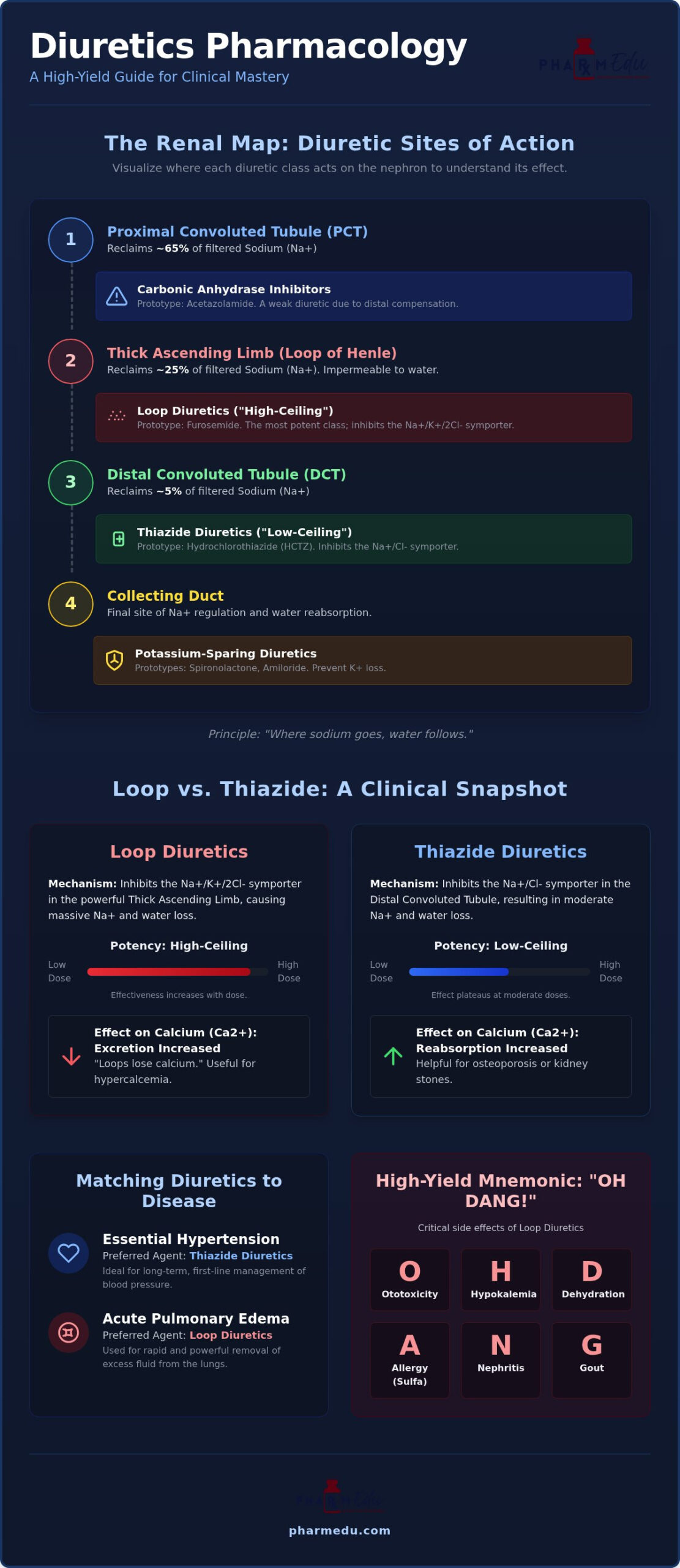
Diuretics are pharmacological agents that increase urine output by inhibiting the reabsorption of sodium within the renal tubules. When sodium remains in the tubular lumen, it creates an osmotic pressure that prevents water from being reabsorbed into the bloodstream. This “where sodium goes, water follows” principle is the cornerstone of how these medications manage fluid overload. To master diuretics pharmacology, you must visualize the nephron as a “Renal Map” divided into four primary therapeutic zones: the proximal convoluted tubule, the Loop of Henle, the distal convoluted tubule, and the collecting duct.
The efficacy of a diuretic is determined by its site of action. For instance, loop diuretics are known as “high-ceiling” agents because they target a segment of the nephron where a large percentage of filtered sodium is normally reclaimed. Understanding Diuretic mechanisms and classifications requires a deep dive into these specific anatomical segments and the transporters they house. By blocking reabsorption at earlier, more high-volume sites, these drugs produce a much more profound effect than those acting at the end of the nephron.
The Proximal Convoluted Tubule (PCT) and Bicarbonate
The PCT is the initial site of bulk reabsorption, reclaiming roughly 65% of filtered sodium and almost all filtered glucose and amino acids. Within this segment, the enzyme carbonic anhydrase facilitates the reabsorption of sodium bicarbonate. Drugs like acetazolamide inhibit this enzyme, which leads to bicarbonate loss in the urine and a mild diuretic effect. These are typically considered weak agents because the distal segments of the nephron have a significant capacity to compensate by reabsorbing the excess sodium that escapes the PCT. In the context of renal physiology, the filtration fraction is defined as the ratio of the glomerular filtration rate to the renal plasma flow, representing the fraction of plasma that actually enters the tubule system.
The Loop of Henle: The Powerhouse of Reabsorption
The thick ascending limb of the Loop of Henle is the primary site of action for the most potent diuretics in diuretics pharmacology. This segment utilizes the Na+/K+/2Cl- symporter to actively transport electrolytes out of the tubule and into the medullary interstitium, accounting for about 25% of total sodium reabsorption. This active transport is essential for the countercurrent multiplier system, a mechanism that establishes the high osmotic gradient in the renal medulla necessary for concentrating urine. Crucially, the ascending limb is completely impermeable to water. When loop diuretics block this symporter, they disrupt the medullary gradient and prevent the kidney from reabsorbing water later in the collecting duct, leading to a massive increase in total diuresis.
Classification of Diuretics: Mechanisms and Prototypes
Mastering diuretics pharmacology requires moving beyond simple drug lists to understand the specific molecular targets within the nephron. Diuretics are generally categorized into five primary classes based on their Diuretic Sites of Action: Carbonic Anhydrase Inhibitors, Loop diuretics, Thiazides, Potassium-Sparing agents, and Osmotics. A critical distinction in clinical practice is the “ceiling effect.” Loop diuretics are “high-ceiling,” meaning that increasing the dose leads to a proportional increase in diuresis over a wide range. In contrast, Thiazides are “low-ceiling” drugs; once the maximum therapeutic dose is reached, giving more medication provides no additional benefit but significantly increases the risk of toxicity.
Loop and Thiazide Diuretics: The Clinical Workhorses
Loop diuretics, with Furosemide as the prototype, are the most potent agents available. They work by inhibiting the Na+/K+/2Cl- (NKCC2) carrier in the thick ascending limb. Because this segment is responsible for reabsorbing about 25% of filtered sodium, blocking it results in a massive “salt dump” into the distal tubule. Thiazides, such as Hydrochlorothiazide (HCTZ), target the Na+/Cl- symporter in the distal convoluted tubule. While less potent than loops, they are essential for long-term hypertension management.
A high-yield clinical differentiator is how these two classes handle calcium. Loop diuretics inhibit the reabsorption of calcium, essentially “looping” it out into the urine, which makes them useful for treating hypercalcemia. Thiazides do the opposite. They enhance calcium reabsorption in the distal tubule. This makes Thiazides a preferred choice for hypertensive patients who also suffer from calcium-based kidney stones or osteoporosis. To cement these drug-class prototypes in your long-term memory, consider using Interactive Pharmacology Flashcards for daily active recall sessions.
Potassium-Sparing Diuretics and Osmotic Agents
Potassium-sparing diuretics act in the late distal tubule and collecting duct. They are divided into two categories: Aldosterone Antagonists, like Spironolactone, which prevent the synthesis of new sodium channels, and ENaC blockers, like Triamterene, which directly block existing epithelial sodium channels. Both types prevent the secretion of potassium into the urine, making them vital for countering the hypokalemia caused by loops and thiazides.
Clinical Indications: Matching Diuretics to Disease States
Selecting the right drug for the right condition is the practical application of diuretics pharmacology. Thiazide diuretics remain a first-line treatment for essential hypertension, which affects an estimated 120 million adults in the United States. According to the 2025 AHA/ACC Hypertension Guidelines, these agents are recommended as race-neutral first-line options to reach the universal blood pressure target of < 130/80 mmHg. While thiazides manage chronic pressure, loop diuretics are the gold standard for acute volume overload, particularly in patients with congestive heart failure (CHF) or acute pulmonary edema.
Potassium-sparing diuretics serve a specialized role. Spironolactone is often the drug of choice for managing ascites in liver cirrhosis because it directly antagonizes the secondary hyperaldosteronism common in hepatic failure. Beyond the cardiovascular system, diuretics address other clinical emergencies. Acetazolamide reduces intraocular pressure in open-angle glaucoma by decreasing aqueous humor production; meanwhile, Mannitol is utilized in neuro-intensive care to reduce increased intracranial pressure through its osmotic effect.
Management of Edematous States
Edema isn’t a single diagnosis. It’s a symptom of cardiac, hepatic, or renal dysfunction. In cardiac edema, the primary goal is reducing preload. However, clinicians must watch for “diuretic resistance,” which a 2026 analysis of the TRANSFORM-HF trial found in approximately 21% of hospitalized heart failure patients. This resistance often requires combining different diuretic classes or integrating other medications. For a deeper look at how these drugs work alongside other cardiac therapies, see our guide on ACE Inhibitors Pharmacology: The High-Yield Guide for Healthcare Students (2026). In hepatic cases, the focus shifts to blocking aldosterone to manage fluid shifts, whereas renal edema requires careful titration to maintain glomerular filtration.
Emergent vs. Chronic Use
Mastering diuretics pharmacology requires a precise understanding of how these drugs shift the “Big Three” electrolytes: potassium, sodium, and calcium. While their therapeutic goal is to reduce fluid volume, the secondary effects on electrolyte balance often dictate clinical decision-making. Loop diuretics and thiazides both drive potassium out of the body, yet they treat calcium in opposite ways. Understanding these nuances is the difference between a passing grade and true clinical mastery. To keep these complex side effects organized, healthcare students rely on standard high-yield mnemonics.
For loop diuretics like furosemide or the newer nasal bumetanide approved in 2025, remember “OH DANG!”. This stands for Ototoxicity, Hypokalemia, Dehydration, Allergy (sulfa), Nephritis (interstitial), and Gout. The “G” is especially important, as loop diuretics compete with uric acid for secretion in the proximal tubule, potentially triggering a gout flare. Thiazides, on the other hand, follow the “Hyper-GLUC” pattern. They can lead to Hyperglycemia, Hyperlipidemia, Hyperuricemia, and Hypercalcemia. Unlike loops, thiazides decrease urinary calcium, which is why they’re often used to prevent calcium-based kidney stones.
Potassium-sparing agents present a different set of risks. Because they inhibit sodium reabsorption without promoting potassium secretion, they carry a significant risk of life-threatening hyperkalemia. This risk is amplified in patients with chronic kidney disease or those concurrently taking ACE inhibitors. Master these complications through our high-yield pharmacology practice quizzes which simulate real board-style questions.
Metabolic Alkalosis vs. Acidosis
Loop and thiazide diuretics frequently cause contraction alkalosis. As these drugs force the excretion of sodium and water, the body attempts to maintain volume by increasing aldosterone activity, which leads to the loss of hydrogen ions and a subsequent rise in blood pH. In contrast, carbonic anhydrase inhibitors like acetazolamide cause a hyperchloremic metabolic acidosis because they prevent the reabsorption of bicarbonate in the proximal tubule. If you’re studying potassium-sparing agents, don’t forget that spironolactone can cause gynecomastia because its chemical structure allows it to bind and inhibit androgen receptors.
Ototoxicity and Sulfa Allergies
Most loop diuretics are sulfonamide derivatives. Patients with severe sulfa allergies may require ethacrynic acid, which is the only non-sulfa loop diuretic available. Ototoxicity is another critical concern, particularly with loop diuretics. This side effect is often linked to the speed of administration; rapid IV boluses can damage the hair cells in the inner ear. For a structured approach to all drug classes, check out The Ultimate Pharmacology Study Guide for Nursing Students in 2026. Always ensure IV furosemide is administered slowly to minimize the risk of permanent hearing loss.
Mastering Diuretics with PharmEDU’s Digital Learning Platform
Theoretical knowledge of the nephron is just the first step; true mastery comes through consistent active recall and visualization. PharmEDU transforms the way you approach diuretics pharmacology by shifting the focus from passive reading to interactive engagement. Our platform is designed to take the cognitive load off your shoulders, acting as a digital mentor that helps you navigate the complexities of renal medicine without the burden of dry, academic text.
One of the most effective tools for understanding these drugs is our High-Yield Video Vignettes. These sessions allow you to visualize the Na-K-2Cl symporter and the Na-Cl symporter in action, bridging the gap between molecular biology and clinical effect. When you see how a loop diuretic physically interacts with the thick ascending limb, you don’t just memorize a fact; you understand a process. This visual foundation makes it much easier to predict the electrolyte shifts we discussed earlier, such as hypokalemia and metabolic alkalosis.
Memorization remains a hurdle for many students, especially when trying to keep drug-class prototypes and their specific sites of action straight. Our Interactive Pharmacology Flashcards are built on the principle of spaced repetition, ensuring that you revisit the most challenging concepts, like the difference between aldosterone antagonists and ENaC blockers, at the optimal time for retention. Supplementing this with our Pharmacology Practice Quizzes prepares you for the pressure of an actual exam. These quizzes simulate board-style renal questions, forcing you to apply your knowledge to complex patient scenarios rather than just reciting drug names.
Micro-Learning for Busy Students
Clinicals and long shifts don’t leave much room for four-hour study blocks. PharmEDU’s micro-learning approach uses 5-10 minute videos to replace hours of reading through dense textbooks. The platform’s mobile-compliant design means you can review high-yield facts between patient rounds or while commuting. For those seeking a broader context for their studies, our internal resources provide a strong foundation, such as Pharmacology: The Comprehensive Guide to the Science of Drugs. This efficiency ensures you stay on track without sacrificing your personal well-being.
Success on the NAPLEX and NCLEX
Our curriculum is strictly aligned with the 2026 board exam content outlines for both the NAPLEX and NCLEX. We don’t just teach you the “what” of diuretic therapy; we show you the “how” through detailed clinical case studies. By applying diuretics pharmacology to real-world patient profiles, you gain the confidence needed to tackle the most difficult questions on exam day. Don’t leave your professional future to chance. Start your PharmEDU Monthly Subscription today and master diuretics!
Elevating Your Clinical Competence in Renal Pharmacology
Mastering the intricate balance of the nephron and the critical electrolyte shifts is a milestone for every healthcare student. By internalizing the renal map and applying high-yield mnemonics, you’ve moved beyond surface-level memorization toward a deeper understanding of diuretics pharmacology. Whether you’re navigating the 2026 clinical guidelines for hypertension or managing acute volume overload, this foundational knowledge is your most reliable tool in the clinical setting.
True exam readiness requires a transition from theory to active application. PharmEDU supports your professional growth with a curriculum strictly aligned with NAPLEX and NCLEX standards. You can optimize your limited study time through our High-Yield Video Vignettes and use Interactive Flashcards to ensure long-term retention of drug prototypes. Join PharmEDU for High-Yield Pharmacology Prep and let us help you navigate the complexities of your medical education. You’ve done the hard work of starting; now let’s ensure you cross the finish line with total confidence.
Frequently Asked Questions
What is the primary difference between loop and thiazide diuretics?
The primary difference lies in their site of action and overall potency. Loop diuretics inhibit the Na-K-2Cl symporter in the thick ascending limb, where 25% of sodium is reabsorbed. Thiazides act on the Na-Cl symporter in the distal convoluted tubule, targeting only 5% of sodium. This makes loop diuretics significantly more potent for acute fluid removal, while thiazides are preferred for long-term hypertension management due to their gentler, sustained effect.
Why do loop diuretics cause hypokalemia?
Loop diuretics cause hypokalemia primarily by increasing sodium delivery to the distal nephron. When more sodium reaches the collecting duct, the body activates exchange mechanisms that reabsorb sodium while secreting potassium and hydrogen ions into the urine. This process, driven by aldosterone, leads to significant potassium loss. Understanding these shifts is a core part of diuretics pharmacology, as clinicians must often supplement potassium to prevent dangerous cardiac arrhythmias or muscle weakness.
Which diuretic is used to treat increased intracranial pressure?
Mannitol is the diuretic of choice for treating increased intracranial pressure. As an osmotic agent, it remains in the vascular space and creates an osmotic gradient that draws water out of the brain tissues and into the bloodstream. This rapid fluid shift helps reduce cerebral edema and prevent potential brain herniation. It’s also used in specific ocular emergencies to lower intraocular pressure when other pharmacological interventions have failed to produce results.
Can patients with a sulfa allergy take furosemide?
Furosemide is a sulfonamide derivative, so it’s generally avoided in patients with a documented severe sulfa allergy. While cross-reactivity between antimicrobial sulfas and non-antimicrobial sulfas is debated, clinical practice often prioritizes safety. If a loop diuretic is absolutely necessary for a sulfa-allergic patient, ethacrynic acid is the preferred alternative. It provides the same “high-ceiling” potency without the sulfonamide structure, effectively avoiding the risk of a potentially life-threatening hypersensitivity reaction.
What are the signs of an electrolyte imbalance caused by diuretics?
Signs of an electrolyte imbalance vary depending on which ion is affected. Common symptoms include:
- Muscle weakness or painful cramps (hypokalemia)
- Cardiac palpitations or irregular heartbeats (potassium shifts)
- Confusion, seizures, or extreme lethargy (hyponatremia)
- Increased thirst and dry mucous membranes (dehydration)
Monitoring serum levels is essential, as these imbalances can develop rapidly during the initial stages of therapy or after a significant dosage adjustment.
How does spironolactone work compared to other diuretics?
Spironolactone works as a potassium-sparing diuretic by antagonizing aldosterone receptors in the collecting duct. Unlike loop or thiazide diuretics that promote potassium loss, spironolactone prevents the secretion of potassium into the tubular lumen. It’s particularly effective for patients with heart failure or cirrhosis. Because it inhibits the synthesis of new sodium channels rather than blocking existing ones, its clinical effects take several days to fully manifest compared to faster-acting agents.
What is the “High-Ceiling” effect in diuretics?
The “High-Ceiling” effect refers to a pharmacological profile where the diuretic response increases linearly with the dose over a wide range. Loop diuretics are the classic example of high-ceiling agents. You can continue to achieve greater diuresis by increasing the dosage until a very high plateau is reached. Thiazides are “low-ceiling” drugs because they have a narrow therapeutic window; once you reach the maximum effective dose, giving more medication only increases toxicity.
How can PharmEDU help me pass my pharmacology board exams?
PharmEDU simplifies your study process by focusing on high-yield content that directly appears on the NAPLEX and NCLEX. Our platform uses micro-learning through 5-10 minute video vignettes to break down complex diuretics pharmacology topics. You can reinforce your knowledge with interactive flashcards that utilize active recall and take practice quizzes that simulate the actual board exam environment. It’s a comprehensive digital mentor designed to fit into a busy clinical rotation schedule.