Psychopharmacology for Nurse Practitioners: The High-Yield Study Guide
What if the secret to mastering psychopharmacology for nurse practitioners isn’t found in a massive textbook, but in a mechanism-based understanding of the brain? Many PMHNP students feel paralyzed by the volume of drug classes and the anxiety of managing complex polypharmacy. It’s common to feel a massive gap between academic theory and the high-stakes reality of clinical prescribing. We agree that the pressure to prescribe safely while preparing for the boards is immense.
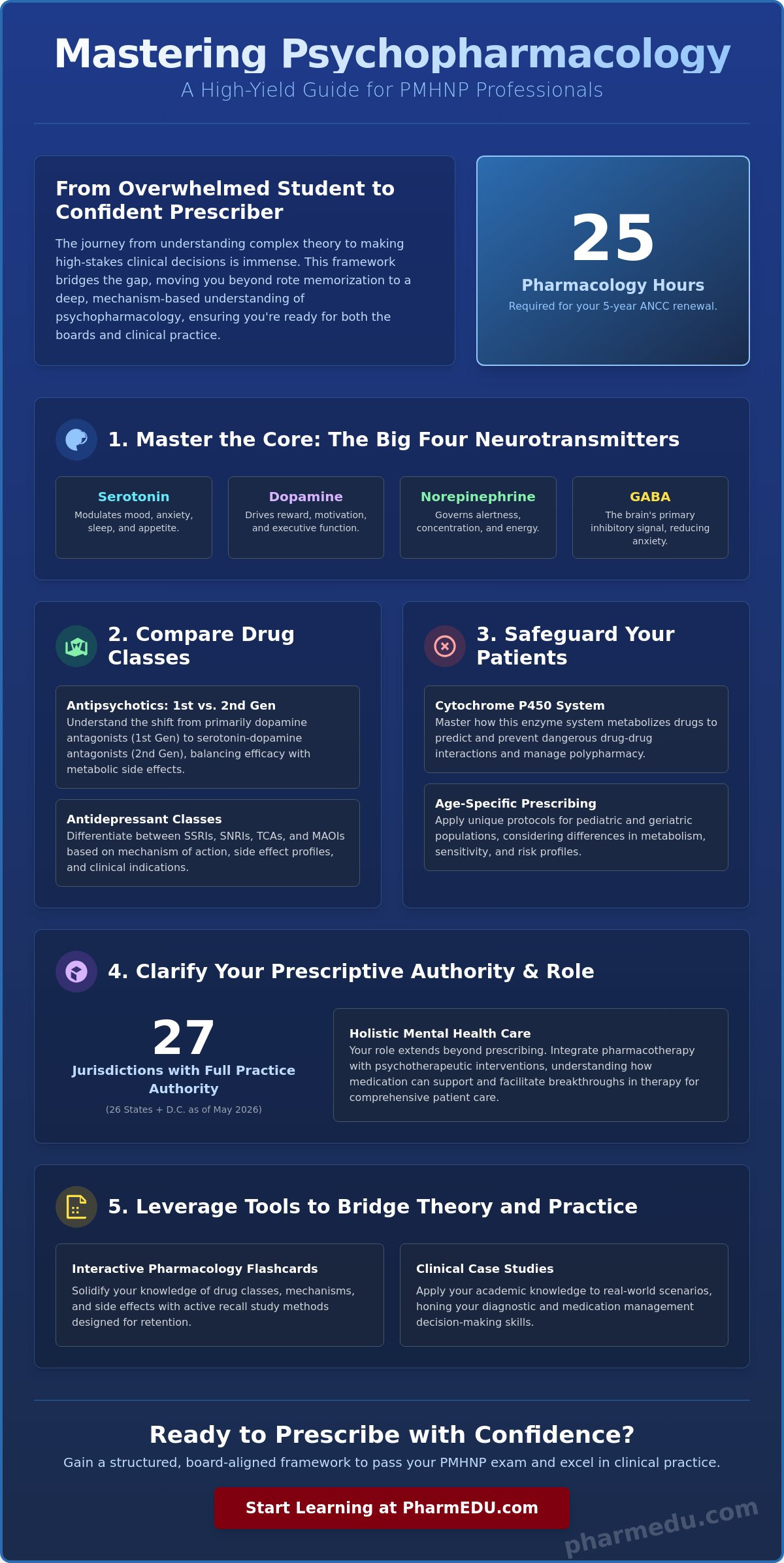
This guide offers a structured, board-aligned framework designed to help you pass the PMHNP exam on your first try and feel confident in your medication management decisions. We’ll break down the latest 2026 clinical updates, including new approvals like Bysanti and Arynta, and show you how to streamline your study process. You’ll learn how to focus on high-yield neurobiology and practical side effect monitoring to ensure you’re ready for the 25 pharmacology contact hours required for your ANCC renewal. By moving beyond rote memorization, you can transform your approach to psychiatric care and build a foundation for professional excellence.
Key Takeaways
- Learn how the big four neurotransmitters and complex signal transduction cascades influence cellular function and long term treatment efficacy.
- Gain a structured approach to psychopharmacology for nurse practitioners by comparing first and second generation antipsychotics and various antidepressant classes.
- Safeguard your patients by mastering the Cytochrome P450 system and applying age specific prescribing protocols for pediatric and geriatric populations.
- Clarify the boundaries of your prescriptive authority while integrating pharmacotherapy with psychotherapeutic interventions for holistic mental health care.
- Leverage interactive pharmacology flashcards and clinical case studies to bridge the gap between academic theory and real world medication management.
The Role of Psychopharmacology in PMHNP Practice
The role of a Psychiatric-Mental Health Nurse Practitioner (PMHNP) has expanded significantly as the demand for mental health services continues to climb. Mastering psychopharmacology for nurse practitioners is no longer just a requirement for graduation; it’s the foundation of clinical autonomy. As of May 2026, 26 states and the District of Columbia allow PMHNPs to practice with full authority. This means the responsibility for safe prescribing and clinical outcomes rests entirely on your shoulders. Understanding the weight of this responsibility is the first step toward professional excellence.
Effective treatment rarely relies on a single modality. Instead, it exists at the intersection where psychotherapy and biology meet. Engaging in the scientific study of psychopharmacology allows you to understand how chemical interventions can facilitate emotional and cognitive breakthroughs in therapy. You aren’t just managing symptoms; you’re modulating the biological environment to support lasting behavioral change. This holistic approach distinguishes the NP model from traditional medical models.
Patient safety is the ultimate priority in every clinical encounter. A deep understanding of pharmacology is non-negotiable because it enables you to predict adverse reactions and manage complex polypharmacy. This expertise is also a core focus of the ANCC board requirements. To maintain your PMHNP-BC certification, you must complete 75 continuing education contact hours every five years, with at least 25 of those hours specifically dedicated to pharmacology. Staying current isn’t just about compliance; it’s about providing the highest standard of care.
The Evolving Landscape of Psychiatric Prescribing
Prescribing is moving away from a trial-and-error approach toward personalized medicine. We now use pharmacogenomics to predict how a patient’s genetic profile might influence their response to specific antidepressants or mood stabilizers. This shift demands that you balance rigid clinical guidelines with the unique biological needs of each individual. Evidence-based practice remains your compass, ensuring every prescription is backed by current scientific consensus rather than clinical habit.
Foundational Competencies for the Prescribing NP
Your ability to prescribe safely starts long before you reach for a prescription pad. It begins with a meticulous psychiatric diagnostic interview that rules out organic causes for mental distress. You must also navigate the legal and ethical implications of prescribing, especially in the 11 states that still require physician supervision. Finally, integrating patient education into every plan is vital. When patients understand why they’re taking a medication and what to expect, adherence rates improve and the therapeutic alliance strengthens.
Essential Neurobiology: Understanding the Mechanism of Action
Mastering the biological underpinnings of mental health is what separates a competent prescriber from an expert. In the study of psychopharmacology for nurse practitioners, we move past simple “chemical imbalance” theories to look at complex circuitries. Your clinical decisions rely on four primary neurotransmitters: Serotonin, which modulates mood and anxiety; Dopamine, the driver of reward and executive function; Norepinephrine, which governs arousal and focus; and GABA, the brain’s primary inhibitory signal. Understanding how these chemicals interact within specific brain regions allows you to predict both therapeutic benefits and potential side effects.
To prescribe effectively, you must also distinguish between pharmacokinetics and pharmacodynamics. Pharmacokinetics describes what the body does to the drug, including absorption, distribution, metabolism, and excretion. Conversely, pharmacodynamics explains what the drug does to the body, specifically how it interacts with receptors to produce a clinical effect. This distinction is the foundation of psychopharmacology for nurse practitioners, especially when managing patients with hepatic or renal impairments who may process medications differently than the general population.
The Synaptic Space and Receptor Binding
Drugs exert their influence by binding to receptors as agonists, which stimulate a response, or antagonists, which block it. Partial agonists act as a thermostat, providing a moderate level of activity regardless of the natural neurotransmitter concentration. Many antidepressants work through reuptake inhibition, leaving more neurotransmitter in the synaptic cleft to interact with postsynaptic receptors. A drug’s receptor affinity determines its side effect profile; for example, high affinity for H1 histamine receptors often leads to significant sedation and weight gain.
Signal Transduction and Gene Expression
The immediate increase in neurotransmitters doesn’t explain why most psychiatric medications take weeks to show clinical results. This delay occurs because the real work happens through signal transduction cascades, where G-protein-linked systems trigger changes in cellular function and gene expression. These cascades eventually lead to structural changes in the brain. Neuroplasticity represents the antidepressant-induced stimulation of Brain-Derived Neurotrophic Factor (BDNF) which promotes the survival and growth of neurons in brain regions like the hippocampus. Visualizing these microscopic events can be challenging, but using High-Yield Video Vignettes can help you see exactly how these cascades unfold within the neuron.
High-Yield Drug Classes for PMHNP Board Review
Developing a systematic way to categorize medications is a hallmark of mastering psychopharmacology for nurse practitioners. Instead of memorizing endless lists, successful PMHNP candidates focus on the high-yield characteristics that distinguish one class from another. This section outlines the essential drug classes you’ll encounter on the boards and in clinical practice, focusing on the nuanced differences that influence prescribing choices and patient outcomes.
Antidepressants remain the most frequently prescribed class, spanning from foundational SSRIs and SNRIs to the more complex MAOIs and TCAs. Your selection framework should match the drug’s side effect profile to the patient’s specific symptoms. For instance, an activating SSRI like fluoxetine might benefit a patient with low energy, whereas a more sedating option like paroxetine could assist someone struggling with insomnia. You must also remain vigilant for Serotonin Syndrome, a life-threatening condition characterized by autonomic instability and neuromuscular excitability. Additionally, keep an eye on medications for comorbid conditions; for example, ACE inhibitors can significantly increase lithium levels, requiring careful monitoring to prevent toxicity.
Antidepressant Selection Framework
Effective prescribing requires a deep dive into the unique profiles of each medication. Beyond just symptom matching, you’ll need to manage withdrawal phenomena by using slow tapers to avoid discontinuation syndrome. It’s also vital to understand rare but serious cross-reactions with non-psychiatric medications to ensure comprehensive patient safety in primary care settings.
Antipsychotics and Metabolic Monitoring
Antipsychotic management requires a clear understanding of the trade-offs between first-generation (FGA) and second-generation (SGA) agents. While FGAs like haloperidol carry a higher risk of Extrapyramidal Symptoms (EPS) and Tardive Dyskinesia, SGAs are more frequently associated with metabolic syndrome. You’ll need to implement regular monitoring of weight, blood pressure, and lipid profiles for any patient on an SGA. Clozapine stands in a category of its own due to its superior efficacy in treatment-resistant cases, but it requires strict adherence to the Risk Evaluation and Mitigation Strategy (REMS) program to monitor for absolute neutrophil count (ANC) levels.
Mood stabilizers and anxiolytics round out the essential toolkit. Lithium, Valproate, and Lamotrigine each require specific clinical pearls for safe use. Lithium has a notoriously narrow therapeutic index, while Valproate necessitates monitoring of liver function and platelets. Lamotrigine is invaluable for bipolar depression but carries the risk of Stevens-Johnson Syndrome if not titrated slowly. When managing anxiety, you must balance the immediate relief provided by benzodiazepines against the high risk of dependence and cognitive impairment. Utilizing structured study aids like Pharmacology Practice Quizzes can help solidify these distinctions before you step into the exam room.
Clinical Application: Prescribing Safety and Polypharmacy
Effective clinical application of psychopharmacology for nurse practitioners requires a transition from understanding mechanisms to managing real-world patient variables. The guiding principle for vulnerable populations, such as pediatric and geriatric patients, remains “start low and go slow.” This cautious approach minimizes the risk of toxicity and adverse events in systems with varying metabolic capacities. You must also master the Cytochrome P450 (CYP450) enzyme system to prevent dangerous drug-drug interactions. Identifying whether a medication acts as a CYP450 inhibitor or inducer is critical, as these interactions can lead to subtherapeutic levels or life-threatening toxicity.
Adverse effect management is a daily reality in psychiatric care. You’ll frequently address metabolic issues like weight gain associated with second-generation antipsychotics, or cardiac risks such as QTc prolongation. Sexual dysfunction is another common barrier to medication adherence that requires proactive discussion and management. Beyond initiating treatment, the NP role involves deprescribing and simplifying complex regimens to reduce the burden of polypharmacy. This process ensures that every medication in a patient’s profile serves a clear, evidence-based purpose.
Managing Complex Comorbidities
Prescribing becomes significantly more complex when patients present with hepatic or renal impairment, as these conditions alter drug clearance and half-lives. For pregnant or lactating patients, you’ll conduct thorough risk-benefit analyses to support maternal mental health while protecting fetal development. Dual-diagnosis cases involving substance use disorders (SUD) also require a specialized approach, often prioritizing non-addictive alternatives to manage underlying psychiatric symptoms.
Monitoring and Follow-Up Protocols
Safety protocols are non-negotiable for high-risk medications. Lithium requires regular monitoring of serum levels, thyroid function, and renal health, while Clozapine necessitates strict adherence to the REMS program for absolute neutrophil counts. You’ll also utilize standardized tools like the Abnormal Involuntary Movement Scale (AIMS) to screen for tardive dyskinesia, alongside the PHQ-9 and GAD-7 to track clinical progress. Antidepressants carry a black box warning regarding the increased risk of suicidal thinking and behavior in children, adolescents, and young adults up to age 24. To refine these decision-making skills in a risk-free environment, explore our Clinical Case Studies to see how these protocols apply to diverse patient scenarios.
Mastering Psychopharmacology with PharmEDU
Traditional textbooks often struggle to keep pace with the rapid advancements in psychiatric medicine. While they provide a deep academic foundation, they frequently fail the modern student who needs to translate dense neurobiology into clinical action. PharmEDU addresses this gap by offering a structured, interactive alternative specifically tailored for those mastering psychopharmacology for nurse practitioners. Instead of wading through hundreds of static pages, you can engage with dynamic tools that prioritize high-yield information and board exam readiness.
Our High-Yield Video Vignettes bring complex concepts to life by visualizing how drugs interact with the brain. These short, focused segments allow you to see exactly how a medication modulates a receptor or influences a signal transduction cascade. To reinforce this visual learning, our Interactive Pharmacology Flashcards facilitate rapid-fire memorization of receptor profiles and side effect risks. By using these tools together, you’ll build the mental muscle memory required to distinguish between complex drug classes under the pressure of a timed exam or a busy clinical day.
The PharmEDU Study Advantage
Success in graduate school and clinical practice requires a study method that fits into a professional schedule. Our micro-learning segments are designed for busy practitioners, allowing you to master one topic at a time during a lunch break or between patient sessions. Clinical Case Studies further bridge the gap to real-world prescribing by placing you in the role of the decision-maker. For those who need to solidify their basics before diving into advanced psychiatric concepts, accessing the ultimate pharmacology study guide for nursing students provides the necessary foundational review to ensure no knowledge gaps remain.
Preparing for Board Success
Acing the ANCC PMHNP exam requires more than just knowledge; it requires a strategy. You can create a personalized study schedule using our comprehensive library of Practice Quizzes, which are meticulously designed to mirror the actual board exam format. Using comprehensive pharmacy review tools helps you master cross-disciplinary concepts, such as managing psychiatric medications in patients with complex medical comorbidities. You’re not just studying to pass a test; you’re preparing to lead in your field. Join thousands of NPs who have already secured their board success and clinical confidence through our platform. With the right resources, the complex world of psychopharmacology for nurse practitioners becomes a manageable and rewarding part of your professional journey.
Elevate Your Clinical Practice and Secure Board Success
Mastering psychopharmacology for nurse practitioners involves more than just passing a single exam; it’s about building a lifelong foundation for safe, effective patient care. By shifting your focus from rote memorization to a deep understanding of neurobiology and clinical safety protocols, you’re preparing yourself for the high-stakes complexities of modern psychiatric practice. We’ve discussed how a structured approach to drug classes and metabolic monitoring can directly transform your clinical outcomes and patient safety.
You can streamline this entire journey with a platform specifically designed for the busy professional. Our mobile-compliant micro-learning platform offers over 100 high-yield topics and ANCC board-aligned practice questions to ensure you’re fully prepared for the boards and beyond. Start your high-yield psychopharmacology review today with a PharmEDU subscription to bridge the gap between academic theory and real-world clinical application.
You have the dedication to serve your patients; now give yourself the precise tools you need to excel. Your professional milestone is well within reach, and we’re here to support your growth every step of the way.
Frequently Asked Questions
What is the best way to study psychopharmacology for the PMHNP boards?
The most effective way to study is to move beyond rote memorization and adopt a mechanism-based learning strategy. Focus on how specific drug classes affect the primary neurotransmitters to predict both therapeutic outcomes and side effects. Utilizing mobile-friendly tools like interactive flashcards and practice quizzes allows for consistent, high-yield review that fits into a busy clinical schedule without the need for dense, outdated textbooks.
How much pharmacology is on the PMHNP ANCC exam?
Pharmacology represents a substantial domain of the ANCC PMHNP board exam. Competency in medication management is foundational to the role, covering everything from pharmacokinetics to complex drug interactions. Success requires a deep understanding of FDA-approved treatments, including newer 2025 and 2026 approvals like Arynta and Bysanti. This ensures you’re prepared for both the board exam and current clinical standards.
Can a Nurse Practitioner prescribe controlled substances for psychiatric conditions?
Prescriptive authority for controlled substances depends entirely on your state’s regulations. As of May 2026, 26 states and the District of Columbia grant PMHNPs full practice authority, allowing them to prescribe all medications independently. In the remaining states, you may be subject to reduced or restricted authority. This often requires a collaborative agreement or physician supervision to prescribe Schedule II through V substances.
What are the most common side effects of second-generation antipsychotics?
Second-generation antipsychotics are most frequently associated with metabolic side effects, including significant weight gain, dyslipidemia, and elevated blood glucose. Some agents also carry risks of sedation and QTc prolongation. Because of these risks, regular metabolic monitoring of a patient’s BMI and lipid profile is a standard requirement for safe clinical practice. Understanding these profiles is a core part of psychopharmacology for nurse practitioners.
How do I differentiate between Serotonin Syndrome and Neuroleptic Malignant Syndrome?
You can differentiate these conditions by observing the nature of muscle involvement and the speed of onset. Serotonin Syndrome typically presents rapidly with neuromuscular excitability, such as hyperreflexia and myoclonus. In contrast, Neuroleptic Malignant Syndrome develops more slowly and is characterized by lead-pipe muscle rigidity and significantly elevated creatine kinase levels. Both conditions are medical emergencies that require immediate clinical intervention and medication discontinuation.
What resources does PharmEDU offer specifically for NP students?
PharmEDU provides a comprehensive suite of digital tools designed to simplify psychopharmacology for nurse practitioners. Our platform includes High-Yield Video Vignettes for visualizing neurobiology, Interactive Pharmacology Flashcards for receptor profiles, and Practice Quizzes that mirror the ANCC exam structure. Students also benefit from Clinical Case Studies that help bridge the gap between theoretical knowledge and real-world prescribing decisions in a risk-free environment.
Is Lithium still considered a first-line treatment for Bipolar Disorder?
Lithium remains a gold-standard, first-line treatment for Bipolar I Disorder, particularly for the management of acute mania and long-term suicide prevention. While newer long-acting injectables like Uzedy have been approved for maintenance treatment as of late 2025, Lithium’s established efficacy makes it a staple in psychiatric care. Its use requires diligent monitoring of renal function and serum levels due to its notoriously narrow therapeutic index.
How does the Cytochrome P450 system affect psychiatric drug metabolism?
The Cytochrome P450 system is the primary pathway for the hepatic metabolism of most psychotropic medications. Drugs that act as inhibitors can slow metabolism, leading to potentially toxic drug levels, while inducers can accelerate metabolism and render treatments subtherapeutic. Understanding these interactions is vital for avoiding polypharmacy complications, especially when combining psychiatric medications with common primary care treatments that may share the same metabolic pathways.