
The Ultimate Physician Assistant Pharmacology Review: Master the PANCE in 2026
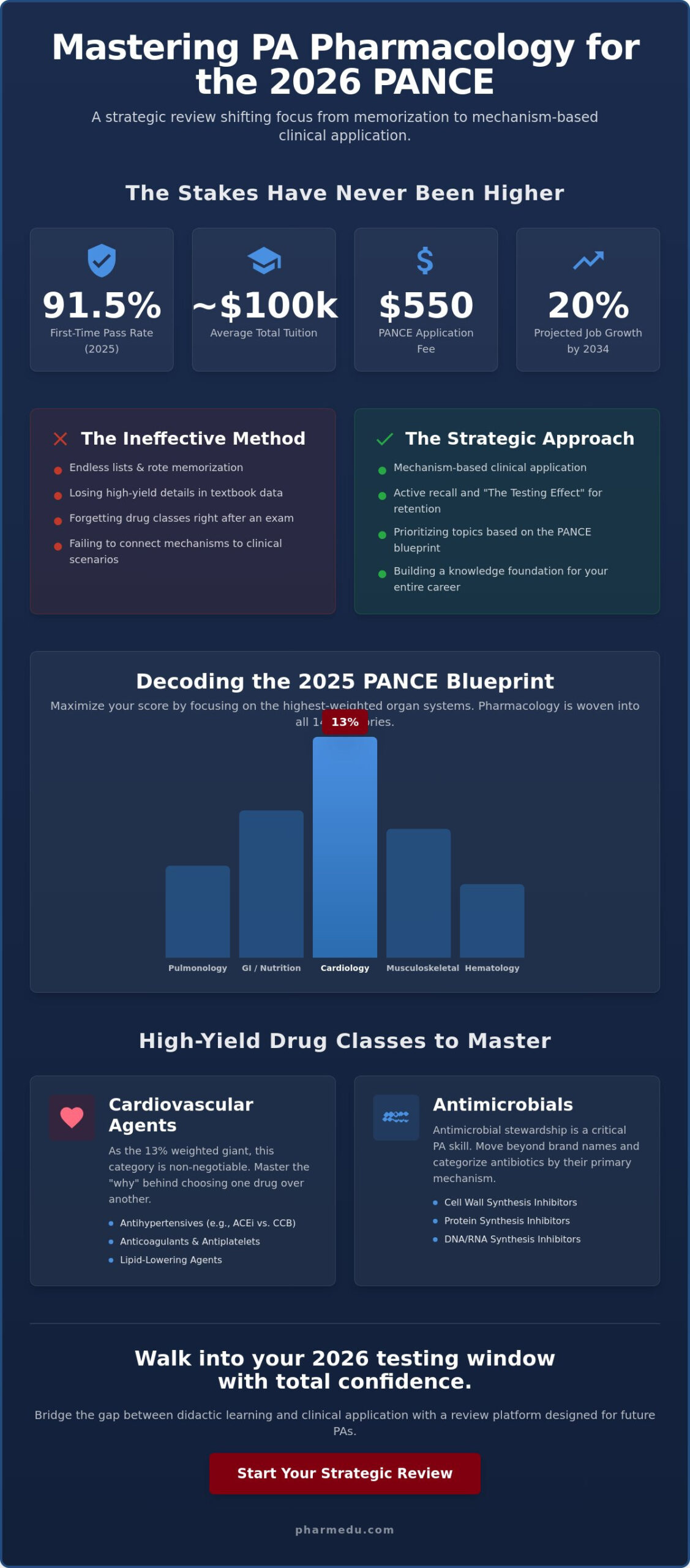
Did you know that first-time PANCE pass rates dipped to 91.5% in 2025, even as the demand for physician assistants is projected to grow by 20% through 2034? With the application fee at $550 and average total tuition for the class of 2026 reaching nearly $100,000, the stakes for your board preparation have never been higher. You’ve likely felt the exhaustion of staring at endless drug lists, only to realize you can’t connect a mechanism of action to a clinical scenario during your rotations. It’s a common struggle to feel like you’re drowning in textbook data while losing the high-yield details needed for the exam.
This guide offers a comprehensive physician assistant pharmacology review that shifts the focus from simple memorization to mechanism-based clinical application. You’ll gain a clear strategy to master complex drug classes and retain that knowledge long after your didactic exams are over. We’ll break down the updated 2025 NCCPA blueprint, explore how to use micro-learning for better retention, and provide a roadmap to help you walk into your 2026 testing window with total confidence.
Key Takeaways
- Discover how a strategic physician assistant pharmacology review transforms overwhelming drug lists into a clinical synthesis of the 14 organ systems found in the PANCE blueprint.
- Identify high-yield drug classes, specifically cardiovascular agents and antimicrobials, that form the foundation of both your didactic exams and boards.
- Move beyond passive reading by implementing active recall strategies and the “Testing Effect” to ensure long-term retention of mechanism-based concepts.
- Build a customized study schedule that prioritizes high-weight topics like cardiology over hematology to maximize your scoring potential.
- Learn how to integrate mobile-compliant digital tools and case studies into your clinical rotations to stay professional and prepared on the go.
Why Physician Assistant Pharmacology Review is Critical for Career Success
A successful physician assistant pharmacology review isn’t just a list of generic names and side effects. It’s a strategic synthesis of drug classes and clinical management that prepares you for the high-stakes environment of modern medicine. As you prepare for the PANCE in 2026, you’ll find that Pharmacology serves as the connective tissue between pathophysiology and patient outcomes. The downward trend in first-time pass rates, which hit 91.5% in 2025, underscores the need for a more rigorous approach. You aren’t just studying to pass a class; you’re studying to ensure patient safety in a landscape that now demands fluency in biologicals and pharmacogenomics.
Effective preparation requires you to look beyond the surface. The 2026 standards reflect a healthcare system that’s increasingly reliant on precision medicine. This means your physician assistant pharmacology review must include a solid grasp of how genetic variations influence drug metabolism. If you can’t explain why a specific biological agent is preferred over a traditional disease-modifying antirheumatic drug, you’re missing a critical piece of the modern PANCE puzzle. This depth of knowledge is what allows you to transition from the classroom to the clinic without losing momentum. It’s about building a foundation that supports your growth throughout your entire career.
The PANCE Blueprint: Pharmacology by the Numbers
The NCCPA updated the PANCE content blueprint for all exams beginning in January 2025. This update places a heavy emphasis on “Pharmaceutical Therapeutics” as a core task category that’s woven into every organ system. Pharmacology isn’t a siloed subject. It accounts for a significant portion of questions across all 14 categories, with Cardiology remaining the highest-weighted area at 13%. When you consider the $550 application fee, you realize that every question counts toward your professional future. The NCCPA expects candidates to identify the most likely drug intervention for a given clinical presentation with absolute precision and clinical logic.
Didactic vs. Clinical Pharmacology: Bridging the Gap
During your didactic year, the focus is often mechanism-heavy. You’re learning about receptors, half-lives, and biochemical pathways. Once you start clinical rotations, the shift moves toward management. You’ll quickly realize that rote memorization fails during a 12-hour hospital shift when a preceptor asks for a second-line treatment for a patient with multiple comorbidities. High-yield review acts as the bridge between these two phases. It helps you translate the “Testing Effect” into real-world confidence, ensuring you don’t forget drug classes the moment you finish an exam. Mastering this synthesis is what separates a student from a truly competent clinician.
High-Yield Drug Classes Every PA Student Must Master
Mastering the hierarchy of medications is the most effective way to streamline your physician assistant pharmacology review. You can’t treat every drug with equal importance because the NCCPA doesn’t either. The American Academy of Physician Assistants outlines specific educational requirements for PAs, emphasizing that pharmacology is a cornerstone of classroom instruction. To succeed in 2026, you must prioritize the classes that appear most frequently on the board and in clinical practice. This means moving beyond disorganized lists and focusing on the high-yield categories that define patient management.
Cardiovascular Pharmacology: The 13% Weighted Giant
Cardiology is the highest-weighted organ system on the PANCE, making up 13% of the total exam content. Your review should focus heavily on antihypertensives, anticoagulants, and lipid-lowering agents. Board examiners frequently test your ability to distinguish between first-line and second-line indications. For example, knowing when to choose an ACE inhibitor over a calcium channel blocker for a patient with comorbid diabetes is a classic high-yield scenario. For a deeper look at these specific mechanisms, consult our ACE inhibitors pharmacology guide. Understanding the “why” behind the choice is what prevents you from second-guessing yourself during the exam.
Antibiotics: Beyond the ‘Big Gun’ Approach
Antimicrobial stewardship is a critical skill for any clinician. You should categorize antibiotics by their primary mechanism; cell wall synthesis inhibitors, protein synthesis inhibitors, and DNA synthesis inhibitors. While memorizing every name is difficult, mastering the “spectrum of activity” for each class is manageable and highly effective for rotations. You must also identify “must-know” adverse effects that are frequently tested. This includes the risk of tendon rupture with fluoroquinolones or ototoxicity associated with aminoglycosides. Using Pharmacology Practice Quizzes can help you apply this knowledge to clinical vignettes, ensuring you select the correct empiric therapy every time.
Endocrine and metabolic medications require a nuanced understanding of insulin types and the rising importance of SGLT2 inhibitors. Since the 2025 blueprint update, there is a greater focus on managing chronic conditions like Type 2 Diabetes with multi-drug regimens. Similarly, neurology and psychiatry questions often center on the complex side effect profiles of psychotropics. You don’t just need to know that an SSRI treats depression. You must understand the risks of serotonin syndrome and the metabolic side effects of atypical antipsychotics. This level of detail is what ensures you provide safe, effective care while maintaining the high standards of the profession.
Active Recall Strategies for Long-Term Pharmacology Retention
Passive reading is a trap that many students fall into during their didactic year. You might spend hours highlighting a textbook and feel like you’re making progress, but you’re often just building “illusions of competence.” True mastery in your physician assistant pharmacology review comes from active retrieval practice. This process forces your brain to pull information from memory without looking at your notes, which is much more cognitively demanding than simply re-reading. It’s the difference between looking at a map and actually driving the route from memory.
The “Testing Effect” is a scientifically proven phenomenon where the act of being tested on information strengthens your memory more than additional study sessions do. Don’t fear getting questions wrong during your practice sessions. Each mistake is a valuable data point that tells you exactly where your understanding is weak. This is vital because the roles and responsibilities of a PA involve making rapid, accurate decisions about drug therapy in high-pressure environments. Interactive vignettes that simulate real-patient encounters are far more effective than static lists for this reason.
Flashcards vs. Clinical Case Studies
Flashcards are excellent for rote facts, such as drug names, standard dosages, or specific contraindications. However, they often fail to teach you how to apply that knowledge in a clinical setting. Clinical case studies bridge this gap by forcing you to consider patient comorbidities, drug-drug interactions, and lab values. Many students find that interactive pharmacology quizzes are a superior alternative to traditional paper cards because they provide immediate feedback and context.
| Study Format | Pros | Cons |
|---|---|---|
| Flashcards | Great for rapid-fire memorization of drug names. | Lacks clinical context and complex application. |
| Clinical Case Studies | Simulates real-world decision-making and logic. | Can be time-consuming for quick review sessions. |
| Interactive Quizzes | Combines active recall with immediate feedback. | Requires a digital platform and internet access. |
Visual Learning and Micro-Learning Segments
High-yield video vignettes are designed to reduce your cognitive load by breaking down complex pathways into manageable visual stories. Instead of struggling through a 50-page chapter on hematology, you can use a 5-10 minute micro-learning module to master the clotting cascade. These short segments are perfect for a busy PA student’s schedule, allowing you to study during a lunch break or between patient rounds. Visual mnemonics can also serve as powerful anchors for complex information, ensuring that you don’t experience “knowledge decay” shortly after your exam. By using spaced repetition, you ensure that the high-yield concepts stay fresh throughout your clinical year and into your 2026 PANCE window.
Building Your PA Pharmacology Study Schedule
Creating a study schedule for your physician assistant pharmacology review requires more than just blocking out time on a calendar. It’s a strategic allocation of your most valuable resource: attention. You should begin by assessing your current baseline with a comprehensive pharmacology pre-test. This data-driven approach allows you to identify which organ systems require a deep dive and which simply need a quick refresher. Without this baseline, you risk spending too much time on topics you already know while neglecting high-weight areas that could make or break your PANCE score.
Efficiency is key when you’re balancing didactic requirements or a heavy rotation schedule. You must align your study hours with the NCCPA blueprint weights. For instance, Cardiology accounts for 13% of the exam, while Hematology only represents 3% to 5%. It makes little sense to spend equal time on both. A successful schedule integrates daily “quick reviews” of 15-20 minutes to keep drug names fresh, coupled with weekly deep dives into complex classes like antiarrhythmics or biologicals. This consistent exposure prevents the “knowledge decay” that often happens after a single, intense cramming session.
The 8-Week PANCE Pharmacology Intensive
For graduating students, an 8-week intensive period is the gold standard for board preparation. This timeframe allows you to move through the organ systems methodically without burning out. A structured physician assistant pharmacology review requires high-quality sources, so incorporate the pharmacology study guide into your core curriculum to ensure you cover every essential mechanism. You should aim for specific milestones, such as achieving 75% accuracy on Cardiovascular practice quizzes by week two and 80% on Infectious Disease by week six.
- Weeks 1-2: Focus on Cardiology and Renal systems (High weight).
- Weeks 3-4: Pulmonary, GI, and Endocrine.
- Weeks 5-6: Neurology, Psychiatry, and MSK.
- Weeks 7-8: Infectious Disease, Heme, and Reproductive, followed by full-length practice exams.
Maintaining Knowledge During Clinical Rotations
Clinical rotations offer a unique opportunity to see pharmacology in action, but they also leave you with very little dedicated study time. You can maximize these months by using mobile-compliant resources between patient rounds. When a patient is prescribed a new medication, take sixty seconds to look up the drug of choice for their specific condition. This real-time reinforcement anchors the textbook knowledge in a clinical memory. Focus on the “spectrum of activity” for the antibiotics used in your current specialty, whether you’re in the ER or an outpatient clinic. To access these structured modules today, you can choose a PharmEDU monthly or annual subscription that fits your graduation timeline.
PharmEDU: The Digital Mentor for Future PAs
Your physician assistant pharmacology review shouldn’t end when you close your laptop. PharmEDU acts as a digital mentor, providing a structured bridge between the classroom and the clinical floor. As the NCCPA continues to refine its expectations for the 2026 exam cycle, our platform evolves alongside these standards. We’ve built a curriculum that mirrors the 2025 blueprint update, ensuring that every minute you spend on our platform translates directly to board readiness. It’s about moving from uncertainty to a place of professional authority and clinical safety.
Many PA programs now integrate our Institutional Platform License to track student performance in real-time. This allows faculty to identify gaps in knowledge before they become failures on a high-stakes exam. For the individual student, the mobile-compliant design means you can review a critical drug class while walking to the hospital cafeteria or during a brief lull in patient rounds. We’ve heard from countless PAs who transitioned from the brink of failing their pharmacology courses to passing the PANCE on their first attempt with scores well above the 350 passing threshold. Their success proves that with the right tools, the “pharmacology beast” is entirely manageable.
High-Yield Content for the Modern PA Student
Our library features over 100 specialized topics tailored specifically for healthcare professionals. Instead of wading through dry, 800-page textbook chapters, you can engage with expert-led video vignettes that highlight the most relevant clinical points. If you’re looking for a flexible entry point to boost your physician assistant pharmacology review, the PharmEDU monthly subscription offers full access to our interactive flashcards and practice quizzes. This allows you to test your knowledge in a low-stakes environment while building the muscle memory needed for your 2026 testing window.
- Video Vignettes: Visual stories that simplify complex biochemical pathways.
- Interactive Flashcards: Digital tools designed for rapid-fire active recall.
- Practice Quizzes: Questions modeled after the NCCPA task categories.
- Clinical Case Studies: Real-world scenarios that bridge the didactic-clinical gap.
Start Your Pharmacology Mastery Today
The PharmEDU advantage lies in our commitment to scientific precision and supportive education. We don’t just give you the facts; we provide the context that makes those facts stick. As you face the challenges of your 2026 graduation year, remember that you don’t have to tackle this subject alone. You have the potential to join a community of successful clinicians who have used our platform to secure their professional futures and ensure patient safety. Your journey to becoming a board-certified physician assistant starts with a single, focused study session. Take that step today and master the concepts that will define your career.
Step Into Your 2026 Testing Window With Clinical Confidence
Success on the PANCE requires a shift from passive memorization to the active clinical application of drug mechanisms. By focusing your physician assistant pharmacology review on high-yield organ systems like the 13% weighted cardiology section, you align your efforts with the updated 2025 NCCPA blueprint. This strategic approach isn’t just about protecting your $550 exam investment or reaching the 350 passing score; it’s about preparing for a career where employment is projected to grow 20% through 2034. You’re building the expertise required to handle real-world patient encounters safely and effectively.
PharmEDU supports this journey with a curriculum designed by healthcare educators, featuring over 100+ high-yield pharmacology topics. Our mobile-compliant micro-learning modules ensure you can study effectively during hospital rounds or between classes. Master high-yield pharmacology today with PharmEDU’s expert-led review courses. You’ve already committed to the rigorous path of becoming a physician assistant. Now, take the final step to ensure you walk into your testing center with the knowledge and confidence to excel in your new profession.
Frequently Asked Questions
What is the most effective way to study pharmacology in PA school?
Active recall and spaced repetition are the most effective methods for long term retention. Instead of passive reading, you should engage with clinical vignettes and practice quizzes that force you to retrieve information from memory. This approach leverages the “Testing Effect” to anchor drug mechanisms to real patient scenarios, which is essential for the 2026 PANCE standards.
How much of the PANCE exam is focused on pharmacology?
Pharmacology is integrated into the “Pharmaceutical Therapeutics” task category, which affects questions across all 14 organ systems. While it isn’t a standalone section, it represents a significant portion of the exam logic. Cardiology alone accounts for 13% of the blueprint, making a focused physician assistant pharmacology review critical for achieving the minimum passing score of 350.
Should I use flashcards or practice questions for my PA board review?
You should use both tools for different stages of your physician assistant pharmacology review. Flashcards are excellent for memorizing rote facts like drug names and contraindications. Practice questions and clinical case studies are better for developing the diagnostic reasoning needed to identify the “most likely” pharmaceutical intervention during the actual board exam.
What are the highest-yield drug classes to focus on for the PANCE?
Cardiovascular agents and antimicrobials are the highest-yield classes due to their heavy weight in the NCCPA blueprint. Cardiology remains the most tested system at 13%, while infectious disease questions frequently appear in both primary care and emergency medicine contexts. Mastering these two categories provides the strongest scoring foundation for any PA student.
How does PharmEDU differ from traditional PA school textbooks?
PharmEDU replaces dry, 800-page textbook chapters with high-yield video vignettes and interactive digital tools. Unlike passive reading, our platform focuses on clinical application and the “Testing Effect” to reduce cognitive load. This helps students retain complex information long after their didactic exams, which is vital given the 91.5% first-time pass rate seen in 2025.
Can I use PharmEDU on my phone during clinical rotations?
Yes, the platform is fully mobile-compliant and designed for use during hospital rounds. You can access interactive flashcards or 5-10 minute micro-learning modules between patient encounters. This real-time reinforcement helps anchor textbook knowledge in a clinical setting, making it easier to answer preceptor questions and prepare for end-of-rotation exams.
Is a monthly or annual subscription better for a didactic year student?
An annual subscription is generally better for didactic students because it provides consistent access throughout the entire 12-month curriculum. Pharmacology requires constant spaced repetition to prevent knowledge decay. Having a long-term resource ensures you can revisit complex topics like autonomic drugs or chemotherapy agents as you move from the classroom to your 2026 rotations.
What happens if I fail my pharmacology exam in PA school?
Failing an exam typically requires a remediation process defined by your specific ARC-PA accredited program. It’s a signal that your current study methods aren’t producing the necessary clinical synthesis. You should immediately shift to active recall strategies and high-yield resources to address these gaps before they impact your performance on the PANCE.