Master Pharmacology: 10 High-Yield Study Tips for Medical Students (2026)
With over 90% of U.S. medical students now relying on UWorld’s 3,600 practice questions, the technical demands of the $695 USMLE Step 1 have never been more precise. It’s natural to feel overwhelmed by the requirement to memorize 100+ drug classes while fearing that critical mechanisms of action will fade before you reach clinical rotations. You’ve likely experienced the frustration of information overload, where hours of intense study don’t always translate into exam day confidence or long term retention. We understand that you need a reliable partner to help manage this academic burden efficiently.
This guide delivers the exact pharmacology study tips for medical students that bridge the gap between academic theory and professional mastery. We’ll explore how to synchronize modern resources like Anki 25.09 and Sketchy’s 1,300 visual lessons into a structured daily routine that protects your mental well-being while maximizing your output. By shifting your focus from rote memorization to integrated, class-based logic, you’ll learn the specific micro-learning strategies used by top performers to ensure high scores on your shelf exams and a seamless transition to the wards.
Key Takeaways
- Shift from rote memorization to a mechanism-first framework by identifying prototype drugs and mastering physiology before tackling pharmacology.
- Discover effective pharmacology study tips for medical students that leverage active recall and spaced repetition to build long-term retention.
- Tailor your preparation by distinguishing between Step 1 biochemical pathways and the clinical decision-making required for Step 2 and rotations.
- Maximize your limited time through micro-learning strategies. Use high-yield video vignettes to break down complex drug classes into ten-minute segments.
- Streamline your workflow with digital tools like interactive flashcards and quizzes. These automate the review process and help prevent burnout.
Why Pharmacology is the “Final Boss” of Medical School
Many students view pharmacology as the ultimate hurdle in their medical education. It isn’t just another subject; it’s the “final boss” that tests your ability to synthesize biochemistry, physiology, and pathology. At its core, Pharmacology is the study of drug-body interactions. It requires you to understand how a specific chemical compound alters biological systems to produce a therapeutic effect. Mastering this discipline is a prerequisite for safe clinical practice and academic success.
The primary challenge is the “Volume Problem.” Medical curricula typically introduce over 100 drug classes, each containing dozens of individual agents. When you’re preparing for board exams and facing 3,600+ questions in tools like UWorld, the weight of these facts can lead to cognitive burnout. This is why finding effective pharmacology study tips for medical students is essential for survival. You aren’t just learning names; you’re learning a new language that governs patient care.
We call the initial confusion “Alphabet Soup” anxiety. Drug names like “bevacizumab” or “levetiracetam” often feel like a random string of letters. However, these names aren’t arbitrary. They follow a nomenclature that, once decoded, reveals the drug’s purpose and class. Pharmacology becomes logical the moment you stop seeing drugs as isolated facts and start seeing them as members of a family with shared “Rules of the Class.”
The Difference Between Memorization and Understanding
Rote memorization often fails under the pressure of a $695 USMLE Step 1 exam. You need to distinguish between pharmacokinetics, which is what the body does to the drug, and pharmacodynamics, which is what the drug does to the body. This distinction is vital for long-term retention during clinical rotations. Understanding pharmacology as a foundational science allows you to predict outcomes rather than just recalling them. It’s about building a mental framework that supports new information as you progress through your career.
The “Mechanism-First” Mental Model
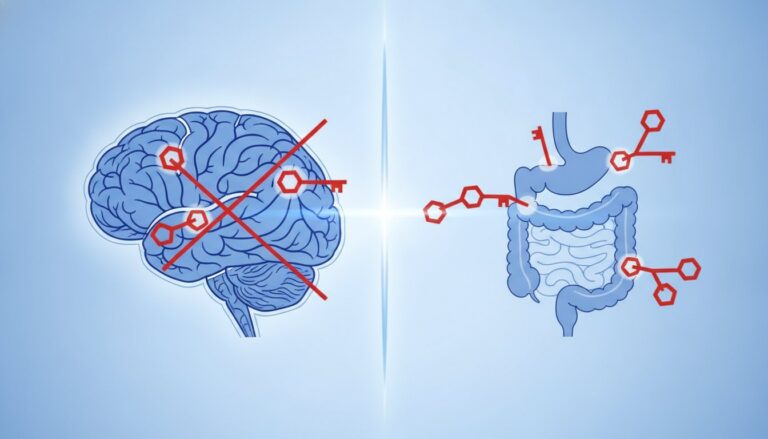
The Mechanism of Action (MOA) serves as your cognitive anchor. If you know a drug is a beta-blocker, you don’t need to memorize its side effects individually. You can deduce them from your knowledge of the autonomic nervous system. Understanding a single receptor type allows you to predict side effects across an entire class of medications. In the context of drug mechanisms, “High-Yield” refers to the core physiological interaction that explains at least 80% of a drug’s clinical presentation and adverse effects. Mastering these anchors is one of the most powerful pharmacology study tips for medical students because it reduces the need for brute-force memory and builds true clinical competence.
The Mechanism-First Framework: 5 Steps to Mastery
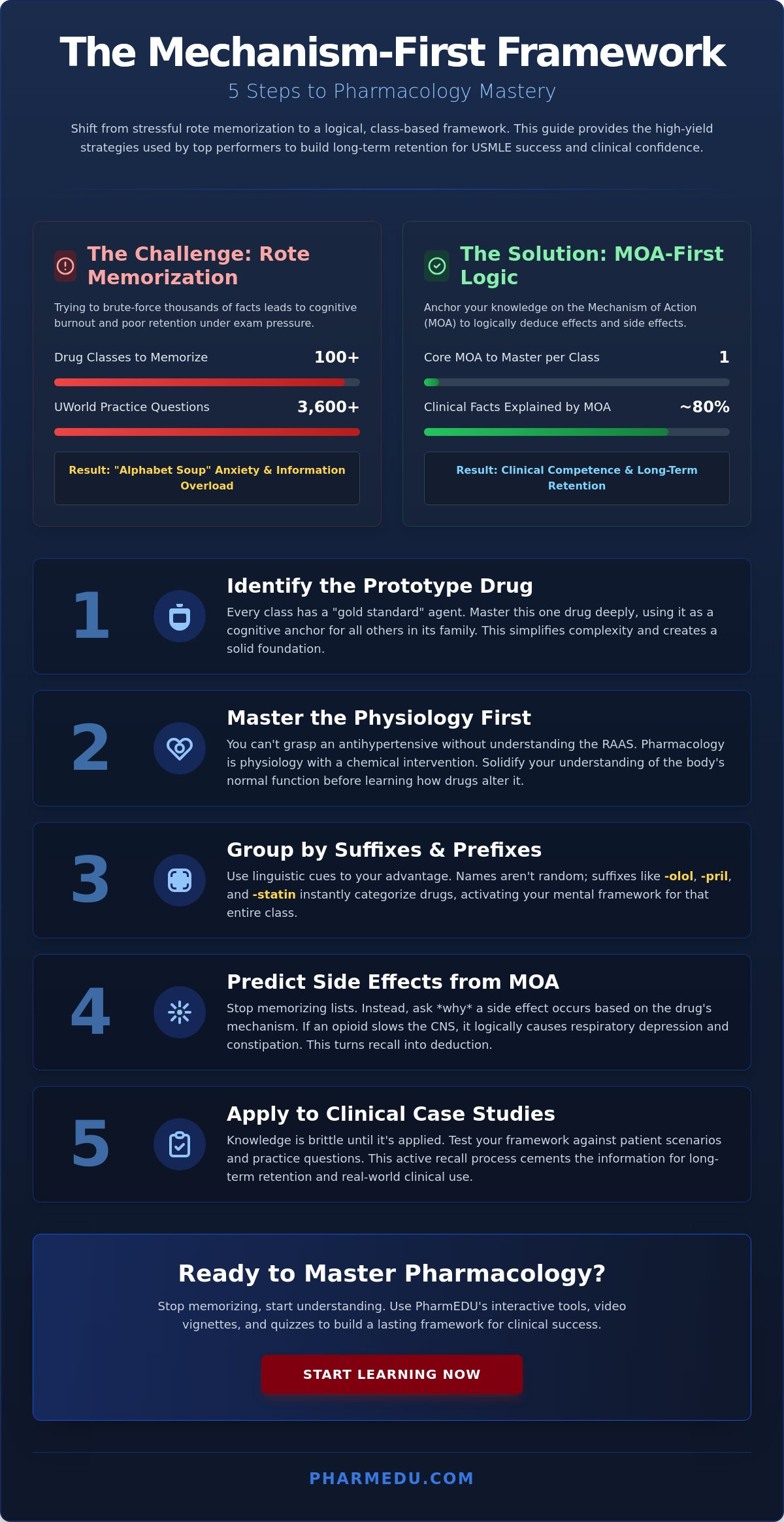
Mastering pharmacology isn’t about memorizing a phone book of drug names. It’s about developing a logical sequence that allows you to predict how a drug behaves based on its class. This five-step framework provides the most effective pharmacology study tips for medical students who want to move beyond rote memorization and achieve clinical fluency. If you don’t understand the underlying system, you’ll find yourself relearning the same facts every time a new agent is introduced.
- Step 1: Identify the Prototype Drug. Every class has a “gold standard” representative. Learn this one drug deeply, and use it as your baseline for all others.
- Step 2: Master the Physiology first. You can’t understand an antihypertensive if you don’t understand the renin-angiotensin-aldosterone system (RAAS). Pharmacology is simply physiology with a chemical intervention.
- Step 3: Group by Suffixes and Prefixes. Use linguistic cues like -statin, -olol, or -pril to instantly categorize new drugs into their respective classes.
- Step 4: Predict Side Effects based on MOA. Instead of memorizing lists, ask why a drug causes a specific effect. If an opioid slows down the central nervous system, it’s logical that it also causes respiratory depression and constipation.
- Step 5: Apply to Clinical Case Studies. Facts are brittle until they’re used. Testing your knowledge against patient scenarios cements the information for long-term retention.
Grouping Drugs by Class Hierarchy
Think of your brain as a filing cabinet. You shouldn’t have 500 loose papers; you should have 20 well-organized folders. Building a mental hierarchy allows you to store new information under existing “parent” categories. For example, using the pharmacology study guide for nursing students as a cross-reference can help you identify foundational drug classes that are often simplified for easier initial comprehension. Mastering a specific class, such as ace inhibitors, provides a gateway to understanding the entire RAAS system, making it easier to learn ARBs and aldosterone antagonists later.
The Power of Prototype Drugs
A prototype drug is the template for its entire family. When studying pharmacology, focusing on this single representative reduces your memorization load by approximately 70%. Once the prototype’s mechanism, side effects, and contraindications are locked in, you only need to learn how other drugs in the class differ from it. We call this “Difference-Mapping.” If you know Propranolol is the prototype beta-blocker, you only need to note that Metoprolol is cardioselective. This targeted approach prevents the burnout associated with traditional study methods. To see this logic in action, you can explore the high-yield video vignettes that break down these prototypes into manageable, five-minute lessons.
Tailoring Your Strategy: Step 1 vs. Step 2 vs. Clinicals
The transition from the lecture hall to the hospital ward requires a fundamental shift in how you process pharmaceutical data. Your approach must evolve as your academic goals change. During your pre-clinical years, the focus is almost entirely on molecular mechanisms and biochemical pathways. This is the foundation you’ll need for the USMLE Step 1, which remains a critical milestone despite the shift to a pass/fail format. Once you transition to Step 2 CK and clinical rotations, the questions change from “how does this work?” to “which drug is the best next step for this specific patient?” Implementing specific pharmacology study tips for medical students that reflect these changing priorities prevents you from wasting time on low-yield details.
Balancing board preparation with real-world prescribing requires a dual-track mindset. You need to master the “clean” pharmacology of the boards while acknowledging the “messy” pharmacology of actual patients who often present with polypharmacy and multiple comorbidities. Clinical vignettes serve as the bridge between these two worlds. They force you to apply theoretical knowledge to a simulated patient, which is exactly what you’ll face during the $695 USMLE Step 2 CK exam. By practicing with vignettes, you move beyond simple recall and begin to develop the clinical intuition necessary for your future career.
Preparing for the USMLE Step 1
For Step 1, you should prioritize the “General Principles” section of your resources. Many students skip this to get to the “fun” drugs, but understanding pharmacokinetics and the autonomic nervous system (ANS) is non-negotiable. The ANS is the backbone of pharmacology; if you master its receptors, you’ve already learned half of the cardiovascular and pulmonary drugs. You’ll find that using effective learning strategies for pharmacology involves integrating traditional high-yield texts like First Aid with digital platforms that offer visual mnemonics. This combination helps lock in the “why” behind the drug before you’re asked to apply it in a clinical context.
Success in Clinical Rotations
On the wards, the “One Drug a Day” rule is your most effective tool. Each day, pick one medication a patient is taking and research it thoroughly. This creates an “Emotional Anchor.” You’re no longer just memorizing a list of side effects; you’re remembering why Mrs. Jones couldn’t take an ACE inhibitor because of her dry cough. As you move through your internal medicine clerkship, you might find that transitioning to comprehensive pharmacy review tools provides a more practical edge than the basic science books you used for Step 1. These resources focus on drug-drug interactions and contraindications, which are the primary concerns of an attending physician during rounds.
Building a High-Yield Daily Routine
Passive reading is the most significant time-waster in medical education. While highlighting a textbook feels productive, it often creates an illusion of competence that vanishes during a high-stakes exam. High-yield pharmacology study tips for medical students focus on active engagement rather than passive consumption. To truly master 100+ drug classes, you must build a routine that forces your brain to retrieve information repeatedly. This approach transforms your study sessions from a chore into a precise, diagnostic process that identifies exactly what you don’t know.
Integrating multi-sensory tools is the key to breaking the monotony of pharmaceutical data. By combining auditory and visual inputs through video vignettes, you engage different parts of your brain simultaneously. This dual-coding strategy makes complex mechanisms of action much harder to forget. A structured daily routine ensures that you’re not just “looking at” drugs, but actively processing how they function within the clinical environment.
The Spaced Repetition Revolution
The “Forgetting Curve” is your primary obstacle. Research shows that without reinforcement, you’ll likely forget 70% of new information within 24 hours. Spaced repetition software, such as Anki 25.09, solves this by showing you information just as you’re about to forget it. To avoid the dreaded “card-debt,” limit your daily new cards to a manageable number, such as 20 to 30. While making your own cards can be helpful, using pre-made high-yield decks allows you to spend more time on application and less on data entry. This efficiency is vital when you’re balancing 3,600+ practice questions in your primary question bank.
Mobile-First Learning for the Modern Student
Your most valuable study time often happens in small bursts. The psychology of micro-learning suggests that four 15-minute sessions are more effective for retention than a single one-hour block. You can turn “dead time” during transit or between clinical rounds into high-yield review sessions by using mobile-compliant platforms. Instead of waiting for a large block of free time, use these windows to complete a few Interactive Pharmacology Flashcards or watch a single five-minute vignette. Interactive quizzes should serve as diagnostic tools. Don’t use them just to see your score; use them to identify the specific biochemical pathways where your understanding is weakest. This targeted approach ensures that every minute of your study routine contributes directly to your board exam success.
PharmEDU: Your Digital Mentor for Pharmacology Mastery
Traditional study methods often leave students feeling isolated in a sea of 100+ drug classes and complex biochemical pathways. PharmEDU serves as your digital mentor, transforming this academic burden into a structured path toward clinical competence. We don’t just provide data. Our platform organizes 100+ high-yield video vignettes into a logical progression that mirrors your medical school curriculum. By integrating these targeted pharmacology study tips for medical students into your daily workflow, you replace anxiety with a predictable system for success.
Our interactive pharmacology flashcards and practice quizzes do more than test your knowledge; they automate the entire spaced repetition process. Instead of manually managing a deck of thousands of cards, our algorithm identifies your weak points and resurfaces them at the precise moment before you’re likely to forget. This efficiency is critical when preparing for high-stakes milestones like the $695 USMLE Step 1. Beyond the boards, our Clinical Case Studies help you apply theoretical facts to patient scenarios, which is an essential skill for residency and your long-term career. Whether you’re a medical student or researching how to become a pharmacist, having a reliable digital partner ensures your professional development remains on track.
High-Yield Content Designed for Retention
The philosophy behind our micro-learning segments is simple. We believe that 10-minute, focused lessons are more effective than grueling hour-long lectures. Our faculty-led vignettes simplify complex biochemical pathways by stripping away the “academic bikkfanyelv” and focusing on the core mechanisms that appear on exams. This precision allows you to master the “Rules of the Class” without the burnout associated with traditional textbooks. You’ll find that our content is modern, accessible, and scientifically rigorous. Start your journey toward pharmacology mastery today and experience the difference that structured mentorship makes.
Join a Community of Healthcare Learners
PharmEDU isn’t just for individual learners. We offer institutional platform licenses for universities and pharmacy schools that want to provide their students with the highest quality digital resources. Tracking your progress through our dashboard allows you to identify specific weak areas weeks before your shelf exams or boards. This data-driven approach removes the guesswork from your study sessions. Our community is built on the principles of professional credibility and supportive education, ensuring you have the tools to excel in a rapidly changing healthcare landscape. Join PharmEDU and Ace Your Exams to secure your future as a confident, knowledgeable healthcare professional.
Elevate Your Clinical Competence
Mastering pharmacology requires moving beyond the “Volume Problem” and adopting the mechanism-first framework we’ve discussed. By identifying prototype drugs and leveraging 100+ high-yield video vignettes, you can build a sustainable routine that survives the high-stakes pressure of the $695 USMLE Step 1. These pharmacology study tips for medical students provide a clear roadmap to clinical fluency. You’ll stop feeling overwhelmed by the “Alphabet Soup” of drug names and start predicting therapeutic outcomes with precision.
Our interactive spaced-repetition flashcards and board-style practice quizzes are designed to automate your review process, ensuring no critical mechanism of action is forgotten before your clinical rotations. It’s time to trade burnout for a structured, evidence-based study plan that supports your long-term professional growth. Start Your PharmEDU Subscription Now to access our full suite of digital mentorship tools. You have the dedication to succeed. We provide the precision tools to get you there.
Frequently Asked Questions
How do I start studying pharmacology if I am completely overwhelmed?
Start by mastering the general principles and the autonomic nervous system (ANS) receptors. These foundational concepts act as the scaffolding for almost every other organ system in the body. Focus on one prototype drug per class to build your initial mental framework. Once you understand how the “parent” drug functions, you can easily map the minor differences of secondary agents without feeling buried by the volume of data.
Is it better to use Sketchy or a comprehensive platform like PharmEDU?
While Sketchy is excellent for initial visual mnemonics, a comprehensive platform like PharmEDU provides the clinical depth and diagnostic testing needed for residency. Effective pharmacology study tips for medical students often involve using visual tools for memorization and PharmEDU for clinical case studies and board-style quizzes. This integrated approach ensures you aren’t just recalling images but actually applying knowledge to patient care scenarios.
What are the most high-yield drug classes for the USMLE Step 1?
Autonomic drugs, antimicrobials, cardiovascular agents, and central nervous system medications are historically the most tested areas. These categories frequently appear in approximately 15% to 20% of Step 1 questions. Prioritizing these classes allows you to maximize your score potential. You should pay particular attention to the “General Principles” section, as it governs how you’ll interpret every drug interaction and side effect throughout the exam.
How many hours a day should I dedicate to pharmacology?
Consistency is more important than total hours, so aim for 45 to 60 minutes of focused study each day. Use the micro-learning approach by breaking this time into four 15-minute blocks. This method aligns with the psychology of spaced repetition and prevents the cognitive fatigue that sets in after long cramming sessions. Dedicated daily practice helps you manage the 3,600+ questions found in major question banks effectively.
Can I rely solely on flashcards to pass my pharmacology shelf exam?
Flashcards are powerful for active recall, but they won’t teach you the “best next step” in clinical management. To pass a shelf exam, you must combine flashcards with practice quizzes and case studies. While cards help you remember that an ACE inhibitor causes a cough, only practice questions will teach you how to choose the appropriate alternative for a patient with specific comorbidities.
What is the best way to remember drug-drug interactions?
The most efficient method is to group interactions by their metabolic pathways, specifically the Cytochrome P450 system. Instead of memorizing individual pairs, learn the major inducers and inhibitors as a single list. Once you know that a drug like rifampin is a potent inducer, you can predict its interactions with dozens of other medications. This logical grouping reduces your memorization load and improves clinical safety.
How do I balance pharmacology with other heavy subjects like pathology?
The best strategy is to study pharmacology and pathology concurrently. When you learn about the pathophysiology of a disease like heart failure, immediately study the corresponding drugs like beta-blockers and diuretics. This creates a strong “Emotional Anchor” and helps you understand the “why” behind the treatment. Integrated learning is one of the most effective pharmacology study tips for medical students for long-term retention.
Should I focus on brand names or generic names for the boards?
You should focus 100% of your energy on generic names. The USMLE and other major board exams use generic nomenclature almost exclusively to maintain international standards and avoid commercial bias. Learning brand names is a low-yield activity that consumes valuable cognitive bandwidth. Stick to the generic stems, like -statin or -olol, to ensure you’re prepared for the exact terminology used on exam day.