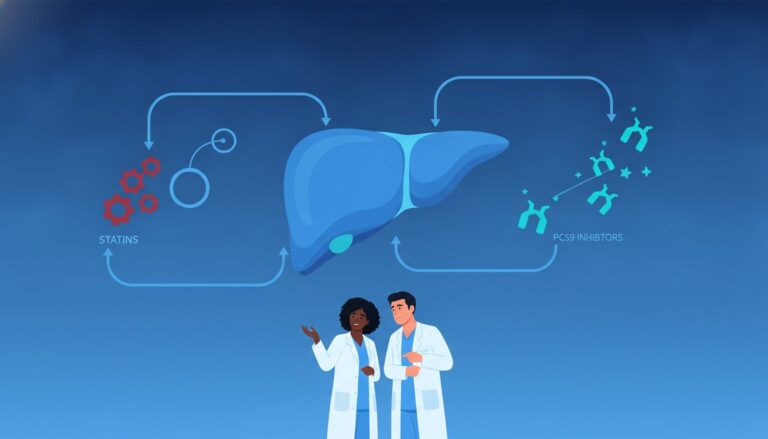

How to Study for Pharmacology in Nursing School: A Professional 2026 Strategy
What if the secret to passing your next exam isn’t memorizing more drugs, but actually memorizing fewer of them? Most students feel crushed by the weight of their textbooks, yet the 2026 NCLEX-RN focuses heavily on clinical judgment rather than simple recall. If you’re wondering how to study for pharmacology in nursing school without burning out, you aren’t alone. It’s incredibly stressful to face a mountain of similar sounding medications while knowing that “Pharmacological and Parenteral Therapies” makes up 13% to 19% of your licensure exam.
We’ve developed a professional strategy to help you move past the anxiety of information overload. You’ll learn how to replace brute-force memorization with high-yield pattern recognition and clinical application. This article breaks down a structured categorization method that improves your scores and builds the confidence you’ll need for clinical rotations. We’ll explore how to leverage drug classes, interactive tools, and case studies to streamline your study time and ensure you’re prepared for the latest Next Generation NCLEX formats.
Key Takeaways
- Learn why focusing on drug classifications and prototype medications is more effective than memorizing hundreds of individual drug names.
- Discover the most efficient methods for how to study for pharmacology in nursing school by utilizing digital spaced-repetition and high-yield visual mnemonics.
- Understand how to deconstruct complex NCLEX-style questions by identifying strategic words and applying clinical rationales.
- Find out how to integrate high-yield micro-learning into a busy nursing schedule using mobile-compliant tools like video vignettes and interactive flashcards.
Why Pharmacology in Nursing School Feels Overwhelming
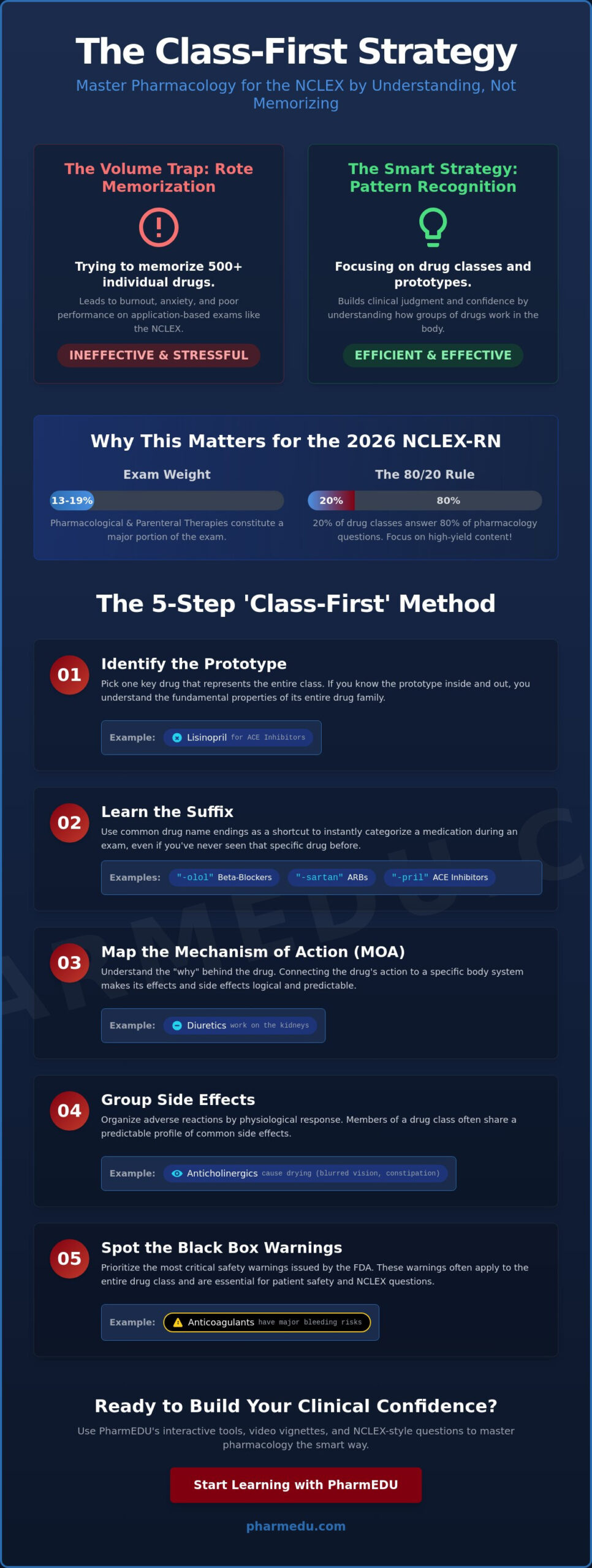
Many students fall into the “Volume Trap” by trying to memorize 500 or more individual drugs. This approach is a recipe for failure because it treats pharmacology like a dictionary instead of a system. To succeed, you need to understand the difference between academic pharmacology, which focuses on the science of drug chemistry, and clinical pharmacology, which focuses on how the drug affects the patient. For a comprehensive overview of pharmacology and its various branches, foundational knowledge in pharmacokinetics and pharmacodynamics is essential. These concepts explain how the body processes a drug and how the drug acts on the body. As of 2026, nursing standards prioritize safety-first clinical reasoning. This means exams now test your ability to predict patient outcomes rather than just naming a side effect from a list.
The Memorization vs. Understanding Debate
Rote memorization often fails during high-stakes exams because NCLEX-style questions are designed to test application. When you understand the mechanism of action, or the “why” behind a drug, you naturally know the “what” regarding its effects and nursing interventions. If you know a drug blocks a specific receptor, you can predict both its therapeutic effect and its side effects without a textbook. The Nursing Process in pharmacology is a cyclical safety framework consisting of assessment, diagnosis, planning, implementation, and evaluation. This shift in perspective is the first step in mastering how to study for pharmacology in nursing school without losing your mind to endless lists.
Identifying High-Yield Content Early
Your syllabus is a roadmap to the “Must-Know” drug classes. Instead of studying every drug in the book, apply the 80/20 rule: roughly 20% of drug classes represent 80% of the questions you’ll see on exams and in clinical practice. Focus your energy on prototype drugs, which serve as the primary example for an entire classification. If you master one prototype, you’ve essentially learned the characteristics of dozens of related medications. Learning how to study for pharmacology in nursing school effectively means identifying these high-yield targets early in the semester to maximize your study efficiency. You don’t need to know every rare drug; you need to be an expert on the ones that represent the greatest risk or benefit to your patients.
The ‘Class-First’ Strategy: How to Master Drug Classifications
Mastering drug classifications is the most effective way to manage the massive curriculum of a modern nursing program. Instead of viewing each medication as an isolated island of information, you should treat them as members of a family with shared characteristics and predictable behaviors. This systematic approach is the gold standard for how to study for pharmacology in nursing school without falling into the trap of rote memorization. For more foundational advice, these pharmacology study tips from Chamberlain University emphasize the importance of moving beyond simple recall to focus on broader categories.
To implement this strategy, follow these five methodical steps:
- Identify the Prototype: Pick one drug that perfectly represents the class, such as Lisinopril for ACE Inhibitors. If you know the prototype, you know the family.
- Learn the Suffix: Look for common linguistic markers like “-olol” for Beta-Blockers or “-sartan” for Angiotensin II Receptor Blockers.
- Map the MOA: Connect the Mechanism of Action to a specific body system. Understanding that diuretics work on the kidneys makes their effects logical.
- Group Side Effects: Organize reactions by physiological response. For example, anticholinergics “dry you up,” leading to blurred vision and constipation.
- Spot the Black Box: Focus on critical safety warnings and nursing considerations that apply to the entire class, such as bleeding risks for anticoagulants.
Using Suffixes to Decode Drug Names
Suffixes serve as a secret code during high-stakes exams. Creating a “Suffix Cheat Sheet” allows you to categorize unfamiliar drugs instantly. It’s a powerful tool, but you must watch for pitfalls. While “-mab” always indicates a monoclonal antibody, it’s easy to confuse it with “-nib,” which refers to kinase inhibitors. Both are biological modifiers, but their clinical applications are distinct. Linking these suffixes to their pharmacologic classes in your notes ensures you don’t guess when the clock is ticking. If you need a more visual way to connect these names, interactive pharmacology flashcards can help solidify these patterns through spaced repetition.
Grouping Adverse Effects by Body System
Most medications within a single class share roughly 80% of their side effect profile. Using a “Head-to-Toe” assessment method helps you remember these patterns without a list. For a patient on a calcium channel blocker, start at the head (headaches), move to the heart (bradycardia), and end at the feet (peripheral edema). This method helps you distinguish between common side effects and life-threatening adverse reactions. It’s a critical skill for how to study for pharmacology in nursing school because it mirrors the way you’ll actually monitor patients in a clinical setting.
Active Learning Techniques: Flashcards, Mnemonics, and Micro-Learning
Passive reading is the enemy of retention. Many students spend hours highlighting textbooks only to realize they can’t recall a single contraindication during a quiz. If you want to master how to study for pharmacology in nursing school, you must transition to active learning strategies. These methods force your brain to retrieve information, which strengthens neural pathways and ensures that critical drug data stays accessible during high-stakes clinical moments. In 2026, the most successful students utilize digital tools that leverage micro-learning, breaking complex topics into manageable, five-minute sessions that fit into a hectic clinical schedule.
Digital Spaced-Repetition Systems (SRS) have revolutionized the way we handle information. Unlike paper cards, digital platforms track your performance and show you difficult medications more frequently. High-yield video vignettes further enhance this by visualizing drug mechanisms in under five minutes. This visual approach is especially helpful for complex processes like the RAAS pathway or the coagulation cascade. For students who spend hours commuting or at the gym, audio learning serves as a powerful supplement. Listening to drug class reviews during “dead time” transforms passive hours into productive study blocks without adding to your mental fatigue.
Designing Effective Pharmacology Flashcards
The biggest mistake students make is cluttering cards with too much text. You should follow the “One Fact Per Card” rule to prevent cognitive overload. If a card contains the drug name, mechanism, side effects, and nursing interventions, your brain will struggle to anchor the information. Instead, create separate cards for each specific detail. Focus heavily on nursing interventions rather than just doses. To save time and ensure accuracy, you can utilize Interactive Pharmacology Flashcards which provide pre-made, expert-vetted content that aligns with the latest 2026 nursing standards.
Effective Mnemonics for Nursing Students
Mnemonics remain a staple of nursing education because they provide a mental “hook” for stubborn facts. Classic examples like “SLUDGE” for cholinergic crisis (Salivation, Lacrimation, Urination, Defecation, Gastric upset, Emesis) are still essential today. While pre-made mnemonics are helpful, creating your own personalized stories for the drugs you find most difficult often leads to better long-term recall. Active recall is superior to passive re-reading because it requires the brain to reconstruct the information, making the memory significantly more durable. By actively engaging with the material through these creative shortcuts, you turn an overwhelming list of facts into a structured, retrievable knowledge base.
Bridging the Gap: NCLEX-Style Questions and Clinical Case Studies
Simply knowing a drug’s name and its primary effect won’t guarantee success on your exams or in the hospital. The 2026 NCLEX-RN standards place a massive emphasis on clinical judgment, meaning you’re tested on your ability to make safe decisions under pressure. If you’re looking for how to study for pharmacology in nursing school effectively, you must move beyond the “what” and focus on the “so what.” When a question asks about a patient taking a diuretic, the exam isn’t checking if you know it increases urination; it’s checking if you know to assess for hypokalemia before the patient experiences a cardiac event.
Deconstructing these questions requires a sharp eye for “Strategic Words.” Terms like “initial,” “priority,” “best,” or “immediate” are signals that multiple answers might be technically correct, but only one is the safest first step. You should also ground your practice in the “Rights of Medication Administration.” In many exam scenarios, the correct answer hinges on verifying the right patient, dose, or route, reflecting the safety-first culture of modern nursing. By practicing with these high-stakes scenarios, you build the mental muscle memory needed to avoid clinical errors during your rotations.
Mastering the Rationale
The most important part of a practice quiz isn’t the score you receive at the end. It’s the rationale provided for every answer choice. You’ll learn more from why an answer was “wrong” than from confirming what you already knew. If you consistently miss questions about medication timing, your digital analytics will reveal that specific weakness. You can then target those gaps using board-aligned Pharmacology Practice Quizzes to ensure your knowledge is both broad and precise. Tracking these trends allows you to study smarter, not longer, by focusing on the drug classes that actually challenge you.
Applying Knowledge in Clinical Case Studies
Real-world nursing is rarely as simple as a single drug for a single condition. Patients often deal with polypharmacy, where multiple medications interact in complex ways. Case studies simulate these messy, real-life scenarios, forcing you to prioritize nursing actions when an adverse effect occurs. This practice is essential for how to study for pharmacology in nursing school because it builds professional confidence before you ever step onto a clinical floor. To master these complex interactions, you can explore Clinical Case Studies that bridge the gap between textbook theory and bedside reality. Start practicing these high-yield scenarios today to ensure you’re prepared for the clinical judgment demands of the 2026 licensure exam.
Optimizing Your Study Workflow with PharmEDU
Traditional textbooks are static, heavy, and often outdated by the time they reach your desk. In contrast, a professional digital platform offers dynamic updates that reflect the most current drug approvals and safety regulations. If you’re refining how to study for pharmacology in nursing school, your workflow must adapt to the fast-paced nature of modern healthcare. Integrating a mobile-compliant design into your daily life allows you to turn “hidden” pockets of time into productive study sessions. Whether you’re waiting for a bus or between clinical shifts, 10 to 15 minute blocks of micro-learning prevent the burnout associated with marathon cramming sessions.
High-yield video vignettes provide a significant advantage over dry, hour-long academic lectures. These concise segments focus strictly on the clinical essentials, using visual cues to anchor complex mechanisms in your memory. For those in institutional settings, platform licensing allows faculty to track progress and provide targeted support where students struggle most. This data-driven approach ensures that no student falls behind due to the sheer volume of data. By shifting your focus from passive reading to active, technology-driven engagement, you’ll find that mastering drug data becomes a manageable part of your professional development.
Creating a 2026 Study Schedule
Consistency beats intensity every time. We recommend the “Daily 30” routine, where you dedicate exactly 30 minutes to pharmacology every single day, regardless of your other coursework. This habit prevents the “forgetting curve” from eroding your progress, which is a vital component of how to study for pharmacology in nursing school effectively. Balancing this with core subjects like Med-Surg requires a strategic approach to ensure you aren’t neglecting physiological integrity for the sake of drug lists. For a step-by-step breakdown of this routine, consult The Ultimate Pharmacology Study Guide for Nursing Students in 2026. This resource helps you align your calendar with the high-yield topics most likely to appear on your exams.
Leveraging Professional Support
While student forums can offer peer support, they often lack the clinical precision required for professional practice. Moving toward expert-led education platforms ensures that the information you’re consuming is accurate, vetted, and up to date with 2026 regulations. Digital mentors act as a bridge, helping you navigate new drug approvals and changing safety protocols that textbooks simply can’t keep up with. This professional guidance transforms your study time from a source of stress into a foundation for clinical excellence. Ready to elevate your performance? Start your professional journey today with a PharmEDU Monthly Subscription and gain the tools you need to succeed.
Build Your Path to Clinical Excellence
Transitioning from rote memorization to a systematic, class-first approach is the only sustainable way to stay ahead in 2026. By focusing on prototype drugs and utilizing active learning sessions, you’ve already simplified the most difficult course in the nursing curriculum. Understanding the physiological rationale behind every medication is what separates a safe, competent nurse from a student who simply recites facts for a quiz. Mastering how to study for pharmacology in nursing school isn’t about working harder; it’s about working with your brain’s natural ability to recognize patterns rather than fighting against a mountain of data.
You don’t have to manage this overwhelming volume of information on your own. Access over 100 high-yield topics through mobile-compliant micro-learning segments specifically designed for a busy clinical schedule. Our platform provides NCLEX-aligned practice quizzes and real-world case studies that ensure you’re ready for the latest 2026 licensure standards. Master pharmacology today with PharmEDU’s high-yield study tools. You have the professional roadmap. Now it’s time to build the clinical confidence your future patients deserve.
Frequently Asked Questions
What is the best way to start studying pharmacology as a beginner?
The best way to start is by mastering foundational principles like pharmacokinetics and pharmacodynamics before diving into specific drugs. These concepts explain how the body processes medications and how drugs interact with receptors. Understanding these basics allows you to predict drug behavior across entire classes. Beginners should prioritize learning the 20% of drug classes that appear in 80% of clinical scenarios to build early momentum and professional confidence.
How do I distinguish between drugs that have similar names?
Distinguishing between similar drug names requires a focus on Tall Man lettering and pharmacological suffixes. For instance, hydralazine and hydroxyzine look alike but serve vastly different purposes. You should always look for the unique suffix or prefix that identifies the drug class. This linguistic decoding is a core part of how to study for pharmacology in nursing school because it prevents dangerous medication errors during both exams and clinical rotations.
Is pharmacology in nursing school mostly math or memorization?
Pharmacology is a combination of dosage calculations and conceptual understanding, though the 2026 NCLEX-RN emphasizes clinical application over simple recall. While you must be proficient in dimensional analysis for safe dosing, the majority of the course focuses on drug mechanisms and patient safety. Successful students typically spend about 30% of their time on math and 70% on understanding the physiological impact of various drug classifications and prototype medications.
How many hours a week should I dedicate to studying pharmacology?
You should dedicate approximately 10 to 15 hours per week to pharmacology, ideally broken into daily micro-learning sessions. Consistent exposure is more effective than a single 10-hour block. By spending 30 minutes every day on active recall and another 2 to 3 hours on deeper conceptual reviews, you ensure long-term retention. This structured approach prevents the cognitive fatigue that often leads to burnout in high-volume nursing courses.
Can I use flashcards for every drug I learn in class?
No, creating flashcards for every single drug is inefficient and leads to information overload. Instead, create cards for prototype drugs that represent an entire class, such as using metoprolol to represent all beta-blockers. This strategy reduces your total workload by up to 60% while still covering the essential information. Focus your cards on high-yield facts like black box warnings and critical nursing assessments rather than obscure or rare side effects.
What are the most common drug classes tested on the NCLEX?
The most frequently tested drug classes on the NCLEX-RN include cardiovascular agents, endocrine medications like insulin, and psychotropic drugs. These categories account for a significant portion of the 13% to 19% of questions found in the Pharmacological and Parenteral Therapies section. You should also prioritize anticoagulants and respiratory medications, as these are critical for patient safety and appear often in the latest Next Generation NCLEX case studies.
What happens if I fail my first pharmacology exam?
If you fail your first exam, immediately analyze the rationales for every question you missed to identify if your weakness is in math, memorization, or clinical application. Many students fail because they rely on passive reading rather than active recall. Adjust your strategy to include more practice questions and prototype-based studying. Use digital analytics to track your progress and seek faculty support early to ensure you meet the 2026 passing standards.
Are online pharmacology study guides better than traditional textbooks?
Online study guides are generally superior for how to study for pharmacology in nursing school because they offer dynamic updates and interactive features that static textbooks lack. Digital platforms can integrate new FDA approvals or safety alerts within days, whereas textbooks may be outdated for several years. High-yield video vignettes and interactive quizzes provide a more engaging, efficient learning experience compared to reading hundreds of pages of dry academic text.