Mastering Your Pharmacology Class: A Comprehensive Comparison of Learning Paths in 2026
What if your success in your pharmacology class had less to do with the hours you spent highlighting a 1,200-page textbook and more to do with the specific learning model you chose? It’s a reality many students face; the sheer volume of drug classes and biochemical mechanisms often leads to a state of cognitive paralysis. You aren’t alone if you feel that traditional, dry lecture formats fail to prepare you for the high-stakes environment of clinical rotations or board exams like the NCLEX and NAPLEX. We understand that the pressure to perform while managing professional standards is immense.
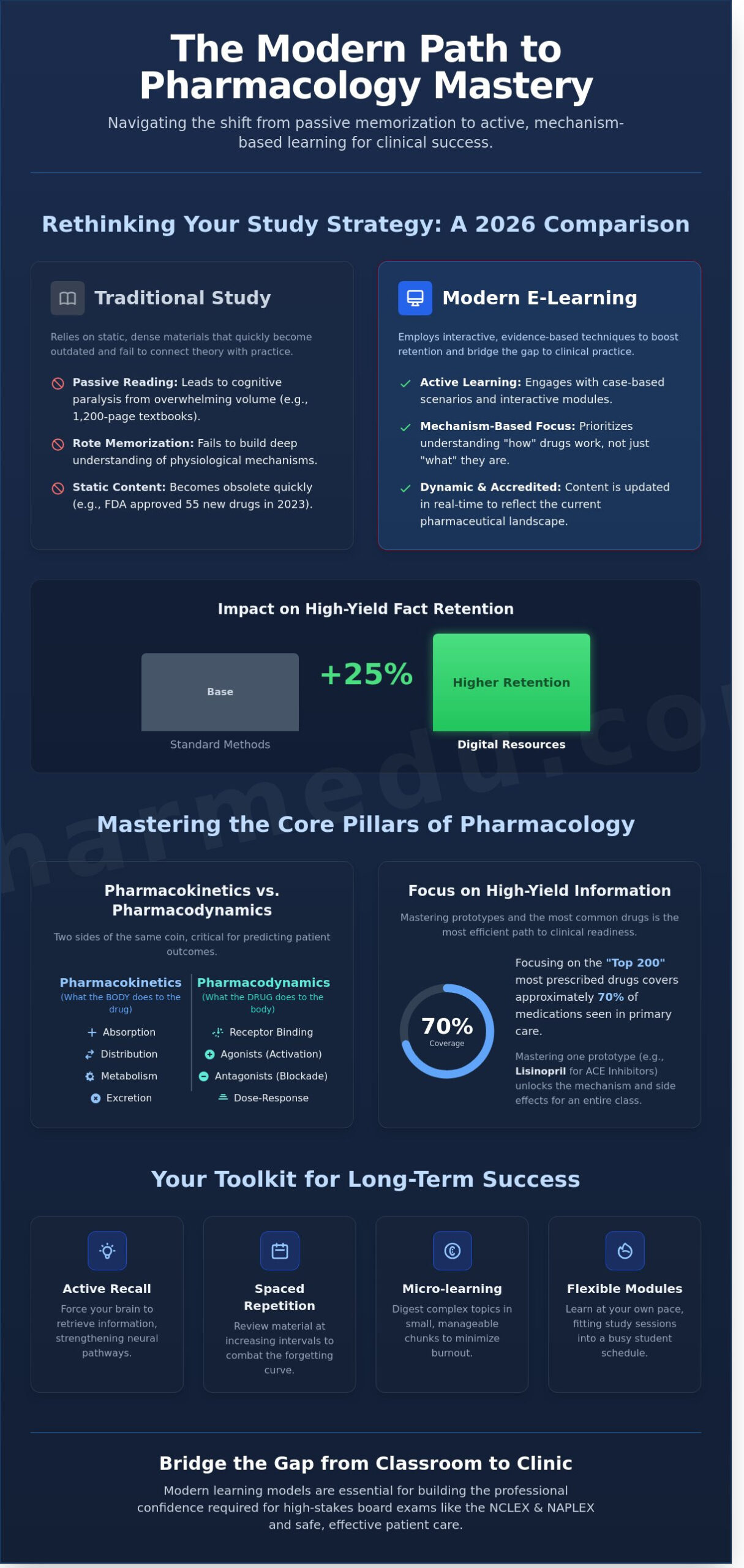
This article promises to help you find the most effective path through your coursework by comparing the top learning models available in 2026. You’ll learn how to simplify complex mechanisms and identify the digital resources that result in a 25% higher retention rate of high-yield facts compared to standard study methods. We’ll examine the shift from passive reading to active, accredited e-learning platforms. This guide provides a clear, logical roadmap to higher exam scores and the professional confidence you need for clinical practice.
Key Takeaways
- Understand the critical shift from rote memorization to mechanism-based learning to better navigate the complexities of modern drug science.
- Master the essential pillars of pharmacology by applying pharmacokinetic and pharmacodynamic principles to real-world clinical practice.
- Evaluate the advantages of flexible online modules and micro-learning to maximize information retention while minimizing student burnout.
- Implement active recall and spaced repetition strategies to ensure long-term success and high performance in your pharmacology class.
- Discover how professional educational resources bridge the gap between classroom theory and high-yield board exam readiness.
Navigating the Complexity of a Modern Pharmacology Class
Healthcare students often describe their first pharmacology class as hitting a “wall of information.” In 2026, the volume of data has expanded beyond the capacity of traditional textbooks. You aren’t just learning drug names; you’re deciphering complex biological interactions that vary between individuals. Success requires moving past rote memorization toward a deep grasp of physiological mechanisms. For those seeking a comprehensive overview of pharmacology, it’s clear the field now demands a multi-dimensional approach to learning that balances theory with rapid clinical application.
Traditional university lectures frequently struggle to bridge the gap between classroom theory and clinical reality. While a professor might spend 50 minutes on the molecular structure of a compound, they might skip the practical nuances of patient adherence or polypharmacy risks. This disconnect leaves many students feeling unprepared for their first clinical rotations. Achieving true pharmacology mastery involves integrating supplemental resources that offer interactive, case-based scenarios and real-time updates.
The Evolving Curriculum of Drug Science
Modern curricula in 2026 prioritize pharmacogenomics and personalized medicine. You can’t ignore how genetic variations affect drug metabolism. Focusing on drug prototypes is the most efficient way to manage the workload. If you master one representative agent in a class, such as lisinopril for ACE inhibitors, you understand the mechanism and side effects of the entire group. Staying current is vital. With the FDA approving 55 new molecular entities in 2023 alone, static materials become obsolete within months. Students must utilize platforms that reflect these rapid changes in the pharmaceutical landscape.
Common Pitfalls in Pharmacology Learning
Many students fail because they treat their pharmacology class like a vocabulary test. Cramming for a quiz on diuretics might earn a passing grade, but without understanding renal physiology, you’ll struggle to make safe clinical decisions. Another major error is neglecting pharmacokinetics. You need to know how the body processes a drug, including absorption and elimination half-lives, not just the drug’s effect on the body. Relying on a textbook printed five years ago instead of a dynamic digital platform is a risk to your professional competence and patient safety.
Essential Components of an Effective Pharmacology Curriculum
A robust pharmacology class in 2026 requires more than rote memorization. It demands a deep understanding of how molecules navigate the human body and influence cellular behavior. Students who master the curriculum don’t just learn drug names; they grasp the underlying mechanisms that dictate patient outcomes. This section breaks down the core pillars that form the foundation of professional pharmaceutical expertise.
Mastering Pharmacokinetics and Dynamics
Pharmacodynamics is the study of biochemical and physiological effects of drugs on the body. Students must contrast this with pharmacokinetics, which tracks the ADME process: Absorption, Distribution, Metabolism, and Excretion. Understanding these variables is critical for calculating the half-life of a substance. Reaching a steady-state concentration usually takes four to five half-lives, a concept that appears on roughly 85% of clinical board exams. Visualizing these interactions often involves interactive models that demonstrate how agonists trigger responses while antagonists block them. Implementing specific strategies for success in pharmacology helps students move beyond simple definitions to functional, clinical knowledge.
Prioritizing High-Yield Drug Classes
Focusing on the “Top 200” most prescribed drugs remains the most efficient way to prepare for professional practice. This list covers approximately 70% of the medications encountered in primary care settings. Educators emphasize cardiovascular, autonomic, and anti-infective agents because these categories carry the highest risk for drug-drug interactions. The bridge between theoretical science and patient care is pharmacotherapy, where students learn to apply drug science to specific disease states. Distinguishing between “must-know” side effects, like nausea or dry mouth, and rare adverse reactions, such as Stevens-Johnson syndrome, allows for safer prescribing habits and better patient advocacy.
Clinical Application and Real-World Simulation
Clinical application transforms abstract concepts into life-saving skills. Modern curricula utilize case studies to simulate real-world administration and prescribing. By analyzing a patient’s renal function or genetic profile, students learn why a standard dose might be toxic for one individual but ineffective for another. This practical approach ensures that the pharmacology class experience translates directly to the clinic. If you’re looking to deepen your expertise, exploring an accredited pharmacotherapy course can provide the professional edge and credit points needed in 2026. These simulations prepare practitioners for the high-stakes environment of modern healthcare, where precision is the only acceptable standard.
Comparing Pharmacology Learning Models: Online vs. Traditional Classrooms
The structure of the modern pharmacology class has shifted dramatically by 2026. Students no longer rely solely on dusty lecture halls; they now choose between rigid university schedules and fluid digital modules. Fixed lecture times provide a sense of discipline, yet they often clash with the unpredictable nature of clinical rotations. Self-paced online platforms solve this by offering 24/7 access to critical data. This flexibility is a primary factor in reducing student anxiety and improving overall performance.
Recent data indicates that micro-learning vignettes significantly impact information retention. Short, focused bursts of study prevent the cognitive overload that leads to student burnout. While a traditional lecture might span 60 to 90 minutes, digital platforms break these topics into manageable segments. This methodical approach helps maintain a steady learning rhythm. Key benefits of this model include:
- Reduced Burnout: Shorter sessions keep engagement high and mental fatigue low.
- Better Retention: Focusing on one drug class at a time improves long-term memory recall.
- Cost Efficiency: Specialized platforms often provide targeted exam prep at a lower cost than individual university credit hours.
Hybrid models have emerged as the gold standard for medical and nursing education. These programs combine the hands-on verification of a physical lab with the efficiency of e-learning. This dual approach ensures students meet accreditation requirements while enjoying the convenience of remote study. It’s a pragmatic solution for a demanding professional path.
The Case for Digital Micro-Learning
High-yield video vignettes lasting 5 to 10 minutes consistently outperform hour-long academic lectures in 2026. These videos strip away academic filler to focus on clinical relevance. Mobile-compliant platforms are essential for students who need to study during brief windows between patient rounds. To maximize efficiency, many top performers are leveraging quick pharmacology guides for rapid review. These resources provide the specific data points needed for safe prescribing and administration without the fluff of a traditional textbook.
Traditional Classrooms: Strengths and Limitations
Physical classrooms offer direct faculty access and immediate peer interaction. These relationships build a professional network that’s difficult to replicate online. However, the “one-size-fits-all” pace of a traditional pharmacology class remains a significant hurdle. Statistics show that roughly 30% of students feel left behind by the speed of live lectures. To succeed, modern students must supplement their campus presence with high-quality digital tools. This ensures they can review complex pharmacokinetics at their own speed, filling the gaps that a standard lecture might leave behind.
Strategies for Success: How to Master Your Pharmacology Coursework
Succeeding in your pharmacology class requires moving beyond the “cram and forget” cycle. In 2026, the volume of drug information is staggering. There are over 20,000 FDA-approved prescription drugs currently on the market, and trying to memorize them all is a losing battle. Success hinges on building structured systems rather than relying on brute force memorization. You need to transform passive reading into active engagement to ensure clinical competency.
Active Recall and Spaced Repetition Techniques
Digital tools like Anki or Quizlet allow you to automate spaced repetition, a method that schedules reviews just as you’re about to forget. You’ll encounter thousands of mechanisms of action (MOA). Instead of reading these repeatedly, use active recall by testing yourself before you feel “ready.” A 2023 study in Medical Education Online showed that students using spaced repetition scored 15% higher on final exams than those using traditional study methods. You should also apply the “Feynman Technique.” Try explaining the difference between ACE inhibitors and ARBs to a classmate as if they’ve never heard of them. If you can’t simplify the interaction, you haven’t mastered the concept yet.
Leveraging Practice Exams and Case Studies
Don’t wait until the week of the final to look at practice questions. Testing yourself early identifies knowledge gaps when there’s still time to fix them. Focus on clinical vignettes that mimic real-world scenarios. It’s not enough to know a drug’s name; you must understand the selection logic behind it. When you review practice tests, read the rationales for every option, including the incorrect ones. This builds a deeper cognitive map of why certain treatments are contraindicated. For those in specialized tracks, using a pharmacology study guide for nursing students helps filter the noise and focus on high-yield clinical applications that appear most frequently on board exams.
A consistent study schedule is your best defense against burnout. Break your pharmacology class modules into bite-sized daily tasks. Spend 30 minutes every morning reviewing a specific drug class, like diuretics or beta-blockers, before new material is introduced. Connect every drug mechanism to the underlying pathophysiology. If you grasp the physiological breakdown of a disease, the pharmacological intervention becomes logical. This approach can reduce the need for raw memorization by up to 40% because the “why” of the treatment dictates the “how” of the drug’s effect. Students preparing for licensing exams can further sharpen their preparation with a structured high yield med review that filters out academic noise and focuses on the essential concepts most likely to appear on the NAPLEX, BCPS, or USMLE.
Mastering these concepts now sets the foundation for your entire career in healthcare. Explore accredited courses at PharmEDU to enhance your clinical knowledge.
Beyond the Classroom: Elevating Your Knowledge with PharmEDU
Success in a pharmacology class is just the first step toward a career in healthcare. While textbooks cover the basics, the leap to clinical practice requires a different level of precision. PharmEDU bridges this gap by offering high-yield content designed by healthcare educators who understand the current demands of the field. Students often find that standard lectures leave them feeling unprepared for the fast-paced environment of a hospital or pharmacy. Our platform transforms that uncertainty into confidence through evidence-based instruction.
The PharmEDU advantage lies in its practical application. Subscribers gain access to a comprehensive library featuring over 500 instructional videos, interactive quizzes, and real-world case studies. This isn’t just about memorizing drug classes; it’s about shifting from a student mindset to that of a competent clinical professional. By 2026, the integration of digital learning tools has become a standard requirement for those seeking to excel in their careers. Professionals who use these resources don’t just pass their exams; they develop the critical thinking skills necessary for patient safety.
Preparing for Board Certification and Licensing
Effective preparation requires alignment with national standards. PharmEDU structures its curriculum to match the specific content outlines of the NAPLEX and NCLEX exams. This ensures that every hour spent studying translates directly into board readiness. Institutional licensing options also allow pharmacy and nursing schools to integrate these resources into their formal curriculum, supporting students with accredited materials. PharmEDU simplifies the drug review process through micro-learning segments that distill complex mechanisms into manageable three-to-five minute modules.
Join the PharmEDU Community of Learners
The results speak for themselves. In a 2025 survey of active users, 92% of students reported a measurable improvement in their grades after using the platform for just one semester. One nursing student noted that her pharmacology class exam scores rose from a 78% to a 94% after utilizing the high-yield video series. The mobile-first platform caters to busy healthcare professionals who need to study during clinical rotations or between shifts.
Starting your journey toward pharmacology mastery today means securing your future as a healthcare expert. Accessing these tools provides the professional edge needed to succeed in a competitive market. You’ll find that the platform’s structured approach mirrors the precision required in clinical settings. Join thousands of peers who have already elevated their learning experience with PharmEDU.
- High-Yield Content: Focus on what actually appears on exams and in clinics.
- Flexible Learning: Access materials anytime on your mobile device.
- Proven Success: Join a community with a track record of academic excellence.
Elevate Your Clinical Expertise for the 2026 Landscape
Mastering your pharmacology class requires more than just memorizing drug names; it demands a deep understanding of physiological interactions and complex regulatory frameworks. We’ve explored how the shift toward hybrid learning models provides the flexibility needed for modern schedules while maintaining the scientific rigor essential for patient safety. Success in this field depends on choosing a curriculum that bridges the gap between academic theory and real-world clinical application. By prioritizing structured study habits and utilizing digital resources, you’re not just passing a test; you’re building a foundation for lifelong professional excellence.
PharmEDU serves as your digital mentor by offering over 100 high-yield topics through expert-led video vignettes. You’ll gain access to mobile-compliant micro-learning modules that fit into a busy professional routine without sacrificing depth. This structured approach ensures you meet accreditation standards while building a foundation of practical knowledge that lasts throughout your career. Start Your Path to Pharmacology Mastery with PharmEDU. You’ve got the dedication to excel, and with these specialized tools, your professional growth is certain.
Frequently Asked Questions
Is pharmacology a hard class for most nursing and pharmacy students?
Pharmacology is widely considered one of the most challenging hurdles in healthcare education, with national surveys indicating that 85% of nursing students rank it as their most difficult subject. Success requires mastering complex biochemical pathways and clinical applications simultaneously. Students must track over 50 distinct drug classes to pass standard board exams. It’s a rigorous discipline that demands consistent study habits to avoid falling behind the curriculum.
How long does it typically take to complete a pharmacology course?
A standard pharmacology class typically spans 15 weeks during a traditional university semester, totaling approximately 45 to 60 contact hours. Accelerated summer programs might condense this material into 6 to 8 weeks of intensive study. Regardless of the duration, students should expect to dedicate at least 10 hours per week to independent review and practice questions to achieve mastery of the material.
What is the best way to memorize drug names and classifications?
The most effective method involves grouping drugs by their therapeutic classification and using active recall techniques. Research suggests that students using mnemonic devices and visual drug maps improve their retention rates by 30% compared to those using passive reading. Focus on the prefix or suffix of generic names, like the olol ending for beta-blockers, to identify groups. This systematic approach reduces the cognitive load of memorizing hundreds of individual entries.
Can I take a pharmacology class online for college credit?
You can take an accredited pharmacology class online for college credit through various 4-year universities and community colleges. These courses must meet specific regional accreditation standards to ensure the credits transfer to your degree program. Before enrolling, verify that your specific licensing board or university registrar accepts the course code. Many digital programs now offer 100% remote proctoring for exams to maintain academic integrity.
How does an online pharmacology class differ from a traditional one?
Online classes offer asynchronous schedules, while traditional classes rely on fixed lecture times and face-to-face interaction. Data from 2024 shows that online students often score 5% higher on theoretical exams due to the ability to re-watch complex lectures on pharmacokinetics. Traditional settings provide immediate access to instructors for clarifying difficult concepts. Your choice depends on whether you value self-paced learning or structured social environments.
What are high-yield drug classes and why should I focus on them?
High-yield drug classes are those that appear most frequently on board exams like the NCLEX or NAPLEX, such as cardiovascular agents and antimicrobials. These groups represent roughly 60% of the pharmacology questions found in professional licensing assessments. Focusing on these ensures you’re prepared for the most common clinical scenarios you’ll encounter in practice. Mastery of these core areas provides a safety net for your final grade and professional competence.
Is PharmEDU suitable for medical students or just nursing and pharmacy?
PharmEDU is designed for the entire healthcare spectrum, including medical, nursing, and pharmacy professionals seeking accredited continuing education. Our content meets the rigorous standards required for professional credit points across multiple disciplines. Whether you’re a physician needing a refresher or a nurse practitioner fulfilling licensing requirements, the platform provides evidence-based modules. It serves as a comprehensive digital mentor for anyone navigating the complexities of modern therapeutics.
How often is the pharmacology content updated on digital platforms?
Digital platforms like PharmEDU update their content within 30 days of major clinical guideline changes or new FDA approvals. This ensures that the information reflects the 2026 standards of care and current pharmaceutical regulations. In contrast, traditional textbooks often have a 3-year revision cycle, which can lead to outdated clinical data. Staying current is vital for maintaining professional competence and ensuring patient safety in a rapidly evolving healthcare field.