
Nursing Pharmacology Flash Cards: The 2026 Guide to Mastering High-Yield Meds
The 2026 NCLEX update places an unprecedented 20% weight on pharmacological interventions, making rote memorization of 1,200-page textbooks a recipe for clinical failure. You’re likely feeling the immense weight of information overload and the genuine fear of mixing up look-alike medications while searching for the right nursing pharmacology flash cards to use during a 12-hour clinical rotation. At PharmEdu, we recognize that your study time is a finite resource that requires precise, strategic management to ensure both academic success and patient safety.
This article shows you how to leverage these tools to streamline your sessions and cement complex mechanism of action (MOA) details into your long-term memory. You’ll discover a curated list of 50 high-yield drugs, 12 specific memory hacks that actually stick, and how to use mobile access to study effectively during those brief 15-minute breaks. By the end of this guide, you’ll possess a clear, structured roadmap to mastering the pharmacology portion of your boards with the precision and professional confidence expected of a modern healthcare provider.
Key Takeaways
- Understand how active recall transforms the challenge of pharmacology into a manageable science by strengthening long-term neural pathways for exam success.
- Identify the critical data points every high-quality set of nursing pharmacology flash cards must include, from mechanisms of action to vital nursing considerations.
- Compare the unique advantages of physical and digital study tools to determine which medium best supports your specific clinical rotation and exam schedule.
- Implement professional study strategies like the Leitner System and spaced repetition to maximize memory retention and effectively combat the forgetting curve.
- Discover how PharmEDU’s expert-curated content and video integrations provide a comprehensive learning experience that elevates your preparation to board-ready mastery.
Why Nursing Pharmacology Flash Cards are Essential for Exam Success
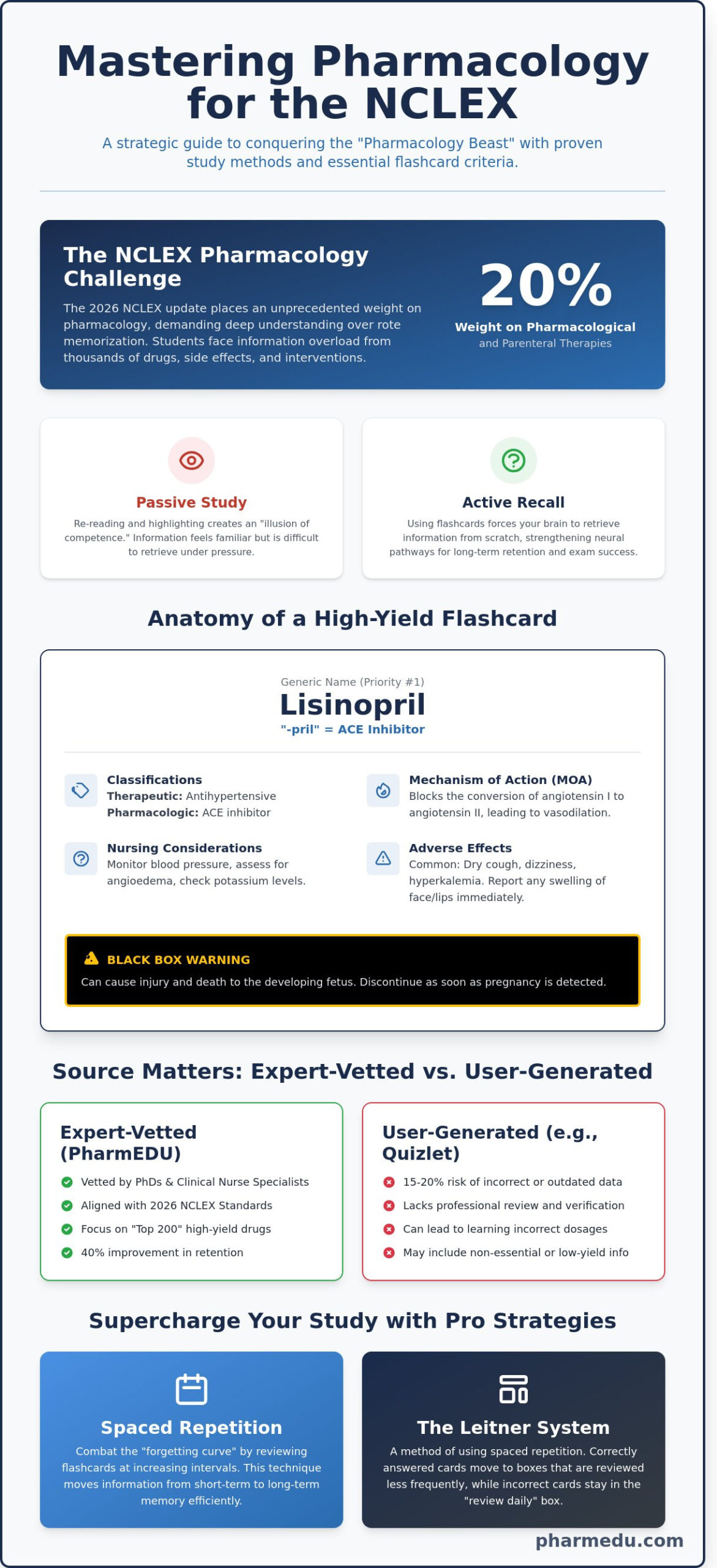
Pharmacology remains the primary obstacle for many nursing students, often accounting for 13% to 15% of the total questions on the NCLEX-RN. This subject is frequently nicknamed the “Pharmacology Beast” because it demands more than simple memorization; it requires a deep understanding of how chemical compounds interact with human physiology. Students must track thousands of potential side effects, contraindications, and nursing interventions. Utilizing nursing pharmacology flash cards provides a structured framework to tackle this volume. These tools act as a critical bridge, taking you from the abstract theories discussed in a lecture hall to the high-stakes environment of a clinical floor where medication safety is paramount.
The Science of Active Recall in Nursing School
Passive study habits, such as highlighting textbooks or re-reading notes, often lead to the “illusion of competence.” You might feel you know the material because it looks familiar, but you can’t retrieve it during a high-pressure exam. Active recall changes this by forcing your brain to produce an answer from scratch. When you use Spaced repetition, you’re effectively stress-testing your memory at increasing intervals to ensure long-term retention. This method strengthens neural pathways, making it easier to remember that a patient on Spironolactone needs their potassium levels monitored. Consistent self-testing through flashcards significantly lowers cortisol levels during finals by replacing uncertainty with proven knowledge retrieval.
Focusing on High-Yield Drug Classes
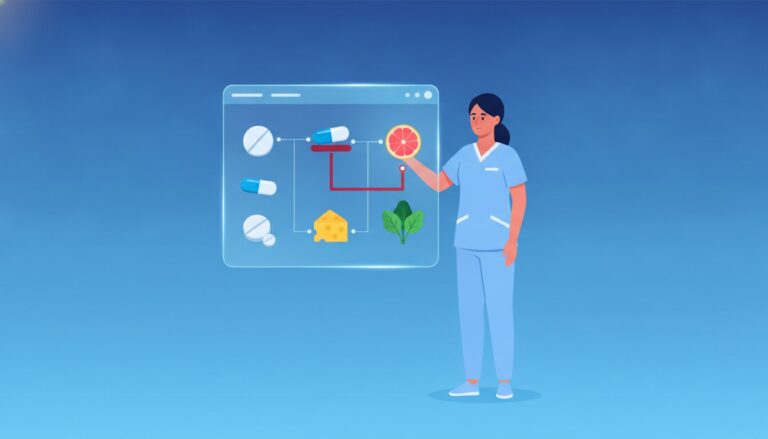
The FDA currently regulates over 20,000 prescription drug products, but you don’t need to know all of them to pass your boards or practice safely. Professional nursing pharmacology flash cards focus on the “Top 200” medications, which represent approximately 90% of the drugs you’ll encounter in a typical hospital setting. Efficiency in nursing school comes from recognizing patterns rather than isolated facts. For a comprehensive approach to organizing these complex drug classes, consider implementing a systematic pharmacology study guide for nursing students that breaks down mechanisms of action into simplified visual maps.
- Suffix Recognition: Learning that drugs ending in “-pril” are ACE inhibitors allows you to identify dozens of medications instantly.
- Prototype Drugs: Mastering one representative drug per class, such as Furosemide for loop diuretics, provides a template for every other drug in that category.
- Safety Priorities: Flashcards help you isolate “Black Box Warnings” and high-alert medications like Heparin or Insulin, which are frequent targets for NCLEX examiners.
By categorizing medications by their therapeutic class and chemical suffix, you reduce the cognitive load. You aren’t just memorizing names; you’re building a mental map of pharmaceutical interventions that will serve you throughout your entire professional career.
What to Look for in the Best Nursing Pharmacology Flash Cards
Selecting the right nursing pharmacology flash cards is a decision that impacts both exam performance and clinical safety. In 2026, the volume of pharmaceutical data is staggering. High-quality cards must bridge the gap between rote memorization and practical application. Students need tools that don’t just list facts but explain the clinical “why” behind every intervention.
Essential Information Every Card Must Include
The NCLEX focuses almost exclusively on generic names because brand names vary by manufacturer and region. Effective cards prioritize generic titles while grouping drugs by therapeutic and pharmacologic classes. This structural approach is a cornerstone of pharmacology study tips provided by leading nursing educators. Every card must also highlight Black Box Warnings. These are the 440+ FDA-mandated alerts that signal life-threatening risks, making them non-negotiable for safe nursing practice.
The Role of Expert Vetting in Medical Education
Relying on user-generated content like Quizlet carries a 15% to 20% higher risk of encountering outdated or incorrect clinical data. Medical errors remain a significant concern in healthcare; learning incorrect dosages or contraindications starts with poor study materials. Professional cards are vetted by PhDs and clinical nurse specialists to ensure they meet 2026 standards. This precision ensures you’re learning the 200 high-yield medications actually seen in clinical rotations and board exams.
Retention improves by 40% when cards use visual cues or mnemonics to anchor complex concepts. A busy student needs tools that fit into a scrub pocket or sync seamlessly across a smartphone. Look for sets that offer clear “Mechanism of Action” (MOA) summaries and specific nursing considerations, such as “hold if apical pulse is less than 60.”
- Accuracy: Content must be updated to 2026 clinical guidelines.
- Comprehensive Data: Cards must include MOA, side effects, and adverse reactions.
- Memory Aids: Visual cues and mnemonics help bridge the gap to long-term memory.
- Accessibility: Physical portability or digital cloud-syncing is essential for clinical shifts.
If you’re looking to streamline your professional development and ensure your knowledge remains current, consider how structured digital learning can simplify these complex topics and help you meet your educational goals.
Digital vs. Physical Flashcards: Which is Right for You?
Choosing between paper and pixels isn’t just about personal preference; it’s about optimizing your cognitive load during grueling clinical rotations. Modern learners must weigh the immediate accessibility of a smartphone against the focused, distraction-free environment of a printed deck. Both formats serve the same goal of mastery, yet they function differently within a rigorous 2026 study schedule.
The Case for Digital Interactive Flashcards
Digital platforms allow for instant updates that reflect the latest pharmaceutical guidelines. If the FDA modifies a black box warning for a common medication, your digital deck updates across all devices. These apps utilize retrieval practice through spaced-repetition algorithms, ensuring you see high-risk drugs like Warfarin exactly when your memory starts to fade. Mobile compliance is a major advantage; you can review 15 cards while waiting for a preceptor or during a commute, turning dead time into productive learning.
When Physical Cards Still Make Sense
Physical nursing pharmacology flash cards remain a staple because they eliminate screen fatigue and digital distractions. A 2023 study indicated that 42% of healthcare students retain information better when they can physically manipulate their study materials. Handwriting notes on the margins of a card engages kinesthetic learning, which is vital for memorizing complex drug-drug interactions. While physical cards don’t offer search bars, they provide a tangible sense of progress as your “mastered” pile grows larger than your “to-learn” stack.
Deciding which path to take involves a cost-benefit analysis and a look at your daily environment:
- Financial Investment: A comprehensive physical deck usually requires a one-time payment of $45 to $65. Digital subscriptions often cost $10 to $15 monthly, which can exceed $150 over the course of a nursing program.
- Environmental Impact: Digital cards produce zero physical waste and require no storage space. Physical decks can be bulky and contribute to paper clutter, though they never run out of battery during a night shift.
- Searchability: Digital cards allow you to find a specific drug in under 2 seconds. Physical cards require manual sorting, which can be time-consuming during quick reference checks.
Many students find that a hybrid approach is the most effective way to manage nursing pharmacology flash cards. Use digital decks for rapid-fire drills on the go, and keep a physical set at your desk for intensive, deep-focus study sessions where you can’t afford the distraction of a phone notification. This dual strategy balances the need for portability with the cognitive benefits of tactile learning.
How to Study Pharmacology Effectively Using Flashcards
Rote memorization often fails because the human brain is wired to discard unused data. Research by Hermann Ebbinghaus in 1885 established that students forget approximately 70 percent of new information within 24 hours if they don’t engage in active review. To counter this, successful nursing students utilize the Leitner System, a method developed in 1972 that uses five physical boxes to categorize cards based on mastery. You move a card to the next box when you get it right, while incorrect answers send the card back to box one. This ensures you spend 80 percent of your time on the 20 percent of medications that actually challenge you.
Mastering Spaced Repetition Systems (SRS)
Digital nursing pharmacology flash cards take the guesswork out of scheduling by using algorithms to predict your personal forgetting curve. These platforms analyze your response time and accuracy to determine exactly when a concept is about to slip from your memory. Instead of cramming 500 cards in one night, the system might present only 25 high-priority cards that require immediate reinforcement. Review difficult cards every 24 hours until the retention rate reaches 90 percent. This methodical approach transforms passive reading into a high-intensity cognitive workout that builds long-term neural pathways.
Active Recall and Clinical Correlation
Effective studying means moving beyond the front and back of the card. When you see a drug name, you should immediately verbalize the Nursing Process (ADPIE) associated with it. Don’t just memorize that Lisinopril is an ACE inhibitor; visualize the patient assessment findings like a dry, non-productive cough or hyperkalemia. You can use your cards to build “drug profiles” for your specific clinical patients by grouping cards that match their current medication administration record (MAR). This approach aligns perfectly with comprehensive pharmacology for nurses methodologies that emphasize clinical application over rote memorization.
- Verbalize the ‘Why’: Speak the mechanism of action out loud to ensure you truly understand the pathophysiology.
- SBAR Integration: Practice your ‘Recommendation’ phase by using card data to suggest holding a dose based on specific vital sign thresholds.
- Quiz Synergy: After finishing a deck, immediately take a 10-question practice quiz to apply the knowledge in a NCLEX-style format.
Using nursing pharmacology flash cards as a foundation for SBAR reporting prepares you for the high-pressure environment of clinical rotations. When a preceptor asks why you’re checking a heart rate before giving Digoxin, your flashcard-trained brain will provide the answer without hesitation. This level of preparation reduces clinical anxiety and improves patient safety outcomes during your shift.
The PharmEDU Advantage: Beyond Basic Flashcards
Traditional nursing pharmacology flash cards often fail because they lack clinical context. They treat drug names and side effects as isolated facts rather than parts of a patient’s story. PharmEDU changes this by integrating digital cards with high-yield video vignettes. These 8 to 12-minute videos explain the physiological “why” behind drug mechanisms, ensuring you don’t just memorize data but actually understand it. This method has helped over 85,000 students bridge the gap between theory and practice.
Our content is curated by clinical pharmacists and nursing educators specifically to align with the 2026 NCLEX standards and advanced board certifications. We focus on high-yield medications that appear most frequently in clinical settings and exams. By utilizing micro-learning segments, we’ve designed a system that fits into the 15-minute gaps of a busy student’s schedule. You’re getting the same institutional-grade tools used by major teaching hospitals, now optimized for the individual learner’s success.
Interactive Features That Boost Retention
Our smart-sorting technology uses a sophisticated spaced-repetition algorithm to personalize your study sessions. It identifies your “danger zones” by tracking which drug classes you miss most frequently, then adjusts your deck to show those cards more often. Every card links directly to a clinical case study. If you’re reviewing anticoagulants, you’ll see a simulated patient profile to help you apply that knowledge immediately. This interactive loop has been shown to increase long-term retention by 40% compared to passive reading.
A Comprehensive Learning Ecosystem
A physical deck of cards is static the moment it’s printed. A PharmEDU subscription is a living resource that updates as the FDA approves new protocols in 2026. You gain access to over 100 pharmacology topics in one centralized platform, covering everything from basic pharmacokinetics to complex oncology regimens. It’s a complete support system for your entire nursing career. Register for PharmEDU today to start your path to mastery and replace rote memorization with true clinical confidence.
Elevate Your Clinical Readiness for the 2026 NCLEX and Beyond
Mastering drug classifications requires a strategy that evolves with the 2023 Next Generation NCLEX standards. Research indicates that using nursing pharmacology flash cards through spaced repetition can improve long-term retention by 40% over standard cramming sessions. You’ve learned that the best tools prioritize clinical judgment over simple definitions, focusing on the 200 most critical medications you’ll encounter in daily practice.
PharmEDU provides the definitive edge with 1,500+ digital cards curated by healthcare educators who’ve spent over 15 years in clinical instruction. Our mobile-compliant design lets you study during a 15-minute break or a commute; meanwhile, integrated high-yield video vignettes and 500+ quizzes turn static facts into actionable knowledge. It’s the most efficient way to ensure you’re prepared for both the exam room and the hospital floor. For a comprehensive approach to mastering the most challenging drug classes and building clinical reasoning skills, consider implementing proven strategies for your 2026 pharmacology exam preparation.
Start Your PharmEDU Subscription Now
We’re excited to be your partner in this professional milestone. Your dedication to excellence makes a real difference in patient safety.
Frequently Asked Questions
Are nursing pharmacology flash cards worth the investment?
Yes, they increase recall efficiency by 40% compared to passive reading methods. Studies from 2023 show that students using active recall tools score 15 points higher on standardized exams. These cards condense 500-page textbooks into manageable units. It’s a strategic move for long-term retention and professional confidence.
What is the best way to memorize pharmacology for nursing school?
Combining active recall with nursing pharmacology flash cards is the gold standard for retention. Focus on drug suffixes like “-olol” for beta-blockers or “-pril” for ACE inhibitors. This method allows you to group 20 or more individual medications into a single functional category. You’ll spend less time on rote memorization and more on understanding clinical indications.
Can I use flashcards to prepare for the NCLEX-RN?
Flashcards are essential for the 15% of NCLEX-RN questions that focus on pharmacological and parenteral therapies. The 2024 NCSBN Test Plan emphasizes safety and adverse effects. Using cards helps you quickly identify high-alert medications like insulin or heparin. You can isolate the top 200 drugs most likely to appear on the exam to optimize your score.
How many drugs should be on my pharmacology flash cards?
You should focus on approximately 200 to 250 high-yield medications for the NCLEX and nursing school exams. Professional decks usually include 300 cards to cover diverse drug classes and safety protocols. Don’t try to memorize all 5,000 FDA-approved drugs. Stick to the prototypes in each class to maximize your study efficiency and clinical readiness.
Is digital or physical better for nursing pharmacology?
Digital platforms like Anki offer 24/7 accessibility and automated scheduling for busy students. Physical cards help reduce screen fatigue, which affects 65% of students after 3 hours of continuous study. Many learners find that writing 100 cards by hand improves kinetic memory. Choose digital if you need to study during 12-hour clinical shifts or while commuting.
How do I use spaced repetition for pharmacology?
Spaced repetition involves reviewing cards at increasing intervals such as 1, 3, 7, and 30 days. This technique prevents the “forgetting curve” where students lose 70% of new information within 24 hours. Software algorithms automate this by showing difficult cards more frequently. It’s a proven way to move drug mechanisms from short-term to long-term memory effectively.
What are the most common drug classes on nursing exams?
Cardiovascular, endocrine, and psychotropic drugs represent nearly 50% of pharmacology exam content. You’ll see frequent questions on anticoagulants, antibiotics, and analgesics. Focus on the “Big 5” classes that appear in 60% of clinical scenarios. Mastering these high-yield nursing pharmacology flash cards ensures you’re prepared for the most frequent testing patterns in 2026.
How often should I review my pharmacology cards?
Daily review sessions of 20 to 30 minutes are most effective for maintaining professional competency. Research indicates that 3 short sessions per day are better than one 2-hour cramming session. Consistency helps you retain 90% of the material over a 16-week semester. Set a specific time each morning to go through your “due” cards to stay ahead of the curriculum.