
How to Read a Prescription Correctly: A Clinical Guide for Healthcare Students (2026)
Imagine standing in a high-pressure clinical environment, holding a medical order that looks more like a collection of abstract ink strokes than a life-saving instruction. Learning how to read a prescription correctly isn’t just a hurdle for your pharmacology exam; it’s the primary safeguard between a successful therapy and a critical medication error. It’s understandable if you feel a surge of anxiety when faced with archaic Latin abbreviations or illegible handwriting. Most students worry that a single misunderstanding of a “sig” code could compromise patient safety.
This clinical guide will transform that uncertainty into professional fluency by providing a systematic framework for interpreting every element of a medical order. We’ll master the standard parts of a prescription and decipher complex codes while addressing the latest 2026 regulatory shifts. You’ll learn about the DEA’s telemedicine extensions for controlled substances valid through the end of 2026, new accessibility labeling laws in states like Maryland and Iowa, and the essential legal requirements for passing your boards. By the end, you’ll approach the medication use process with the precision and confidence required of a modern healthcare professional.
Key Takeaways
- Understand the legal significance of a prescription as a formal clinical document that serves as a primary safeguard for patient safety.
- Learn how to read a prescription correctly by mastering the four essential structural components, including the superscription, inscription, subscription, and signa.
- Decipher complex Latin sig codes and identify the ISMP list of error-prone abbreviations to eliminate common points of clinical failure.
- Apply a systematic 5-step interpretation process that aligns with the “Rights of Medication Administration” to ensure every dose is clinically validated.
- Bridge the gap between classroom theory and practice by leveraging High-Yield Video Vignettes that simulate complex, real-world medication scenarios.
Understanding the Prescription as a Legal and Clinical Document
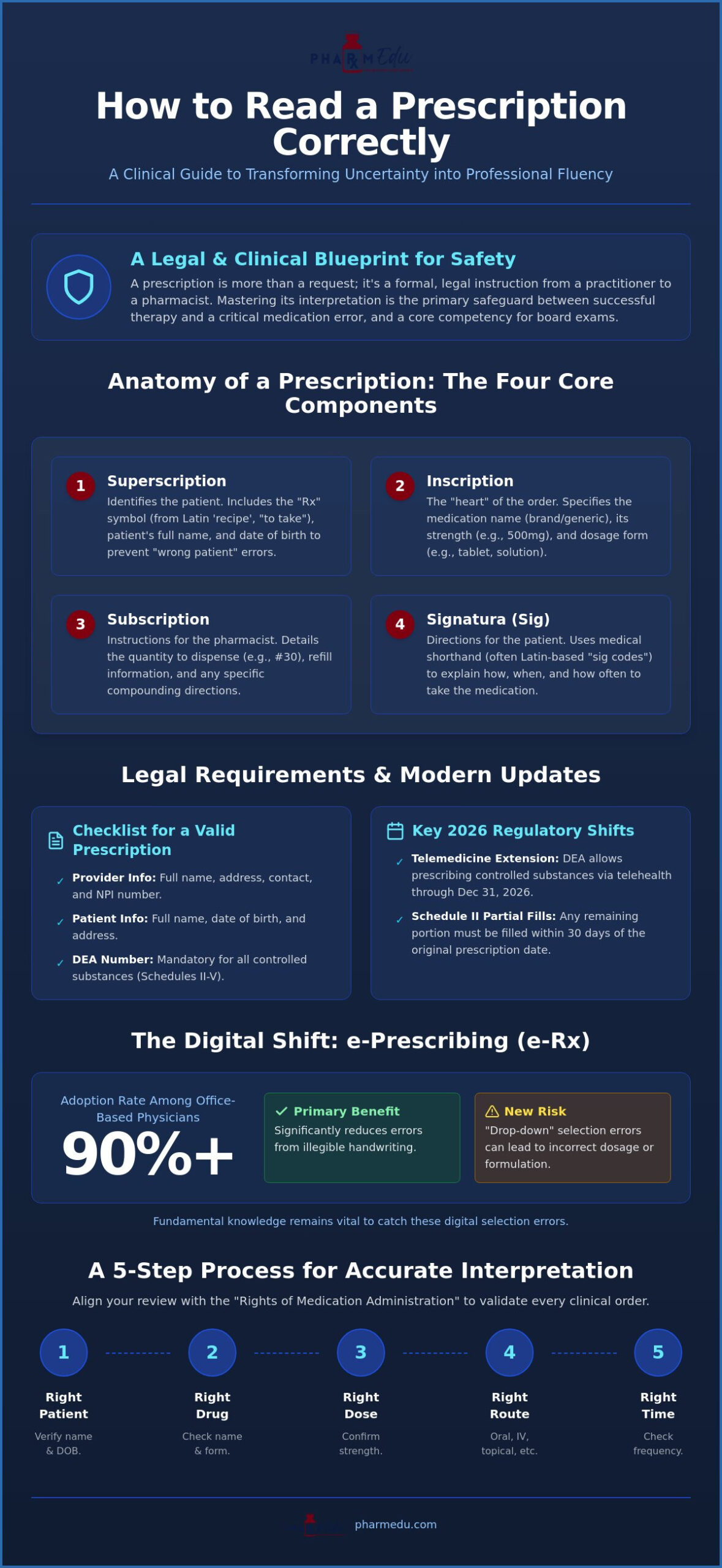
A Medical Prescription is much more than a simple request for medication. It’s a formal, legal instruction from a licensed healthcare practitioner to a registered pharmacist. This document carries significant legal weight because it authorizes the dispensing of substances that are strictly regulated under federal and state laws. For healthcare students, learning how to read a prescription correctly is a foundational skill that ensures patient safety by preventing errors before they reach the pharmacy counter. Mastery of this process is also a critical component of pharmacology board exams, where the ability to validate clinical orders is tested rigorously.
The Legal Requirements of a Valid Prescription
A valid prescription must contain specific identifiers to be legally enforceable. This includes the provider’s name, office address, and contact information, along with their National Provider Identifier (NPI). Patient identifiers like full name, date of birth, and address must be clearly stated to avoid identity errors. For orders involving controlled substances (Schedules II-V), the provider’s Drug Enforcement Administration (DEA) number is mandatory. Under 2026 federal standards, if a patient requests a partial fill of a Schedule II controlled substance, the remaining portion must be filled within 30 days of the original issue date. Additionally, the DEA has extended telemedicine flexibilities through December 31, 2026, allowing providers to prescribe controlled substances without an initial in-person visit in specific clinical contexts.
The Shift to Electronic Prescribing (e-Rx)
Deciphering the Four Essential Parts of a Medical Prescription
While many online resources focus on the pharmacy label found on a medication bottle, clinicians must understand the underlying structure of the original order. Learning how to read a prescription correctly requires a deep dive into the four traditional components that have guided medical practice for centuries. If any of these elements are missing or ambiguous, it triggers a “clarification” delay, stalling patient care while the pharmacist contacts the provider. These parts ensure that the right patient receives the right drug in the correct amount. To maintain a systematic approach, it’s helpful to remember that the four pillars of a prescription are the Superscription, which identifies the patient; the Inscription, which names the drug; the Subscription, which instructs the pharmacist; and the Signatura, which guides the patient.
Superscription and Inscription
The Superscription is anchored by the “Rx” symbol, derived from the Latin word recipe, meaning “take thou.” Beyond this symbolic header, this section must include accurate patient demographics, such as full name and date of birth, to prevent “wrong patient” errors. The Inscription is the “heart” of the document, as it identifies the medication, its strength, and the dosage form. Clinicians often struggle with brand versus generic naming conventions, which can lead to confusion during the dispensing process. For instance, a provider might write for “Lipitor” when “Atorvastatin” is the intended generic. Referencing MedlinePlus Drug Information can help students verify generic equivalents and therapeutic classes during their clinical rotations. Accuracy in the Inscription is vital because look-alike, sound-alike drug names are a primary source of medication errors.
Subscription and Signatura (Sig)
The Subscription tells the pharmacist exactly what to dispense, such as “Dispense 30 tablets” or “Mitte 15 capsules.” It also includes the number of authorized refills, which is strictly regulated for controlled substances. The Signatura is where the “Sig” codes live. These are the instructions that will eventually appear on the patient’s medication label. Modern safety standards increasingly emphasize including the “Indication” within the Sig to provide a secondary check. Writing “one tablet by mouth daily for blood pressure” provides a crucial context for both the pharmacist and the patient. If you’re looking to sharpen your recognition of these components, PharmEDU’s interactive pharmacology flashcards offer a practical way to drill these structures until they’re second nature. Understanding how to read a prescription correctly means looking past the abbreviations to the clinical intent behind the Subscription and Signatura.
Mastering Sig Codes: Common Latin Abbreviations and Their Meanings
Latin abbreviations persist in modern medicine primarily for the sake of clinical brevity. These shorthand codes allow practitioners to communicate complex instructions in a compact format, but they require absolute precision to interpret. Understanding how to read a prescription correctly means knowing which abbreviations are standard and which are dangerous. The Institute for Safe Medication Practices (ISMP) maintains a rigorous list of error-prone abbreviations that every healthcare student must recognize. For instance, using “U” for “units” is strictly discouraged because it’s easily misread as a zero, potentially causing a ten-fold insulin overdose. While patients often rely on a simplified how to read a prescription label, you must master the underlying clinical language to ensure no safety details are lost during the dispensing process.
To translate a string of sig codes into a plain English sentence, follow a systematic framework. Start with the action verb, such as “take,” “instill,” or “apply.” Follow this with the dosage quantity, the route of administration, the frequency, and finally any specific timing or indications. A string like “1 tab PO TID PC PRN pain” translates logically to: “Take one tablet by mouth three times daily after meals as needed for pain.” Breaking the code down into these functional units reduces the cognitive load and minimizes the risk of interpretive errors during a busy shift.
Timing and Frequency Abbreviations
Daily frequencies form the core of most medication regimens. You’ll encounter BID (twice daily), TID (three times daily), and QID (four times daily) on a near-constant basis. While “QD” was historically used for once daily, modern safety protocols prefer writing out “daily” to avoid confusion with QID. Use PRN for “as needed” orders, but ensure a specific indication is included. Timing codes like AC (before meals) and PC (after meals) are vital for medications that require specific gastric conditions for absorption. In acute care, you must distinguish between “stat” orders, which require immediate action, and “now” orders, which generally allow a broader window of up to 90 minutes depending on facility policy.
Route of Administration and Dosage Forms
The route of administration determines the drug’s pharmacokinetic profile. PO (by mouth) remains the most common, but you’ll also see SL (sublingual) for medications requiring rapid mucosal absorption. A frequent hurdle for students is distinguishing between ophthalmic and otic codes. Remember that “O” refers to ocular (eyes: OU, OD, OS) while “A” refers to aural (ears: AU, AD, AS). Dosage forms like Tab (tablet), Cap (capsule), Gtt (drops), and Susp (suspension) must be verified against the prescribed route to ensure clinical appropriateness. Mastering these distinctions is a non-negotiable step in learning how to read a prescription correctly before entering your clinical rotations.
A Systematic 5-Step Process for Accurate Prescription Interpretation
Mastering the clinical language of medicine is only the first half of the equation. To truly understand how to read a prescription correctly, you must shift your focus from passive translation to active clinical validation. This transition is a core pillar of pharmacology for nursing students and other healthcare disciplines. Instead of simply reading the words on the page, you’re acting as a safety filter, ensuring the order aligns with the “Rights of Medication Administration.” If any element of the order feels ambiguous or clinically inappropriate, the standard of care requires you to stop and contact the prescriber for clarification before the medication is dispensed or administered.
The 5-Step Verification Framework
- Step 1: Identify the Patient and Prescriber. Verify the patient’s identity using at least two markers and confirm the prescriber’s legal authority. With the 2026 extension of telemedicine flexibilities, ensure the provider has the appropriate credentials to prescribe controlled substances via remote platforms.
- Step 2: Validate the Medication and Strength. Check the drug name against common Sound-Alike/Look-Alike Drugs (SALAD). Cross-reference the strength with available manufacturer concentrations to ensure the order is realistic.
- Step 3: Calculate the Dose and Frequency. Perform the clinical math to ensure the prescribed dose falls within the safe therapeutic range. For pediatric or geriatric patients, this step often requires weight-based verification.
- Step 4: Confirm the Route and Quantity. Ensure the route of administration is appropriate for the patient’s condition. Verify that the total quantity dispensed covers the intended duration of therapy. Remember that for Schedule II partial fills, the remaining balance must be filled within 30 days of the issue date.
- Step 5: Review for Contraindications and Allergies. This is the final safety gate. Check the patient’s record for documented allergies or potential drug-drug interactions that the prescriber might have overlooked.
Red Flags Every Student Should Know
Decimal points are a frequent source of catastrophic errors. You should never see a trailing zero, such as 5.0 mg, because it’s easily misread as 50 mg if the decimal is faint. Conversely, always use a leading zero for doses less than one, like 0.5 mg, to prevent it from being read as 5 mg. Vague sigs like “take as directed” are another major red flag. These instructions fail to provide a clear clinical path and increase the risk of patient non-compliance or overdose.
When handling paper scripts for controlled substances, look for tamper-evident features like heat-sensitive ink or watermarks. If an emergency oral prescription for a Schedule II substance is issued, the practitioner must provide a written, signed copy to the pharmacy within 7 days. To apply these steps to real-world scenarios, explore PharmEDU’s Clinical Case Studies, which provide simulated patient charts to test your interpretative accuracy. Understanding how to read a prescription correctly means identifying these red flags before they reach the patient.
Enhancing Your Clinical Accuracy with PharmEDU Pharmacology Review
Understanding how to read a prescription correctly is the first step toward clinical excellence. It’s the gateway to mastering the entire medication use process. PharmEDU acts as your digital mentor, bridging the gap between classroom theory and the fast-paced reality of clinical rotations. By integrating our Pharmacology Practice Quizzes with real-world scenarios, you don’t just memorize abbreviations; you learn to anticipate patient needs and prevent adverse drug events. Our platform focuses on the practical application of knowledge, ensuring you’re prepared for the responsibilities of a licensed professional.
Our High-Yield Video Vignettes simulate the pressure of a clinical environment. You’ll see a provider issue an order, and your task is to validate it in real-time. This active learning approach ensures that when you’re on the floor, interpreting complex sig codes feels like second nature rather than a source of anxiety. We also provide Interactive Pharmacology Flashcards that allow you to drill the most common Latin abbreviations and dosing calculations until they’re ingrained in your clinical muscle memory.
Mastering High-Yield Drug Classes
Our curriculum is meticulously designed to cover the most frequently prescribed medications in modern practice. For example, our high-yield guide on ACE inhibitors serves as a model for understanding how specific prescription nuances must be integrated into the interpretation process. You’ll learn to look for monitoring parameters like renal function or potassium levels that should accompany the order. We break these complex topics into micro-learning segments. This structure allows you to fit high-quality education into a busy clinical schedule, ensuring you’re always prepared for the next patient interaction without feeling overwhelmed by dry academic text.
Preparing for Board Certification
Board exams like the NAPLEX and NCLEX test your clinical judgment rather than simple recall. Many high-stakes questions are built around a patient chart or a specific prescription order. PharmEDU’s Clinical Case Studies mirror these exact challenges, providing the practice needed to identify errors in strength, route, or frequency under timed conditions. We align every resource with the 2026 exam blueprints. This includes the 33% emphasis on the “Medication Use Process” found in the Uniform Multistate Pharmacy Jurisprudence Examination. To unlock full clinical mastery and secure your professional future, Subscribe to PharmEDU today and gain access to our complete suite of interactive tools. Mastering how to read a prescription correctly is the foundation of your career, and we’re here to ensure that foundation is unbreakable.
Advancing Your Clinical Practice with Confidence
Mastering the structural and legal nuances of medical orders is a transformative step in your healthcare journey. By moving beyond simple translation to a rigorous 5-step validation framework, you ensure that every medication dispensed is safe, accurate, and clinically appropriate. You’ve learned how to navigate the four core parts of a prescription and decipher complex sig codes while staying current with the latest 2026 regulatory changes. Understanding how to read a prescription correctly isn’t just about passing an exam; it’s about becoming a reliable guardian of patient safety in an increasingly complex medical landscape.
Your path to professional fluency doesn’t end here. To truly bridge the gap between classroom theory and clinical reality, you need a partner that understands the demands of modern healthcare education. You can master clinical pharmacology with a PharmEDU subscription and gain access to over 100 high-yield pharmacology topics designed by expert healthcare educators. Our board-aligned curriculum is specifically built to streamline your NAPLEX and NCLEX preparation, helping you achieve student success with precision. Approach your next clinical rotation with the authority and expertise that your patients deserve.
Frequently Asked Questions
What does “Rx” actually stand for in a prescription?
“Rx” is the symbol for the superscription and stands for the Latin word recipe, which translates to “take thou.” Historically, this symbol was an invocation to the Roman god Jupiter for healing, but in modern practice, it serves as a formal header for the medication order. It signifies the transition from patient demographics to the specific clinical instructions provided by the practitioner to the pharmacist, marking the start of the therapeutic directive.
Why do doctors still use Latin abbreviations like “BID” or “PO”?
Latin abbreviations like “BID” or “PO” persist in clinical settings because they provide a standardized, shorthand method for rapid communication between practitioners. While electronic systems often translate these into plain English for patient labels, the abbreviations remain the “lingua franca” of medical records and prescriptions. Learning how to read a prescription correctly involves mastering these codes to ensure you can interpret professional medical documentation without delay or confusion.
What should I do if a prescription is unreadable or missing information?
You must contact the prescribing practitioner immediately for clarification if any part of a prescription is illegible or incomplete. Guessing a provider’s intent is a primary cause of medication errors and a violation of professional standards. A pharmacist or nurse cannot legally dispense or administer a medication if the dose, route, or frequency is ambiguous. Always document the name of the person you spoke with and the specific clarification provided during the call.
How do I know if a prescription for a controlled substance is legal?
A legal prescription for a controlled substance must include the provider’s DEA number, a specific date of issue, and the practitioner’s signature. For Schedule II drugs, the order is typically limited to a 30-day supply with no refills permitted. Under 2026 federal guidelines, you must also verify that telemedicine prescriptions for these substances meet the current DEA and HHS flexibility requirements, which are valid through December 31, 2026, for Schedules II-V.
What is the difference between a “stat” order and a “PRN” order?
A “stat” order requires immediate administration for an urgent clinical need, whereas a “PRN” order is executed only as needed based on a specific patient condition. Stat orders are usually one-time doses given within minutes of the request to address acute symptoms. PRN orders must include a clear indication, such as “for pain” or “for nausea,” and specify a minimum time interval between doses to prevent toxic accumulation or drug misuse.
Can a pharmacist change the directions on a prescription without calling the doctor?
Pharmacists generally cannot change the clinical directions on a prescription without direct authorization from the prescribing provider. While they may correct minor clerical errors or perform a generic substitution as permitted by state law, changes to the dose, frequency, or route require a new order. Every modification must be documented in the pharmacy record to maintain a clear legal and clinical trail for patient safety and regulatory compliance.
What are the most common errors made when reading a prescription?
The most common errors include misplacing decimal points and confusing drugs with look-alike or sound-alike names. For example, a “trailing zero” like 5.0 mg can be misread as 50 mg if the decimal is faint. Mastering how to read a prescription correctly requires a high level of vigilance for these “red flags” and a commitment to using leading zeros, such as 0.5 mg, to ensure dose clarity and prevent overdoses.
Is it better to use brand names or generic names when interpreting a script?
Using generic names is generally considered safer and more professional when interpreting or writing a script. Generic names reduce the risk of confusion between similar-sounding brand names and are often the standard for hospital formularies and board exams. However, brand names are still used for certain narrow therapeutic index drugs where specific bioequivalence is required. Always cross-reference the generic name if a brand name is provided to ensure therapeutic accuracy and cost-effectiveness.