
How to Build a High-Yield Study Plan for Pharmacology Class: A 2026 Guide
What if your ability to pass pharmacology had less to do with your memory and everything to do with your architecture? It’s a daunting reality that the FDA currently lists over 20,000 approved drug products, leaving students to feel like they’re drowning in a sea of suffixes and side effects. You likely agree that the hardest part isn’t just the volume, but the struggle to connect a molecular mechanism to a clinical outcome while managing a 40-hour weekly rotation schedule.
This guide introduces a high-yield study plan for pharmacology class designed to stop the cycle of cramming and forgetting. We’ll show you how to implement a structured, 4-phase framework that builds the deep logic required for clinical practice. By following this method, you’ll gain the tools to achieve higher exam scores and maintain the 90% retention rate necessary for success on the 2026 NAPLEX or NCLEX board exams. We’ll walk through the exact steps to categorize drugs by class, master the mechanisms, and apply them to patient cases.
Key Takeaways
- Transition from rote memorization to class-based learning by utilizing drug prototypes to simplify the vast volume of pharmacological data.
- Build a high-yield study plan for pharmacology class based on a strategic 4-phase schedule that prioritizes both priming and deep-dive categorization.
- Enhance your retention speed by replacing passive reading with active recall techniques and modern digital tools designed for healthcare students.
- Leverage high-yield video vignettes and curated resources to navigate complex curricula efficiently while maintaining professional precision.
The Challenge of Pharmacology: Why a Structured Plan is Essential
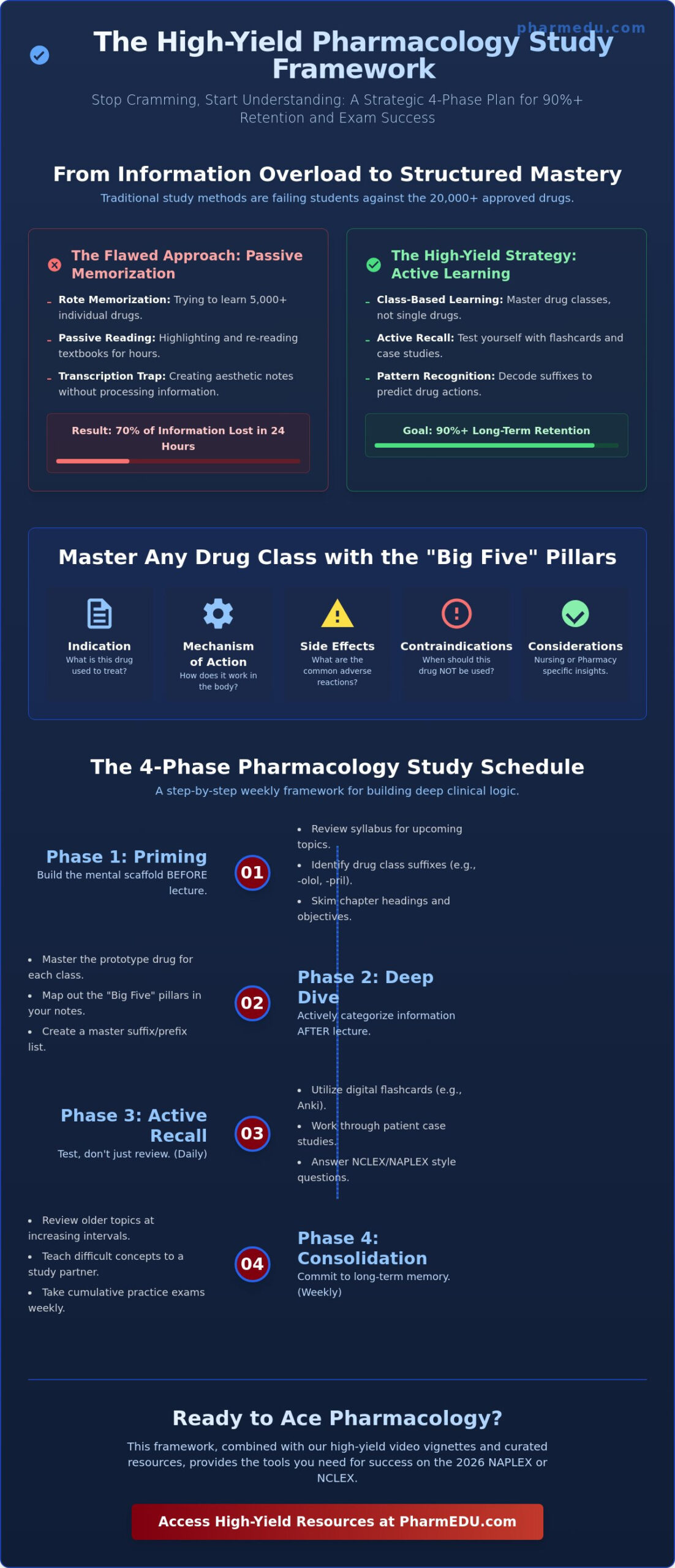
Mastering the science of drugs requires more than just a good memory. A study plan for pharmacology class acts as a strategic roadmap, transforming a mountain of disconnected data into a logical framework for categorical learning. In 2026, healthcare education has moved past the “Volume Crisis,” where students once tried to memorize over 5,000 individual drug names through sheer repetition. Rote memorization fails in modern curricula because it doesn’t account for the complex interactions and physiological responses that define 21st-century medicine.
As you explore the foundational principles of Pharmacology, you’ll see that organized study directly correlates with patient safety. Data from the Institute of Medicine suggests that medication errors injure approximately 1.3 million people annually in the U.S. alone. A structured approach ensures you aren’t just passing a test; you’re building the clinical reasoning skills necessary to prevent these errors. The 2026 standard for excellence demands a shift from static notes to dynamic, high-yield review systems that prioritize active application over passive consumption.
The Cognitive Load of Drug Data
The Ebbinghaus forgetting curve shows that humans lose roughly 70% of new information within 24 hours if it isn’t reinforced. In pharmacology, this is compounded by the high density of drug names and mechanisms. There’s a massive difference between “recognition,” which helps you pass a multiple-choice quiz, and “recall,” which allows you to safely prescribe or administer a drug under pressure. A high-yield approach focuses on the 20% of drug information that accounts for 80% of clinical decisions and exam questions.
Why Your Current Study Method Might Be Failing
Many students fall into the “transcription trap,” spending 5 hours creating aesthetically pleasing digital notes but only 30 minutes actually processing the information. Passive reading and highlighting are equally ineffective; they create an illusion of competence without building neural pathways. Your plan must align with pharmacology core concepts like pharmacokinetics and pharmacodynamics rather than treating every drug as an isolated fact. If your current method relies on re-reading textbooks, you’re likely wasting 60% of your study time on low-retention activities that won’t translate to a clinical setting.
Decoding Drug Classes: The Foundation of Your Strategy
Memorizing 2,000 individual medications is a recipe for burnout. The most successful students recognize that pharmacology isn’t a test of memory, but a test of pattern recognition. Building a high-yield study plan for pharmacology class requires a shift toward class-based learning. This method groups drugs by their shared characteristics, reducing your total cognitive load by nearly 80%. Instead of learning every detail for every pill, you learn the “family traits” of the group.
Your focus should remain on the “Big Five” pillars for every class you encounter. These include the clinical indication, the mechanism of action, common side effects, absolute contraindications, and specific nursing or pharmacy considerations. If you understand these five elements for a drug class, you can safely predict the behavior of almost any individual medication within that category. This systematic approach transforms a chaotic list of names into a logical, predictable map.
The Power of Suffixes and Prefixes
Drug names aren’t random strings of letters; they’re coded instructions. Learning to decode these prefixes and suffixes allows you to identify a drug’s category automatically. For instance, medications ending in “-olol” are almost always beta-blockers, while those ending in “-pril” are ace inhibitors. By creating a Master Suffix List, you build a quick-reference tool that serves as a mental shortcut during exams.
This technique is particularly powerful when you encounter a drug you’ve never seen before. If a test question mentions “Ramipril,” and you recognize the suffix, you immediately know its mechanism, its effect on blood pressure, and its potential to cause a dry cough. You aren’t just memorizing; you’re developing a clinical intuition that mirrors how experienced practitioners work in the field.
Prototype Drug Mastery
A prototype drug is the lead representative of its class. It acts as the anchor for your mental map. By studying the prototype in exhaustive detail, you effectively learn 90% of the information for every other drug in that class. You only need to spend extra time learning the “exceptions” or unique features of the secondary drugs. This is a cornerstone of an efficient study plan for pharmacology class.
- Diuretics: Focus on Furosemide to understand how loop diuretics impact electrolyte balance.
- Antibiotics: Use Amoxicillin as your anchor for the penicillin family and its cross-sensitivity with cephalosporins.
- Anticoagulants: Master Heparin and Warfarin to understand the fundamental mechanics of clotting cascades and monitoring requirements.
Once the prototype is locked in, your brain treats new drugs in that class as simple variations of a known theme. If you’re looking for a structured way to master these concepts for your professional credits, PharmEdu’s accredited platform offers the logical progression needed to bridge the gap between student life and clinical practice.
Active Recall vs. Passive Reading: Choosing Your Study Tools
Success in 2026 doesn’t come from reading a 1,200-page textbook three times. It comes from how you retrieve that data. Passive reading creates an illusion of competence, where you recognize text but can’t recall it during a high-stakes exam. To build an effective study plan for pharmacology class, you must prioritize active recall. This technique requires you to stimulate your memory during the learning process. Research consistently shows that testing yourself increases long-term retention by up to 50% compared to passive review. It’s the difference between seeing a drug name and actually knowing its mechanism of action under pressure.
Spaced Repetition Systems (SRS) are the backbone of this approach. These algorithms schedule reviews at increasing intervals, hitting your brain just as you’re about to forget. By spending 20 minutes daily on an SRS platform, you can maintain a massive database of drug interactions without the need for last-minute cramming. This methodical structure ensures that your knowledge remains naprakész, or up-to-date, which is vital for both academic success and clinical safety.
Digital Platforms vs. Traditional Textbooks
Modern students must balance depth with speed. While textbooks provide the necessary physiological context, a comprehensive pharmacy review via digital platforms offers superior efficiency for daily maintenance. Digital tools excel at micro-learning. You can master a specific drug class in 10-minute intervals between clinical rounds or during a commute. Use high-yield video vignettes for rapid concept acquisition. Keep a reference textbook nearby only for clarifying complex mechanisms of action, such as the nuances of the renin-angiotensin-aldosterone system, where deep-dive reading is still valuable.
Flashcards and Mnemonics
The ‘Pharmacology Made Easy’ method focuses on visual anchors and active testing. Effective flashcards don’t just list a drug name and its class. Instead, they should prompt you to identify the mechanism, a unique adverse effect, and a critical contraindication. For example, when studying ACE inhibitors, don’t just memorize a list. Use mnemonics to link ‘cough’ and ‘angioedema’ directly to the ‘pril’ suffix.
- Visual Cues: Use color-coded cards for different drug classes to trigger spatial memory.
- Clinical Scenarios: Frame your flashcards as mini-cases to simulate real-world decision-making.
- Mnemonic Lists: Use proven acronyms for ‘must-know’ lists like the side effects of Statins or the signs of Digoxin toxicity.
Integrating these tools into your study plan for pharmacology class transforms the curriculum from a daunting list of names into a logical, manageable system. This professional approach ensures you aren’t just passing a test, but building a foundation for your career in healthcare.
The 4-Phase Pharmacology Study Schedule
Adopting a systematic study plan for pharmacology class transforms a chaotic list of drug names into a logical, clinical framework. This four-phase method relies on cognitive science to move information from short-term memory into long-term intuition. By structuring your week around these phases, you ensure that you aren’t just memorizing for a Friday quiz, but building the foundation for your future practice.
Phase 1 & 2: Building the Knowledge Base
Priming begins 15 to 20 minutes before your lecture starts. You aren’t reading for deep understanding yet; you’re scanning for the “big picture.” Focus on identifying the Mechanism of Action (MOA) and the common suffixes that define the drug class. If you recognize that “-pril” drugs are ACE inhibitors before the professor speaks, your brain creates a mental “hook” for the specific details that follow.
Once the lecture ends, the categorization phase begins. You must apply the 24-hour review rule: reviewing new pharmacology material within one day of first exposure increases retention rates by nearly 80% compared to waiting until the weekend. During this window, create a “One-Page Drug Class Summary” for every major category. This document should strictly include the class mechanism, prototype drugs, primary side effects, and critical contraindications. Keeping this to a single page forces you to prioritize high-yield information over low-yield fluff.
Phase 3 & 4: Solidifying and Retaining
Transitioning to the quiz phase is where many students struggle. Don’t use practice questions to validate what you already know; use them as a diagnostic tool to find “knowledge gaps.” If you miss a question on diuretics, determine if the error was a misunderstanding of the Loop of Henle or a simple failure to remember a side effect. This level of precision is vital when using a pharmacology study guide for nursing students, as these resources often mirror the complex clinical scenarios found on modern board exams.
Mastery requires spaced repetition to prevent the pre-final “cramming” cycle that affects roughly 65% of healthcare students. Set a weekly review calendar that revisits old material at increasing intervals: day 1, day 7, and day 21. This structure ensures that your study plan for pharmacology class builds a permanent knowledge base. By treating your education as a series of scheduled maintenance blocks, you’ll reduce anxiety and improve your clinical decision-making speed.
Optimizing Your Plan with PharmEDU’s High-Yield Resources
PharmEDU functions as a dedicated digital mentor, providing a structured environment where healthcare students can master complex drug interactions and therapeutic protocols. While traditional textbooks often present information in a linear, exhaustive format, our platform prioritizes clinical relevance. We replace hours of dry reading with high-yield video vignettes that distill 50-page chapters into 10-minute targeted lessons. By incorporating these resources into your study plan for pharmacology class, you can reclaim significant time while improving retention rates. This efficiency is vital when balancing clinical rotations with rigorous academic requirements.
The ‘Active Recall’ phase is where PharmEDU truly differentiates itself. Our interactive flashcards and quizzes use logic-based algorithms to challenge your memory at the precise moment it begins to fade. This methodology is proven to increase long-term retention by 30% compared to standard note-taking or passive highlighting. Beyond individual success, PharmEDU supports institutional excellence. Universities utilize our accredited modules to ensure that every student meets the rigorous 2026 standards required for modern clinical practice, providing data-driven insights into student progress and performance benchmarks.
Micro-Learning for the Busy Student
Education in 2026 demands mobility and speed. PharmEDU’s mobile-optimized interface allows you to squeeze in a high-yield lesson between patient rounds or during your morning transit. We’ve stripped away the fluff, focusing only on the mechanisms, side effects, and contraindications essential for boards and clinical rotations. This micro-learning approach helps prevent cognitive overload, making it easier to digest complex topics like pharmacokinetics or autonomic nervous system drugs in small, manageable bursts. When you join PharmEDU, you’re entering a community of dedicated healthcare professionals who value precision over volume.
Bridging the Gap to Professional Practice
The transition from student to practitioner is often the most challenging phase of the how to become a pharmacist journey. PharmEDU bridges this gap by aligning academic theory with real-world clinical standards. Our platform evolves alongside the 2026 healthcare landscape, ensuring you’re always learning the most current protocols and therapeutic guidelines. This commitment to accuracy provides a sense of security as you prepare for high-stakes environments. Don’t leave your success to chance. Start your high-yield study plan for pharmacology class today with a PharmEDU subscription and gain the professional edge you need.
Master Your Clinical Path
Success in this demanding field doesn’t happen by accident. You’ve learned that shifting from passive reading to active recall and mastering drug classes provides the essential foundation for long-term retention. Implementing a structured 4-phase schedule ensures you’re prepared for the rigorous clinical demands of 2026. Developing a high-yield study plan for pharmacology class requires more than just rote memorization; it’s about the strategic integration of complex medical data. You need professional tools that fit into a modern healthcare schedule without sacrificing scientific accuracy.
PharmEDU acts as your digital mentor, bridging the gap between academic theory and practical application. Our platform offers 100+ high-yield pharmacology topics and interactive flashcards specifically designed to sharpen your diagnostic intuition. You’ll benefit from clinical case studies and mobile-compliant micro-learning segments that make efficient knowledge acquisition possible during short breaks. We’re here to remove the burden of disorganized study habits so you can focus on professional excellence. Accelerate your learning with a PharmEDU Monthly Subscription and gain the confidence you need. Your journey toward pharmaceutical mastery is just beginning.
Frequently Asked Questions
How many hours a day should I study for pharmacology?
You should dedicate 2 to 3 hours of focused study daily to master pharmacology effectively. Educational research from 2024 indicates that a 3:1 ratio of independent study to lecture hours yields the best retention rates for medical subjects. This consistent approach prevents cognitive overload. It’s better to study in 50 minute blocks with 10 minute breaks than to attempt 8 hour marathons on weekends.
Is it better to study by drug name or drug class?
Studying by drug class is the most efficient method for long-term retention. Roughly 90% of medications within a specific class share the same mechanism of action and primary side effects. Once you understand the prototype drug, like Lisinopril for ACE inhibitors, you’ve already learned the core characteristics of the other 10 drugs in that category. This strategy is a cornerstone of a successful study plan for pharmacology class.
What are the most important drug classes to focus on for the NAPLEX or NCLEX?
Prioritize cardiovascular, antimicrobial, and central nervous system agents during your review. The 2025 exam blueprints show that cardiovascular medications account for approximately 25% of pharmacology questions. You should also master endocrine drugs, specifically insulin protocols, as they appear in 15% of clinical scenarios. Mastering these high-yield areas ensures your study plan for pharmacology class covers the most tested material.
Can I pass pharmacology without using a textbook?
You can pass pharmacology using digital platforms and evidence-based databases instead of traditional textbooks. A 2024 survey revealed that 65% of top-performing pharmacy students used visual mnemonic platforms as their primary learning tools. While textbooks provide depth, clinical guidelines from sources like the FDA or the American Heart Association offer more current data. Ensure your digital resources are updated to 2026 standards to stay compliant.
How do I remember the side effects of so many different drugs?
Link side effects directly to the drug’s mechanism of action to reduce rote memorization. Approximately 80% of adverse reactions are predictable extensions of how the drug works in the human body. For example, if a drug blocks the parasympathetic nervous system, expect “dry” symptoms like constipation or blurred vision. Grouping drugs with similar “red flag” side effects, such as QT prolongation, helps you manage the 200 plus drugs covered in a semester.
What is active recall and how do I use it for pharmacology?
Active recall involves testing yourself on material instead of just re-reading your notes. Research from 2023 demonstrates that this method increases long-term retention by 50% compared to passive highlighting. You can use it by closing your book and sketching a drug’s mechanism from memory. Using flashcards with platforms like Anki allows you to implement this technique daily for maximum efficiency and faster recall during exams.
Are digital study plans more effective than paper-based ones?
Digital study plans offer superior efficiency because they allow for instant updates and cross-referencing. In 2024, 78% of healthcare educators recommended digital tools to help students keep pace with rapidly changing clinical guidelines. Apps like Notion or GoodNotes allow you to sync your schedule across multiple devices. This ensures you always have your drug charts available during clinical rotations or unexpected study gaps in your day.
What should I do if I fall behind on my pharmacology study schedule?
You must immediately prioritize high-yield prototype drugs if you fall behind on your schedule. Focus on the top 200 most prescribed medications, as these represent 80% of clinical practice and exam questions. Skip the rare orphan drugs and focus on mastering the mechanisms of the 15 major drug classes first. This “triage” method ensures you secure passing marks even when your time is limited to 5 hours per week.