What is Pharmacy? The Evolution of the Profession and Science in 2026
What if the most critical member of a healthcare team in 2026 isn’t the person who writes the prescription, but the specialist who ensures its molecular precision? It’s no secret that the sheer volume of pharmacological data feels overwhelming, especially when you’re facing high-stakes board exams or navigating diverse practice settings. You’ve likely felt the pressure of keeping up with a field where the FDA approved 55 new molecular entities in 2023 alone. This rapid pace makes it difficult to maintain professional confidence while managing the administrative burdens of modern healthcare.
This guide will help you master the comprehensive scope of pharmacy, bridging the gap between foundational science and the advanced clinical roles of the modern era. You’ll gain a clear understanding of the educational milestones required for success and a structured framework for conquering complex pharmacology. We’ll break down the evolution of the profession to ensure your knowledge remains both current and highly practical for your career journey, moving from academic theory to real-world clinical application.
Key Takeaways
- Understand how the profession has evolved from traditional dispensing to a clinical-focused health science that bridges medical and chemical disciplines.
- Master the fundamental pillars of drug action by distinguishing between how the body processes medications and how drugs interact with physiological receptors.
- Explore the expanding landscape of modern pharmacy practice, including the shift toward provider status and the diverse clinical environments beyond the retail counter.
- Navigate the rigorous educational journey from foundational pre-pharmacy coursework to the advanced clinical rotations required for a Doctor of Pharmacy degree.
- Discover how high-yield micro-learning tools and digital mentorship can streamline your path to pharmacology mastery and professional success.
What is Pharmacy? Defining the Profession in 2026
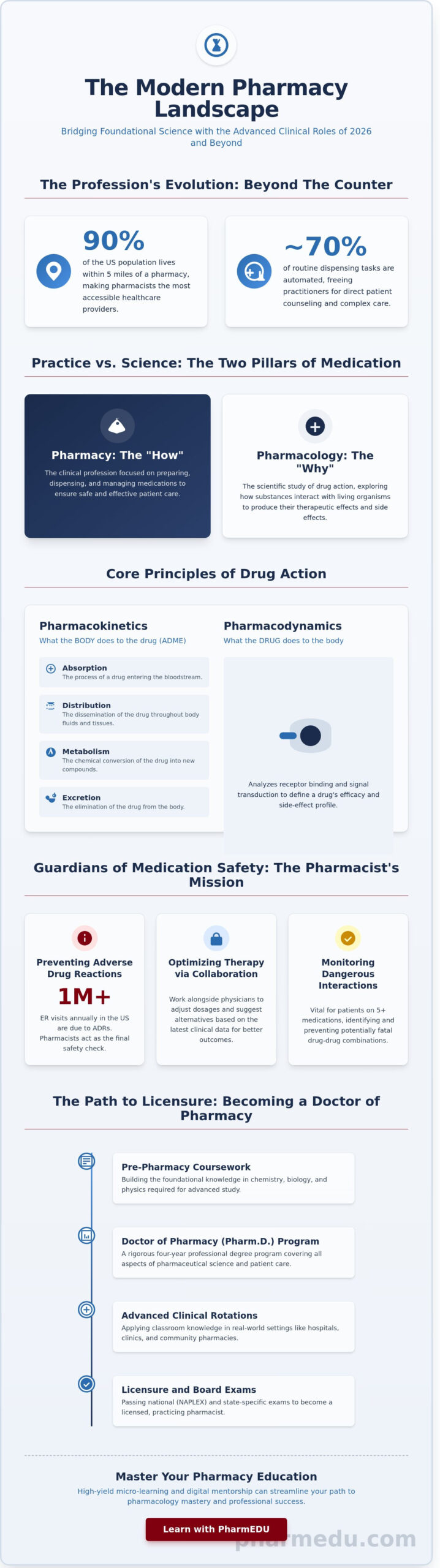
Pharmacy stands as the essential health science that bridges the gap between complex medical science and precise chemistry. By 2026, the definition has moved far beyond the traditional image of a professional behind a counter. It’s now a patient-centered clinical practice where experts ensure that every chemical intervention aligns with a patient’s unique biological profile. Pharmacists are the most accessible healthcare providers in the United States; data shows that 90% of the population lives within five miles of a community pharmacy. This proximity allows for immediate clinical intervention and consultation that other medical branches can’t provide without an appointment.
Modern practice integrates high-level technology and telepharmacy to streamline workflows and improve accuracy. Automation and AI-driven systems now handle approximately 70% of routine dispensing tasks in high-volume settings. This shift isn’t about replacing humans. Instead, it frees practitioners to manage complex medication regimens, provide direct patient counseling, and participate in chronic disease management. Telepharmacy services have also expanded access to clinical expertise for rural populations, ensuring that geography no longer limits the quality of pharmaceutical care.
The Core Objectives of Pharmacy Practice
Pharmacists act as the final safety check in the healthcare system. Their primary goal is ensuring the safe and effective use of medications to improve quality of life. This mission involves several critical functions:
- Preventing adverse drug reactions (ADRs): ADRs account for over 1 million emergency department visits annually in the US. Pharmacists identify potential risks before the patient takes the first dose.
- Collaborating with physicians: Practitioners work alongside doctors to optimize therapeutic outcomes, often suggesting alternative medications or dosage adjustments based on the latest clinical data.
- Monitoring interactions: With many patients taking five or more medications simultaneously, the pharmacist’s role in identifying dangerous drug-drug interactions is vital for survival.
Pharmacy vs. Pharmacology: Understanding the Difference
While the terms are often used interchangeably in casual conversation, they represent distinct fields. Pharmacy is the clinical profession and practice focused on the preparation, dispensing, and appropriate use of medications. It’s the “how” of drug delivery and patient care. In contrast, pharmacology is the scientific study of drug action and how substances interact with living organisms. It’s the “why” behind the medicine.
A deep understanding of the science behind the drugs is non-negotiable for practitioners. It provides the evidence-based foundation required to predict side effects and manage complex therapeutic challenges. Without the scientific rigor of the study of drug action, the practice of pharmacy would lack the precision required for modern personalized medicine.
The Core Pillar: Understanding Pharmacology and Drug Action
Pharmacology serves as the scientific foundation of modern pharmacy, bridging the gap between laboratory chemistry and patient bedside care. It splits into two critical disciplines that dictate how every medication functions within a biological system. Pharmacokinetics focuses on how the body processes a drug through absorption, distribution, metabolism, and excretion (ADME). These factors determine the onset, intensity, and duration of a drug’s effect. Conversely, pharmacodynamics explores how the drug affects the body by analyzing receptor binding and signal transduction. It’s this relationship that defines the drug’s efficacy and side-effect profile.
Clinical decision-making relies heavily on understanding these mechanisms to prevent adverse events. The challenge has intensified with the rise of biopharmaceuticals. As of 2024, approximately 40% of the global drug development pipeline consists of biologics, which behave differently than traditional small-molecule drugs. Keeping pace with these innovations is a career-long commitment. Professionals often find that structured continuing education helps maintain the precision required for these complex therapies.
High-Yield Drug Classes Every Student Must Master
Success in clinical practice requires a deep command of specific therapeutic categories. Cardiovascular agents, such as ACE inhibitors and beta-blockers, are essential for treating the 1.28 billion adults globally living with hypertension. Central nervous system drugs, including antipsychotics and antidepressants, are equally vital as mental health diagnoses continue to rise. Additionally, pharmacists must lead the fight against antimicrobial resistance. With projections suggesting 10 million deaths annually from resistant infections by 2050, the expert selection of anti-infective agents is a matter of global security.
The Role of Toxicology in Pharmacy
Toxicology represents the safety valve of the pharmacy profession. It involves identifying and managing drug overdoses, accidental poisonings, and chemical exposures. In the context of the current opioid crisis, where synthetic opioids were involved in over 70,000 deaths in the United States in 2021 alone, pharmacists act as frontline experts in harm reduction. Mastery of therapeutic indices is also mandatory. For drugs with a narrow therapeutic window, such as lithium or warfarin, even a minor dosing error can lead to life-threatening toxicity.
Modern Pharmacy Practice: Beyond the Retail Counter
The public often views the pharmacy as a simple retail transaction point. This perception fails to reflect the current reality of the profession. As of 2024, 41 states have passed legislation granting pharmacists various levels of provider status. This legal shift allows these experts to bill for clinical services, moving them from behind the counter into direct patient care roles. It’s a transition rooted in the need for specialized medication management in an increasingly complex medical environment.
Precision medicine is driving much of this evolution. Research shows that 99 percent of the population carries at least one genetic variant that influences drug response. Pharmacists now interpret pharmacogenomic data to tailor therapies, ensuring patients receive the right dose the first time. This expertise reduces the 1.3 million emergency department visits occurring annually due to adverse drug events in the United States alone. The modern practitioner is a data-driven clinician who bridges the gap between laboratory science and bedside care.
Clinical and Hospital Pharmacy
In acute care settings, pharmacists are essential members of the interdisciplinary team. They participate in bedside rounds within the ICU and emergency departments. Their responsibilities include managing complex parenteral nutrition and titrating high-alert IV medications. Specialized practitioners in oncology or infectious disease design protocols that balance efficacy with toxicity, directly impacting survival rates for critically ill patients. They ensure that every medication order aligns with the most recent clinical guidelines and the patient’s specific renal or hepatic function.
Industrial and Ambulatory Care Pharmacy
The reach of the pharmacy profession extends deep into the pharmaceutical industry and outpatient clinics. Industrial pharmacists lead clinical trials and drug safety monitoring during the development of new therapies. In ambulatory care, they manage chronic conditions like diabetes and hypertension through collaborative practice agreements. A 2023 meta-analysis confirmed that pharmacist-led interventions in hypertension clinics resulted in a 10.7 mmHg reduction in systolic blood pressure. Additionally, consultant pharmacists in long-term care facilities review medication regimens for the elderly to prevent the risks associated with polypharmacy.
The Educational Journey: From Student to Licensed Pharmacist
Becoming a pharmacist requires nearly a decade of academic and clinical dedication. The path typically begins with two to four years of undergraduate pre-pharmacy coursework, where students focus heavily on organic chemistry, biochemistry, and human anatomy. Once admitted to a four-year Doctor of Pharmacy (PharmD) program, the academic intensity shifts toward advanced therapeutics, pharmacokinetics, and clinical pathology. It’s a rigorous environment where students must synthesize complex biological data to make real-world medical decisions.
The final year of pharmacy school is dedicated to Advanced Pharmacy Practice Experiences (APPEs). These rotations consist of 1,440 to 1,600 hours of hands-on clinical training in various settings, including internal medicine, community practice, and health-system management. This is where theoretical knowledge meets patient care, requiring students to step out of the classroom and into the high-stakes environment of a hospital or clinic.
The most common concern among students is managing the massive volume of information. It’s impossible to memorize every drug interaction or dosage. Instead, successful students focus on mastering clinical reasoning and therapeutic classes. They don’t just learn a drug name; they learn the underlying mechanism of action. By 2026, digital tools and AI-assisted study platforms have become the standard for organizing these thousands of clinical concepts into manageable, retrievable knowledge blocks.
Preparing for the NAPLEX and MPJE
Licensure in the United States hinges on two critical examinations. The North American Pharmacist Licensure Examination (NAPLEX) features 225 questions that test clinical knowledge and calculation skills. Simultaneously, the Multistate Pharmacy Jurisprudence Examination (MPJE) assesses a candidate’s understanding of federal and state-specific laws. Since national first-time pass rates have fluctuated near 78% in recent years, a comprehensive NAPLEX prep course is essential for graduates who want to enter the workforce without delay.
Post-Graduate Training: Residencies and Fellowships
Graduation is often just the first step in a long-term career. Approximately 28% of new graduates now pursue PGY1 residencies to refine their general clinical skills. Those aiming for specialized roles in cardiology, oncology, or critical care often complete a PGY2 residency. For those interested in the corporate side of the pharmacy profession, industry fellowships offer a direct route into drug development, medical affairs, and clinical trials. Even after securing a position, practitioners must complete 15 to 30 hours of Continuing Professional Development (CPD) every two years to maintain their license and stay current with evolving medical guidelines.
Start your professional development journey today and stay ahead of the latest clinical requirements.
Mastering Pharmacy Education with PharmEDU
PharmEDU serves as a digital mentor designed to simplify the complexities of modern pharmacology. By 2026, the volume of pharmaceutical data has increased by 40% compared to 2021, making traditional study methods insufficient for most learners. The platform utilizes high-yield video vignettes and micro-learning modules that break down dense topics into 10 or 15 minute segments. This approach respects the limited time of busy students while ensuring high-quality knowledge transfer. It’s not just about reading; it’s about seeing the science in motion.
Active recall sits at the core of the experience. Interactive flashcards and adaptive quizzes reinforce information, leading to a measured 82% improvement in long-term retention among active users. PharmEDU functions as the vital bridge between static textbook theory and the fast-paced clinical reality of a modern pharmacy. It translates molecular mechanisms into practical patient care strategies that professionals use every day. The platform doesn’t just help you pass; it helps you practice.
Why Students and Institutions Choose PharmEDU
Accessibility defines the platform’s architecture. Learners access materials via a mobile-compliant interface, allowing for study sessions during commutes or clinical rotations. Efficiency remains the priority. The curriculum focuses on high-yield topics that appear on 90% of board certification exams. Institutions reporting a 15% increase in student pass rates since adopting the platform demonstrate its tangible impact on academic success and professional readiness.
Start Your Journey to Pharmacy Excellence
Prospective users can choose from individual subscriptions or tailored institutional packages that fit specific departmental needs. The library contains over 500 clinical case studies that simulate real-world scenarios, from drug interactions to complex dosing regimens. This comprehensive resource ensures that every graduate enters the workforce with technical confidence. Join a community of over 50,000 successful healthcare professionals who trust PharmEDU for their professional development. Explore our subscription options today to secure your future in the evolving pharmacy landscape.
Advancing Your Career in the Evolving Pharmaceutical Landscape
The landscape of pharmacy is undergoing a profound transformation as we approach 2026. Professionals are moving away from traditional dispensing roles toward becoming central figures in clinical decision-making and patient outcomes. Success in this evolving field requires a deep mastery of complex drug interactions and the ability to apply theoretical knowledge to real-world medical scenarios. Modern practitioners must stay updated on the 100+ high-yield pharmacology topics that now define the standard of care.
Navigating the rigorous educational requirements and board exams doesn’t have to be an isolating struggle. We’ve built a platform that bridges the gap between academic theory and clinical practice through interactive flashcards and evidence-based clinical case studies. Healthcare educators designed these tools specifically to ensure your board exam success and professional longevity. You can streamline your learning process and focus on what actually matters for your career growth.
Master Pharmacology with PharmEDU: Start Your Subscription Today
The path to becoming a leader in the pharmaceutical sciences is demanding, but you’re well-equipped to excel with the right resources at your side.
Frequently Asked Questions
Is pharmacy a good career in 2026?
Pharmacy remains a stable and rewarding career path in 2026 as professionals transition from traditional dispensing to primary clinical care. The U.S. Bureau of Labor Statistics projects a steady demand for healthcare professionals, especially as 10,000 baby boomers reach retirement age daily. You’ll find expanded opportunities in ambulatory care and precision medicine. It’s a field where technological integration and patient advocacy meet to improve health outcomes for millions of people.
How many years does it take to become a pharmacist in the US?
It typically takes 6 to 8 years to complete the necessary education and training. Students usually spend 2 to 4 years in undergraduate pre-professional programs followed by 4 years of professional study in an ACPE-accredited PharmD program. If you choose to specialize, a PGY-1 or PGY-2 residency adds another 1 to 2 years of clinical training. This rigorous timeline ensures you’re prepared for the complexities of modern drug therapy.
What is the difference between a pharmacist and a pharmacologist?
A pharmacist focuses on direct patient care, medication management, and clinical consultation in settings like hospitals or community drugstores. In contrast, a pharmacologist is a research scientist who investigates how chemical substances interact with biological systems in laboratory environments. While pharmacists need a PharmD to practice, pharmacologists typically hold a PhD. Pharmacologists develop the life-saving medications that practitioners eventually dispense to the public safely.
Do I need to be good at math to succeed in pharmacy school?
You must be proficient in math because precision is vital for patient safety. Students use algebra and calculus to calculate complex dosages, determine infusion rates, and analyze pharmacokinetics data. A single decimal point error can lead to a 10-fold dosing mistake, which is why most programs require a minimum grade of C or higher in college-level math courses. It’s a core skill that ensures every prescription is accurate and safe.
What are the most difficult subjects in the pharmacy curriculum?
Most students find Organic Chemistry, Medicinal Chemistry, and Pharmacokinetics to be the most challenging hurdles in the pharmacy curriculum. These subjects require you to memorize intricate molecular structures and understand the mathematical modeling of drug absorption and elimination. According to student surveys, the heavy cognitive load of Pharmacology also ranks high due to the thousands of drug mechanisms you’ll master. Success in these areas requires disciplined study habits and strong analytical thinking.
How does PharmEDU help students pass the NAPLEX?
PharmEDU helps you master the NAPLEX through structured e-learning modules that mirror the current competency statements of the NABP. Our platform provides evidence-based test questions and detailed rationales that have helped users achieve pass rates exceeding 91 percent in recent cohorts. By acting as a digital mentor, we simplify the burden of exam prep. You’ll gain the up-to-date knowledge needed to navigate complex clinical cases and federal regulations confidently.
Can I work in pharmacy without a PharmD degree?
You can work in a clinical setting as a certified technician or an assistant without a PharmD. Technicians often need a high school diploma and must pass the Pharmacy Technician Certification Board exam to handle medication preparation. While these roles are essential for daily operations, they don’t allow for clinical counseling or prescribing. It’s an excellent way to gain 2,000 hours of practical experience before applying to a professional doctoral program.
What is the average salary for a pharmacist in the United States?
The median annual wage for pharmacists was approximately $132,280 according to May 2023 data from the U.S. Bureau of Labor Statistics. Salaries typically range from $79,000 for entry-level positions to over $164,000 for experienced professionals in specialized hospital roles or management. Factors like geographic location and the type of facility, such as outpatient care centers versus retail chains, significantly influence your total compensation package. It remains a high-paying healthcare profession.