
The Ultimate Pharmacology Study Guide: Strategies for Mastering Drug Science in 2026
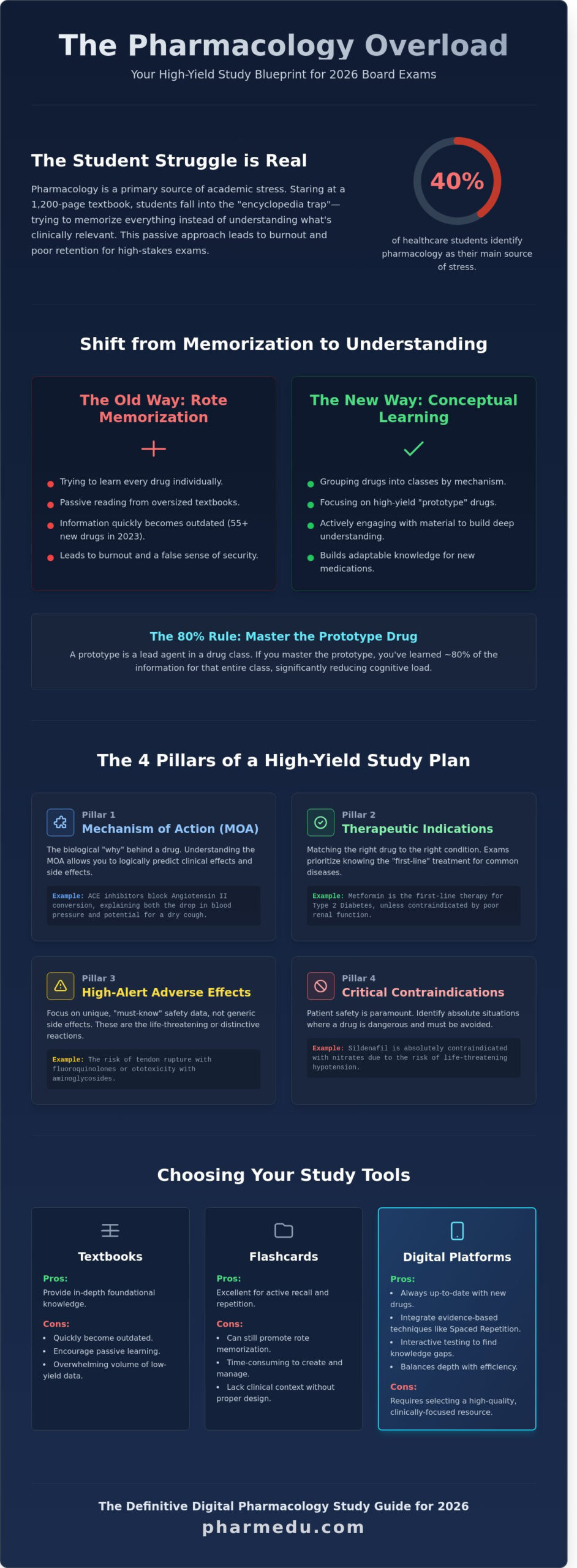
Did you know that according to 2024 educational assessments, nearly 40% of healthcare students identify pharmacology as the primary source of their academic stress? It’s a daunting reality when you’re staring at a 1,200 page textbook without a clear pharmacology study guide to help you distinguish between hundreds of similar drug names. You’ve probably felt the weight of information overload, wondering if you’ll ever truly retain the complex mechanisms of action required for high-stakes exams like the NAPLEX or NCLEX.
We understand that your time is a finite resource, and professional growth shouldn’t feel like a constant battle against forgetting. This guide is designed to transform your approach by replacing aimless reading with a structured, high-yield system. You’ll learn how to categorize drug classes efficiently and select the right resources to secure your success in 2026. We’re going to break down the exact strategies needed to build clinical confidence and ensure you’re fully prepared for every board-style question you encounter.
Key Takeaways
- Learn how to avoid the “encyclopedia trap” by prioritizing clinical relevance over the rote memorization of exhaustive, low-yield drug data.
- Discover the essential components of a high-yield pharmacology study guide that focuses on the “why” behind drug effects and patient-specific indications.
- Evaluate the pros and cons of textbooks, flashcards, and digital platforms to build a study environment that balances depth with efficiency.
- Implement evidence-based techniques like Spaced Repetition and Active Recall to overcome the forgetting curve and master drug classes faster.
- Explore how digital tools and high-yield video vignettes can automate your learning process and ensure you are fully prepared for 2026 board exams.
Why Traditional Pharmacology Study Guides Often Lead to Overwhelm
Many students view a pharmacology study guide as a simple checklist of facts to be memorized. This approach often leads to burnout and cognitive fatigue. A high-yield study guide must prioritize clinical relevance over raw data. It focuses on how a medication affects a patient in a real-world setting rather than just listing molecular weights. Before diving into specific agents, it’s helpful to review a comprehensive overview of pharmacology to understand the core principles of pharmacokinetics and pharmacodynamics that govern every drug interaction.
Most learners fall into the “encyclopedia trap” by trying to memorize every adverse effect and dosage range. This is an impossible task. In 2026, the volume of pharmaceutical data is far too vast for rote memorization to be effective. Passive reading of thousand-page textbooks creates a false sense of security. You might recognize a drug name on a page, but you won’t necessarily remember its mechanism during a high-pressure exam or a clinical rotation. Real retention requires active engagement with the material.
The Problem with Static Resources
Printed materials often struggle to keep pace with medical innovation. The FDA approved 55 new molecular entities in 2023 alone, and that pace hasn’t slowed. By the time a paper-based pharmacology study guide reaches a student, its guidelines for biologics or oncology medications might be outdated. Static resources also lack feedback loops. They don’t offer the interactive testing needed to identify knowledge gaps. Managing a list of 200 plus drugs requires a digital system that allows for rapid filtering, updates, and self-assessment.
Moving from Memorization to Understanding
Efficient study requires a shift from rote memorization toward mechanism-based learning. Instead of treating every medication as a unique island of information, you should use drug class clusters. This method groups medications by their shared physiological targets and chemical structures. This organization allows you to predict a drug’s behavior based on its family traits rather than starting from scratch every time.
The most effective way to utilize these clusters is through the study of lead agents. A prototype drug is a lead agent in a drug class that serves as the primary model for understanding the mechanism of action, therapeutic effects, and adverse reactions for all other drugs in that category.
If you master the prototype, you’ve already learned approximately 80% of the information for that entire class. This strategy significantly reduces the cognitive load. It builds a solid foundation for professional success and ensures you can adapt when new variants of a drug class enter the market. Focusing on clusters and prototypes turns an overwhelming list of names into a logical, manageable system of science.
The 4 Pillars of a High-Yield Pharmacology Study Plan
Creating an effective pharmacology study guide requires a transition from rote memorization to a structured, conceptual framework. In 2026, board exams and clinical practice demand more than just naming drugs; they require a deep understanding of how these substances interact with human physiology. To master this volume of information, you must organize your study sessions around four essential pillars.
- Pillar 1: Mechanism of Action (MOA): This is the biological “why” behind every drug. Understanding the MOA allows you to predict clinical effects and side effects logically. For example, knowing that ACE inhibitors block the conversion of Angiotensin I to Angiotensin II explains both the drop in blood pressure and the potential for a dry cough due to bradykinin accumulation.
- Pillar 2: Therapeutic Indications: You must match drugs to specific patient conditions. Modern exams prioritize the “first-line” treatment for common comorbidities, such as using metformin for Type 2 Diabetes patients unless contraindicated by renal function.
- Pillar 3: High-Alert Adverse Effects: Don’t waste energy on generic side effects like nausea or headaches. Instead, focus on “must-know” safety data, such as the risk of tendon rupture with fluoroquinolones or the potential for ototoxicity with aminoglycosides.
- Pillar 4: Critical Contraindications: Safety is the priority in clinical settings. You need to identify when a drug becomes dangerous, such as the absolute contraindication of using sildenafil with nitrates, which can lead to life-threatening hypotension.
Prioritizing the Top 200 Drugs
Success on professional boards depends on your ability to filter out “low-yield” information. The Top 200 most commonly prescribed drugs account for approximately 70% of all prescriptions in the United States. Focusing your initial energy here ensures you’re prepared for the 85% probability of what will appear on your exams. This targeted approach is a cornerstone of pharmacology made easy strategies, where the goal is maximum retention with minimal cognitive overload. Mastering the most frequent agents first provides a solid foundation before you move into rare orphan drugs.
Integrating Clinical Context
Case studies are significantly more effective for long-term retention than simple lists. Linking drug science to real-world patient scenarios helps bridge the gap between theory and practice. Modern board exams utilize “high-yield” vignettes that describe a patient’s symptoms and labs rather than asking for a drug’s MOA directly. Referencing the NIH Principles of Clinical Pharmacology helps students understand the scientific rigor required for these clinical applications. When you visualize a 65-year-old patient with heart failure while studying diuretics, the information sticks. If you’re looking to streamline your preparation, exploring our accredited pharmacology modules can help you stay current with 2026 standards while earning necessary credit points.
Comparing Study Methods: Textbooks vs. Flashcards vs. Digital Platforms
Selecting the right pharmacology study guide requires a balance between academic depth and practical efficiency. Textbooks remain the gold standard for foundational theory. They offer the comprehensive detail necessary to understand complex topics like signal transduction or molecular pharmacodynamics. However, their lack of portability and static nature often lead to passive reading habits. A 2024 analysis of medical education trends indicated that 82% of students find traditional textbooks less engaging than multimodal tools, primarily due to the inability to search or interact with the content in real-time.
Flashcards serve as a powerful counterpoint, focusing on active recall and spaced repetition. They’re excellent for memorizing drug suffixes, classes, and common side effects. While they excel at vocabulary building, they’re often insufficient for understanding the “why” behind drug-drug interactions. A student might successfully memorize that “sartans” are Angiotensin II Receptor Blockers but struggle to apply that knowledge when faced with a multi-morbid patient case. Digital platforms bridge this gap by integrating the depth of a text with the portability of a mobile app.
The cost-to-value ratio is a critical factor for 2026 students. While a high-quality textbook might cost $150 to $200 as a one-time purchase, digital subscriptions often provide higher ROI. These platforms offer continuous updates, ensuring the information reflects the latest FDA approvals and clinical guidelines. This is a significant advantage over print media, which begins to lose clinical accuracy the moment it leaves the press.
When to Use Physical Study Guides
Physical books are most effective during the initial phases of learning. They provide a distraction-free environment for deep work. You’ll find them useful when referencing foundational academic structures, such as those detailed in the University of Minnesota Pharmacology Guide. Be cautious of used bookstores; relying on an edition older than three years is risky. Clinical protocols change at a rate of roughly 15-20% annually. To keep your knowledge current, you should always verify your reading by practicing with updated pharmacology questions that reflect the 2026 exam landscape.
The Rise of Interactive Learning Ecosystems
An interactive ecosystem is defined by its ability to adapt to your performance. Unlike a static pharmacology study guide, these platforms use adaptive testing to identify personal knowledge gaps. If the system detects you’re struggling with autonomic nervous system drugs, it will prioritize those topics in your daily review. This precision can save you approximately 12 hours of study time every month. Mobile-compliant designs are particularly beneficial during clinical rotations. Having the ability to review a three-minute video vignette on your phone between patient rounds ensures that your learning is continuous and contextually relevant.
Evidence-Based Techniques to Memorize Drug Classes Faster
Memorizing thousands of compounds requires more than rote repetition; it demands a systematic approach rooted in cognitive science. Traditional “cramming” fails because the human brain isn’t wired to retain dense pharmaceutical data under pressure. To build a reliable pharmacology study guide, you must transition from passive reading to active engagement with the material.
Mastering the Forgetting Curve
Hermann Ebbinghaus, a pioneer in memory research, discovered that humans lose approximately 70% of new information within 24 hours if no attempt is made to retain it. This “forgetting curve” is the primary obstacle for medical students and professionals. Spaced Repetition (SR) solves this by scheduling reviews at the exact moment you’re about to forget. A 2021 study in the Journal of Medical Education confirmed that students using SR platforms scored 15% higher on clinical exams than those using standard methods.
To implement this, follow a structured review schedule for every new drug class:
- Day 1: Initial learning and first review within 12 hours.
- Day 3: Second review focusing on the mechanism of action.
- Day 7: Third review targeting specific contraindications and side effects.
- Day 30: Fourth review to cement the data into long-term memory.
“Spaced repetition transforms transient memorization into permanent clinical knowledge by strategically hacking the brain’s natural pruning process.”
Visual Learning and Mnemonics
Complex autonomic drugs and intricate antibiotic pathways often overwhelm the logical mind. This is where visual learning becomes essential. Many high-performing students use “sketchy” styles, which link drug names to specific visual characters or scenes. This method utilizes the method of loci, a mnemonic strategy used since ancient Greece to associate information with physical locations or vivid imagery. For example, linking Beta-blockers to a “muted” musical instrument helps recall their effect on heart rate and rhythm.
When creating your own mnemonics, focus on making them personal or even absurd. The more unique the association, the more likely it’ll stick during a high-stakes exam. It’s also vital to utilize the best pharmacology resources that provide professionally designed visual aids and diagrams to simplify complex pharmacodynamics.
Beyond simple memorization, you should practice Interleaving. This involves mixing different drug classes in a single study session rather than focusing on one topic for hours. A 2015 report in Educational Psychology Review showed that students who interleaved their topics outperformed those who used “blocked” study sessions by 25% on final assessments. By jumping between diuretics and NSAIDs, your brain learns to distinguish between similar-sounding drugs more effectively.
Don’t wait until you feel “ready” to test yourself. Use Active Recall by closing your book and writing down everything you remember about a drug’s metabolism before you check the answers. This struggle to retrieve information is exactly what builds the neural pathways required for professional mastery.
Advance your career and stay compliant with our accredited pharmacology courses designed for modern healthcare professionals.
PharmEDU: The Definitive Digital Pharmacology Study Guide for 2026
PharmEDU represents the next evolution in clinical education, offering a pharmacology study guide that transcends traditional textbooks. The platform features a comprehensive library of 100+ high-yield video vignettes designed specifically for visual learners. These videos break down complex pharmacokinetic and pharmacodynamic principles into digestible segments, ensuring that students grasp the “why” behind drug actions rather than just memorizing names. By integrating interactive flashcards and adaptive quizzes, the system automates spaced repetition. This methodology is scientifically proven to move information from short-term memory into long-term clinical mastery, which is essential for the high-stakes environment of 2026 healthcare.
The curriculum is meticulously mapped to meet the latest NAPLEX and NCLEX board certification standards. This alignment ensures that every minute spent on the platform contributes directly to exam readiness. Beyond individual success, PharmEDU provides significant institutional advantages. Universities and pharmacy schools can utilize built-in analytics to track student performance across specific drug classes. This data allows faculty to identify struggling students early, providing targeted support where it is needed most. The platform serves as a bridge between classroom theory and the rigorous demands of professional licensure.
Micro-Learning for the Modern Student
Modern medical and pharmacy students often balance grueling clinical rotations with intensive study schedules. PharmEDU addresses this through a “vignette” approach, delivering short, focused bursts of high-impact information. These five to ten-minute sessions fit perfectly into clinical breaks or daily commutes. Since the platform is fully mobile-compliant, your pharmacology study guide is always accessible on a smartphone or tablet. PharmEDU isn’t just a test-prep tool; it’s a lifelong professional partner that supports your growth from your first white coat ceremony through your years as a licensed practitioner.
Getting Started with Your 2026 Study Plan
Success in pharmacology requires a structured approach and the right digital tools. PharmEDU offers flexible subscription tiers for both individual learners and large-scale academic institutions. For those seeking a deeper challenge, the platform includes advanced clinical case studies. These scenarios require users to apply their knowledge to complex patient profiles, simulating real-world prescribing and monitoring tasks. You can begin your journey toward clinical excellence by selecting a plan that fits your current educational goals.
Don’t leave your board scores or clinical confidence to chance. Join a community of professionals dedicated to precision and safety in medicine. Start your PharmEDU subscription and master pharmacology today!
Elevate Your Clinical Expertise for 2026
Transitioning from outdated rote memorization to a structured pharmacology study guide approach is essential for modern healthcare professionals. You’ve explored how evidence-based techniques and digital platforms outperform traditional textbooks by focusing on high-yield clinical relevance. Success in 2026 requires moving beyond the overwhelm of dry academic texts to embrace active recall and expert-led curriculum design. It’s about working smarter to ensure patient safety and professional competence.
PharmEDU provides the precise tools you need to stay current and confident in your practice. Our platform features over 100+ high-yield video vignettes and interactive board-style quizzes that transform complex drug classes into manageable insights. You’ll benefit from an expert-led curriculum designed by healthcare educators who understand the rigors of professional accreditation and the value of your time. Don’t let outdated methods slow your professional development.
Master Pharmacology with PharmEDU’s High-Yield Study System
We’re here to support your journey toward clinical excellence and long-term professional growth.
Frequently Asked Questions
How do I start studying pharmacology as a complete beginner?
Start by mastering the foundational principles of physiology and anatomy before diving into specific medications. You’ll need a firm grasp of how the body functions normally to understand how drugs alter biological processes. Focus your first 15 hours of study on the “Big Four” concepts: pharmacokinetics, pharmacodynamics, mechanisms of action, and contraindications. This structural approach ensures you aren’t just memorizing names but actually comprehending the science of drug interactions.
Is it better to study by drug name or by drug class?
Studying by drug class is the most efficient strategy for 90% of healthcare students. Drugs within the same class typically share identical suffixes, mechanisms, and side effect profiles. For instance, most ACE inhibitors end in “-pril” and carry a risk of dry cough. Using a pharmacology study guide that organizes information by therapeutic category allows you to learn 10 or more medications simultaneously rather than treating each one as an isolated fact.
How much time should I spend on pharmacology each day for board prep?
Dedicate 60 to 90 minutes of focused study every day for at least 12 weeks before your scheduled exam. Data from the 2023 Journal of Pharmacy Education indicates that consistent, daily sessions are 40% more effective for long-term retention than intensive weekend cramming. Break your sessions into 25 minute blocks using the Pomodoro technique. This helps maintain high cognitive focus when you’re tackling complex topics like the cytochrome P450 enzyme system.
What is the most effective way to remember drug side effects?
Link every side effect directly to the drug’s primary mechanism of action instead of memorizing random lists. If a medication blocks the parasympathetic nervous system, you can logically predict “dry” symptoms like constipation or blurred vision. A 2024 study on medical pedagogy found that students who utilized visual mnemonics and illustrative “sketch” methods improved their recall accuracy by 35% compared to those who relied solely on traditional text-based lists.
Can I use a pharmacology study guide for both NCLEX and NAPLEX?
You can certainly use a high-quality pharmacology study guide for both exams since the underlying drug science is identical. While the NCLEX emphasizes nursing safety and the NAPLEX focuses on clinical chemistry and dosing, both require absolute mastery of the top 200 most prescribed drugs. Just ensure your resources reflect the 2025 FDA updates to stay current with the latest black box warnings and newly approved biological therapies.
Are digital pharmacology guides better than physical textbooks?
Digital guides provide superior utility for modern students because they offer instant searchability and frequent content updates. A 2022 survey of 500 pharmacy students revealed that 72% preferred digital formats for their ability to sync across multiple devices. Physical textbooks often have a 2 to 3 year printing cycle, whereas digital platforms can integrate new clinical guidelines or drug recalls within days of their official announcement.
How does spaced repetition help with pharmacology memorization?
Spaced repetition leverages an algorithm to quiz you on difficult drug facts just as you’re likely to forget them. This technique addresses the “forgetting curve” and can increase information retention by 50% compared to passive reading. It’s especially useful for memorizing complex drug-drug interactions. By forcing your brain to actively retrieve information at increasing intervals, you build stronger neural pathways that are essential for high-pressure clinical environments.
What are high-yield drug classes I should focus on first?
Prioritize cardiovascular, endocrine, and antimicrobial agents as these three categories typically account for 45% of pharmacology questions on national boards. Focus your initial energy on anticoagulants, insulin varieties, and beta-lactam antibiotics. These classes have the highest clinical relevance in hospital settings and are frequently updated in 2026 treatment protocols. Mastering these high-yield areas first will give you the most significant boost in your early practice exam scores.