
The Ultimate Pharmacology Study Guide for Nursing Students in 2026
The most dangerous moment in a nursing student’s career isn’t the first day of clinicals. It’s the second you try to memorize 500 individual drugs without a logical system. You’ve likely felt the crushing weight of information overload while staring at a 1,200-page textbook. It’s common to feel paralyzed by complex dosage calculations or the fear of a single medication error during your 2026 clinical rotations. We understand that the pressure to be perfect is overwhelming when lives are literally on the line. This pharmacology study guide for nursing students eliminates the noise by providing a high-yield, clinical-first framework.
It’s designed to help you master complex drug classes and ace your exams with 90% or higher accuracy. We don’t just want you to pass; we want you to walk into every patient room with total confidence. In the following sections, we’ll break down mechanisms of action into simplified visual maps and provide the exact formulas needed to eliminate calculation anxiety for good. You’ll gain a structured path from academic theory to safe, professional bedside practice that prioritizes patient safety above all else.
Key Takeaways
- Learn why nursing pharmacology prioritizes patient safety and clinical monitoring over traditional pharmaceutical chemistry.
- Master the “Class-Suffix” method to decode complex medications instantly, an essential strategy within this pharmacology study guide for nursing students.
- Transition from passive reading to high-yield active recall and visual mapping to significantly improve your long-term memory retention.
- Eliminate anxiety surrounding dosage calculations by applying a systematic framework and the “Rights of Medication Administration” safety check.
- Discover how interactive video vignettes and simulated testing environments can bridge the gap between textbook theory and NCLEX success.
Why a Pharmacology Study Guide for Nursing Students is Essential
Pharmacology represents the critical intersection of biological science and clinical vigilance. For a nurse, this discipline isn’t just about memorizing drug names or classifications; it’s about the literal safety of the patient under your care. To build a solid foundation, one must first understand What is Pharmacology? at its core. It involves the study of how chemical substances interact with living systems to produce a biological effect. In a clinical setting, this knowledge translates into your ability to predict how a patient will react to a new prescription and identify life-threatening complications before they escalate.
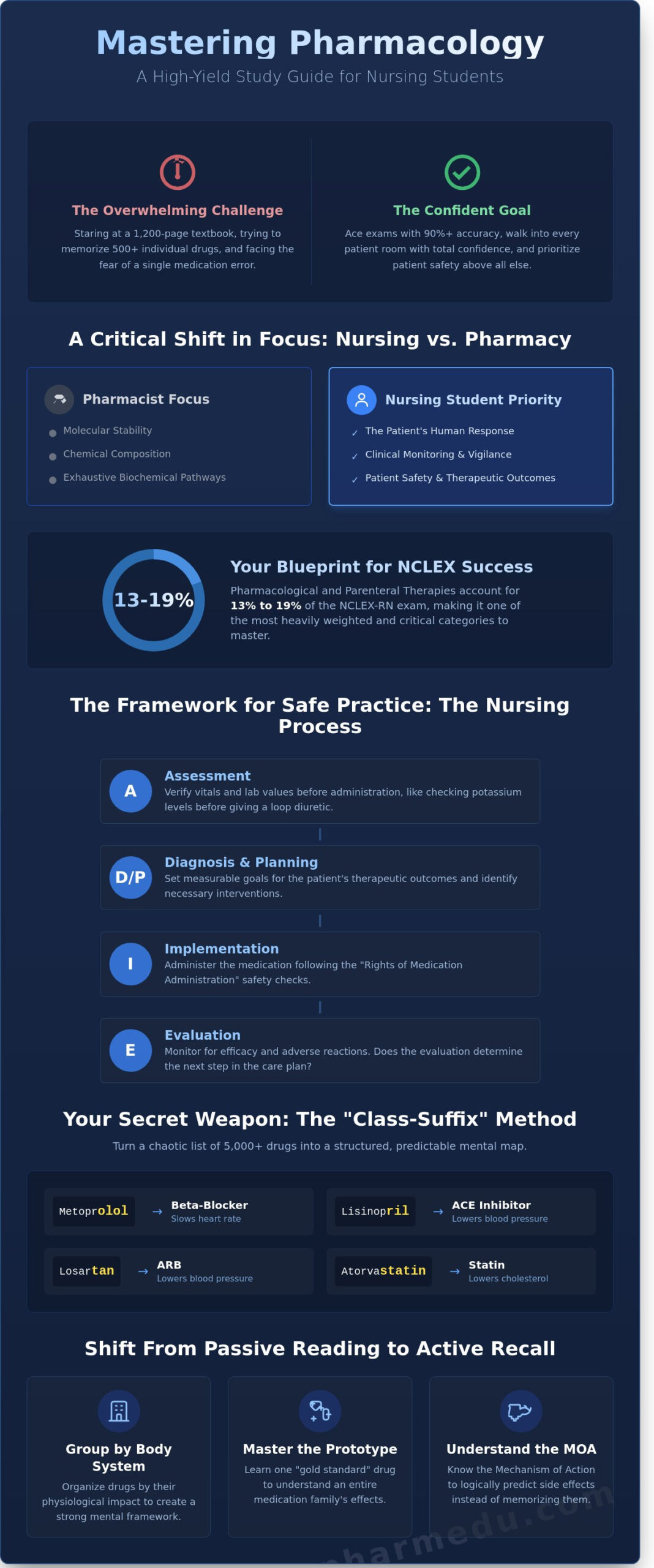
A specialized pharmacology study guide for nursing students is vital because nursing pharmacology differs significantly from pharmacy-specific tracks. While a pharmacist focuses on the molecular stability and chemical composition of a drug, a nurse’s priority is the human response. You’re the professional who monitors the patient’s heart rate after a dose of digoxin or checks the blood glucose levels before administering insulin. This focus on monitoring and clinical judgment is the backbone of the 2026 NCLEX-RN Next Gen questions. The NCSBN indicates that pharmacological and parenteral therapies account for 13% to 19% of the exam, making it one of the most heavily weighted categories.
Efficiency is key when preparing for these exams. Using a high-yield pharmacology study guide for nursing students allows you to bypass exhaustive biochemical pathways and focus on what actually appears on boards and in the ICU. By prioritizing “Must-Know” drug classes and their associated nursing interventions, you save hundreds of hours of study time while increasing your clinical confidence.
The Nursing Process (ADPIE) and Medication
The nursing process provides the structured framework for safe drug administration. During Assessment, you verify vitals or lab values, such as checking potassium levels before giving a loop diuretic. Diagnosis and Planning involve setting measurable goals for the patient’s therapeutic outcomes. During Implementation and Evaluation, you don’t just give the pill; you monitor for efficacy and adverse reactions. If a patient’s blood pressure remains high 60 minutes after an antihypertensive dose, your evaluation determines the next step in the care plan.
Pharmacology vs. Pharmacotherapeutics
It’s helpful to distinguish between the drug’s mechanism and its clinical application. Pharmacology explains the “how” of a drug, while pharmacotherapeutics focuses on the “why” regarding specific diseases. Understanding the therapeutic intent helps you provide better patient education, which is a core nursing responsibility. When you explain to a patient that their anticoagulant is prescribed specifically to prevent a stroke due to atrial fibrillation, you improve their adherence and safety. Focusing on the “why” makes the complex “how” much easier to remember during high-stakes exams.
The “Class-Suffix” Method: Your Secret to Mastering Meds
Nursing students often feel buried under the weight of 5,000+ FDA-approved medications. You don’t need to memorize every individual name to succeed. Using a structured pharmacology study guide for nursing students helps you identify the therapeutic category of 90% of medications encountered in clinical practice. This strategy turns a chaotic list into a structured mental map. Instead of treating every drug as a new entity, you’ll learn to recognize the root, prefix, or suffix that dictates its behavior.
Effective pharmacology study starts with the body system. You should group drugs by their physiological impact to create a mental map. For each class, identify one “Prototype Drug.” This is the gold standard medication that represents the entire group. If you master Metoprolol, you’ve effectively learned the side effects and nursing considerations for the entire beta-blocker family. This foundation is essential for any OpenStax pharmacology textbook reference or classroom lecture. Understanding the Mechanism of Action (MOA) is your most powerful tool. If you know exactly how a drug interacts with a specific receptor, the side effects become predictable physiological responses rather than random facts to memorize. For instance, if a drug blocks a beta-receptor in the heart to slow the rate, it’s logical that a common side effect is bradycardia.
Common Drug Suffixes You Must Know
Cardiovascular meds are highly predictable. Beta-blockers end in “-olol,” ACE inhibitors end in “-pril,” and many Calcium Channel Blockers end in “-dipine.” Anti-infectives follow similar rules; penicillins end in “-cillin,” cephalosporins start with “cef-” or “ceph-,” and fluoroquinolones end in “-floxacin.” For psychotropic drugs, look for “-ine” in many SSRIs or “-pam” and “-lam” for benzodiazepines. These patterns are the core of an effective pharmacology study guide for nursing students.
Mastering Pharmacokinetics and Pharmacodynamics
Success requires mastering ADME: Absorption, Distribution, Metabolism, and Excretion. It takes roughly five half-lives for a drug to reach a steady state in the blood or to be cleared from the body. You’ll also need to understand the “Lock and Key” analogy for pharmacodynamics. Agonists turn the key to activate a receptor; antagonists fit the lock but block the action. If you’re looking for structured support to bridge these theoretical concepts with clinical practice, you can explore the accredited professional courses available for your future career development.
Effective Study Strategies for Nursing Pharmacology
Mastering a pharmacology study guide for nursing students requires moving beyond passive highlighting. Research indicates that students who rely solely on re-reading textbooks often retain less than 20% of the material after 48 hours. Successful candidates in 2026 prioritize active engagement to build durable neural pathways that withstand the pressure of clinical practice.
Active Recall and Spaced Repetition
Relying on a 10-hour cram session before an exam leads to rapid cognitive decay and increased anxiety. Instead, use nursing pharmacology flash cards to implement spaced repetition. Testing your knowledge every 3 days reinforces memory far more effectively than a single marathon session. During busy clinical days, leverage 5-minute micro-learning segments to review high-yield drug classes. This method exploits the “spacing effect,” a psychological phenomenon where information is better learned when intervals separate study sessions.
Visual Learning and Drug Cards
The human brain processes visual data with incredible speed compared to dense text. Diagrams illustrating the Mechanism of Action (MOA) for diuretics or beta-blockers provide immediate context that long paragraphs lack. Create “Drug Cards” specifically for your clinical rotations. Each card should list the generic name, therapeutic class, 3 critical side effects, and essential nursing considerations. This structured format helps you quickly recall life-saving information when a preceptor asks a question at the bedside.
Practice Questions and Authoritative Resources
Identify knowledge gaps early by integrating practice questions into your daily routine. You shouldn’t wait until the week of the exam to discover you struggle with pharmacokinetics. Utilizing the Open RN Nursing Pharmacology textbook provides access to evidence-based content aligned with the latest NCLEX-RN standards. This resource is particularly helpful for clarifying complex dosage calculations and medication safety protocols. Using practice questions allows you to apply theoretical knowledge to realistic patient scenarios, which is the primary goal of any pharmacology study guide for nursing students.
Mnemonics and Memory Triggers
Mnemonics serve as vital mental hooks for complex information. Use classic triggers like “P-R-I-L” for ACE inhibitors, such as Lisinopril or Enalapril, to recognize drug families instantly. If a contraindication is particularly rare, create a unique or “silly” story to anchor the fact in your mind. Finally, employ the “Teach-Back” method. If you can explain the indications and risks of Warfarin to a non-medical friend without using jargon, you’ve achieved true mastery. This technique forces your brain to organize information logically, ensuring you’re prepared for both exams and patient education.
Dosage Calculations and Medication Safety
Math anxiety affects approximately 80% of nursing students during their first pharmacology course. It’s often the biggest hurdle to passing the NCLEX, yet clinical precision is non-negotiable. This pharmacology study guide for nursing students aims to transform that apprehension into clinical confidence. You aren’t just solving for X; you’re ensuring patient survival. Safety begins with the 10 Rights of Medication Administration. These rights, including the right patient, drug, dose, route, and time, serve as your final defensive line before a drug enters a patient’s system.
Errors frequently stem from Look-Alike, Sound-Alike (LASA) medications. The Institute for Safe Medication Practices (ISMP) maintains a list of hundreds of drug pairs, such as Dopamine and Dobutamine, that require extra scrutiny. You must also recognize Black Box Warnings. These are the FDA’s most stringent alerts for serious adverse effects. For instance, antidepressants like Fluoxetine carry warnings regarding increased suicidal thoughts in young adults, while Warfarin requires constant monitoring due to major bleeding risks.
Dimensional Analysis vs. Desired Over Have
Most nursing programs prioritize Dimensional Analysis (DA) or the “Desired Over Have” formula. While “Desired Over Have” works well for simple, single-step calculations, DA is superior for complex, multi-step conversions. Research indicates that students using DA experience a 15% lower error rate in complex titration problems. Your golden rule for unit conversions is simple: 1 mg equals 1,000 mcg, and 1 gram equals 1,000 mg. You’ve got to practice these daily to build the muscle memory required for high-pressure clinical environments.
Preventing Medication Errors
A comprehensive pharmacology study guide for nursing students must bridge the gap between the classroom and the bedside. Medication errors cause an estimated 7,000 to 9,000 deaths annually in the United States alone. To prevent these, you must master the Medication Administration Record (MAR) and recognize early signs of toxicity. For example, if a patient on Digoxin reports blurred vision or yellow halos, their serum levels likely exceed the therapeutic threshold of 2.0 ng/mL. Always double-check high-alert medications, such as insulin or heparin, with a second licensed nurse to ensure 100% accuracy.
Mastering these safety protocols is easier with structured, expert-led training. Explore PharmEdu’s accredited courses to sharpen your clinical calculation skills and earn necessary credit points.
Beyond the Textbook: Using PharmEDU for High-Yield Review
Textbooks provide the theory, but PharmEDU provides the application. Most nursing students struggle with the sheer volume of data found in a 1,200-page drug manual. We’ve replaced dense paragraphs with high-yield video vignettes that highlight the “must-know” facts for clinical practice. This pharmacology study guide for nursing students transforms passive reading into active engagement. Our interactive quizzes use adaptive logic to simulate the NCLEX testing environment, preparing you for the specific pressure of board exams.
The platform serves as the essential bridge between learning what is pharmacology and achieving clinical excellence. By focusing on drug-to-drug interactions and adverse effects seen in 85% of hospital admissions, we ensure you’re ready for the floor, not just the classroom. You can access these tools on any mobile device, making it easy to study during clinical rotations or between shifts.
Micro-Learning for the Modern Student
Cognitive load is a major barrier to medical education. Data from educational psychology indicates that 5-minute video segments increase information retention by 40%. PharmEDU utilizes this micro-learning approach to help you master complex mechanisms of action without burnout. Each segment includes case studies mirroring real-life clinical scenarios, such as managing acute hypertensive crises or insulin titration. You can monitor your growth through individual dashboards that track your accuracy across different pharmacological categories.
Preparing for Boards and Beyond
Success on the NCLEX is just the first milestone in a professional journey. This pharmacology study guide for nursing students builds the specific foundation needed for future transitions, including an advanced NAPLEX prep course if you pursue pharmacy specializations later. The pharmaceutical world moves fast. With the FDA approving an average of 45 new molecular entities each year, lifelong learning isn’t optional. PharmEDU keeps your knowledge current, ensuring you remain a safe, competent, and confident healthcare provider throughout your career.
Take the Next Step Toward Clinical Excellence
Mastering medication classes through the suffix method provides a foundation for safe practice that lasts throughout your career. You’ve seen how systematic study strategies and precise dosage calculations help prevent the 7,000 to 9,000 annual medication errors reported in modern clinical settings. This pharmacology study guide for nursing students serves as your roadmap for navigating these complex requirements with precision and confidence.
PharmEDU acts as your digital mentor, providing the tools needed to excel in a demanding healthcare environment. Our platform features over 100 high-yield topics and interactive NCLEX-style quizzes that align with the latest 2026 standards. Because we prioritize efficiency, our mobile-compliant micro-learning modules ensure you can study effectively during even the shortest breaks in your clinical rotation. It’s time to transform your approach to medication safety and academic success.
Master Nursing Pharmacology with PharmEDU Subscriptions
You’ve got the dedication required to succeed in this field, and we’re here to provide the expertise that guarantees it.
Frequently Asked Questions
How do I start studying pharmacology as a beginner nursing student?
Start by mastering anatomy and physiology because you can’t understand how drugs work without knowing the body’s baseline. A 2024 study in nursing education journals shows students who score above 85% in physiology perform 30% better in pharmacology. Focus on cellular receptors and the autonomic nervous system first. Once you grasp these systems, you’ll find that drug mechanisms become logical rather than random facts to memorize.
What are the most common drug classes on nursing exams?
Cardiovascular, respiratory, and endocrine medications represent 45% of the pharmacology questions on standard NCLEX exams. You must prioritize beta-blockers, ACE inhibitors, and anticoagulants. These classes are high-risk medications that require precise monitoring. This pharmacology study guide for nursing students recommends grouping these by their suffix, like “olol” for beta-blockers, to identify their function immediately during testing.
How can I memorize drug side effects without getting confused?
Group side effects by the physiological system they affect rather than memorizing individual drug lists. For example, 90% of anticholinergic drugs cause dry mouth, blurred vision, and urinary retention. This systematic approach reduces the 500+ individual facts you need to know into 12 predictable patterns. Focus on the “deadly” side effects first, as these are the most likely to appear on clinical safety evaluations.
Is dimensional analysis the best way to do dosage calculations?
Dimensional analysis is the gold standard because it uses a single equation to convert units and calculate dosages simultaneously. Research indicates that 95% of medication errors in clinical settings stem from incorrect unit conversions. By using this method, you ensure that your units cancel out correctly before you even touch a calculator. It provides a consistent framework that works for everything from simple pills to complex IV titrations.
What is the “Prototype Drug” method in pharmacology?
The prototype drug method involves learning one representative medication for an entire class to understand the whole group’s characteristics. For instance, if you learn Morphine, you’ve effectively learned the mechanism and side effects for 8 other opioid analgesics. This strategy is a cornerstone of any effective pharmacology study guide for nursing students. It shifts your focus from memorizing 2,000 individual drugs to mastering approximately 100 key prototypes.
How often should I use pharmacology flashcards?
Use flashcards for 15 minutes every single day to leverage the power of spaced repetition. Studies on cognitive retention show that reviewing material in 24 hour, 3 day, and 7 day intervals increases long-term recall by 60%. Don’t try to cram 100 cards in one sitting. Instead, focus on 10 new cards daily while reviewing 20 old ones to keep the information fresh in your working memory.
Can I pass pharmacology without a physical textbook?
You can pass using digital resources, but 70% of top-performing nursing students still use a physical reference for deep focus sessions. Digital platforms like PharmEdu provide the advantage of 2026’s latest drug updates and interactive testing. While a textbook offers a static foundation, online modules allow you to track your progress through 500+ practice questions and real-time feedback. Combining both methods often yields the highest exam scores.
What are the 7 rights of medication administration?
The 7 rights include the right patient, right drug, right dose, right route, right time, right documentation, and right reason. These protocols are the primary defense against the 1.3 million medication-related injuries reported annually in the United States. You’ll need to perform these checks at least 3 times before the medication reaches the patient. Mastering this sequence is non-negotiable for clinical safety and professional accreditation.