
The Ultimate Pharmacology Exam Checklist: How to Ace Your Boards in 2026
What if the difference between passing your 2026 boards and facing a retake isn’t the total hours you spend in the library, but how you categorize the 1,500 distinct drug names currently listed in the pharmacopoeia? It’s a common reality for students who feel buried under an avalanche of mechanisms and side effects. You’ve likely felt that specific dread when “metoprolol” and “metoclopramide” start looking identical during a late-night study session. Preparing for your pharmacology exam shouldn’t feel like a desperate attempt to memorize a dictionary.
Our methodology recognizes that information overload is the primary barrier to your professional success. This guide changes your approach by providing a high-yield roadmap to master the most complex drug classes and sharpen your clinical reasoning. You’ll gain access to proven mnemonics for remembering side effects and a structured checklist designed to build your confidence for clinical case study questions. We’re going to break down exactly what to study first so you can walk into your exam room with professional precision and total clarity.
Key Takeaways
- Understand the critical shift from simple recall to clinical judgment to align your preparation with modern testing standards.
- Implement a structured four-phase study timeline that builds a solid physiological foundation before moving into systematic drug reviews.
- Identify the most high-yield drug classes and clinical applications essential for mastering your upcoming pharmacology exam.
- Elevate your retention by replacing traditional rote memorization with advanced visual mastery techniques and high-yield vignettes.
- Follow a precise 48-hour countdown protocol to manage logistics and mental readiness without the risks of last-minute cramming.
Anatomy of a Modern Pharmacology Exam: What to Expect
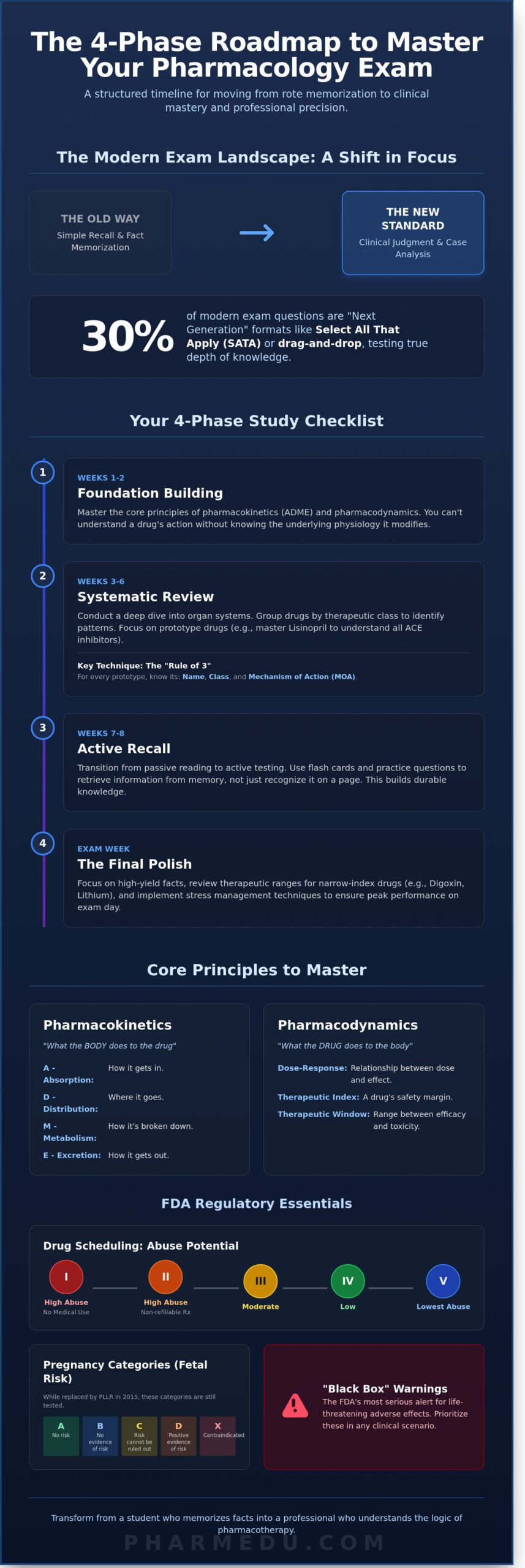
A pharmacology exam evaluates more than your ability to memorize drug names; it measures your clinical competence in managing drug-body interactions. As we approach 2026, the landscape of medical and nursing boards has moved away from simple recall. You’ll find that modern assessments prioritize “Next Generation” clinical judgment. This shift means you’ll encounter complex case-based vignettes where you must analyze patient data to determine the safest intervention. Approximately 30% of modern exam questions now utilize Select All That Apply (SATA) or drag-and-drop formats to test your depth of knowledge. Understanding pharmacology serves as the vital foundation for all clinical practice, as it bridges the gap between pathophysiology and patient recovery.
Pharmacokinetics vs. Pharmacodynamics
To succeed, you must master the distinction between what the body does to the drug and what the drug does to the body. Your study plan should center on the ADME checklist: Absorption, Distribution, Metabolism, and Excretion. These four pillars dictate how quickly a drug reaches peak plasma concentration and how long it remains active. You’ll also face questions on dose-response relationships and the therapeutic index, which measures a drug’s safety margin. The Therapeutic Window is the range between efficacy and toxicity. If a drug has a narrow window, such as digoxin or lithium, the pharmacology exam will likely test your knowledge of serum level monitoring and signs of toxicity.
The Role of Regulatory Standards (FDA)
Federal regulations provide the legal framework for medication administration, and they’re a staple of board-level testing. You must be proficient in drug scheduling, which categorizes substances from Schedule I (high abuse potential, no accepted medical use) to Schedule V (low abuse potential). For instance, knowing that Schedule II drugs require a non-refillable prescription is a common test point. While the FDA transitioned to the Pregnancy and Lactation Labeling Rule (PLLR) in 2015, many exams still reference the traditional A, B, C, D, and X categories to assess fetal risk. Additionally, you must prioritize “black box warnings.” These are the FDA’s most serious alerts regarding life-threatening adverse effects, and they’re frequently used to test your ability to recognize high-risk clinical scenarios before they escalate.
Practical application is the goal of these assessments. You won’t just be asked what a beta-blocker does; you’ll be asked which patient should not receive one based on their 12-lead ECG or respiratory history. By focusing on these structured categories, you’ll transform from a student who memorizes facts into a professional who understands the logic of pharmacotherapy.
The 4-Phase Pharmacology Study Checklist
Success in a pharmacology exam requires a structured timeline that respects the cognitive load of memorizing hundreds of therapeutic agents. Most students fail because they treat every drug as an isolated fact. Instead, divide your preparation into four distinct phases to move from basic comprehension to clinical application. This methodical approach ensures that you aren’t just memorizing names, but understanding the physiological impact of every prescription.
- Phase 1: Foundation Building (Weeks 1-2). Master pharmacokinetics and pharmacodynamics. You can’t understand how a drug works if you don’t understand the underlying physiology it’s modifying.
- Phase 2: Systematic Review (Weeks 3-6). Conduct a deep dive into organ systems. Group drugs by therapeutic class to identify patterns in side effects and contraindications.
- Phase 3: Active Recall (Weeks 7-8). Transition from reading to testing. This phase focuses on retrieving information from memory rather than simply recognizing it on a page.
- Phase 4: The Final Polish (Exam Week). Focus on high-yield facts, therapeutic ranges for narrow-index drugs, and stress management techniques to maintain focus.
Phase 1 & 2: Organizing the Chaos
Start by creating a ‘Master Drug List’ centered on prototype drugs. If you master the mechanism of Lisinopril, you’ve effectively learned the entire ACE inhibitor class. Use nursing pharmacology flash cards to build baseline recognition during short study bursts throughout the day. This builds a mental library of drug prefixes and suffixes that help you categorize new medications instantly.
Apply the “Rule of 3” for every prototype: Name, Class, and Mechanism of Action (MOA). These three pillars form the foundation of your knowledge. Once these are firm, adding secondary details like adverse reactions becomes much easier. If you’re feeling overwhelmed by the volume of information, our accredited study modules provide a structured path to help you prioritize the most relevant clinical data.
Phase 3 & 4: Simulating Exam Conditions
Passive reading is the primary cause of failure for many candidates. It creates an “illusion of competence” where material looks familiar, but you can’t recall it under the pressure of a pharmacology exam. Spaced repetition is the only proven solution. This method combats the Forgetting Curve, a concept established in 1885 showing that memory retention can drop to 30% after just 24 hours without active review.
During the final weeks, use timed practice quizzes to build stamina. A 180-minute test requires more than just knowledge; it requires the mental endurance to process complex clinical scenarios without fatigue. Shift your focus to high-yield data, such as specific antidotes and life-threatening drug interactions, which frequently appear in board-style questions. By simulating the exact conditions of the testing center, you reduce anxiety and improve your processing speed.
High-Yield Drug Classes: Your Essential Content Checklist
Mastering a pharmacology exam requires more than rote memorization; it demands a deep understanding of how specific drug classes interact with physiological systems. Data from 2024 board pass rates suggest that students who prioritize the Autonomic Nervous System (ANS) and Cardiovascular drugs score 15% higher on average. You’ll need to clearly distinguish between adrenergic agents, which trigger the sympathetic “fight or flight” response, and cholinergic agents that govern parasympathetic “rest and digest” functions. Within the anti-infective category, focus on the mechanism of action for penicillins and cephalosporins. These beta-lactams inhibit cell wall synthesis, but cross-sensitivity remains a high-yield topic, as roughly 10% of penicillin-allergic patients may react to cephalosporins. Fluoroquinolones also require attention due to their association with tendon rupture and QT prolongation.
The ‘Big Five’ Cardiac Classes
Cardiovascular pharmacology is a cornerstone of any professional pharmacology exam. ACE Inhibitors are recognizable by the ‘pril’ suffix, such as enalapril or lisinopril. A critical clinical pearl is the accumulation of bradykinin, which causes a persistent dry cough in up to 20% of users. Beta-blockers, identified by the ‘olol’ suffix, are equally essential. You must remember that non-selective beta-blockers are contraindicated for patients with asthma or COPD because they can trigger life-threatening bronchospasm. Calcium Channel Blockers (CCBs) require a different approach. Dihydropyridines (DHPs) like amlodipine focus on peripheral vasodilation, whereas non-DHPs like verapamil and diltiazem exert significant negative inotropic and chronotropic effects on the heart itself.
Neurological and Psychiatric Medications
Psychotropic drug questions often hinge on neurotransmitter pathways. SSRIs increase serotonin levels in the synaptic cleft by blocking reuptake, while SNRIs provide a dual mechanism by also inhibiting norepinephrine reuptake. These differences are vital when selecting treatments for comorbid conditions like neuropathic pain. For medications with a narrow therapeutic index, precision is non-negotiable. Lithium requires serum monitoring to stay within the 0.6 to 1.2 mEq/L range, and Digoxin toxicity must be suspected if a patient reports blurred vision or yellow halos. Anticholinergic side effects are the most common distractor on exams because they mimic various autonomic dysfunctions across multiple organ systems.
- Anxiolytics: Focus on the risk of respiratory depression and the reversal agent flumazenil.
- Opioids: Prioritize the assessment of respiratory rate and the use of naloxone as an antagonist.
- Diuretics: Differentiate between potassium-wasting loop diuretics and potassium-sparing agents like spironolactone.
- Antidepressants: Watch for Serotonin Syndrome when multiple serotonergic agents are combined.
Beyond Rote Memorization: Advanced Mastery Techniques
Success on a pharmacology exam in 2026 requires more than a stack of flashcards. You’ve got to bridge the gap between knowing a drug’s name and understanding its physiological impact. Clinical reasoning is the cornerstone of this process. A drug’s Mechanism of Action (MOA) dictates its entire profile. If you understand that ACE inhibitors block the conversion of Angiotensin I to Angiotensin II, you don’t need to memorize that they cause vasodilation; you can deduce it. This logic helps you predict adverse effects like the dry cough caused by bradykinin accumulation without looking at a textbook.
Modern students shouldn’t struggle with dense, 1,000-page manuals alone. High-quality study resources, such as a naplex prep course, simplify these complex pathways into 10 to 15 minute micro-learning segments. This approach prevents cognitive overload and ensures you’re mastering one mechanism before moving to the next. It’s about quality of engagement over quantity of hours spent reading.
Visualizing Pharmacotherapy
Visual learning isn’t just a preference. It’s a physiological advantage. Data from the Social Science Research Network suggests that 65% of the population are visual learners. When you map out the Renin-Angiotensin-Aldosterone System (RAAS) on a whiteboard, you create a mental map that text alone cannot provide. Video-based learning increases retention rates to 80% after three days, compared to only 20% for text-heavy notes. Always apply the “Case Study” approach. Ask yourself why a specific 62-year-old patient with heart failure is taking a specific beta-blocker. This context transforms abstract data into clinical reality.
Developing ‘Exam Sense’
Mastering the pharmacology exam involves decoding the language of the examiners. You must treat every question like a clinical puzzle. Practice identifying the specific “Keywords” that change the entire landscape of the answer. Use these strategies to improve your score:
- Focus on Modifiers: Words like “Initial,” “Priority,” or “Avoid” are the most important parts of the prompt.
- SATA Strategy: For Select All That Apply questions, treat each option as an individual true or false statement. Don’t look for a single “best” answer.
- Analyze Morphology: If you encounter an unfamiliar drug, look at the suffix. A drug ending in “-mab” is a monoclonal antibody, while “-statin” indicates an HMG-CoA reductase inhibitor.
Developing this “Exam Sense” allows you to navigate through the 15% to 20% of questions that usually feature drugs you haven’t studied in depth. It turns guesswork into an educated, systematic process of elimination.
Final Countdown: The 48-Hour Pre-Exam Checklist
The final 48 hours before your pharmacology exam represent a shift from active acquisition to cognitive preservation. Within this window, your brain reaches a saturation point for complex data. Attempting to memorize a new class of monoclonal antibodies or rare side effects at 11:00 PM the night before creates cognitive interference. This stress response elevates cortisol levels, which actually hinders your ability to retrieve the thousands of drug facts you’ve already mastered. Instead of cramming, focus on logistical precision and mental clarity.
- Verify your Pearson VUE appointment confirmation and testing center address.
- Prepare two forms of valid, government-issued identification with matching signatures.
- Plan to arrive at least 30 minutes before your scheduled start time; arriving late often results in a forfeited seat and lost registration fees.
- Confirm your transport route to account for 2026 traffic patterns or potential transit delays.
The Day Before the Exam
Limit your study to a high-level review of your personal “Cheat Sheet.” Focus on critical narrow therapeutic index drugs and standard lab values, such as Digoxin levels (0.5 to 2.0 ng/mL) or International Normalized Ratio (INR) targets for warfarin. Your brain needs glucose and rest to function during a grueling multi-hour session. Prioritize a meal rich in complex carbohydrates and aim for at least seven hours of sleep to facilitate memory consolidation. Remember that understanding how to become a pharmacist involves realizing this pharmacology exam is a single, manageable milestone in a long-term professional trajectory.
During the Exam
Success depends on strict time management. You’ll typically have about 60 to 90 seconds per question. If a complex clinical vignette involving polypharmacy takes longer than two minutes, flag it and move on. Trust your initial choice. Data from educational psychometricians shows that when students change answers, they move from a correct response to an incorrect one 55% of the time. Stay focused by using controlled breathing if you hit a block of difficult questions. Maintain your pace even when vignettes grow long, as the core clinical question is often found in the final two sentences.
Mental Prep and Post-Exam Reflection
Manage test anxiety by using the 4-7-8 breathing technique during your scheduled breaks. This helps reset your autonomic nervous system and improves focus for the remaining sections. Once you leave the center, perform a brief reflection while the experience is fresh. Note which therapeutic classes felt most challenging, such as oncology or neurology. This data is vital for your future licensing boards, as it identifies specific areas where you’ll need targeted continuing education to maintain professional excellence and clinical safety in your future practice.
Secure Your Professional Future in Clinical Pharmacology
Success on your pharmacology exam requires more than just memorizing drug names; it demands a systematic approach to high-yield content and clinical logic. By following the 4-phase study checklist and focusing on the essential drug classes we’ve discussed, you’re building a foundation for professional excellence. Modern medical boards in 2026 prioritize your ability to apply pharmacological principles in real-world scenarios. You’ve already identified the high-yield topics and established a 48-hour pre-exam routine that eliminates last-minute panic. Now it’s time to solidify that knowledge with tools designed for the modern healthcare professional.
You don’t have to navigate this rigorous preparation alone. PharmEDU provides a structured environment where you can access over 100+ high-yield video vignettes and an interactive flashcard library optimized for mobile study. Our expert-led curriculum, developed by a team of 12 healthcare educators, ensures every minute of your study time translates into measurable progress. You’re ready to transform your study habits into professional mastery.
Start Your High-Yield Pharmacology Review with PharmEDU Today
The path to accreditation is demanding, but your dedication is the most important factor in this equation. You’ve got the plan; we’ve got the tools to help you cross the finish line with confidence.
Frequently Asked Questions
What are the most common drug classes on a pharmacology exam?
The most common drug classes appearing on a pharmacology exam include cardiovascular agents, central nervous system drugs, and antimicrobials. Statistically, cardiovascular medications like ACE inhibitors and beta-blockers represent approximately 25% of exam questions. You’ll also encounter a high volume of questions regarding endocrine drugs, specifically insulin protocols and oral hypoglycemics. Focus your revision on these high-yield areas to ensure you cover the 80% of material that typically forms the core of the boards.
How many hours should I study for a pharmacology final?
You should dedicate between 100 and 150 hours of focused study for a comprehensive pharmacology final or board exam. This translates to roughly 15 to 20 hours per week over an 8-week period. Research from medical education journals suggests that spaced repetition over 60 days leads to a 30% higher retention rate compared to cramming. Break your sessions into 50-minute blocks followed by 10-minute breaks to maintain peak cognitive function and long-term memory integration.
Is it better to memorize drug names or drug classes?
It’s significantly more effective to prioritize learning drug classes and their common mechanisms of action over individual drug names. Once you understand the “class profile,” you can apply that knowledge to 90% of the drugs within that category. For example, knowing how aminoglycosides work allows you to predict the side effects of gentamicin, tobramycin, and amikacin simultaneously. Mastering the class characteristics provides a logical framework that makes identifying specific medications much simpler during a high-pressure pharmacology exam. For nursing students specifically, a comprehensive pharmacology study guide for nursing students can provide the clinical-first framework needed to understand these drug classes in the context of patient care.
What are the best resources for pharmacology practice questions?
The highest-rated resources for practice questions include UWorld, Kaplan, and the PharmEdu question bank. UWorld is frequently cited by 85% of successful candidates for its detailed rationales and similarity to actual board interfaces. You should aim to complete at least 1,500 to 2,000 unique practice questions before your test date. Using these platforms helps you familiarize yourself with the 2026 testing standards and ensures your knowledge remains current with the latest clinical guidelines and pharmaceutical developments.
How do I remember drug suffixes and prefixes?
You can remember drug suffixes and prefixes by creating a master list of official USP (United States Pharmacopeia) stems. For instance, the suffix “-pril” always denotes an ACE inhibitor, while “-statin” identifies HMG-CoA reductase inhibitors. There are approximately 40 critical stems that cover the majority of tested medications. Create category-based tables that link these linguistic markers to their physiological effects. This method reduces the need for rote memorization and allows you to deduce the function of unfamiliar drugs.
What should I do if I fail my pharmacology exam?
If you fail your exam, your first step is to analyze the performance report provided by the testing body to identify your specific weak areas. Most boards require a mandatory 45-day waiting period before you can attempt a retake. Use this time to restructure your study plan, focusing 70% of your effort on the categories where you scored below the passing threshold. Seek professional guidance or join a structured remediation program to ensure your next attempt meets the required accreditation standards.
Can I use flashcards to study for clinical case studies?
You can use flashcards for clinical case studies if you design them to include patient scenarios instead of simple definitions. Instead of just listing a drug name, include a prompt with a patient’s age, symptoms, and lab values. Data shows that students using case-based flashcards improve their diagnostic accuracy by 22% compared to those using standard term-and-definition cards. This approach bridges the gap between theoretical knowledge and the practical application required in modern healthcare environments.
Why are ‘Select All That Apply’ questions so common in pharmacology?
‘Select All That Apply’ questions are common because they measure multi-dimensional clinical judgment rather than simple recognition. These questions typically make up 20% to 30% of modern pharmacology assessments. They’re designed to ensure you understand the full spectrum of a drug’s contraindications and side effects. Because there’s no partial credit on most boards, these questions force you to be 100% certain of every piece of information, which reflects the high stakes of real-world medication administration.